

15 Pro Tips for Better Air Consumption While Diving: Breathe Like a Local
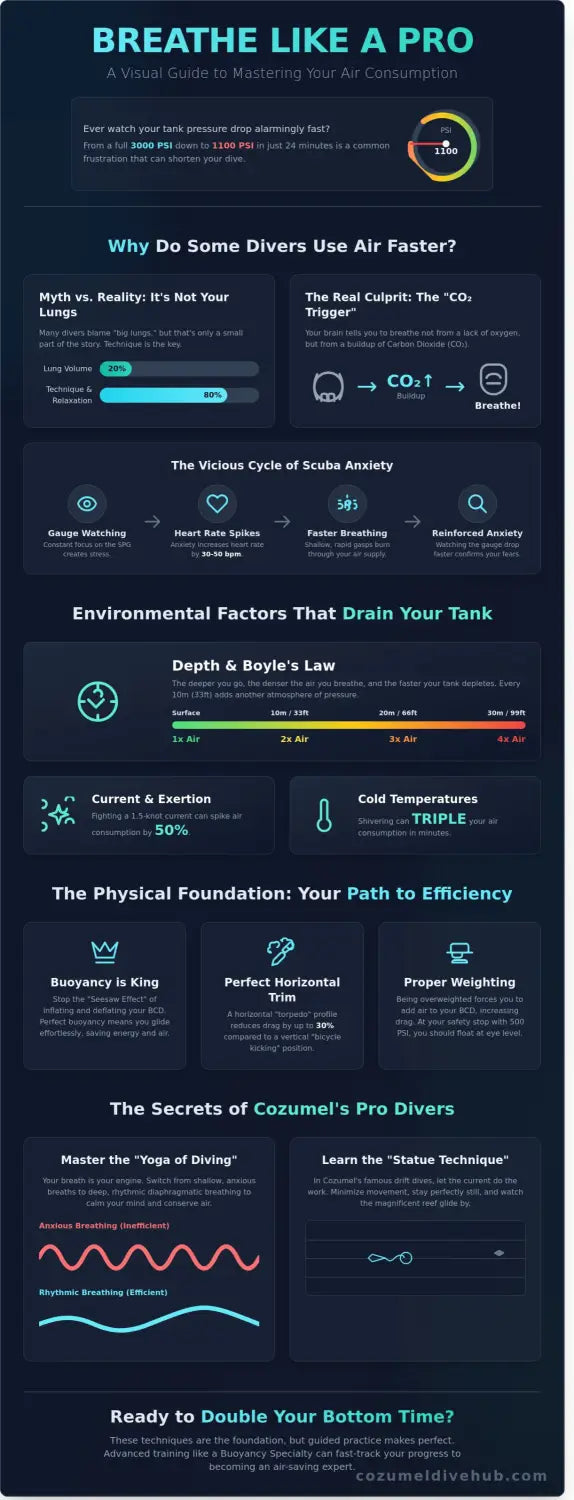
Imagine hovering over the vibrant reefs of Palancar Gardens when you check your SPG and realize your 3000 psi has plummeted to 1100 in just 24 minutes. You feel that familiar knot of anxiety as you prepare to signal the divemaster, knowing you're about to end the dive for the entire group. It's a common frustration that leaves many divers searching for tips for better air consumption while diving after feeling physically exhausted and defeated before the boat even heads back to the pier. We've all been there, and we know that nothing ruins the magic of Cozumel like watching your tank drain while your buddy still has half their air left.
The good news is that you don't need a bigger tank to stay down longer. By mastering these 15 expert techniques, you'll learn how to double your bottom time and finally reach that elusive 60-minute mark on a standard cylinder. We're sharing the exact secrets our local guides use to stay relaxed and "at one" with the water. From perfecting your horizontal trim to adopting a professional breathing rhythm, this guide will give you the confidence to explore deep sites like Palancar Caves without ever stressing about your gauge again. Your adventure starts here, so let's get you breathing like a local!
Key Takeaways
- Understand the physiological "CO2 trigger" and learn how calculating your SAC rate can help you track your progress toward becoming an air-saving expert.
- Discover why perfect buoyancy is the foundation of conservation and how to eliminate the "seesaw effect" to glide effortlessly through the water.
- Master the "Yoga of Diving" by implementing professional tips for better air consumption while diving that focus on deep, rhythmic diaphragmatic breathing.
- Learn the "Statue Technique" to leverage Cozumel’s unique drift currents, allowing the reef to pass you by while you minimize movement and save energy.
- Find out how advanced training and buoyancy specialties can fast-track your skills, helping you double your bottom time on every adventure.
Why Do Some Divers Use Air Faster? Understanding the "Air Hog" Syndrome
Welcome to the family! If you have ever felt the "shame" of being the first diver to signal 700 psi (50 bar) while your buddy still has half a tank, don't worry. We have all been there. At Cozumel Dive Hub, we believe every diver can master their breathing. To start, you need to understand your Surface Air Consumption (SAC) rate. This is a simple measurement of how many liters or cubic feet of air you breathe per minute at the surface. It is a benchmark, not a grade. Knowing your SAC helps you plan for a 60-minute adventure instead of a 35-minute one.
Many beginners think they breathe fast because they have "big lungs." This is a common myth. While lung volume varies by about 20% between adults, your technique and relaxation level account for 80% of your air efficiency. The real culprit is often the "CO2 trigger." Your brain does not actually signal you to breathe because you lack oxygen. It triggers a breath because of Carbon Dioxide buildup. When you learn to manage this trigger, you unlock the best tips for better air consumption while diving.
The Vicious Cycle of Scuba Anxiety
Watching your pressure gauge every 60 seconds often creates a feedback loop of stress. This anxiety can increase your heart rate by 30 to 50 beats per minute. A higher heart rate leads to faster gas exchange in your lungs, which means you burn through your tank faster. You might find yourself "stress-breathing," which involves shallow, rapid gasps. This is different from "work-breathing," which is the heavy but necessary respiration you do when swimming against a flow. Identifying this mental link is the first step toward professional-level air management.
Environmental Factors: Current, Cold, and Depth
Physics plays a massive role in how long your tank lasts. Boyle’s Law is the main reason why deeper dives consume air faster. At 30 meters (99 feet), the air you breathe is four times denser than at the surface. This means every single breath uses four times as many air molecules. We also see this in our local Cozumel waters. Fighting a 1.5-knot current at a site like Santa Rosa Wall can spike your consumption by 50% compared to a drift dive. Additionally, if you are cold, your metabolic rate increases by up to 15% as your body works to maintain a core temperature of 37°C (98.6°F). Proper thermal protection is one of the most underrated tips for better air consumption while diving.
- Depth: Every 10 meters of depth adds 1 atmosphere of pressure.
- Temperature: Shivering can triple your air consumption in minutes.
- Exertion: Moving your arms while swimming increases drag and heart rate.
Ready to dive into paradise and leave the "air hog" title behind? Let's make some bubbles together and turn those short dives into epic journeys!
The Physical Foundation: Buoyancy, Trim, and Hydrodynamics
Buoyancy is the undisputed king of air conservation. When you achieve perfect neutral buoyancy, you stop fighting gravity and start gliding effortlessly through the water. Many divers fall into the "Seesaw Effect" trap. They add air to the BCD, rise too fast, then dump air and sink. This constant cycling wastes air directly from your tank and forces your heart rate up as you struggle to stabilize. You want to feel like a sleek torpedo, not a dragging parachute. A 2023 study on diver ergonomics showed that a horizontal profile reduces water resistance by up to 30 percent compared to a vertical "bicycle kicking" position. Mastering these tips for better air consumption while diving starts with how you position your body in the blue.
Mastering the Art of Proper Weighting
Overweighting is a massive air killer that many divers don't even realize they are struggling with. Carrying just 4 extra pounds of lead requires you to put more air in your BCD to stay neutral. This creates a larger, bulkier surface area that increases drag and makes your lungs work harder to move you forward. Before we hit the crystal-clear waters of the Santa Rosa Wall, perform a proper weight check. With an empty BCD and about 500 psi in your tank, you should float at eye level while holding a normal breath. Proper distribution is the secret to perfect trim. Moving a single 2-pound weight from your waist to a trim pocket on your tank strap can instantly fix a "feet-heavy" position, keeping you perfectly horizontal.
Streamlining Your Gear for Less Resistance
Every dangling gauge or loose octopus acts like a mini-anchor in the current. Tucking in your consoles eliminates "dangle drag" and protects the delicate coral of our Cozumel reefs. Your choice of kick also impacts your tank life significantly. While the flutter kick is common, the frog kick is often 25 percent more efficient because it allows for a dedicated glide phase between strokes. Most importantly, stop "hand-paddling" immediately. Flailing your arms is a silent killer of your air supply and usually signals that your buoyancy is off. If you want to glide effortlessly like our local guides, book a personalized coaching dive to perfect your underwater profile.
- Keep it tight: Use clips to ensure your gear stays close to your body.
- The Frog Kick: Use this technique to maximize distance while minimizing effort.
- Hands at your side: Fold your hands or hold your BCD straps to prevent unnecessary movement.
Mastering the Scuba Breath: Techniques for Efficiency
Think of your regulator as a gateway to a hidden world, not just a piece of life-support equipment. Mastering your breath is the "Yoga of Diving." It transforms a standard 40-minute excursion into a 60-minute epic adventure. When you learn to control your respiration, you aren't just saving gas; you're calming your nervous system and becoming one with the crystal-clear waters of Cozumel. Most divers don't realize that their lungs are their most effective buoyancy tool, capable of providing 3 to 4 kilograms of lift with a single deep breath.
The golden rule of scuba is to never hold your breath. This is non-negotiable for safety, but it's also a secret weapon for efficiency. Instead of a hard stop, focus on a continuous, fluid cycle. If you feel the need to pause, do it with an open airway. This prevents the build-up of CO2, which is the primary trigger that tells your brain to take another gulp of air. By keeping your airway open and relaxed, you'll find that one of the best tips for better air consumption while diving is simply staying calm and keeping the air moving.
Experienced divers use their lungs to handle minor depth changes of 0.5 to 1 meter. Reaching for your BCD inflator for every small rise in the reef wastes air and creates drag. Instead, use a controlled inhale to rise over a coral head and a slow exhale to settle back into your trim position. This precision saves significant energy and keeps your profile streamlined, which reduces the effort required to move through the water.
The Diaphragmatic Breathing Method
Most people are "chest breathers," using only the top third of their lung capacity. This is shallow and inefficient. For diving, you must transition to "belly breathing." This method maximizes gas exchange in the lower lobes of the lungs, where blood flow is highest. You can practice this at home by lying on your back with a book on your stomach; try to make the book rise and fall without moving your chest. Follow these steps during your next descent:
- Inhale slowly, focusing on pushing your navel outward.
- Fill the lungs from the bottom up, like filling a glass with water.
- Exhale fully but gently, ensuring you clear out the "dead air" in your throat and regulator.
Slow and Low: The Rhythm of a Pro
Consistency is key to a long dive. Aim for a 4-second inhale followed by a 6-second exhale. This 10-second cycle results in only 6 breaths per minute, compared to the 12-15 breaths a stressed diver might take. This rhythm creates a natural, relaxed state that keeps your heart rate low. These tips for better air consumption while diving only work if you stay relaxed. Monitor your SPG every 8 to 10 minutes, but don't obsess over the numbers. Staring at the needle can create anxiety, which inadvertently spikes your consumption. Trust your rhythm, trust your training, and let the beauty of the reef dictate your pace.
The Cozumel Secret: Using the Current to Your Advantage
Cozumel is world-famous for its "drift dives," which act like a high-speed underwater moving sidewalk. This unique environment provides some of the most effective tips for better air consumption while diving because the Caribbean Sea does the heavy lifting for you. Instead of kicking against a current, we teach our guests the "Statue Technique." By staying perfectly still, tucking your arms, and letting the reef pass you by, you reduce physical exertion to nearly zero. You aren't just diving; you're flying through a vibrant gallery of life.
Local experts from a scuba diving Cozumel guide can point out "Dead Zones." These are specific pockets behind large coral formations, like the massive buttresses at Palancar Gardens, where the water flow drops by as much as 90 percent. Resting in these eddies for just 60 seconds can lower your heart rate by 10 or 15 beats per minute. This brief pause is a secret weapon for heavy breathers, allowing your lungs to reset before you step back into the flow.
Mental Relaxation: Underwater Meditation
Diving is 70 percent mental. Before you back-roll off our boat, spend 30 seconds visualizing yourself as a weightless, liquid part of the ocean. Once you're submerged, use the "Finger-Tip Rule." Instead of using your whole arm to turn, use a single finger to gently pivot off a barren rock or patch of sand. This tiny movement prevents a spike in CO2 levels. Focusing your eyes on macro life, such as a 2-centimeter nudibranch or a tiny seahorse, naturally slows your breathing cycle and brings your focus inward.
Drift Diving Tactics for Energy Conservation
Positioning is everything when you want to make that tank last. Staying 3 feet above the reef structure often puts you in the strongest part of the "glide," allowing you to cover 500 yards of reef with zero kicks. We see many beginners fall into the "bicycle kick" trap when they feel the current pick up. This panic response can double your air consumption in under 3 minutes. It’s much better to stay streamlined and communicate with your Divemaster to find the easiest path.
- Maintain a horizontal trim to reduce drag by 25 percent.
- Watch your Divemaster’s bubbles to see exactly which way the current is pulling at different depths.
- Stay close to the reef wall where the friction of the coral slows the water speed.
- Keep your hands clasped or tucked to minimize your profile.
Ready to glide through paradise and see the reefs like a local? Join our dive family and let us show you the magic of the Cozumel drift!
How to Fast-Track Your Progress with Cozumel Dive Hub
Ready to turn those 40 minute dives into 60 minute adventures? At Cozumel Dive Hub, we believe that mastering your breath is the key to unlocking the full beauty of our reefs. Memo and our team of local experts don't just lead tours; we provide personalized coaching to help you find your "Zen" underwater. We've watched hundreds of divers transform their technique by focusing on the small details that make a massive difference in their gas supply.
The fastest way to improve is through the Advanced Open Water Cozumel course. It is the ultimate shortcut because it focuses on the skills that stop you from wasting energy. During the Peak Performance Buoyancy module, you'll learn to hover effortlessly in our famous drift currents. When you stop fighting the water and start gliding with it, your air consumption drops instantly. These tips for better air consumption while diving become second nature when you have a professional instructor correcting your trim in real-time.
Specialty Courses That Save Air
Deep diving requires a specific approach to gas management. Our Deep Diver specialty teaches you how to handle gas density at 30 meters, where every breath pulls four times more molecules from your tank than at the surface. Understanding this physics helps you plan better and stay calm. Many divers ask if Nitrox helps with air consumption. While Nitrox doesn't physically make your air last longer, it can reduce post-dive fatigue. A relaxed, energized diver always breathes better than an exhausted one. Still, nothing beats time in the water. We've seen divers reduce their air intake by 25 percent just by completing 10 consecutive dives with our guides. Experience is the ultimate teacher.
Your Adventure Starts with a Long Dive
Our small group philosophy is designed for maximum bottom time. We keep groups intimate, usually capped at 6 divers, so we can focus on your specific needs. You won't be rushed by a crowded boat of 20 people. Instead, you'll join our Dive Hub family for a relaxed, professional experience where we prioritize your comfort. These tips for better air consumption while diving only truly click when you are in the water with mentors who care about your progress.
Don't let a fast-breathing habit cut your exploration short. You are just one dive away from your best air day yet. Book your personalized trip with us and see the difference that local knowledge and expert coaching can make. Let's make some bubbles together! Your adventure starts here.
Master the Deep and Extend Your Underwater Adventure
Mastering these tips for better air consumption while diving transforms your experience from a frantic race against the pressure gauge into a serene journey. By perfecting your horizontal trim to reduce drag and utilizing Cozumel's 1 to 2 knot currents, you can significantly lower your respiratory rate. Our local experts, born and raised on these shores, have spent over 20 years perfecting these techniques to ensure you enjoy the longest bottom times possible. We keep our groups small, typically limited to 6 divers per boat, so you receive the personalized attention needed to refine your skills safely. Our lead guide, Memo, has logged thousands of hours beneath these waves, and he's ready to show you how to move with the ocean instead of fighting it. You'll notice the difference on your very first dive when your tank lasts longer than ever before. Your adventure starts here with a team that treats you like family. We're excited to help you explore our breathtaking walls and vibrant reefs with total confidence. Let's make some bubbles together!
Ready to put these tips into practice? Join our family for a Cozumel dive adventure!
Frequently Asked Questions
Is it dangerous to try and breathe less while scuba diving?
Yes, skip breathing or holding your breath is dangerous because it causes carbon dioxide to build up in your bloodstream and increases the risk of lung overexpansion. Divers who attempt this often face severe headaches; research shows that CO2 levels can reach uncomfortable levels in just 30 seconds of irregular breathing. You should always maintain a continuous, natural rhythm to ensure your body stays oxygenated and safe.
Does being physically fit help with air consumption?
Physical fitness helps immensely because a healthy cardiovascular system processes oxygen with much higher efficiency. Divers with high aerobic capacity can lower their respiratory minute volume by 15% compared to those who don't exercise regularly. Improving your fitness is one of the most effective tips for better air consumption while diving because it lowers your heart rate and calms your nervous system.
Why do men usually use more air than women while diving?
Men generally consume more air because they possess larger lung volumes and higher muscle mass than women. An average adult male has a lung capacity of approximately 6 liters, while the average female capacity is closer to 4.2 liters. Since muscle tissue requires constant oxygen to function, the larger physical frame of most men naturally demands a higher volume of gas during every breath.
Can my scuba gear choice affect how much air I breathe?
Your gear choice directly impacts your air use by either creating or minimizing drag as you move through the water. Using a streamlined BCD and securing loose hoses can reduce your water resistance by 25%, which means you spend less energy on every kick. Our favorite tips for better air consumption while diving always include optimizing your kit to be as sleek and hydrodynamic as possible.
How much air should I have left when I start my safety stop?
You should plan to arrive at your safety stop with at least 500 PSI or 35 bar remaining in your tank. This specific reserve provides enough gas for your 3 minute stop at 15 feet and a slow, controlled ascent to the boat. Starting your stop with 500 PSI ensures that you have a safety cushion for yourself or your buddy if an unexpected situation arises.
Does smoking or caffeine intake affect my diving air consumption?
Both smoking and caffeine significantly increase your air consumption by raising your heart rate and metabolic demand. Caffeine can spike your heart rate by 10 to 15 beats per minute, which leads to a faster and more shallow breathing pattern. Smoking is even more impactful; it reduces the oxygen carrying capacity of your hemoglobin by up to 10%, forcing you to breathe more often to compensate.
Will a larger tank solve my air consumption problems?
A larger tank like a Steel 120 provides more gas, but it doesn't solve the technical issues that cause high air consumption. While a Steel 120 holds 40% more air than a standard Aluminum 80, it also adds about 8 pounds of weight to your setup. This extra weight can actually make you work harder and breathe faster if your buoyancy and trim aren't already dialed in perfectly.