

Avoiding Seasickness on Cozumel Dive Boats: The Ultimate Diver’s Guide (2026)
Last July, a diver named Sarah spent 165 dollars on a premium two-tank trip only to spend her entire surface interval leaning over the rail while her group raved about a passing manta ray. It's a heartbreaking scene we see too often, where the fear of getting sick in front of others ruins the thrill of our pristine reefs. If you've ever felt that rising tide of nausea, you know it's not just about the physical discomfort. It's about the wasted money and the foggy brain that comes from standard Dramamine. We believe your focus should be on the vibrant coral, not the horizon. Mastering the art of avoiding seasickness on a Cozumel dive boat trip is the secret to reclaiming your underwater journey.
At Cozumeldivehub, our team has guided over 4,200 divers through these waters and we know exactly how to handle the Caribbean chop. We agree that nobody should have to choose between being seasick or being a sleepy zombie during their dive. This guide promises to give you the expert, diver-safe strategies you need to stay clear-headed and energized. We'll cover everything from 2026's best non-drowsy remedies to the specific spots on the boat that offer the smoothest ride. Your adventure starts here, and it's going to be a nausea-free trip to Palancar Reef.
Key Takeaways
- Understand the unique "Cozumel Channel" effect and how the meeting of Caribbean currents and island geography impacts your equilibrium.
- Learn the critical difference between common medications and the best diver-safe strategies for avoiding seasickness on cozumel dive boat trips without the risk of drowsiness.
- Discover the "center of gravity" seating secrets for both pangas and large vessels to ensure a smooth, stable ride to the reefs.
- Debunk the "empty stomach" myth and find out which pre-dive rituals and hydration habits actually keep your stomach settled in the tropical sun.
- See how our small-group approach and expert local captains help you spend less time waiting on the waves and more time exploring breathtaking walls.
Why Do Divers Get Seasick in Cozumel? (Understanding the Cozumel Channel)
Welcome to the world of drift diving! Cozumel offers some of the most vibrant reefs on the planet, with visibility often exceeding 100 feet. While the underwater world is serene, the journey to the reef involves crossing the famous Cozumel Channel. This body of water is a 30-mile stretch between the island and the Yucatan Peninsula where the powerful Caribbean Current funnels northward. It's a dynamic environment. Your success in avoiding seasickness on cozumel dive boat trips starts with understanding why your body reacts to these specific waters.
Seasickness isn't a sign of weakness; it's a sensory conflict. When you're on a boat, your inner ear feels the swaying, pitching, and rolling of the vessel. However, if you're looking at the deck or your dive gear, your eyes tell your brain that you're standing still. This mismatch triggers a stress response. Even our most seasoned pros like Memo, who has logged over 5,000 dives in these waters, still feel the "wobbles" on particularly active days. Validating this feeling is the first step toward managing it. You're in good company, and we're here to help you stay comfortable.
The Science of the 'Motion of the Ocean'
The vestibular system in your inner ear acts like a biological spirit level. In the Caribbean, waves often have a long period but a significant height, creating a slow, rhythmic roll. Understanding Motion Sickness involves recognizing that your brain receives conflicting data from your eyes and your balance centers. Looking at the horizon works because it gives your eyes a stable reference point that matches the motion your ears feel. Mal de Mer is the physiological response of a diver's body to the rhythmic swaying of a vessel, resulting in nausea and disorientation. To combat this, keep your head up and your eyes on the distant coastline of Playa del Carmen.
Cozumel’s Unique Sea Conditions
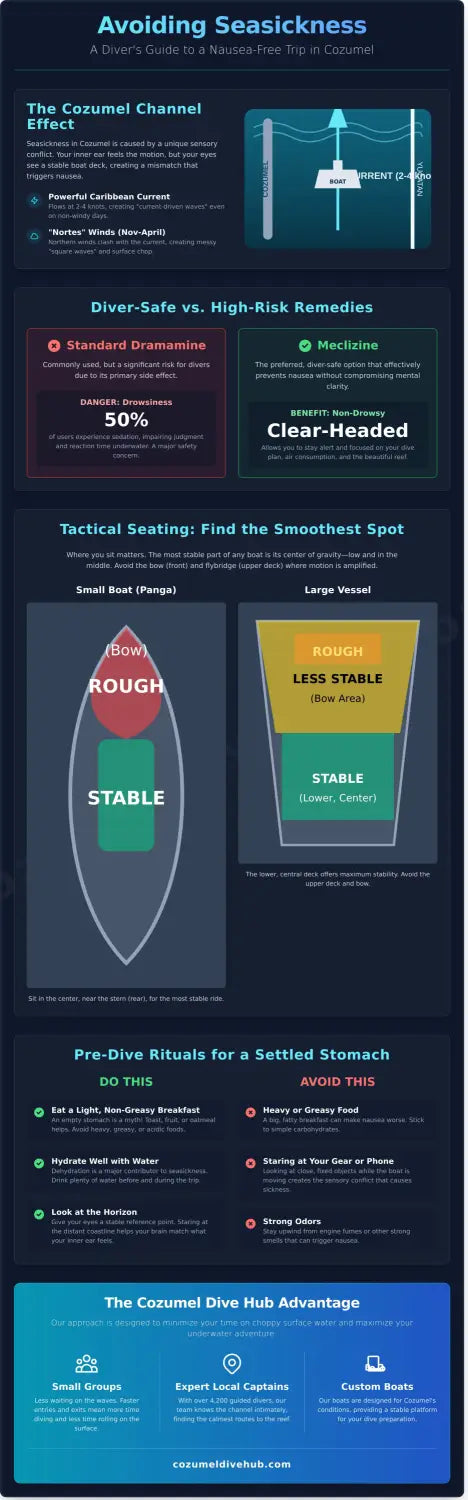
Cozumel is unique because of its geography. Most of our world-class dive sites sit on the Leeward (western) side of the island, which is shielded from the open Atlantic. This usually means calmer waters compared to the Windward (eastern) side, where waves crash relentlessly against the rocks. However, the current in the channel moves at 2 to 4 knots. This movement creates "current-driven waves" that feel different than standard wind-driven chop. These waves can cause the boat to roll even when the wind is low, making surface intervals feel more "rolly" than in other Caribbean destinations.
- The Nortes: Between November and April, cold fronts from the north bring winds of 15 to 20 knots.
- Surface Chop: When these north winds hit the northward-flowing current, they create "square waves" or messy surface chop.
- The Treadmill Effect: The boat must often keep its engines engaged to stay near the divers, which adds a vibration that can contribute to queasiness.
When you're avoiding seasickness on cozumel dive boat excursions during the Norte season, timing is everything. These winds can turn a glassy surface into a washing machine in less than 60 minutes. Because our boats are designed for the local environment, they handle the chop well, but your body still feels the energy of the channel. Understanding that the water is moving beneath you, even when the wind is still, helps you prepare mentally and physically for the ride to the southern reefs like Palancar or Columbia.
Diver-Safe Prevention: Medications and Natural Remedies
Nothing ruins a trip to the Palancar Reef faster than feeling like your stomach is doing backflips. While the turquoise waters of the Caribbean are usually inviting, the surface swell can sometimes be a challenge for your inner ear. Understanding Why Do We Get Seasick? is the first step toward a comfortable day on the water. For most divers, avoiding seasickness on cozumel dive boat trips requires a proactive strategy that balances effective relief with underwater safety. We want you focused on the eagle rays, not the bottom of a bucket.
Pharmaceutical Options for Divers
The biggest risk for divers is the "drowsiness danger." Standard Dramamine, known scientifically as dimenhydrinate, is a first-generation antihistamine that causes sedation in roughly 50 percent of users. This is a massive safety concern when you are 60 feet underwater. You need your wits about you to monitor your air and depth. Instead, many divers opt for Meclizine, often sold as Bonine. It provides 24 hours of protection with significantly less grogginess. If you are visiting a local Mexican pharmacy, look for "Meclizina" and check the label for "no produce somnolencia," which means it won't make you sleepy.
Always test any new medication at least 24 hours before your first boat ride. You don't want to discover a weird side effect while you're gearing up on the pier. There is also a known interaction between motion sickness meds and nitrogen narcosis. Some divers find that antihistamines make the "narc'd" feeling hit much earlier than usual. If you prefer the Scopolamine patch, apply it behind your ear 4 hours before boarding. Be careful not to touch the medicated side and then your eye. This can cause dilated pupils and blurred vision, which makes reading your dive computer nearly impossible. Avoiding seasickness on cozumel dive boat excursions is about staying sharp and safe.
The Power of Ginger and Natural Aids
If you prefer to keep your system clear of drugs, ginger is your best friend. A landmark 1982 study published in the journal The Lancet demonstrated that 940 milligrams of powdered ginger was actually more effective at preventing motion sickness than a standard dose of Dramamine. You can chew on candied ginger or take capsules 30 minutes before departure. For an extra boost, many members of our dive family use essential oils like peppermint. A quick sniff of a "QueaseEASE" inhaler can settle a rolling stomach in seconds by calming the olfactory system.
Acupressure is another fantastic, drug-free tool that many professionals swear by. The P6 (Nei-Kuan) point is located three finger-widths below your wrist crease, between the two large tendons. Pressure on this spot has been used for centuries to curb nausea and vomiting. Sea-Bands are a simple way to keep constant pressure on this point without any effort on your part. These small steps ensure you stay focused on the incredible marine life around you. When you feel great, you can truly explore the vibrant reefs with the energy you deserve. Stick to these proven methods, and your only worry will be how many sea turtles you can spot in a single tank.
Tactical Seating: Where to Sit on a Cozumel Dive Boat
Ready to explore the vibrant walls of Santa Rosa or the towering coral pinnacles of Palancar? Your journey into the crystal-clear Caribbean starts the moment you step onto our boat. While we love the thrill of the ride, we want you focused on the eagle rays and sea turtles, not your stomach. Tactical seating is your secret weapon for avoiding seasickness on cozumel dive boat trips, especially when the afternoon breeze picks up and the swells reach 2 or 3 feet.
Think of the boat as a giant seesaw. The center of gravity, which is the point where the vessel rotates, offers the most stability. Data from maritime safety studies suggests that sitting near the 'amidships' can reduce the vertical motion you feel by up to 50% compared to sitting in the bow. If you're feeling the swell, move toward the middle and keep your eyes on the horizon. This 'Horizon Rule' is vital. Your inner ear feels the movement, but if your eyes are fixed on the boat, your brain gets confused. This conflict causes nausea. By looking at the fixed horizon line, you give your brain a steady reference point. Don't look down at your dive computer or try to thread your BCD straps in your lap. Keep your head up and breathe the salty air.
While physical positioning helps, some divers also rely on Medications for Seasickness to ensure their day isn't ruined by a bit of chop. Always check with a professional before mixing meds with nitrogen. Positioning also involves staying upwind. Diesel fumes from the engines can trigger an upset stomach faster than a rolling wave. Always find a spot where the wind hits your face first, blowing the exhaust away from you and toward the stern.
The 'Sweet Spot' on Small Pangas
Cozumel is famous for 25-foot fiberglass pangas. These boats are fast and get you to the reef in under 15 minutes, but they're light. Avoid the bow at all costs. The front of a panga acts like a trampoline in choppy water. Sit in the back third of the boat for a smoother ride. This is a key strategy for avoiding seasickness on cozumel dive boat outings. Just be mindful of the outboard motor fumes. When it's time for the 'giant stride' entry, sitting near the exit point helps you get in the water faster, which is the ultimate cure for any boat-related queasiness.
Navigating Larger Vessels
On a 40-foot custom dive boat, you have more room to move. Stay on the lower deck. While the view from the upper sun deck is stunning, the side-to-side roll is amplified the higher you go. Stay near the center of the main deck. Whatever you do, avoid the 'head' or bathroom. These small, enclosed spaces with no windows are a recipe for disaster if you're already feeling shaky. Stay out in the open where the air is fresh and the horizon is clearly visible. Our team is always here to help you find the best spot so you can focus on the adventure ahead.
Pre-Dive Rituals: Eating and Drinking for Stability
Many divers believe skipping breakfast is the secret to a calm stomach. This is a dangerous myth. When your stomach is empty, it fills with acidic gastric juices. These fluids slosh around with every wave, making you feel nauseous much faster. A 2017 study on motion sickness found that having a light, protein-rich meal can reduce nausea symptoms by 35% compared to fasting. You need a small buffer to keep your digestive system occupied without overtaxing it. Avoiding seasickness on cozumel dive boat trips begins with what you put in your body two hours before departure.
Hydration is your best friend in the Caribbean. Cozumel temperatures often hit 88°F by midday during the summer months. Dehydration mimics the exact symptoms of seasickness, including dizziness, headaches, and fatigue. If you're already dehydrated when you step on the deck, your body can't regulate its equilibrium effectively. Skip the heavy "greasy spoon" breakfasts common in tourist spots. Fried eggs or heavy chorizo will sit in your gut like a lead weight. Focus on fuel that digests quickly and cleanly so your body can focus on the dive.
Watch the "Acid Factor" carefully. While that morning cup of coffee feels essential, caffeine is a diuretic and a stomach irritant. Combined with acidic orange juice, it creates a volatile environment in your belly. If you must have caffeine, stick to a small amount of green tea or half your usual coffee serving. Your goal is a neutral pH balance before the boat starts its engines. This preparation ensures you spend your time looking at the vibrant coral rather than the side of the boat.
The Ideal Diver’s Breakfast in Cozumel
Bland is always better. Stick to dry toast, plain crackers, or a simple bagel. These complex carbohydrates provide steady energy for your 45 minute boat ride to Palancar Reef. Don't forget the bananas. They're a diver favorite because they're high in potassium to prevent leg cramps. Plus, as the old diver joke goes, they're the only food that tastes the same coming up as it does going down. Aim for a balance of 70% carbs and 30% lean protein, like a single hard-boiled egg, to keep your energy levels stable during your 60 minute bottom time.
Hydration and Alcohol
The 24 hour rule is non-negotiable for a comfortable trip. Those three margaritas you enjoyed at the plaza last night will haunt your inner ear today. Alcohol dehydrates your brain's vestibular system, which is responsible for balance. Even a mild hangover increases your sensitivity to motion by 50% according to maritime safety data. Switch to water or electrolyte-rich drinks like Suero as soon as you arrive on the island. "A hydrated diver is a happy, sea-steady diver." This simple mantra ensures you're ready for the current. If you're ready to experience the reefs with a team that prioritizes your comfort, book your next underwater journey with our local experts today.
Your Adventure Starts Here: The Cozumel Dive Hub Approach
We believe your time in Cozumel should be spent marveling at eagle rays, not staring at the horizon with a queasy stomach. At Cozumel Dive Hub, our strategy for avoiding seasickness on cozumel dive boat starts with our boat's capacity. We limit our groups to a maximum of 6 divers per trip. This isn't just for comfort; it is a tactical choice for your physical well-being. Large "cattle boats" carrying 20 or more people often spend 45 minutes idling at the reef while every person checks their weights and masks. That constant rocking at a standstill is exactly what triggers nausea. With our small team, you are geared up and in the crystal-clear water in under 10 minutes.
Our captains, led by Memo and the rest of the family, have spent over 25 years navigating these specific Caribbean channels. They don't just follow a GPS. They "read the ripples" on the water surface to identify exactly where the wind meets the current. If a 12-knot northern wind is kicking up a chop, our local knowledge allows us to find the specific pockets of calm water near the island's edge. We understand how the 8:00 AM swell differs from the afternoon breeze, and we adjust our navigation to keep the ride as level as possible for you.
This reliance on deep local knowledge is a key factor for travelers in other world-class water destinations as well; for instance, those exploring the Red Sea often turn to local agencies like Hurgada Izleti for their excursions.
This reliance on deep local knowledge is a key factor for travelers in other world-class water destinations as well; for instance, those exploring the Red Sea often turn to local agencies like Hurgada Izleti for their excursions.
If you do start to feel unwell, our team is trained to step in immediately. We don't just offer a bucket and a shrug. We provide cold towels, fresh citrus, and the most effective remedy of all: the "Get in the Water" cure. Science shows that your vestibular system often resets once you submerge. When you are 20 feet down, the swaying motion of the surface disappears completely. Your body enters a state of neutral buoyancy where the inner ear stops receiving conflicting signals from the waves. Most of our guests find that their nausea vanishes the moment they see the first school of blue chromis.
Personalized Care for Every Diver
Our team reviews the 6:00 AM swell reports from local maritime stations every single day. We don't just go to a spot because it is on the schedule; we go because the conditions are right for your comfort. Whether you want to drift along the towering walls of Palancar or explore the intricate tunnels of Columbia Reef, we prioritize your safety and your stomach. Ready to explore these world-class sites? Book your trip today!
Join the Dive Hub Family
Being born and raised in this island paradise gives us a perspective you won't find at corporate shops. We treat every guest like a family member visiting from out of town. Our goal is to ensure you feel confident and relaxed from the moment you step onto the pier. Avoiding seasickness on cozumel dive boat becomes much easier when you have a professional crew watching your back. Let’s make some bubbles together without the nausea. Your underwater journey is waiting, and we are here to make sure every second of it is epic. Don't let a little motion stop you from seeing the beauty of the Mesoamerican Reef.
In fact, these skills are transferable, opening up a world of maritime adventures. Once you're confident on the water, you can enjoy everything from tropical diving to scenic tours in other beautiful locations, like those offered by Vancity Cruises in the heart of Vancouver.
We are passionate about what we do. Diving is more than a business for us; it is our life's work. We’ve helped thousands of divers overcome their fears and physical discomforts to discover the magic of the deep. When you dive with Memo and the family, you aren't just another number on a manifest. You are part of the Dive Hub community. We can't wait to show you the vibrant life beneath the waves of our home island.
Claim Your Place in Paradise Today
Don't let a little swell keep you from the world-class drift diving that makes our island famous. By choosing the right seat mid-ship and timing your ginger or medication 60 minutes before departure, you've already won half the battle. Our team at Cozumel Dive Hub uses 20 years of local knowledge to navigate the unique currents of the Cozumel Channel. We maintain a strict 6-diver maximum on every trip to ensure you have the physical space and personalized attention required for a stable ride. Mastering the art of avoiding seasickness on cozumel dive boat excursions means you can focus on the 100-foot visibility and vibrant marine life instead of the horizon. Our certified professional guides prioritize your safety and comfort from the second you step onto the deck. We're a family of divers born and raised right here in Cozumel, and we've spent decades perfecting the most comfortable routes to the reef. Ready for an unforgettable underwater journey? Book your Cozumel dive adventure! Let's get out on the water and make some incredible bubbles together.
Frequently Asked Questions
Is it better to have an empty stomach for a dive boat trip?
No, you shouldn't have an empty stomach because excess stomach acid can actually trigger nausea. Eat a light meal of 300 calories about 2 hours before your boat departs. Stick to bland foods like toast or a banana. This settles your system while avoiding seasickness on cozumel dive boat trips. Our team at Cozumel Dive Hub wants you fueled and ready for the breathtaking 80 foot walls!
Can I take Dramamine and still go scuba diving safely?
You can take Dramamine, but we strongly recommend the non-drowsy formula to stay alert underwater. Take one dose 60 minutes before boarding so the medication is fully active in your system. Some divers find that the original formula causes a 20 percent decrease in reaction time. Always test new medication on land first before joining our family for an epic drift dive through our pristine reefs.
What is the best place to sit on a dive boat if I feel sick?
The best place to sit is the center of the boat or near the stern where motion is lowest. Sitting in the middle reduces the vertical movement by up to 50 percent compared to the bow. Keep your eyes on the horizon instead of looking at your gear. This simple trick helps your inner ear and eyes stay in sync as you prepare for your unforgettable underwater journey!
What should I do if I actually feel like I'm going to vomit while diving?
Keep your regulator in your mouth and breathe through the vomit if you feel sick underwater. Modern second stages handle this easily, and 100 percent of dive professionals agree that removing the regulator risks a fatal accident. Hold the regulator firmly against your face and use the purge button to clear it. Signal your buddy and start a safe ascent with the professional Cozumel Dive Hub team.
How long does seasickness typically last after getting back to land?
Most divers find that seasickness symptoms vanish within 1 to 4 hours of returning to land. For about 90 percent of people, this "land sickness" is very brief and clears up quickly. If you still feel unsteady after 5 hours, try walking on solid ground to help your equilibrium reset. Our local experts, like Memo, suggest a fresh lime juice to settle your stomach once you're back on shore after your adventure.
Are the waters in Cozumel usually rough for diving?
Cozumel is famous for its calm, crystal-clear conditions on the western side of the island. We enjoy flat seas for approximately 300 days each year because the island blocks the prevailing Caribbean winds. This makes avoiding seasickness on cozumel dive boat excursions much easier for our guests. Even during the windy season from November to January, we find protected spots near the pristine southern reefs for a stunning experience.
Do 'Sea-Bands' actually work for scuba divers?
Sea-Bands work for many divers by applying pressure to the P6 acupressure point on the wrist. While scientific results vary, some studies show a 30 percent reduction in nausea for users wearing these bands. They're a great drug-free option for your adventure. Just make sure the plastic stud is positioned exactly three finger-widths below your palm to get the full effect before we jump into the mesmerizing blue water.
Can dehydration make seasickness worse?
Dehydration makes you much more susceptible to motion sickness and physical fatigue. We recommend drinking at least 2 liters of water the day before your trip to ensure you're fully hydrated. When your fluid levels are low, your brain is less effective at processing conflicting signals from your inner ear. Stay hydrated to keep your energy high for exploring our mesmerizing coral gardens with the entire Dive Hub family!