

Best Cozumel Dive Sites for Marine Life: A Local Expert's Guide (2026)
Last January, a diver named Sarah spent six days exploring our Caribbean waters, yet she flew home without seeing a single Eagle Ray because her boat moved with the wrong current. Finding the best cozumel dive sites for marine life isn't just about luck; it's about local timing. We agree that missing out on iconic species due to poor site choice is a major frustration when you've traveled across the world. You want to know that your bottom time will lead to those "wow" moments you've seen in photos.
At Cozumel Dive Hub, we want every minute you spend underwater to be legendary. We've curated this 2026 guide using our 20 years of local expertise to show you exactly where our endemic Splendid Toadfish hide and when the majestic Eagle Rays migrate past our walls. You'll get a specific checklist of sites matched to your skill level and a seasonal animal calendar so you can book your next package with total confidence. Your adventure starts here, so let's make sure you see everything our vibrant reefs have to offer.
Key Takeaways
- Discover exactly where to find Cozumel’s "Big Five," including the elusive Splendid Toadfish and the graceful Hawksbill Sea Turtles.
- Navigate the best cozumel dive sites for marine life, ranging from the breathtaking coral cathedrals of Palancar to the deep-blue wonders of Columbia Deep.
- Master the 2026 marine life calendar to time your visit perfectly for eagle ray migrations or turtle nesting seasons.
- Learn why small-group diving with local experts like Memo provides a more intimate and respectful connection with our vibrant reef residents.
Why Cozumel is a Biodiversity Hotspot in 2026
Get ready for an underwater journey that will completely change how you see the ocean! Cozumel isn't just another Caribbean island; it's a vibrant, living sanctuary where life explodes in every shade of blue. Since its official establishment in 1996, the Arrecifes de Cozumel National Park has protected over 12,000 hectares of marine ecosystems. This long-term commitment to conservation is why we can confidently say the island hosts the best cozumel dive sites for marine life in the entire region. In 2026, the results of three decades of protection are visible in the massive schools of horse-eye jacks and the frequent sightings of the endemic splendid toadfish.
Cozumel occupies a strategic position along the Mesoamerican Barrier Reef, the second-largest reef system on the planet. This isn't just a geographical fact; it's the engine that drives our incredible biodiversity. The reef acts as a nursery for thousands of species, providing shelter and food in a complex web of coral heads and deep walls. Because the local government implemented a rotating reef closure system in 2019, we've seen a 22% recovery in elkhorn coral density across our southern sites as of early 2026. This recovery creates a trickle-down effect, attracting everything from tiny nudibranchs to massive green sea turtles.
Why do we see so much more than other islands? It's our "Dive Hub" philosophy. Our team, led by locals like Memo who were born and raised with these waters in their blood, knows that timing is everything. We don't just drop you in the water; we use decades of local knowledge to track lunar cycles and current shifts. This expertise ensures you aren't just swimming; you're witnessing the ocean's most intimate moments, from coral spawning to the majestic eagle ray migrations that peak between December and March.
The Currents that Feed the Reef
The secret to our crystal-clear visibility and massive coral growth is the Yucatan Current. This powerful flow of water acts like a nutrient-rich conveyor belt, bringing deep-sea minerals to the surface through upwelling. In 2026, average winter water temperatures have stabilized at 28.1°C, a slight shift that has extended the residency of migratory hammerhead sharks near the southern points. Drift diving allows you to cover more ground while using less air, making it easier to spot camouflaged species. It's like flying over a vibrant underwater city without ever breaking a sweat!
Conservation and the 'Dive Hub Family' Ethos
We treat every guest like part of our family, and that family includes the reef itself. We strictly follow the S.T.O.P. (See, Touch, Observe, Protect) protocol on every single excursion. This isn't just a rule; it's our promise to the ocean. The Cozumel Coral Restoration program has successfully outplanted 4,500 coral fragments in the last 18 months, and our divers get to see these nurseries firsthand. When you dive with us, you're directly funding these initiatives. Your park fees and support help maintain the 24-hour patrols that keep our best cozumel dive sites for marine life safe from illegal fishing and anchor damage.
The 'Big Five' Marine Species: What to See and Where
Ready to meet the locals? Diving in Cozumel isn't just about the crystal-clear water; it's about the incredible characters you meet along the way. Our family at Cozumel Dive Hub has spent decades exploring these waters, and we've identified the top five species that every diver dreams of seeing. These iconic animals are the reason we consider these the best cozumel dive sites for marine life. From tiny endemic treasures to massive, gliding rays, the variety here is simply breathtaking!
The "Big Five" represent the health and vibrancy of our ecosystem. You'll likely encounter these stars during your journey:
- The Splendid Toadfish: This is our island's crown jewel. It lives nowhere else on Earth. Look for its vibrant purple stripes and yellow fins peeking out from dark crevices.
- Hawksbill Sea Turtles: These gentle reptiles are permanent residents. They love munching on sponges along the Palancar reef chain.
- Spotted Eagle Rays: These majestic gliders visit us mostly in the winter months. Seeing a squadron of ten or more rays flying past a deep wall is an experience you'll never forget.
- Nurse Sharks: Don't let the name scare you! These "sleepy predators" are often found napping under rocky overhangs during the day.
- Green Moray Eels: Reaching lengths of up to 8 feet, these neon-green hunters are a staple of the mid-reef sections.
While the sightings are frequent, protecting their home is vital. Recent data from the April 2024 report by The Nature Conservancy highlights the importance of conservation efforts for Cozumel's reefs to combat rising sea temperatures and stony coral tissue loss disease. When we dive, we do it with respect, ensuring these species thrive for generations to come.
Hunting for the Splendid Toadfish
Finding a Splendid Toadfish requires a keen eye and a bit of local "know-how." These fish prefer low-profile, sandy-bottom crevices at depths between 30 and 50 feet. Your best bets for a sighting are Paradise Reef and Tikila. These shallow sites allow for long bottom times, giving you plenty of space to search. Expert tip: keep your ears open! You can often hear their distinct, low-frequency "croak" vibrating through the water before you even see them. If you're struggling to find one, our expert guides can point out their favorite hiding spots in seconds.
Turtles and Rays: Cozumel's Majestic Migrators
Palancar Gardens serves as a natural nursery for Hawksbill turtles. We see them on roughly 90% of our dives in this area. They are incredibly relaxed around divers, but remember to maintain a respectful distance of at least 6 feet. If you're looking for Spotted Eagle Rays, head north to Cantarel, also known as Eagle Ray Wall. Between November and March, the strong currents create a "high-speed highway" for these rays. Because these sites often involve high-current drift diving, managing your buoyancy is critical. Stay close to the wall to avoid being swept into the blue, and keep your movements calm to avoid startling these fast-moving beauties. It's a thrilling ride that perfectly showcases why these are the best cozumel dive sites for marine life during the winter season!
Top Cozumel Dive Sites Categorized by Marine Life
Ready to see why we love our underwater backyard? Cozumel's reef system isn't a one-size-fits-all experience. Depending on your depth and location, you will encounter everything from tiny nudibranchs to massive pelagics. To help you plan your 2026 trip, we've broken down the best cozumel dive sites for marine life by what you're most likely to see. Whether you want to drift over "fish soup" or stare into the deep blue for sharks, there is a specific reef waiting for you. Our local experts have spent thousands of hours underwater to map out these hotspots just for our Dive Hub family.
While Palancar Reef serves as the ultimate all-rounder for both megafauna and macro life, other sites offer more specialized encounters. Santa Rosa Wall is our go-to for finding massive crustaceans and green moray eels tucked into deep crevices. If you are lucky, you might even see a Hawksbill turtle cruising alongside the wall at 25 meters. Each site has a unique personality shaped by the Yucatan Current, which delivers the nutrients that keep our reefs so vibrant.
Cedral Pass: The 'Fish Soup' Experience
This site is famous for its high-energy environment and incredible biodiversity. The steady current, which often clocks in between 1.5 and 2.5 knots, acts like a conveyor belt for nutrients. This flow attracts massive schools of over 300 Porkfish and Yellowtail Snappers that cluster so tightly you might lose sight of your buddy. Don't forget to peek inside the limestone ledges in the 'Eel Garden' section. You will find our resident Green Morays here; some of these impressive creatures reach lengths of 1.8 meters. Look closely at the sandy patches under the overhangs to spot Nurse sharks napping during the day.
The Palancar Chain: A Turtle Paradise
The Palancar reef system stretches for over 5 kilometers and offers three distinct experiences. While Palancar Caves features deep swim-throughs and Palancar Bricks is known for its massive coral buttresses, Palancar Gardens is the crown jewel for marine life enthusiasts. The shallow depths of 10 to 18 meters allow maximum sunlight to fuel the soft coral forests. This is one of the best cozumel dive sites for marine life if you love macro photography. Our guides regularly find Seahorses and Pipefish hidden among the sea fans. Data from our 2025 dive logs shows Hawksbill turtle sightings on 92% of dives in this section.
Columbia Deep: The Frontier for Large Pelagics
Are you looking for the big stuff? Columbia Deep is where the island meets the abyss. This site is strictly for Advanced Open Water divers because the reef starts at 20 meters and drops into a 90-meter vertical wall. Keep one eye on the wall and the other on the deep blue. We frequently spot Caribbean Reef sharks patrolling the edge of the drop-off. During the winter months from December to March, the occasional Manta Ray or Eagle Ray school might glide past. The wall itself is a masterpiece of deep-water gorgonians and giant orange elephant ear sponges that thrive in the oxygen-rich water. Your adventure starts here at the edge of the world!
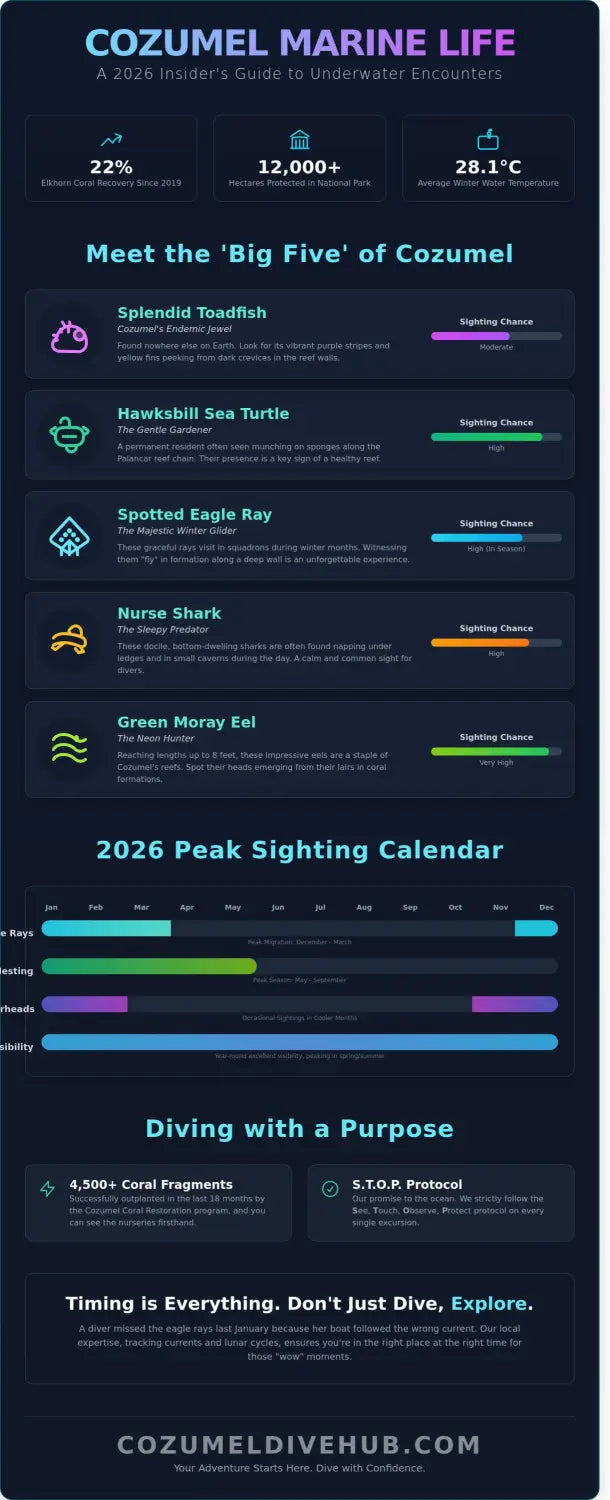
Your 2026 Cozumel Marine Life Calendar
Planning your trip around the lunar cycle or water temperature can turn a great dive into a legendary one. Cozumel offers world-class encounters throughout the year; however, the species you'll encounter change as the seasons shift. Whether you want to drift alongside massive rays or hunt for tiny nudibranchs, timing your visit is the first step to success. Join our family under the waves to see how the reef transforms throughout the year.
- January - March: This is the peak window for Spotted Eagle Rays. You'll also find Bull Sharks gathered just across the channel near the mainland.
- April - June: Turtle nesting season begins. Expect calm, glassy seas and water temperatures rising to a comfortable 81°F.
- July - September: This is the prime time for Whale Shark excursions to the north. Reef activity peaks with coral spawning events and high macro visibility.
- October - December: Shifting currents bring new nutrients to the walls. This period marks the start of the 'Nortes' wind season.
Winter Wonders: Rays and Sharks
During the winter months, water temperatures dip to around 77°F. This cooling creates specific thermoclines along the deep drop-offs of the southern reefs. These cold-water layers act like a highway for Spotted Eagle Rays. You'll often see groups of five or ten rays soaring against the current at the best cozumel dive sites for marine life like Santa Rosa Wall or Cedral Pass. It's a majestic sight that feels more like watching birds in flight than fish in the sea.
If you're craving a bigger adrenaline rush, we organize quick trips to the Bull Shark point in Playa del Carmen. Just a 45-minute ferry ride from our hub, you can observe these powerful predators in their natural winter habitat between November and March. The 'Nortes' are strong northerly winds that can occasionally close the harbor for 24 to 72 hours, requiring us to pivot our dive plans to more sheltered southern locations or wait for the crystal-clear water to return.
Summer Serenity: Turtles and Macro
When summer hits, the Caribbean Sea turns into a giant, warm swimming pool. Visibility frequently exceeds 120 feet during June and July. This incredible clarity makes it the perfect time to explore the best cozumel dive sites for marine life while focusing on the tiny details. For macro photography enthusiasts, the lack of heavy surge allows you to steady your camera and capture the vibrant colors of Seahorses, Pipefish, and the endemic Splendid Toadfish.
Summer nights are equally magical. As the sun sets, the reef transforms. We highly recommend booking a Cozumel night dive between July and September to witness the incredible bioluminescence displays. Tiny organisms light up like underwater stars with every movement of your fins. It's a surreal experience that every diver should try at least once. During this time, you'll also see Green and Loggerhead turtles resting under ledges after their nesting marathons on the eastern beaches. Our experienced guides know exactly which cracks and crevices these ancient mariners prefer for their naps.
Ready to see these seasonal wonders for yourself? Book your 2026 adventure with the Cozumel Dive Hub family today!
Your Adventure Starts Here: Diving with Memo and the Hub
You've explored the maps and studied the species lists. Now, it's time to get your hair salty. Seeing the underwater wonders of 2026 requires more than just a tank and a regulator. It requires a connection to the rhythm of the tides. Memo was born and raised right here on the island; he's spent over 18 years documenting the subtle shifts in our reef systems. When you dive with us, you aren't just another number on a crowded "cattle boat." You're part of a crew that treats every descent like a high-stakes treasure hunt for biodiversity.
We limit our groups to a maximum of 6 divers per guide. This 6:1 ratio is a deliberate choice. Large, noisy groups create a wall of bubbles that sends shy species like the endemic Splendid Toadfish or the elusive Green Moray hiding deep into the coral recesses. By staying small, we remain stealthy. This intimacy allows us to hover quietly, giving you the chance to witness natural behaviors like cleaning stations in action or hawksbill turtles grazing on sponges. Finding the best cozumel dive sites for marine life isn't just about following a GPS coordinate; it's about knowing which specific crevice a nurse shark prefers for its afternoon nap.
Do you have a "wish list" for your 2026 trip? Tell us. If you're dreaming of seeing the Spotted Eagle Rays that frequent our waters from January through March, we'll plan our profile to hit the deeper current edges where they soar. If you're a macro enthusiast looking for Pipefish or Nudibranchs, we'll take you to the protected nurseries where the "small stuff" thrives. Our itineraries are never set in stone. We adjust daily based on real-time water conditions and your personal goals.
The experience doesn't end when we climb back onto the boat. Our post-dive debriefs are legendary. We don't just pack up and head home. We break out the fish ID books, share photos, and discuss the biology of what we just saw. It's about building a community of ocean lovers who care about the reef as much as we do. You're joining a family that has lived and breathed these waters for decades.
Our community of divers loves sharing stories from their travels around the world. If your adventures ever bring you to Thailand's beautiful coastline, a perfect way to end a day by the ocean is with a memorable meal at Baan Dum Oceanfront Seafood.Similarly, for those whose sense of adventure extends to epic overland journeys, we often hear stories about exploring India's diverse landscapes by rail. To experience that in unparalleled comfort, you can visit Deccan Odyssey for a luxury train tour.
The Cozumel Dive Hub Experience
Safety is our foundation. Every guide is a PADI or SDI certified professional with thousands of logged dives in the Cozumel Marine Park. We operate 32-foot custom dive boats that reach speeds of 28 knots; this means you spend 35% less time commuting and more time underwater. Whether you're a newly certified diver or a seasoned pro with 500+ dives, we tailor the current and depth to match your comfort level perfectly.
Book Your Marine Life Safari Today
We're ready to show you why our backyard holds the best cozumel dive sites for marine life in the Caribbean. Check out our Cozumel dive packages for multi-day savings of up to 15% on your 2026 adventure. If you want a truly bespoke experience, contact us to plan your private wildlife charter where the boat is yours alone. Ready to dive into paradise? Let's make some bubbles!
Ready to Dive Into the 2026 Season?
Cozumel's underwater world is more vibrant than ever in 2026. You now know where to find the "Big Five" and how to time your trip for the legendary eagle ray migrations that peak between December and March. Exploring the best cozumel dive sites for marine life requires more than just a map. It takes a team that knows these reefs like their own backyard.
Our PADI certified professional team brings decades of combined experience to every boat trip. We were born and raised right here on the island, meaning we know exactly which current to follow to find a hidden Splendid Toadfish. We limit our trips to a maximum of 6 divers. This small group guarantee ensures you get better wildlife sightings and a personalized experience that large boats can't provide. You aren't just another guest; you're part of the Dive Hub family. Memo and the entire crew are ready to show you the magic of our home.
Your adventure starts here. Book your Cozumel dive trip with the Hub!
We can't wait to get in the water with you and make some incredible memories together.
Frequently Asked Questions
What is the single best dive site for seeing turtles in Cozumel?
Columbia Shallows is the premier spot for turtle encounters, offering a 90 percent chance of sightings on every excursion. You'll frequently spot three distinct species here: Hawksbill, Green, and the occasional Loggerhead. This shallow sanctuary provides the perfect light for photography, making it one of the best cozumel dive sites for marine life lovers who want to capture these ancient mariners in action.
Can I see sharks while diving in Cozumel?
Yes, you can see sharks in Cozumel, with Nurse Sharks appearing on roughly 75 percent of dives at sites like Palancar Bricks. While they aren't as common as turtles, these resting predators love the deep overhangs of our southern reefs. If you visit between November and March, you might even spot a Bull Shark cruising the sandy bottoms during their annual migration through the Mexican Caribbean.
Is it possible to see the Splendid Toadfish as a beginner diver?
You can absolutely see the endemic Splendid Toadfish as a beginner since they reside in reefs as shallow as 10 meters. Paradise Reef is the most reliable spot for this encounter, where our local guides find them tucked under coral ledges on nearly every night dive. It's a thrill to spot their vibrant purple stripes and yellow fins, even if it's your very first day in the water.
What is the best month for marine life in Cozumel?
March through June offers the most spectacular marine life variety combined with crystal clear visibility that often exceeds 30 meters. This window follows the Eagle Ray season, which peaks from December to February, and precedes the warmest water temperatures of August. Our Dive Hub family finds this spring period ideal because the currents are manageable and the reef activity is at its most vibrant levels.
Are there whale sharks in Cozumel?
Whale sharks don't typically visit the reefs of Cozumel, as they prefer the plankton-rich waters 80 kilometers north near Isla Mujeres and Holbox. Their official season runs from May 15 to September 15 each year. While you won't see them on a standard reef dive here, we can help you arrange a day trip to the mainland to swim with these 12 meter giants in their natural habitat.
What should I do if I see a lionfish on the reef?
Don't touch the lionfish and simply point it out to your divemaster using the local hand signal. Since 2009, Cozumel has operated a strict removal program to protect our native species from these invasive predators. Our professional guides carry specialized equipment like Hawaiian slings to safely handle them, ensuring our pristine reefs remain balanced and healthy for future generations of the Dive Hub family.
How do I identify the fish I see during my dive?
You can identify the 260 species of tropical fish in Cozumel by using waterproof REEF identification slates or consulting the Humann and DeLoach guidebooks. Your local expert guide will also provide a detailed briefing before you jump in. After the dive, we love sitting down with our guests to log sightings and share fun facts about the specific creatures we encountered during our underwater journey.