

Cozumel Dive Briefing: What to Expect Before You Hit the Water
The secret to a perfect dive in Cozumel isn't just your buoyancy; it's what you hear on the boat deck before you even get wet. It's natural to feel a bit of "drift anxiety" when you're preparing to drop into the world's second-largest barrier reef system. Whether you're worried about getting separated in the current or fumbling with boat exit protocols, those pre-dive jitters are something almost every diver experiences. We've all been there!
We're here to turn that uncertainty into pure excitement. By understanding the cozumel dive briefing what to expect, you'll master the art of the briefing so you can navigate our legendary drift currents with total confidence and ease. We'll walk you through the boat entry protocols, the vital marine park regulations like the no-touching rule, and how to communicate effectively with your guide while you're "flying" over our 105 types of coral. Get ready to feel prepared, safe, and ready for an unforgettable adventure!
Key Takeaways
- Understand how a Cozumel briefing acts as your strategic "flight plan" for navigating our legendary drift currents with total ease.
- Discover the cozumel dive briefing what to expect, from detailed site topography to the specific boat pick-up coordinates for every drift.
- Learn the step-by-step protocols for a perfect "Giant Stride" entry and how to prep your gear efficiently while on a moving boat.
- Master local hand signals that help you identify Cozumel's "celebrity" marine life, including Eagle Rays and the elusive Splendid Toadfish.
- Gain the confidence to dive like a local by knowing exactly how to communicate and stay connected with your guide throughout the entire drift process.
The Gateway to the Reef: Why the Cozumel Dive Briefing is Your Best Friend
Imagine the golden sun warming your shoulders as you step onto our boat at the pier. The Caribbean Sea is dancing around the hull in shades of turquoise you have to see to believe. You're just minutes away from dropping into a world of vibrant color, but before that splash happens, we gather for the most important part of the morning. A dive briefing is our essential pre-dive meeting where your guide outlines the plan, safety protocols, and the specific topography of the site. While every dive trip includes a talk, the cozumel dive briefing what to expect is a little different than what you might find in still, quarry waters. Here, we aren't just talking about fish; we're planning our journey through the invisible, life-giving rivers of the ocean.
Cozumel is legendary for its world-class drift diving. This means our briefings focus heavily on current direction and our specific drift strategy for the day. For many visitors, the idea of a moving ocean can cause a bit of "drift-anxiety." A professional briefing eliminates that fear by giving you a clear mental map of the adventure ahead. You'll know exactly where we are within the Arrecifes de Cozumel National Park and how we'll move together as a team. This preparation turns a potentially overwhelming experience into a relaxing glide over the reef.
Briefing vs. Reality: Navigating the Cozumel Current
In our waters, you don't "swim" against the ocean. You "glide" with it. The briefing is where we teach you how to use the current as your own personal moving walkway. We follow a strict "follow the leader" protocol to ensure everyone stays together and enjoys the same stunning views of the coral formations. We also prepare you for specific scenarios, like a "negative entry." This is when we descend immediately upon hitting the water to stay grouped together. Knowing the cozumel dive briefing what to expect makes the actual entry feel like second nature rather than a surprise.
The Role of Your Local Divemaster
Our Divemasters are so much more than just guides. They are your current-navigators. Many of our team members are lifelong locals with a deep-rooted heritage in these specific waters. They can read the surface ripples and the sway of the sea fans to predict exactly how the water will behave. This local expertise builds a bridge of trust before you even check your air. When you know your guide understands the heartbeat of the reef, you can relax and focus on the sheer beauty of the dive.
Anatomy of a Cozumel Briefing: 5 Key Points You'll Hear Every Time
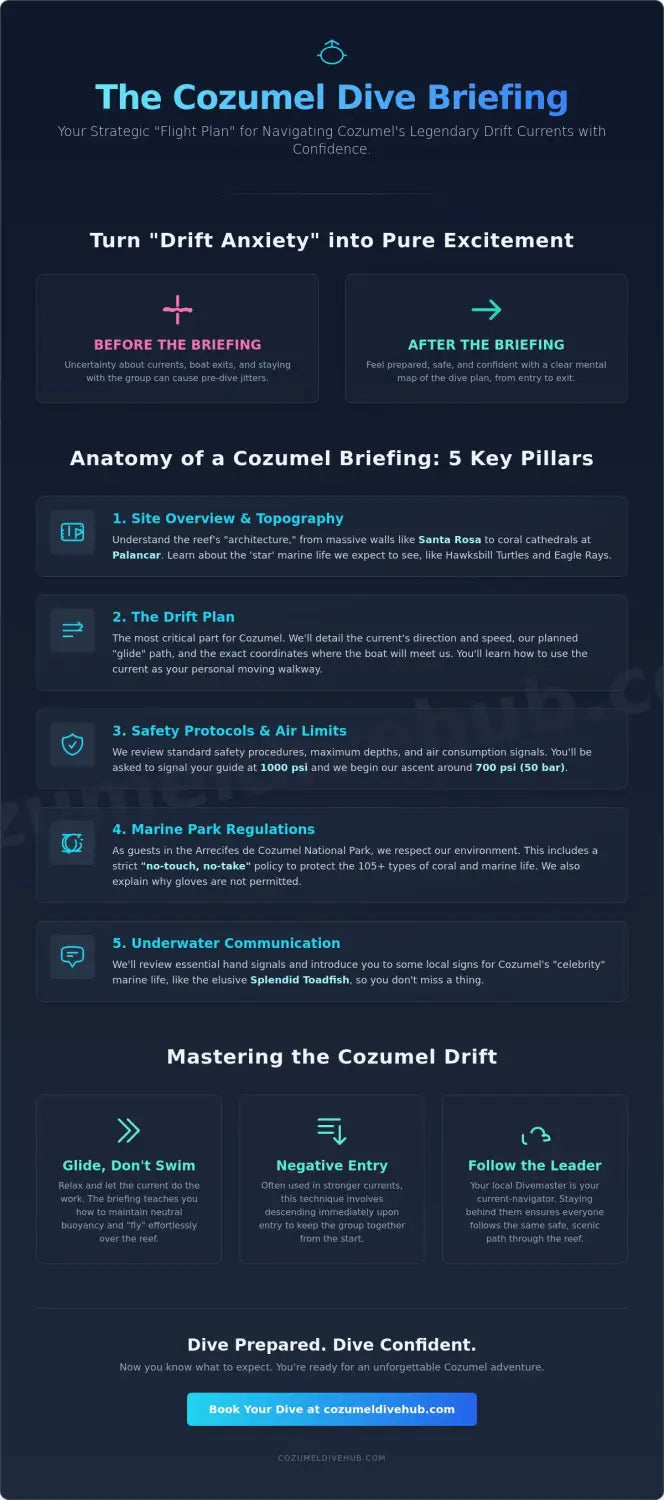
As the boat engines hum and we head toward the southern reefs, our team gathers everyone for the most exciting part of the morning. This talk is our blueprint for adventure. Understanding the cozumel dive briefing what to expect helps you transition from a passenger to a prepared explorer. We focus on five pillars that ensure your experience is as safe as it is breathtaking. We don't just list rules; we share the secrets of the reef so you can enjoy every second of your time underwater.
- Site Overview: We'll describe the "architecture" of the reef, whether it's a massive wall or a shallow coral garden. You'll hear about the "star" residents we hope to see, from Hawksbill turtles to Eagle Rays.
- The Drift Plan: This is the most critical part. We'll explain the direction of the current and how we'll move together. You'll know exactly where the boat will be waiting for us at the end of the glide.
- Safety Protocols: We review air limits, typically asking for a signal at 1000 psi and starting our ascent by 700 psi (50 bar). This mirrors the high standards found in a Scuba Diving Safety Brief to keep everyone secure.
- Marine Park Rules: We'll remind you of the Arrecifes de Cozumel National Park regulations, including the strict "no-touch" policy and why we don't allow gloves.
- Communication: We'll review hand signals, including the special ones for local celebrities like the Splendid Toadfish.
Site Specifics: From Palancar to Santa Rosa
Every reef has its own personality. Wall dives like Santa Rosa offer a dramatic drop into the deep blue, while Palancar is famous for its towering coral cathedrals. During the briefing, we'll identify key landmarks so you can stay oriented. In Cozumel, the maximum depth mentioned in your briefing is a hard limit because exceeding it often pulls you into faster, unpredictable currents that can separate you from the group. If you're ready to see these legendary sites, you can book your next Cozumel dive trip with us today.
Marine Park Regulations and Ethics
Protecting our underwater home is our top priority. Gloves are prohibited in the Cozumel National Park because they can encourage divers to touch or hold onto the delicate coral. We also follow a strict "no-touch" policy for all marine life and sponges. To keep the water pristine for the 262 species of fish living here, please ensure you only use 100% biodegradable, chemical-free sunscreen. These small steps ensure the reef stays vibrant for generations of divers to come.
Boat Procedures and Gear Prep: From the Pier to the Giant Stride
Once the briefing wraps up, the boat transforms into a hub of focused energy. Part of the cozumel dive briefing what to expect is the transition from listening to doing. Prepping your gear on a moving boat is an art form. We always suggest securing your BCD and regulator while we're still in the calmer waters near the pier, but if you need to make adjustments mid-journey, our crew is right there to lend a hand. Keeping your station organized isn't just about being tidy; it's about safety. A stray fin or a loose mask can quickly become a trip hazard when we're navigating the waves to reach the world-class sites for diving in Cozumel.
As we approach the drop point, the captain will bring the boat into position. This is when you'll perform your final buddy checks. When the "pool is open," you'll move to the dive platform. In Cozumel, we almost always use the Giant Stride entry. It's the most efficient way to get a group into the water together, which is vital for staying as a team in the current. Once you hit the water, your first priority is to inflate your BCD. This keeps you buoyant and visible to the captain. Give a clear "OK" signal by tapping the top of your head, letting the crew know you're ready to descend into the blue.
The Art of the Giant Stride
A safe entry starts with the "Cozumel grip." Use your right hand to hold your regulator in your mouth and your mask firmly against your face. At the same time, use your left hand to secure your weight belt buckle and hold your console or gauge close to your chest. Look straight at the horizon, not down at the water. Take a large, deliberate step out into the air. By stepping far enough, you ensure your tank clears the boat's platform. Once you've splashed and checked your buoyancy, swim away from the "drop zone" immediately. This keeps the area clear for your buddy to follow you safely.
Post-Dive: The Ladder and the Logbook
Coming back to the boat is just as strategic as the entry. Because we're drift diving, the boat will often come to us. When it's your turn to exit, approach the ladder from the side to avoid any surge. You'll pass your weight belt up to the crew first, followed by your fins. Keep your mask on and your regulator in your mouth until you're firmly on the deck. Once everyone is back on board, we start the "de-brief." This is our favorite time! We'll pass around the logbooks, share stories of the turtles or eels we spotted, and celebrate another successful journey through the Caribbean.
Underwater Communication: Signals You Need to Know
Once you're submerged in the crystal-clear Caribbean, talking becomes a game of hands and eyes. Understanding the cozumel dive briefing what to expect means knowing how to speak "scuba" fluently so you don't miss a single moment of the action. We use standard signals like "OK" and "Ascend," but our local waters require a bit more nuance to handle the moving environment. Effective communication is what keeps our group connected while we glide effortlessly over the reef.
Because we're drifting, your guide might signal to "stay close" by pulling their hands together or indicate a "strong current" by miming a fast-moving stream with their palms. These signals help us navigate the 11,987 hectares of the marine park as a cohesive unit. It's all about staying in the flow without losing track of your buddy or the group. When everyone understands the plan, the dive feels like a choreographed dance through the blue.
Our Divemasters have incredible eyes for detail. When they want you to see a tiny nudibranch or a cleaning shrimp tucked among the 105 types of coral, they'll use a "look at this" signal. They'll point two fingers to their eyes and then directly at the subject. It’s a silent invitation to witness the secret lives of the 262 species of fish that call this park home. These moments are the highlights of any trip!
Species-Specific Hand Signals
Every local guide has a library of signals for Cozumel's "celebrities." To signal for the endemic Splendid Toadfish, we wiggle our fingers near our chins like whiskers. For the majestic Eagle Rays, we flap our hands slowly like wings. If we spot a Sea Turtle, we stack our hands and wiggle our thumbs to mimic their graceful swim. These signals turn every dive into a shared story of discovery. If you want to practice these signals with the best local guides in the business, book your next Cozumel dive trip with our passionate team today!
Emergency Signals and SMB Use
Safety remains our absolute bedrock. If you ever find yourself separated from the group in the drift, we follow a simple, proven protocol. Look around for one minute to find your team, then ascend safely. Your Divemaster will deploy a Surface Marker Buoy (SMB). This bright orange "safety sausage" floats on the surface, letting the captain know exactly where the group is at all times. We also review the "Low Air" signal, which is usually a fist to the chest, to ensure everyone has plenty of reserve for a relaxed, three-minute safety stop.
Experience the Hub Difference: Why Our Briefings Set You Up for Success
At Cozumeldivehub, we believe the pre-dive talk is the foundation of every great memory. Our team is composed of lifelong locals who treat these reefs like their own backyard. This isn't just about technical details; it's about passing on a legacy of respect for the ocean. When you understand the cozumel dive briefing what to expect, you aren't just following a guide; you're joining a family that prioritizes your comfort and excitement above all else. We never rush the process because we know that a calm, informed diver is a happy diver.
Our safety-first culture means we tailor every adventure to the people on the boat. We listen to your goals and adjust our strategy to match your experience level. Whether we're discussing the nuances of a deep wall or the best way to spot a tiny shrimp, our briefings are interactive and engaging. We want you to feel like an active part of the team before the first splash.
Small Groups, Big Adventures
We keep our groups intimate with a strict 6:1 diver-to-guide ratio. This ensures you're never just a face in the crowd. Our personalized attention is a game-changer for those exploring scuba diving Cozumel for the first time. We make sure every question is answered and every gear check is thorough before the engines even start. This small-group approach allows for a much more detailed and relaxed discussion about the drift ahead.
Join the Family at Cozumeldivehub
Our padi certification cozumel courses focus on building confident, self-reliant divers who value the art of the briefing. We want you to feel like a local every time you hit the water. Our heritage is rooted in these reefs, and we're passionate about sharing that knowledge with you. Ready to start your journey with the best team on the island? Book your adventure with us today!
Ready to Glide Over the Reef?
Mastering the drift starts long before you take that giant stride. By understanding the cozumel dive briefing what to expect, you've already taken the first step toward a stress-free, exhilarating underwater journey. You now know that a great briefing isn't just a list of rules; it's your personalized map to navigating the current and identifying the vibrant marine life that makes our park so legendary. Whether you're mastering local hand signals or perfecting your boat entry, you're ready to dive with total confidence.
Our team of expert local guides brings decades of experience to every trip, ensuring your safety and enjoyment are always the top priority. We focus on small group sizes to provide personalized care and high-quality PADI-certified instruction for all experience levels. It's time to turn these pre-dive plans into reality and witness the beauty of the Caribbean for yourself. We can't wait to see you on the boat and share the magic of our home reefs with you.
Start your Cozumel adventure and book your dive trip today!
Common Questions About Your Cozumel Briefing
How long does a typical Cozumel dive briefing last?
A typical briefing lasts about 10 to 15 minutes on the boat ride out to the reef. This gives us plenty of time to discuss the site topography, the drift plan, and safety protocols without cutting into your actual adventure time. We keep it focused, high-energy, and professional so you're ready to hit the water feeling fully informed and incredibly excited!
What happens if I don't understand something in the briefing?
Speak up immediately! We love questions and want you to feel 100% confident before you splash. Our small group setting is designed for this kind of personal connection, so there's never any pressure to stay silent if a protocol feels unclear. We're fellow enthusiasts who want you to have the best experience possible, so we'll happily explain the plan until you're ready to go.
Do I need to know specific hand signals for Cozumel?
Yes, we'll review the specific signals used in our local waters. Beyond the standard PADI signals, we'll show you how to identify Cozumel's "celebrities," like the Splendid Toadfish or the majestic Eagle Rays. Learning these silent "words" is a fun part of the experience that helps us share the excitement of a discovery without ever needing to say a word underwater while we glide along the reef.
What is a 'negative entry' and will it be in the briefing?
A "negative entry" is when you descend immediately upon hitting the water instead of waiting at the surface. We use this technique when the current is moving quickly to ensure the group stays together from the very start. If the site requires it, we'll walk you through every step during the briefing so you feel prepared to drop into the blue with total ease and confidence.
Will the briefing cover what to do if I get separated in the current?
Absolutely, safety is our top priority. Every cozumel dive briefing what to expect includes a clear plan for what to do if you lose sight of the group in the current. We'll remind you to look for one minute before performing a safe ascent. Knowing this protocol ensures you can relax and enjoy the glide, knowing exactly how we'll reunite on the surface with the boat.
Are Marine Park rules always part of the briefing?
Yes, Marine Park regulations are a mandatory part of every talk we give. We'll remind you about the strict no-touch policy for coral and marine life, as well as the requirement for biodegradable sunscreen. Protecting our 105 types of coral and 262 species of fish is a team effort, and the briefing is where we set the stage for responsible, sustainable exploration of our beautiful home.
Can I ask to see a specific marine animal during the briefing?
Please do! We love hearing what you're most excited to see. While we can't guarantee a sighting, telling your guide you're on the hunt for a Seahorse or a Nurse Shark helps them know exactly where to focus their expert eyes. Our local guides know the reefs' hiding spots better than anyone and will do their absolute best to find those "bucket list" creatures for you during the dive.
Is the briefing different for a night dive in Cozumel?
Yes, night dive briefings focus heavily on light communication and staying close in the dark. We'll review how to use your torch to signal "OK" or get someone's attention without blinding them. It's an essential part of the cozumel dive briefing what to expect when we're searching for nocturnal creatures like octopuses or the bioluminescent "string of pearls" that light up the Caribbean night for us.