

Cozumel Diving Health and Safety Tips: A Complete Guide for 2026
Imagine yourself gliding effortlessly over the vibrant Palancar Reef, feeling like you're flying, until a sudden shift in the current makes you wonder if the boat still has eyes on your bubbles. It's a common thrill, but it's completely natural to feel a flutter of nerves when you're dancing with the deep blue, especially when navigating the legendary currents of the Caribbean. We want you to feel that rush without the worry; that's why mastering cozumel diving health and safety tips is the first step to a truly unforgettable 2026 adventure.
We agree that safety shouldn't feel like a chore. It's actually the foundation that lets you relax and enjoy our island's 100-foot visibility and crystal-clear, warm waters. This guide promises to turn your anxiety into pure confidence by covering everything from drift diving protocols to local medical resources. You'll get a clear preview of how to handle tropical dehydration, ear equalization techniques, and a physical readiness checklist. By the time we're done, you'll be ready to join our dive family with total peace of mind, knowing you're prepared for every current Cozumel throws your way.
Key Takeaways
- Learn to navigate Cozumel's exhilarating drift currents with total confidence and stay perfectly positioned with your dive boat.
- Understand the vital connection between proper hydration and dive safety to protect yourself from heat exhaustion and decompression risks.
- Discover why carrying the right visual and audible signaling gear is a non-negotiable step for every safe Caribbean adventure.
- Master the latest 2026 cozumel diving health and safety tips regarding flying-after-diving windows and recognizing subtle post-dive symptoms.
- See how small group ratios and local divemaster expertise provide the ultimate safety net for exploring our island's stunning reef systems.
Understanding the Cozumel diving environment: Safety in the drift
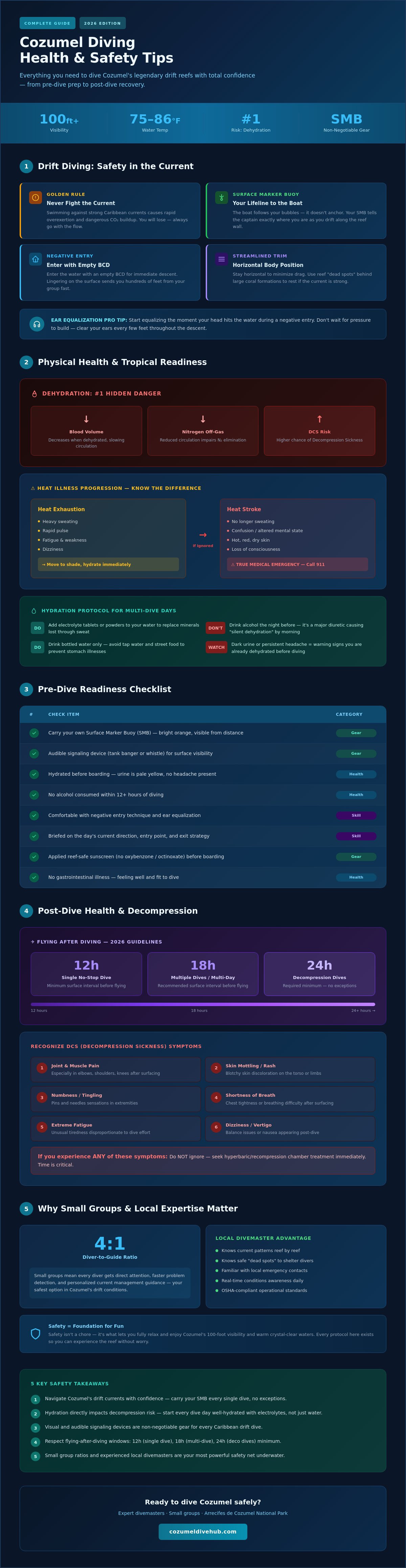
Have you ever wanted to feel like a superhero flying through the ocean? In Cozumel, drift diving is our bread and butter. Unlike most places where you kick hard to get around, here the current does the work for you. It's exhilarating! These moving waters are the lifeblood of the Arrecifes de Cozumel National Park, constantly sweeping in fresh, nutrient-rich water that keeps our visibility at a stunning 100 feet or more. While the current is a gift for photographers and explorers, it's also the most important factor to manage when considering cozumel diving health and safety tips.
Safety in this environment starts before you even hit the water. Because the boat follows your bubbles rather than anchoring, every diver needs to be comfortable with the Surface Marker Buoy (SMB). This bright orange tube is your direct line of communication with the boat captain. It tells them exactly where you are as you drift along the reef wall. Without it, you're just a tiny speck in a vast blue playground. Carrying your own SMB is a non-negotiable part of being a responsible diver in these waters.
Mastering the negative entry and descent
When the captain says "Go!", everyone needs to move as one. A negative entry is a scuba diving technique where the diver enters the water with an empty buoyancy compensator (BCD) to begin an immediate descent, preventing the current from carrying them away from the group or boat. If you linger on the surface, you'll quickly find yourself hundreds of feet away from your dive buddy. Since you're dropping fast, start equalizing your ears the moment your head hits the water. Don't wait for pressure to build up; clear those ears every few feet to keep the descent smooth and pain-free.
The golden rule: Never fight the current
The most important of all cozumel diving health and safety tips is simple: don't fight the ocean. You will lose. Trying to swim against a strong Caribbean current leads to rapid overexertion and dangerous CO2 buildup. Instead, stay relaxed. If you need a break, tuck in close to the reef structure or large coral formations. These natural barriers create "dead spots" where the flow is much weaker. Keep your body in a perfect horizontal trim to minimize drag. By staying streamlined, you'll use less air and enjoy a much longer, safer journey through our underwater paradise.
Physical health and tropical readiness for Caribbean diving
Cozumel is a tropical paradise, but the combination of intense sun, high humidity, and salt water puts unique demands on your body. Most divers focus on their gear, but your physical state is the most important piece of equipment you bring. When the water temperature sits between 75 and 86°F, it's easy to forget that you're still exerting yourself. Maintaining your peak condition is a core part of cozumel diving health and safety tips because a healthy diver is a safe diver. While we follow professional OSHA SCUBA diving safety standards to manage operational risks, your personal readiness begins the moment you wake up.
This readiness includes ensuring your musculoskeletal health is up to the task of carrying heavy scuba tanks. Before your trip, consulting specialists like Coral Way Disc Center for non-surgical spinal decompression can help resolve back or neck issues, ensuring you are in peak form for your underwater adventures.
Dehydration is the most common health hurdle in the Caribbean. It's not just about being thirsty; dehydration actually increases your risk of Decompression Sickness (DCS). When you're dehydrated, your blood volume decreases and your circulation slows down, which makes it harder for your body to off-gas nitrogen effectively. You also need to watch for the "Cozumel Sun." Heat exhaustion can sneak up on you with symptoms like heavy sweating and a rapid pulse. If left unchecked, it can progress to heat stroke, which is a true medical emergency. Stay cool, stay shaded, and listen to your body's signals.
Don't let a stomach bug ruin your vacation. "Montezuma’s Revenge" is easily avoided by sticking to bottled water and eating at reputable spots. Being stuck in your hotel room is no way to spend a dive trip, so choose your snacks wisely to stay dive-ready for every morning departure.
Hydration protocols for multi-dive days
Drinking plain water isn't always enough when you're sweating out essential minerals. We recommend adding electrolyte tablets or powders to your water bottle to maintain a healthy balance. Avoid alcohol the night before your dives; it's a major diuretic that guarantees you'll start your morning in a state of "silent dehydration." If you notice dark urine or a persistent headache, you're already behind on your fluids. Drink early and drink often to keep your system primed for the pressure changes ahead.
Ear care and equalisation techniques
The salt water in Cozumel is beautiful, but it can lead to "swimmer's ear" if you aren't careful. A simple 50/50 solution of rubbing alcohol and white vinegar used after your last dive of the day helps dry out the ear canal and prevent infections. When you're in the current, remember to equalize gently and frequently. Never force it. If you feel a "reverse block" (pain while ascending), stop, descend slightly, and give the air time to escape. If you're congested, it's always safer to sit out a dive than to risk a painful barotrauma.
Essential underwater safety and surface protocols
Ready to drop in? The thrill of flying over our vibrant reefs is unmatched, but staying connected to your team is what makes the adventure truly seamless. While the current does the heavy lifting, your focus should remain on your equipment and your buddy. Effective communication and gas management are the silent partners of every successful dive. These cozumel diving health and safety tips are designed to keep you in the zone, allowing you to soak in the beauty of the Caribbean while maintaining total control.
Gas management in a drift environment requires a proactive approach. We often recommend the "Rule of Thirds" as a baseline: one-third of your air for the dive, one-third for the ascent and safety stop, and one-third held in reserve for emergencies. Even though we aren't swimming back to a fixed anchor line, that extra cushion is vital if the current carries you further than anticipated or if a buddy needs assistance. Speaking of buddies, don't let the stunning coral towers pull your eyes away for too long. Stay side-by-side or slightly behind one another. In a moving current, a gap of just a few feet can widen quickly, so keep your partner within easy reach at all times.
Effective surface signaling in Cozumel
Being seen is everything when you're drifting in the open ocean. A tall, high-visibility SMB is your most important piece of safety gear. If you're just starting your journey, our Scuba Diving Cozumel: The Complete Beginner’s Guide offers a great look at the essential kit you'll need. Learning to deploy your SMB from depth during your safety stop is a game-changer. It alerts the boat captain to your position long before you break the surface. In choppy 2026 conditions or low-light situations, an audible signal like a whistle or a "Dive Alert" horn is equally crucial. These tools ensure that even if you're bobbing in high waves, you're never just a face in the crowd.
Boat safety and the "Diver Down" flag
Your group’s buoy is your lifeline to the boat. It carries the "Diver Down" flag, which warns other vessels to stay at least 50 to 100 feet away. Staying close to your guide’s buoy ensures the captain can track the whole group easily. If you ever find yourself separated, don't panic. Follow the standard "Surface and Wait" protocol: look around for one minute, then perform a safe, controlled ascent. Once you're on the surface, inflate your BCD, deploy your own SMB, and wait for the boat to come to you. Remember, boat traffic in Cozumel can be heavy. Your five-minute safety stop is non-negotiable; it's your window to listen for propellers and ensure you surface slowly and safely into the sunlight.
Post-dive health: Decompression and emergency resources
The high you feel after a day spent with sea turtles and eagle rays is addictive! But even after you've stepped off the boat, your body is still processing the nitrogen from your adventure. We want you to enjoy every sunset in San Miguel with total peace of mind. Understanding the post-dive window is a vital part of cozumel diving health and safety tips. It's the difference between a perfect vacation and a stressful medical detour. Luckily, Cozumel is one of the safest places in the world to dive because our local medical infrastructure is specifically built to support the diving community.
Sometimes, divers ignore what we call "the niggles." These are subtle symptoms like unusual fatigue, a dull ache in a joint, or a tingly sensation in your fingers. It’s easy to blame it on a long day in the sun, but these can be early signs of decompression sickness (DCS). If you feel anything out of the ordinary, tell your divemaster or the shop team immediately. We are a tight-knit community, and we always look out for our own. Having a Divers Alert Network (DAN) membership is the ultimate safety net for international travelers. For an annual fee of $40, you gain access to specialized insurance and a 24-hour emergency hotline staffed by dive medicine experts.
If you're looking to sharpen your safety skills before you arrive, check out our guide on how to Get Your PADI Certification in Cozumel: The Ultimate Guide for more on emergency training. Being prepared means you can focus on the fun!
The "No Fly" window and altitude safety
Current 2026 DAN and PADI guidelines recommend waiting at least 18 hours after multi-day, repetitive diving before you board a plane. If you've only done a single dive, a 12-hour window is the standard, but we always suggest a full 24 hours to be extra safe. Remember that altitude changes aren't just for airplanes. A trip to the Tulum ruins actually counts as an altitude change because of the geographical route and the ferry crossing. Plan your last day for dry land activities like shopping or exploring the town to give your body plenty of time to off-gas before you head home.
Emergency procedures in Cozumel
If an emergency does happen, you're in good hands. Cozumel is home to the SSS Network and several world-class hyperbaric clinics. These facilities are staffed by doctors who specialize in hyperbaric medicine and are available 24/7. While a single session in a hyperbaric chamber can cost between $150 and $300 USD, having proper insurance ensures you're covered without any financial stress. Never hesitate to seek help; early treatment is the key to a full and fast recovery. Our team can help with your dive trip planning to ensure you're always close to the best resources the island has to offer.
Why small groups and local expertise are your best safety tools
When you're drifting through the legendary blue waters of the Caribbean, the people by your side make all the difference. Scuba diving is an incredibly social activity, but in a drift environment, your team is also your primary safety net. We believe that the best cozumel diving health and safety tips start with who you choose to lead your underwater journey. Our divemasters aren't just certified professionals; they're local experts like Carlos or Luis, who have spent their lives learning the rhythm of these reefs. This deep connection to the water allows them to read "current lines," identifying exactly where the flow might shift or where a relaxing "dead spot" behind a coral buttress can be found.
At Cozumeldivehub, we don't leave your security to chance. Every boat in our fleet is fully equipped with medical-grade O2 kits and marine radio gear to ensure constant communication with the shore. There's also a powerful psychological benefit to our "familial" dive environment. When you feel like you're diving with friends rather than just being a number on a boat, your stress levels drop. Lower stress means better air consumption, clearer thinking, and a much more enjoyable experience for everyone involved.
Personalized care vs. "Cattle Boats"
The biggest risk in a strong current is diver separation. On large "cattle boats" with fifteen or twenty divers in the water, it's easy for a guide to lose track of a single pair of bubbles. Large groups often lead to chaotic entries and crowded safety stops, which can be overwhelming for even experienced divers. We focus exclusively on small, curated groups to ensure maximum oversight. This allows our guides to give a thorough pre-dive safety briefing tailored to the specific conditions of the day. With fewer people to watch, your guide can stay close, monitor your buoyancy, and ensure everyone stays together from the moment of the negative entry until the final safety stop.
Your journey starts with safety
Proper preparation is the magic ingredient that turns pre-dive anxiety into pure underwater excitement. When you know your gear is ready and your team has your back, you can truly let go and enjoy the flight. Before you head out for your next cozumel diving health and safety tips checklist, make sure you've covered these essentials:
- Confirm your gear is serviced and your SMB is easily accessible.
- Hydrate with electrolytes and avoid alcohol the night before.
- Review hand signals and separation protocols with your buddy.
- Check the local reef closure schedule to plan your route.
- Verify your DAN insurance is active and your medical form is up to date.
Ready to experience the thrill of the drift with a team that treats you like family? Book your safe and exhilarating Cozumel dive adventure with us today! We can't wait to show you the magic of our island home.
Your Adventure of a Lifetime is Waiting
We've covered the essentials of flying through our world-class drift currents and staying physically primed for the Caribbean sun. By mastering these cozumel diving health and safety tips, you've already taken the biggest step toward a secure and exhilarating 2026 vacation. Remember that true safety comes from a partnership between your personal preparation and the expertise of your guides. Whether it's managing your "No Fly" window or deploying your SMB with total confidence, you're now ready to focus on the magic happening beneath the surface.
At Cozumeldivehub, we treat every guest like family. Our expert local guides have decades of experience navigating these specific waters, and we ensure every boat is equipped with emergency oxygen and GPS tracking. We believe that small group sizes are the only way to provide the 1-on-1 safety attention you deserve. Join our small-group dives for a safer, more personal Cozumel experience! We can't wait to welcome you to our island paradise and share the wonders of the reef together!
Frequently Asked Questions
Is it safe to dive in Cozumel if I am a beginner?
Yes, beginners can dive safely in Cozumel, especially on our shallower southern reefs where the water is calm and clear. We recommend starting with sites like Palancar Gardens where the currents are gentle and manageable. Following professional cozumel diving health and safety tips ensures that your first experience is as thrilling as it is secure, provided you stay close to your guide.
What happens if I get separated from my dive boat in the current?
If you lose sight of your group, follow the standard one-minute search and surface protocol. Once you reach the surface, inflate your BCD and deploy your Surface Marker Buoy immediately. Our boat captains are experts at tracking bubbles and looking for bright orange buoys, so stay calm and wait for pickup. The current will carry you in the same direction as the boat.
Are there hyperbaric chambers in Cozumel?
Cozumel is home to several world-class hyperbaric chambers, including the highly respected SSS Network. These facilities are staffed 24/7 by specialists in dive medicine who are ready to handle any emergency. Having these resources nearby is a major reason why our island remains a top choice for divers who prioritize cozumel diving health and safety tips during their travels.
Can I dive in Cozumel if I have a cold or sinus congestion?
You should never dive with a cold or sinus congestion. Congestion makes it nearly impossible to equalize your ears or sinuses, which can lead to painful barotrauma or "reverse blocks" during your ascent. It's always better to skip one day of diving than to risk a serious injury that could end your entire trip. Your ears will thank you for the rest.
How long should I wait to fly after diving in Cozumel?
You must wait a minimum of 18 hours after multi-day repetitive diving before boarding a flight. For a single dive, the 2026 PADI and DAN guidelines suggest at least 12 hours. We always encourage our guests to wait a full 24 hours to give their bodies maximum time to off-gas safely. Use that extra day to explore the beautiful shops and restaurants in San Miguel.
What is the most common diving injury in Cozumel and how can I avoid it?
Ear barotrauma is the most common injury, usually caused by failing to equalize early and often during the descent. You can avoid this by clearing your ears every few feet before you feel any discomfort. Minor stings from fire coral are also common, so maintain good buoyancy and remember our "no touch" policy to protect yourself and the delicate reef environment.
Does Cozumeldivehub provide oxygen and first aid kits on their boats?
Yes, we provide emergency oxygen kits and fully stocked first aid supplies on every single boat in our fleet. Our team is professionally trained in emergency response, and we also use GPS tracking to ensure the boat captain always knows your position. Your well-being is our absolute top priority, and we maintain our equipment to the highest professional standards.
Is the water in Cozumel safe for divers to drink?
No, the tap water in Cozumel is not safe for drinking. You should always stick to bottled or purified water, which we provide in abundance on all our dive boats. This simple step helps you avoid stomach issues like "Montezuma's Revenge" and ensures you stay properly hydrated and ready for your next underwater adventure in our stunning marine park.