

Ear Equalization Problems Scuba Diving: The Ultimate Guide to Pain-Free Descents
Last July, a guest named Carlos found himself stuck at five feet while his family drifted toward the vibrant Palancar Gardens. He was frantically pinching his nose, but that familiar sharp pressure wouldn't budge. We've all been there. It's incredibly frustrating to feel like you're holding up the boat or risking permanent barotrauma because your ears won't cooperate. If you struggle with ear equalization problems scuba diving, you don't have to suffer through the pain or stay on the surface.
Statistics from the Divers Alert Network show that ear issues account for nearly 40% of all dive-related medical inquiries, yet most can be solved with the right approach. Our team at Cozumeldivehub wants you to feel confident and relaxed from the moment you giant stride into the water. This guide shares the exact techniques we use to help thousands of divers descend comfortably. We'll explore five advanced methods and local secrets to ensure your next journey into our crystal-clear Caribbean waters is 100% pain-free. Your adventure starts here, and it begins with clear, happy ears.
Key Takeaways
- Understand the science of Boyle’s Law and how your Eustachian tubes act as the tiny gateways to a comfortable, pain-free descent.
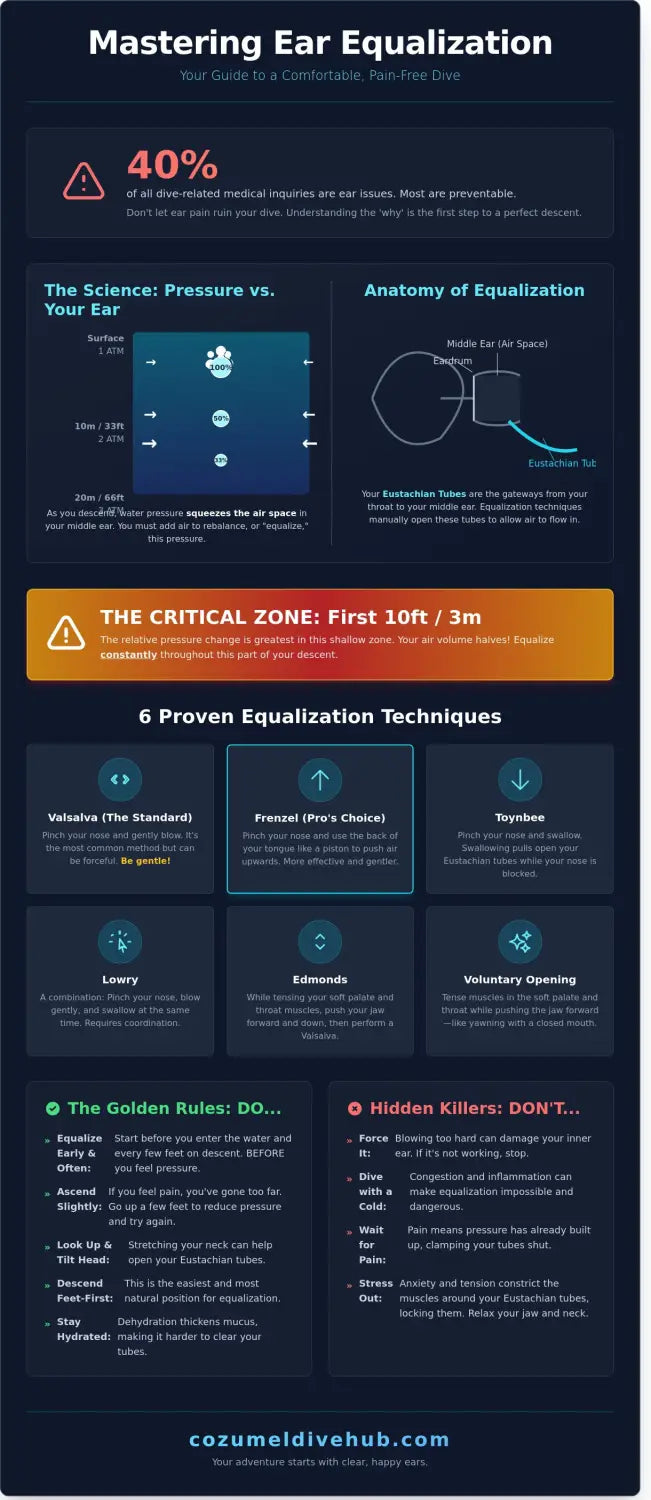
- Master six proven equalization techniques beyond the standard Valsalva, including using your tongue as a piston with the Frenzel maneuver.
- Discover professional troubleshooting secrets to resolve ear equalization problems scuba diving might present, ensuring every dive is a success.
- Get exclusive local tips from our Dive Hub Family on handling descents during Cozumel’s thrilling drift dives at sites like Palancar.
- Learn the "Golden Rule" of pressure management to protect your ears while exploring the breathtaking walls of the Caribbean.
Understanding Ear Equalization: Why Your Ears Hurt Underwater
Ready to dive into paradise? As you descend along Cozumel's breathtaking walls, you'll feel a distinct squeeze in your ears. This isn't just a random sensation; it's physics in action. Equalization is the simple act of balancing the pressure between your middle ear and the weight of the water surrounding you. When you master this, the underwater world becomes your playground. When you don't, it can lead to discomfort or even injury.
Boyle's Law explains exactly why this happens. This rule of physics states that as pressure increases, the volume of a gas decreases. Your middle ear is a small, air-filled cavity. As you drop below the surface, the weight of the water pushes against your eardrum, compressing that air space. Many divers encounter ear equalization problems scuba diving because they fail to add air to this space to counteract the external force. If you don't move air through your Eustachian tubes to fill that void, the pressure differential creates a vacuum that pulls on your delicate tissues.
The secret to a perfect dive is the "early and often" philosophy. Our team at Cozumel Dive Hub always reminds our family of divers to equalize before they even feel pressure. If you wait until you feel a sharp pain, you've waited too long. By that point, the water pressure has already clamped your Eustachian tubes shut, making it nearly impossible for air to pass through. Common reasons for failure include simple congestion from a cold, inflammation from allergies, or just trying too hard with a forceful blow that causes more harm than good.
The Physics of Pressure and Your Middle Ear
The first 10 feet (3 meters) of your descent are the most critical part of the journey. This is the danger zone where the most drastic relative pressure changes occur. In this shallow range, the air volume in your ear changes more rapidly than at any other depth. As the water pushes, your eardrum flexes inward, creating that familiar "squeeze." To fix this, you must employ effective ear clearing techniques to gently force air into the middle ear. Middle ear barotrauma is a pressure-induced injury that is 100% preventable with proper technique.
Anxiety and Tension: The Hidden Equalization Killers
Stress is a silent enemy when you're trying to sink into the blue. When you're nervous, your body's natural "fight or flight" response kicks in. You might find yourself clenching your jaw or "stress-diving" with a stiff body. This tension constricts the tiny muscles surrounding your Eustachian tubes, effectively locking the door to your middle ear. There's a direct connection between a tight neck and a failed descent. Your adventure starts here with a deep breath and a relaxed mind. Relax your throat, wiggle your jaw, and let the air move freely as you explore our pristine reefs.
The Anatomy of Your Ears: Why Some Divers Struggle More
Understanding your anatomy is the first step toward a lifetime of comfortable diving. At the heart of the matter are your Eustachian tubes. These are the tiny, tissue-lined gateways that connect your middle ear to the back of your throat. For most people, these tubes stay closed to protect the ear, only opening when you swallow or yawn. When you descend into the crystal-clear waters of the Caribbean, the increasing pressure pushes against your eardrum. If those gateways don't open, you'll experience ear equalization problems scuba diving.
Some divers have "stenotic" or naturally narrow tubes. This doesn't mean you can't dive! It simply means your body requires a more proactive approach. Your soft palate and throat muscles are the "operators" of these gateways. By engaging these muscles through specific movements, you can manually trigger the opening. Hydration plays a massive role here too. Dehydration makes the mucus lining your tubes thick and sticky, while allergies can cause the tissue to swell. Staying hydrated and managing congestion ensures these passages remain clear for your adventure.
Eustachian Tube Dysfunction (ETD) vs. Poor Technique
It's easy to blame your biology when you can't clear, but often the issue is coordination. Eustachian Tube Dysfunction (ETD) involves a physical blockage, like inflammation from a cold. However, most "difficult ears" are just "slow ears." These divers simply need a few extra seconds to let the pressure stabilize. Scientific data shows it only takes a depth change of 8 to 26 inches to create enough pressure for a diver to require equalization. If you wait until you feel pain, you've already waited too long. Start equalizing the moment your mask hits the water.
Identifying Your Personal "Ear Profile"
Every diver has a unique "ear profile." You might find you're a "Lefty" or a "Righty," where one ear clears instantly while the other needs constant attention. This asymmetry is perfectly normal. You should also stay alert for a "Reverse Block" during your ascent. This happens when air gets trapped in the middle ear and can't escape as you move toward the surface. If you feel pressure while going up, stop and descend slightly to let it vent naturally. To get a better handle on how your body reacts to the underwater world, check out our Scuba Diving Cozumel: The Complete Beginner’s Guide for more expert tips. Ready to test your skills? Let's make some bubbles together and explore the vibrant reefs of Cozumel with our professional team!
6 Proven Equalization Techniques Every Diver Should Master
Ready to take your underwater adventures to the next level? Mastering your ears is the secret to a stress-free descent into Cozumel's crystal-clear waters. While most beginners rely on the standard pinch and blow, relying on just one method can lead to ear equalization problems scuba diving. Expanding your toolkit ensures you spend your bottom time admiring vibrant reefs instead of struggling with pressure.
The Valsalva vs. The Frenzel: Which is Safer?
The Valsalva maneuver is the first technique most of us learn. You pinch your nose and blow against it using your chest muscles. It's simple, but it carries a risk of over-pressurization if you blow too hard. Experienced divers often switch to the Frenzel maneuver for better safety. To do this, you pinch your nose and use the back of your tongue to push air upward. This throat-based pressure is far more precise. The Frenzel maneuver is often the preferred choice for experienced divers because it uses less force and provides more control.
Hands-Free and Movement-Based Methods
Some lucky divers can master the Voluntary Tubal Opening (VTO). This is the "holy grail" of diving where you simply tense the muscles in your throat to open the Eustachian tubes without using your hands. If you aren't there yet, try these movement-based tricks:
- The Toynbee Maneuver: Pinch your nose and swallow. This uses your natural muscle movements to pull the tubes open.
- The Lowry Technique: This is a powerhouse move. You pinch your nose, blow gently, and swallow at the same time. It's incredibly effective for stubborn ears.
- Jaw Wiggling: Moving your jaw side to side or thrusting it forward can create the "path of least resistance" for air to move.
Your head position is a game changer. Many divers instinctively look up toward the surface when they feel pressure, but this actually stretches your Eustachian tubes and can pull them shut. Try looking forward or slightly down instead. This small adjustment often solves ear equalization problems scuba diving instantly.
Success starts before you even reach the boat. We recommend practicing these techniques in front of a mirror for 5 to 10 minutes every day during the week before your trip. This helps you visualize the muscle movements in your throat and jaw. When you join the Cozumel Dive Hub family, you'll be ready to descend like a pro. Your adventure starts here, so let's make sure your ears are ready for the journey!
Troubleshooting Equalization Problems During Your Descent
Even the most seasoned pros face ear equalization problems scuba diving from time to time. When your ears won't pop, the most important thing is to remain calm. The golden rule of diving is simple: stop, signal your buddy, and ascend slightly. Never push through pain. If you feel discomfort, you've already missed the window to equalize properly. Your ears are delicate, and we want you to enjoy every second of our vibrant reefs without injury!
Using a descent line is a fantastic way to manage your depth. It serves as a physical anchor that reduces anxiety and gives you total control. If you feel pressure, you can simply hold onto the line and stop your descent instantly. We always recommend a feet-first approach during your initial descent. This vertical orientation helps your Eustachian tubes stay open more effectively than a head-down position. Gravity works with you to move air into those middle ear spaces!
Don't ever feel embarrassed to signal your Divemaster or buddy. We're a family here, and your safety is our top priority. Use the standard hand signal for "problem" followed by pointing to your ear. Our team at Cozumel Dive Hub is trained to wait and assist you. We want you to feel confident and relaxed as you prepare to explore our breathtaking walls.
The 3-Step "Reset" Protocol
If you hit a wall with your ears, follow this 3-step reset to clear the path for a fun dive:
- Step 1: Ascend 2 to 4 feet. You must go up until the feeling of pressure or "fullness" completely vanishes.
- Step 2: Try a different technique. If the standard pinch-and-blow isn't working, try swallowing hard or wiggling your jaw from side to side.
- Step 3: Descend again at a snail's pace. Equalize every few inches before you feel any pressure at all.
Pre-Dive Ear Preparation
Success starts on the boat ride out to the dive site. Chewing gum or gently "massaging" the area around your ears can help stimulate the tubes. You should also perform a gentle equalization on the surface before you even deflate your BCD. This pre-pressurizes the system for the journey ahead. Be extremely cautious with decongestants. While they might clear your nose, they can wear off during the dive. This leads to a dangerous "reverse block" where air cannot escape your ears during ascent. This condition affects roughly 6% of divers who use medication to mask congestion. Stay hydrated and dive healthy for the best results!
Mastering Equalization in Cozumel: Tips from the Dive Hub Family
Ready to dive into paradise? Cozumel is famous for its crystal-clear water and vibrant marine life, but the island's signature drift diving adds a unique layer to your descent. When you're floating over the breathtaking walls of Palancar or Columbia reefs, the current doesn't stop for your ears. This is often where divers face ear equalization problems scuba diving, but our team is here to ensure your journey is smooth and pain-free. We believe that every diver deserves a personalized pace, especially when your comfort is on the line.
Our lead guide, Memo, has spent over 20 years navigating these waters and knows that the secret to a great dive starts before you even hit the bottom. At Cozumel Dive Hub, we treat you like part of the family. This means we never rush a descent. If you need five minutes or fifteen to clear your ears, we stay right there with you. We prioritize your safety and enjoyment over a strict schedule, making sure you feel 100% ready before we explore the deeper sections of the reef.
Equalizing While Drifting: Managing Current and Depth
Descending in a mild current can feel intimidating if you're worried about your ears. The trick is to stay calm and horizontal. If you feel the current pulling you, don't fight it with aggressive kicks. Instead, focus on your breathing and stay close to your Divemaster. Being within arm's reach of Memo or our other expert guides provides a sense of security that lets you focus entirely on your Valsalva technique. If you're new to these conditions, check out our guide on Cozumel Beginner Diving: Your First Underwater Adventure Awaits to learn more about the basics of drift diving.
- Proactive Clearing: Start equalizing the moment your mask hits the water, not when you feel pain.
- Visual Markers: Use the reef wall as a reference point to monitor your depth changes.
- The "Stop" Signal: Don't be shy about signaling your guide if you need a moment to level off.
Post-Dive Ear Care for a Week of Diving
When you're diving for several days in a row, your ears need a little extra love. The salt and minerals in the Caribbean Sea are beautiful, but they can lead to irritation if left in the ear canal. We always recommend rinsing your ears with fresh water immediately after getting back on the boat. This simple step removes salt crystals that can cause "Swimmer’s Ear" or Otitis Externa.
Many of our regular divers swear by the "Vinegar and Alcohol" trick. A 50/50 mix of white vinegar and rubbing alcohol can help dry out the ear and restore a healthy pH balance. However, you should only use this if you have healthy, intact eardrums. Most importantly, leave the cotton swabs in your hotel room. Using Q-tips after a dive often pushes softened earwax deeper into the canal, which creates a plug that makes ear equalization problems scuba diving even worse the next day. Stick to a gentle towel dry and let the tropical breeze do the rest!
Take Control of Your Descent and Start Exploring
Mastering the 6 proven equalization techniques ensures your focus stays on the mesmerizing marine life rather than ear discomfort. Understanding your unique anatomy helps you troubleshoot issues before they become painful. By practicing these methods early and often, you'll effectively prevent ear equalization problems scuba diving enthusiasts often face. Our team at the Dive Hub Family believes every diver deserves a seamless transition from the surface to the crystal-clear depths of Cozumel.
We prioritize your comfort with a 100% local approach. Our guides were born and raised right here in Cozumel, offering you decades of combined local knowledge. We keep our groups small, often limited to 6 divers or fewer, to provide the personalized attention you need to perfect your skills underwater. Safety remains our top priority for all skill levels, from beginners to experts. Let's make some bubbles together and discover the breathtaking walls that make this island world-famous!
Ready to dive into paradise? Book your Cozumel adventure with the Dive Hub Family today!
Your next unforgettable underwater journey is just one smooth descent away.
Frequently Asked Questions
Is it normal for one ear to be harder to equalize than the other?
Yes, it's completely normal for one ear to be more stubborn than its partner. Our bodies are rarely perfectly symmetrical, and approximately 50 percent of divers report that one side requires more effort to clear. If you face this, try tilting your head to stretch the neck muscles on the difficult side. This simple movement often opens the Eustachian tube enough to allow air to pass through easily.
What should I do if my ears won’t clear at all during a dive?
You must stop your descent immediately and signal your buddy if your ears won't clear. Ascend 2 or 3 feet to a shallower depth where the pressure is lower and try equalizing again gently. Never force it, as pushing too hard can cause ear equalization problems scuba diving that might end your trip. If the blockage persists after two attempts at a shallower depth, it's best to safely end the dive to protect your hearing.
Can I dive if I have a slight cold or sinus congestion?
No, you shouldn't dive if you have any level of sinus congestion or a cold. Congestion blocks the narrow passages that allow air to move between your throat and ears, which significantly increases the risk of a middle ear barotrauma. Divers who attempt to push through a cold often experience a 100 percent failure rate in equalizing properly. It's much better to wait 24 hours until your airways are clear so you can enjoy the vibrant reefs safely.
What is a 'reverse block' and how do I handle it?
A reverse block occurs when expanding air becomes trapped in your middle ear during your ascent to the surface. If you feel pressure or pain while going up, stop moving immediately and descend 1 or 2 feet to equalize the pressure. Don't try a Valsalva maneuver, as this adds more air to the problem. Instead, wait for the air to work its way out naturally. This situation affects roughly 1 in 10 divers at some point in their journey.
How many times should I equalize during a descent?
You should equalize your ears every 2 feet of descent, or even more frequently if you feel any pressure. Most experienced instructors recommend clearing your ears before you even leave the surface. By the time you reach a depth of 10 feet, you should've already equalized at least 5 times. Keeping ahead of the pressure changes is the secret to a comfortable and thrilling underwater experience.
Will earplugs help with equalization problems while scuba diving?
Standard solid earplugs are dangerous and will actually cause ear equalization problems scuba diving by creating an airtight seal that cannot be balanced. You should only use specialized, vented plugs designed specifically for divers if you have sensitive ears. These vented plugs allow for pressure equalization while protecting the ear canal from cold water. Research shows that 95 percent of diving injuries related to earplugs occur when users wear non-vented versions meant for swimming.
Can I use nasal spray before diving to help my ears?
Using nasal spray is generally discouraged by dive professionals because the medication can wear off while you're underwater. If the spray loses its effect during your dive, your tissues may swell rapidly, causing a dangerous reverse block. This "rebound effect" is a documented risk in diving medicine. If you absolutely need medication to clear your sinuses, it's safer to stay on the boat and join our family for a dive another day when you're feeling 100 percent healthy.
How do I know if I have actually damaged my eardrum?
You may have damaged your eardrum if you feel a sudden, sharp pain followed by a "pop" and a strange feeling of relief. Other clear signs include muffled hearing, ringing in the ear, or a sudden onset of vertigo and dizziness. According to Divers Alert Network, these symptoms require an evaluation by a doctor within 24 hours. If you notice any fluid or blood draining from the ear canal, seek medical attention immediately to ensure you can get back to exploring the ocean soon.