

Emergency Action Plan for Cozumel Diving: The Ultimate Safety Guide
Imagine yourself hovering over the shimmering Palancar Reef, weightless and surrounded by a kaleidoscope of tropical fish. It's the kind of magic that brings us all to these turquoise waters. But even in paradise, the most seasoned explorers know that true freedom comes from being prepared. What if the key to a completely stress-free drift dive isn't just your gear, but having a professional emergency action plan for cozumel diving ready before you ever splash in?
We understand the subtle anxiety that can bubble up when thinking about medical response times or the mystery of 'safe profile' DCS. You want to focus on the beauty of the Caribbean, not worry about which hospital has a functional chamber. That's why we've put together this guide to give you total confidence in our local medical infrastructure. You'll master the exact protocols used by the pros and get the latest 2026 details on facilities like the Costamed chamber, which can support up to 14 patients at once.
We're going to break down the specific roles during an incident and provide a saveable template designed for our island's unique conditions. From verified contact numbers to the reality of local response times, you're about to gain the professional peace of mind that turns a great dive into an unforgettable, worry-free journey. Let's make sure your next trip to our vibrant reefs is as safe as it is spectacular.
Key Takeaways
- Understand the 'Safe Profile' paradox and why every professional diver carries a living safety document instead of just a simple list of numbers.
- Learn the exact 911 protocols and direct contact details for Cozumel’s top hyperbaric facilities to build your own emergency action plan for cozumel diving.
- Master the two-phase response for managing incidents, ensuring you know exactly how to handle surface stabilization and oxygen administration during those first critical minutes.
- Discover the essential boat and personal safety equipment, including the vital 'safety sausage,' required to navigate Cozumel’s unique drift diving currents with total confidence.
- See how small group sizes and deep local expertise transform safety protocols from a technical requirement into a seamless, stress-free part of your underwater adventure.
Why Every Cozumel Dive Needs a Dedicated Emergency Action Plan (EAP)
Ready to drift through the crystal-clear waters of the Mesoamerican Reef? It’s an absolute thrill! We live for that moment when you first descend into the vibrant blue. But as any experienced guide will tell you, the secret to a truly legendary adventure is knowing you're prepared for anything. An emergency action plan for cozumel diving isn't just a static piece of paper or a list of phone numbers tucked in a binder. It's a living, breathing document that evolves with every boat trip and every change in the tide.
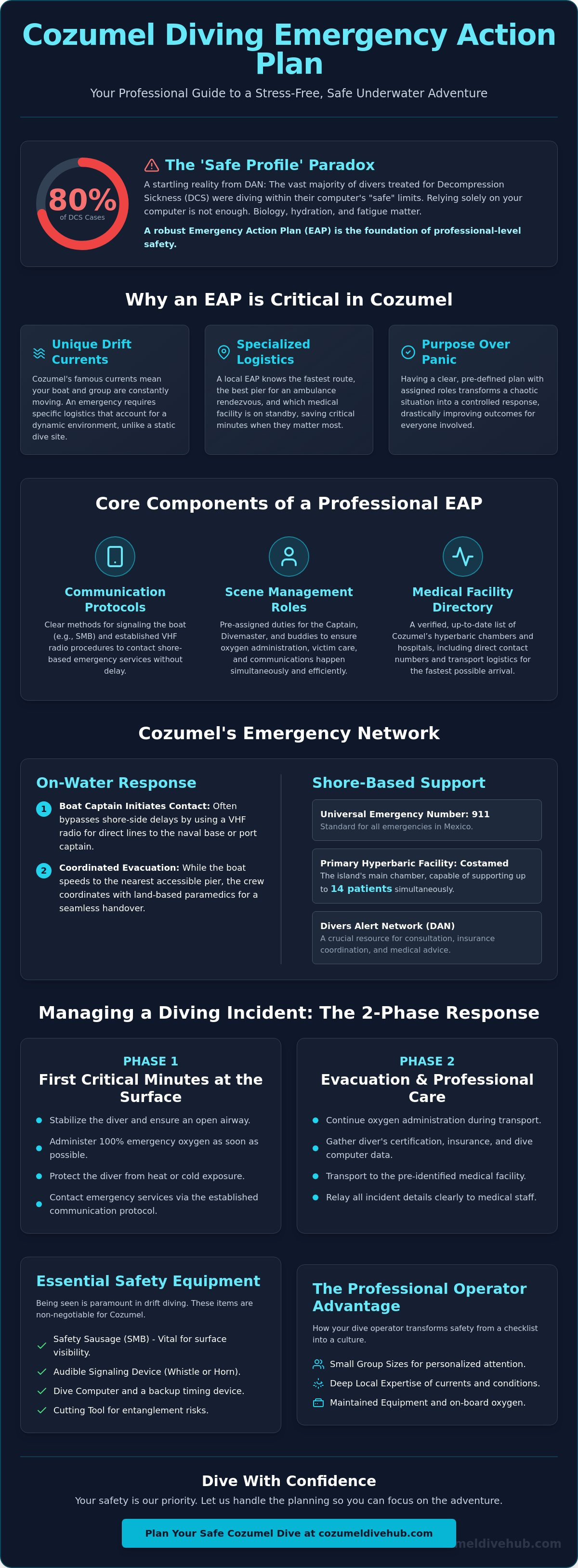
You might be thinking, "I follow my computer and stay within my limits, so I'm safe, right?" This brings us to the 'Safe Profile' paradox. Data from the Divers Alert Network (DAN) reveals a startling reality: roughly 80% of divers treated for Decompression Sickness (DCS) were actually diving within their computer's safe limits. Doing everything "right" doesn't guarantee zero risk. Biology, hydration, and fatigue all play a role. Because of this, building a robust emergency action plan for cozumel diving is the foundation of professional-level safety.
Cozumel’s famous drift currents add another layer of complexity. While flying over the reef feels like soaring through space, it means your boat is moving, your group is moving, and the nearest help might be across a powerful current. Managing an Underwater diving emergency in these conditions requires specific logistics that you won't find in a standard textbook. Preparation isn't about being scared; it's about being powerful. When you have a clear plan, you replace panic with purposeful action, which drastically improves outcomes for everyone involved.
The Core Components of a Professional Dive EAP
- Communication Protocols: Clear methods for signaling the boat from the surface and established radio procedures to contact shore-based EMS.
- Medical Facility Directory: A pre-verified list of Cozumel’s hyperbaric chambers and hospitals, including exact transport logistics for the fastest arrival.
- Scene Management Roles: Designated duties for the captain, divemaster, and buddies to ensure oxygen administration and victim care happen simultaneously.
Cozumel Diving Safety: Beyond the Certification
Your scuba diving Cozumel journey is just beginning once you get your C-card. Local knowledge is what separates a tourist from a savvy explorer. A 'standard' EAP might just list 911, but a 'Cozumel' EAP knows which dock is best for an ambulance meeting and which chamber is currently on standby. An EAP serves as the essential bridge between a sudden incident and a successful medical recovery. We believe that by sharing this local expertise, we can keep our community safe and our reefs full of happy, confident divers.
Cozumel’s Emergency Network: Hospitals, Chambers, and EMS
Cozumel is world-famous for its underwater beauty, but what truly makes it a premier destination is the world-class medical support backing every descent. When you're crafting an emergency action plan for cozumel diving, you aren't just looking for phone numbers. You're tapping into a sophisticated network of specialists. In Mexico, the universal emergency number is 911. However, when you're out on the water, your boat captain will often initiate contact via VHF radio or direct lines to the naval base to bypass any shore-side delays.
Speed is everything. If an incident occurs on the southern reefs like Colombia or Punta Sur, the journey back to town involves a coordinated effort between the boat crew and land-based paramedics. This is why following a framework for Effective Emergency Action Plans to create your own emergency action plan for cozumel diving is so vital. It ensures that while the boat is racing to the nearest accessible pier, the hospital is already prepping the chamber. DAN (Divers Alert Network) plays a huge role here too. They act as the primary coordinator for medical evacuations and insurance verification, making sure the focus stays on your recovery, not the paperwork.
Hyperbaric Chambers in Cozumel: Where to Go
The island is home to some of the most advanced hyperbaric facilities in the Caribbean. Costamed is a major pillar of this network. It boasts a large multi-place chamber that can treat up to 14 patients simultaneously and reach pressures of 6 ATA. This facility is renowned for its specialized dive medicine staff. Another excellent option is CMC (Centro Medico de Cozumel), which provides comprehensive emergency care and modern hyperbaric services. Before you head out, always verify the current operational status of these chambers with your Cozumel dive operator. Knowing which facility is on standby for the day can save precious minutes.
Essential Contact Directory for Divers
Keep these numbers saved in your phone and written on a waterproof card in your gear bag. For immediate marine assistance, Rescate Maritimo (the local Coast Guard) is the gold standard for sea-to-shore coordination. You should also keep the DAN Emergency Hotline (+1-919-684-9111) as a top priority. Many divers find that hiring private dive guides offers an extra layer of security. These local experts carry their own pre-verified contact lists and have deep relationships with the medical teams on the island. If you're looking for a team that prioritizes these protocols, consider booking your next Scuba Diving Trips in Cozumel with experts who know the island's network inside and out.
Step-by-Step: Managing a Diving Incident in Cozumel Waters
When the unexpected occurs in our vibrant turquoise waters, every second counts. Navigating an incident in Cozumel requires a specialized approach because of our unique drift currents and the distance from the southern reefs to the downtown medical facilities. This is where your emergency action plan for cozumel diving transforms from a theoretical concept into a life-saving sequence of events. We focus on the 'Golden Hour,' which is the critical sixty-minute window following an injury where medical intervention is most effective at preventing long-term damage.
Managing a diving incident follows three distinct phases. First, Phase 1 is Recognition and Rescue. In our fast-moving currents, identifying a distressed diver early is vital before they drift away from the group. Once the diver is back on the boat, we're in Phase 2: Surface Stabilization and Oxygen Administration. It's the moment to deploy the O2 kit and begin immediate care. Finally, Phase 3 is Shoreward Transport and EMS Handover. While the captain pushes the engines to reach the nearest pier, the crew coordinates with land-based paramedics to ensure a seamless transition to the hospital.
Immediate Surface Response and First Aid
Providing care on a moving dive boat is a challenge that requires practice and a steady hand. If a diver is non-responsive, beginning rescue breaths or CPR immediately is the priority, even as the boat begins its transit. We always perform a rapid neurological assessment to check for alertness, motor skills, and sensory perception while waiting for EMS. Administering 100% oxygen is the non-negotiable standard for any suspected diving injury. High-flow O2 helps wash out excess nitrogen and is the single most important step you can take on the boat.
Scene Management and Communication
A professional response depends on clear roles. In the heat of the moment, the crew must divide tasks effectively to avoid confusion. One person talks to the captain to coordinate the shore-side meeting, another manages the O2 delivery, and a third records vital data and event times. We also make it a point to gather the injured diver's computer and gear immediately. The dive computer is a 'black box' for doctors treating DCS. It provides the exact depth and time profiles that help hyperbaric specialists determine the most effective treatment table for the patient. By keeping your emergency action plan for cozumel diving organized and role-based, you ensure the focus remains exactly where it should be: on the well-being of our fellow explorer.
Prevention and Preparation: Equipment Standards for Cozumel
We believe that a legendary dive starts long before you roll off the boat. Prevention is the ultimate dive buddy, and it serves as the foundation for any professional emergency action plan for cozumel diving. While we always hope for the best, we prepare for the unexpected by ensuring our gear and our bodies are ready for the challenge. This starts with a 'Safe Profile' checklist. In our warm, tropical climate, staying hydrated and well-rested is just as critical as monitoring your depth. We always suggest setting your dive computer to a conservative setting to account for the physical exertion of our steady drift currents.
The equipment on your vessel makes all the difference when seconds count. When you compare a standard boat to a private dive charter, you'll often find higher safety standards and more redundant systems. It’s about more than just having the gear; it's about having a crew that knows exactly how to use it. A truly robust emergency action plan for cozumel diving requires that every piece of equipment is maintained to the highest professional standards.
The Essential Boat Safety Checklist
- Oxygen Supply: We ensure there is enough medical-grade O2 to support a diver for the entire transit time from the furthest southern reefs back to the downtown piers.
- Communication: While cell signals are great in town, they often drop out on the south side. A high-quality VHF marine radio is a non-negotiable tool for contacting the naval base or EMS.
- Emergency Spare Gear: Our boats carry backup masks, regulators, and extra Surface Marker Buoys (SMBs) to ensure no one is left vulnerable due to a simple gear failure.
Drift Diving Specifics: Preventing Separation
Cozumel is the drift diving capital of the world, and that means staying together is our top priority. The most vital piece of personal safety gear you can carry is a high-visibility 'Safety Sausage' or SMB. If you become separated from the group at the surface, a tall, bright buoy is what helps the captain spot you among the waves. We also highly recommend audible signaling devices like whistles or a DiveAlert that connects to your low-pressure inflator hose. Because the water is always moving, Cozumel beginner diving groups must stay much tighter than in static water environments. This proximity allows your guide to react instantly if you need assistance, keeping your underwater journey focused on the beauty of the reef rather than the stress of separation.
Ready to experience the reefs with a team that puts your safety first? Book one of our Scuba Diving Day trips and dive with the peace of mind that only true local expertise can provide!
Diving with Confidence: How Cozumel Dive Hub Prioritizes Safety
We believe that the most exhilarating underwater adventures are built on a foundation of absolute trust. When you dive with us, you aren't just a customer; you're part of our island family. Our philosophy is simple: small groups lead to better safety. By limiting our groups to just 6 to 8 divers, our guides can provide the personalized attention that is often lost on larger "cattle boats." This intimacy allows us to monitor your air, your comfort level, and your position in the current with eagle-eyed precision. Our professional emergency action plan for cozumel diving isn't just a protocol we follow; it's a commitment we make to every member of our dive family before we ever leave the dock.
The Cozumel Dive Hub safety promise is woven into every trip we organize. We ensure that high-flow O2 kits, fully stocked first aid supplies, and redundant communication tools are on every vessel. But gear is only half the story. The real strength of our safety net lies in our team's emergency response expertise and our deep-rooted connection to this island. We invite you to join a community where the thrill of the drift is always balanced by the highest standards of professional care.
Our Local Roots, Your Safety Net
Our team’s lifelong connection to these reefs informs every aspect of our safety protocols. We don't just know the coordinates of the dive sites; we know the names of the captains on the neighboring boats and the doctors waiting at the chamber. When minutes matter, these relationships are invaluable. Whether you're diving with local experts like Manuel or Sofia, you're benefiting from decades of collective knowledge. We know exactly which pier offers the fastest ambulance access from Palancar and which hyperbaric team is on standby. This local heritage transforms our emergency action plan for cozumel diving from a list of steps into a seamless, coordinated response that you can rely on.
Take the Next Step in Your Dive Journey
Safety is a skill that grows with experience. If you’re looking to sharpen your abilities and become a more confident buddy, consider enrolling in an Advanced Open Water Cozumel course. This training expands your understanding of deep diving and navigation, making you a more capable explorer in our unique environment. We encourage every diver to book with a shop that puts EAP protocols front and center. By choosing a partner that prioritizes preparation, you're free to focus on the vibrant corals and dancing sea turtles that make our island so special. Remember, safety is the silent partner of every great dive.
Your Journey to Worry-Free Exploration Starts Here
Mastering the protocols of a professional emergency action plan for cozumel diving is what transforms a good trip into a legendary one. We've explored how Cozumel's advanced medical network and the 'Golden Hour' response are designed to keep you safe. You now have the local knowledge to navigate our stunning drift currents with the confidence of a seasoned pro. Preparation isn't just about technical safety; it's about opening the door to pure, uninterrupted adventure.
At Cozumel Dive Hub, we live for the thrill of the reef. Our DAN-trained professional guides are dedicated to your well-being, using a small group focus to provide maximum safety monitoring on every single descent. Our boats are fully equipped with emergency O2 and AEDs, ensuring that every detail is handled so you can focus on the vibrant sea life. We're ready to show you the magic of our underwater world with the personalized care and local expertise you deserve!
Book Your Safe and Enthusiastic Cozumel Dive Adventure Today!
We can't wait to welcome you to our island family and share the breathtaking beauty of the Caribbean together. Your next epic chapter underwater is waiting. See you in the blue!
Frequently Asked Questions
What is the primary emergency number for diving accidents in Cozumel?
The primary universal emergency number in Mexico is 911. While this connects you to local dispatch, most professional dive boat captains will use a VHF radio or direct lines to the naval base to bypass shore-side delays. It's a critical part of a professional emergency action plan for cozumel diving to ensure the fastest possible response from marine rescue teams during those first few minutes.
Are there hyperbaric chambers on the island of Cozumel?
Yes, Cozumel is home to world-class hyperbaric facilities! We have multiple chambers on the island, including the large multi-place chamber at Costamed which can treat up to 14 patients at once. These facilities are staffed by medical specialists who deal with diving-related medicine every single day. You're in the best possible hands if an incident occurs while exploring our vibrant reefs.
Does DAN insurance work at Cozumel hospitals?
Absolutely! DAN (Divers Alert Network) insurance is widely recognized and accepted at the major medical facilities on the island. Having this insurance makes the process of verification and medical evacuation much smoother. It acts as your primary safety net, ensuring that the focus remains entirely on your recovery and treatment rather than the administrative logistics of the hospital or chamber.
What should I do if I suspect DCS after a dive in Cozumel?
If you suspect Decompression Sickness, you should immediately stop all diving activities and begin breathing 100% medical-grade oxygen. Notify your dive guide or boat captain right away so they can activate the emergency action plan for cozumel diving. You should also contact the DAN emergency hotline at +1-919-684-9111 to coordinate with medical specialists who can guide your next steps for treatment.
Which Cozumel hospital is best for diving-related injuries?
Costamed and CMC (Centro Medico de Cozumel) are the top choices for diving-related injuries on the island. Both hospitals feature modern hyperbaric chambers and specialized medical teams with extensive experience in dive medicine. We always recommend checking with your dive operator before your trip to see which facility is currently on standby, as this can change based on maintenance or staffing schedules.
Can I dive in Cozumel if I don't have dive accident insurance?
You can technically dive without specific accident insurance, but we strongly advise against it! Emergency hyperbaric treatments can cost between $5,000 and $10,000 USD per session. Without insurance like DAN, you may be required to pay these costs upfront. Investing in a policy is a small price to pay for the incredible peace of mind it brings to your underwater adventures in Mexico.
How do dive boats in Cozumel communicate with emergency services?
Dive boats primarily use high-powered VHF marine radios to communicate with the naval base and other nearby vessels. While cell phones work well near the downtown area, signals can be spotty on the remote southern reefs. Professional crews also maintain direct phone lines to the hyperbaric chambers and local EMS to ensure they can provide a detailed report before the boat even reaches the pier.
What are the symptoms of DCS that I should watch for in my EAP?
Keep a close eye out for joint pain, unusual fatigue, numbness, tingling, or a marbled skin rash. Symptoms can also include dizziness or shortness of breath. These signs can appear immediately or several hours after a dive. Including a clear list of these symptoms in your emergency plan ensures that everyone in your group knows exactly when to stop and seek professional medical help.