

Flying After Diving in Cozumel: The Essential 2026 Safety Guidelines
Imagine you are standing on the white sands of Cozumel on your final morning, staring at the mesmerizing turquoise horizon and wondering if one last 45 minute dive at Palancar Gardens is worth the risk. You aren't alone in this struggle. With over 300,000 divers visiting our island every year, the pressure to squeeze every second out of the Caribbean is intense. We understand that "one last tank" feeling perfectly, but following the correct flying after diving cozumel guidelines is the only way to ensure your adventure ends on a high note. It's hard to stay topside when the world's second largest barrier reef is calling, but your safety is always the priority for our local family here at Cozumel Dive Hub.
You want to enjoy every moment of your vacation without the looming fear of decompression sickness or the confusion of conflicting clock rules. This guide will help you master the essential safety protocols for 2026 so you can maximize your bottom time while keeping your body healthy for the flight home. We'll clarify the science behind the 12, 18, and 24 hour rules using the latest Divers Alert Network data. You will also discover the best local "dry" adventures to keep the excitement going after your gear is packed away. Your safe, thrilling underwater journey starts right here.
Key Takeaways
- Understand the science of nitrogen off-gassing so you can confidently plan your final dives without compromising your health.
- Master the essential flying after diving cozumel guidelines to ensure you leave the perfect 12 to 24-hour safety buffer before heading home.
- Learn how local factors like hydration and physical exertion can impact your DCS risk during your post-dive recovery.
- Navigate the logistics of CZM versus CUN flights and discover if the ferry ride to the mainland affects your mandatory surface interval.
- Transform your "no-fly" time into an epic adventure by exploring Mayan ruins or cruising the breathtaking "Other Side" of the island.
The Science of Bubbles: Why You Can't Fly Right After Diving
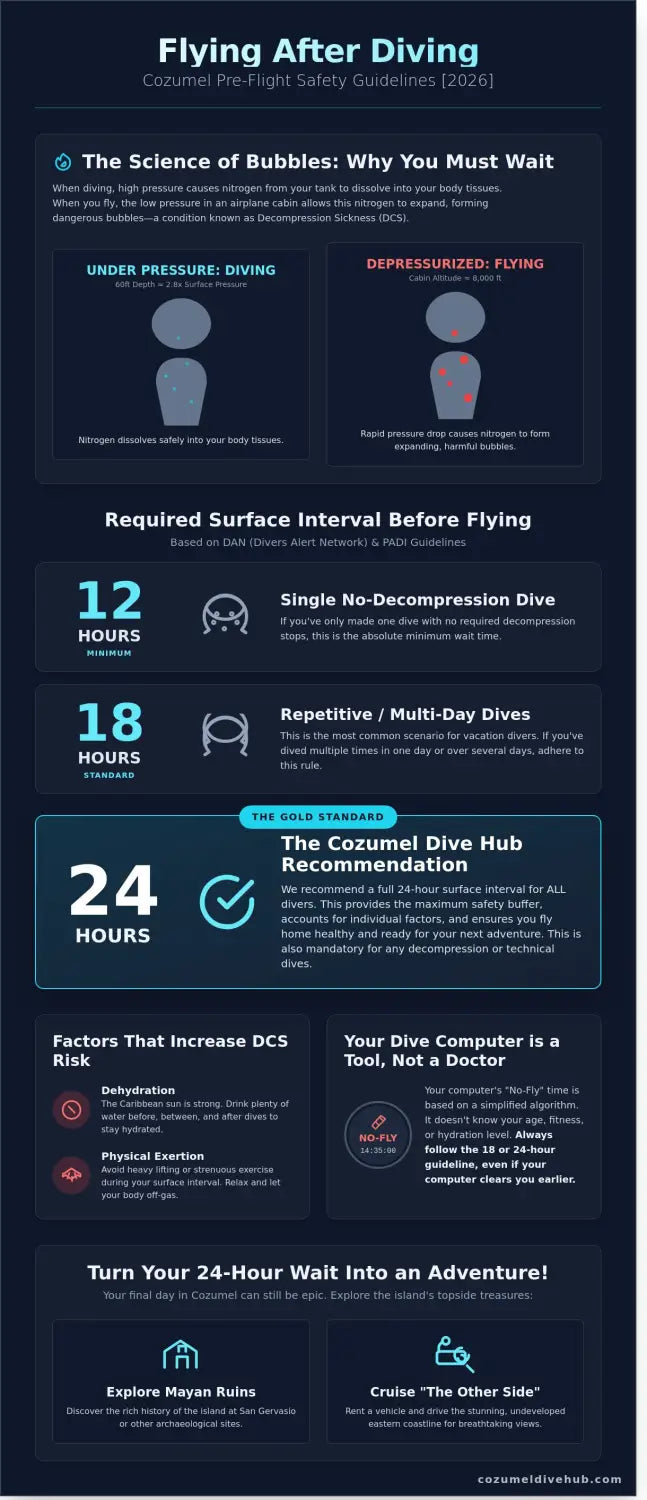
Welcome to the family! We want your 2026 underwater journey to be as safe as it is thrilling. When you descend into the crystal-clear waters of the Caribbean, your body experiences Boyle’s Law firsthand. At a depth of 60 feet, the pressure is 2.8 times higher than at the surface. This causes the nitrogen in your tank to dissolve into your body tissues. It’s a natural part of the adventure, but your body needs time to reset once you’re back on the boat. Understanding The Science of Bubbles: Why You Can't Fly Right After Diving is the first step in planning your trip.
Think of your body like a bottle of champagne. While you're under pressure, the bubbles stay dissolved in the liquid. If you pop the cork too fast by heading to 30,000 feet in a plane, those bubbles expand rapidly. This is why following the flying after diving cozumel guidelines is vital for every diver. Even after you surface, your body continues to work. Off-gassing is the gradual release of nitrogen from tissues back into the blood and lungs.
What is Decompression Sickness (DCS)?
DCS occurs when nitrogen bubbles form in your bloodstream or joints. You might feel a dull ache in your shoulders, notice a patchy red skin rash, or experience sudden dizziness. These symptoms often wait until you reach a cruising altitude of 30,000 feet to appear because the lower pressure allows bubbles to grow. Always be 100% honest with Memo or your divemaster about your flight time. We want you back in the water for your next vacation, not in a hyperbaric chamber!
Atmospheric Pressure vs. Ocean Pressure
The air on a plane is very different from the air in San Miguel. Most commercial aircraft maintain a cabin pressure equivalent to 8,000 feet above sea level. This represents a 25% drop in pressure compared to the beach. This sudden change can trigger residual nitrogen to expand. When you follow the flying after diving cozumel guidelines, you give your body the 18 to 24 hours it needs to reach equilibrium. Your safety is our top priority! We can't wait to see you in the water.
The 2026 Guidelines: How Long Should You Wait?
Ready to head to the airport after exploring the vibrant walls of Santa Rosa? Hold that boarding pass for just a second. Following the latest flying after diving cozumel guidelines ensures your nitrogen levels return to a safe baseline before you hit 30,000 feet. While the thrill of our drift dives is addictive, your body needs time to off-gas properly. The 2026 safety protocols remain rooted in rigorous research from PADI and DAN, but we always add a local layer of caution for our guests.
Standard Wait Times by Dive Profile
Your countdown depends entirely on your underwater itinerary. If you squeezed in a single no-decompression dive on your last morning, the industry minimum is 12 hours. However, most travelers visiting us for a week of adventure fall into the repetitive dive category. For anyone doing multiple dives over several days, the standard wait time jumps to 18 hours. If you are a technical diver pushing limits with decompression stops, 24 hours is your mandatory minimum. Medical experts at the NCBI highlight several Factors That Increase Your DCS Risk While Flying; these include dehydration from the Caribbean sun and physical exertion during your surface interval.
Why Your Dive Computer Isn't the Final Word
Your Garmin Descent or Shearwater Teric is a piece of engineering magic, but it isn't a doctor. Most modern computers display a "No Fly" icon, yet these icons often rely on simplified algorithms. These devices don't account for your specific physiology or how much water you drank between tanks. We often see divers with conservative settings on their Perdix units seeing a 14-hour countdown, while medical guidelines suggest 18. At Cozumel Dive Hub, we always err on the side of caution for our Dive Hub Family. We recommend a full 24-hour window regardless of what your screen says. This "Gold Standard" gives you a massive safety buffer, letting you relax at a beach club on your final day without a worry in the world. You can even use that extra time to plan your next underwater journey with Memo and the team.
- Single Dive: 12-hour minimum (best for quick trips).
- Repetitive/Multi-Day: 18-hour standard (the vacationer's rule).
- The Gold Standard: 24 hours (the Cozumel Dive Hub recommendation).
Safety is the heartbeat of everything we do. By giving your body that extra time, you ensure your flight home is as comfortable as your time on the reef. Don't rush the process; the ocean will be here waiting for your return.
Factors That Increase Your DCS Risk While Flying
You’ve spent your week gliding over the breathtaking walls of Santa Rosa and exploring the vibrant reefs of Cozumel. It’s been an unforgettable journey! But before you check in at the airport, you need to understand that feeling "fine" isn't a 100% guarantee of safety. Microscopic nitrogen pockets, often called "silent bubbles," can exist in your bloodstream without causing any pain while you are at sea level. These bubbles only become a problem when the cabin pressure drops during your flight. Adhering to the flying after diving cozumel guidelines is about managing these invisible risks so your vacation ends on a high note.
The Role of Hydration and Alcohol
Hydration is your best friend in the Caribbean heat. When you’re dehydrated, your blood thickens, which significantly slows down the nitrogen elimination process. This makes it harder for your body to "off-gas" before you reach the 30,000-foot mark. We love a sunset margarita at the local square, but we always tell our Dive Hub family to use the one-for-one rule: drink 8 ounces of water for every alcoholic beverage you consume. Alcohol is a vasodilator that can alter the rate of nitrogen elimination. Staying hydrated ensures your circulatory system stays efficient and ready for the journey home.
Temperature and Fitness
Cozumel’s water stays a balmy 82°F year-round. This warmth increases your peripheral circulation, meaning your body might actually absorb nitrogen more readily than it would in 60°F water. Once you’re out of the ocean, your post-dive habits matter just as much as the dive itself. Avoid these common pitfalls:
- Hot Tubs and Saunas: Jumping into a 104°F hotel hot tub immediately after a dive can cause nitrogen to come out of solution too quickly, forming bubbles.
- Heavy Workouts: Crushing a gym session within 24 hours of your flight increases blood turbulence. This physical stress can trigger the growth of those silent bubbles.
- Physical Exertion: Carrying heavy luggage or sprinting to a gate at the airport can also spike your risk levels.
Individual Physiology
Every body processes nitrogen differently. Divers over the age of 45 or those with a BMI over 30 often retain nitrogen longer because fatty tissue holds gas more readily than muscle. If you have a previous joint injury from five years ago, that area might have restricted blood flow, making it a "trap" for nitrogen. To stay safe, always consult the Divers Alert Network (DAN) guidelines, which suggest a minimum 18-hour surface interval for repetitive dives. For maximum safety, our team recommends waiting a full 24 hours before you fly.
Understanding how your body reacts to different pressure environments is key to any adventure sport. Just as divers manage nitrogen at depth, mountaineers manage oxygen at altitude. If you're curious about high-altitude challenges, you can learn more about Summit Expeditions and their expert-led trips.
Cozumel Travel Logistics: CZM vs. CUN Flights
Flying out of Cozumel International Airport (CZM) is the ultimate way to end your trip. You are only a 15-minute taxi ride from the dive shop to the terminal. It is simple, fast, and keeps your stress levels at zero. However, about 60% of our guests choose to fly into Cancun (CUN) to take advantage of more frequent international connections. If you're heading to CUN, you need to plan for a 45-minute ferry ride and a 1-hour van trek through the jungle. Staying hydrated is vital during this transit. Bring a reusable water bottle and sip constantly to help your body process nitrogen efficiently while you travel.
The Ferry Crossing to Playa del Carmen
There's a common myth that the ferry ride to the mainland affects your nitrogen levels. Let's clear that up right now! The ferry stays at sea level, so it doesn't change the pressure on your body at all. You aren't "going to altitude" when you cross the channel. The real concern is the flight that follows once you reach the airport. We suggest taking the early ferry to avoid rushing. High stress and a racing heart rate aren't ideal when your body is off-gassing. Sit back, feel the Caribbean breeze, and enjoy the view of the coastline one last time.
Scheduling Your Last Splash
To follow the safest flying after diving cozumel guidelines, we suggest the 24-hour rule for all multi-day dive trips. If your flight departs at 2:00 PM on Sunday, you should be out of the water by 2:00 PM on Saturday. We recommend our 9:00 AM Palancar Reef departure for your final day. This gets you back to the pier by 12:30 PM, giving you a generous safety buffer before you head to the airport the next day.
- Day 1 to 5: Enjoy your morning two-tank dives on our vibrant reefs.
- Day 6: Complete your final dive by noon. Use the afternoon to rinse your gear in fresh water and let it sun-dry.
- Day 7: Relax, log your last sightings, and head to CZM or CUN for your flight home.
Don't leave your safety to chance. Memo and our professional team are experts at syncing your dive schedule with your departure time. We'll help you calculate your surface interval so you can dive with total peace of mind. Ready to plan your perfect underwater week?
24 Hours of Dry Fun: What to Do in Cozumel While You Off-Gas
You've finished your final safety stop and climbed back onto the boat with a huge smile. Now, the 24-hour clock starts ticking. Following the flying after diving cozumel guidelines doesn't mean your vacation is over. It simply means the adventure moves from the reefs to the jungle. Cozumel offers 189 square miles of vibrant land to explore while your body safely releases nitrogen. It's the perfect time to see the island from a different perspective.
Top Land Adventures for Divers
- San Gervasio: Visit the San Gervasio Mayan Ruins, the island's most significant archaeological site dating back to 600 AD. You can walk through ancient plazas dedicated to Ixchel, the goddess of fertility. It's a peaceful way to soak up 1,400 years of history without any pressure on your ears.
- Punta Sur Eco Park: Head to the southern tip where this 2,500-acre reserve sits. Climb the 133 steps of the Celarain Lighthouse for a 360-degree view of the Caribbean blue. Afterward, watch for American crocodiles from the wooden boardwalks of Colombia Lagoon.
- The Wild Side: Rent a beach buggy and drive the 15-mile coastal road on the "Other Side." There's no electricity here, just rugged limestone shores and crashing waves. Don't forget to stop at a local beachfront cafe in San Miguel for a fresh coconut as the sun dips below the horizon.
- Shopping: Spend your afternoon in downtown San Miguel. Look for authentic Mexican crafts or pick up a bottle of organic Yucatecan vanilla. It's a great way to support the local community that makes our island so special.
That 'end of vacation' feeling often sparks ideas for the next big trip. For divers who love exploring new coastlines, New Zealand offers a completely different world of underwater and topside adventures. When you're ready to plan that journey, you can explore Short-term accommodation to find the perfect base for your travels.
Relaxation and Prep
A professional massage is the ultimate post-dive treat. A 60-minute session helps stimulate circulation and lymphatic drainage, which supports your body's natural recovery process. Many local spas offer "diver-specific" treatments that focus on the back and shoulders where your gear sits.
Before you pack your bags, join us at Cozumel Dive Hub for a final logbook session. Our founder, Memo, and the rest of the crew love seeing your underwater photos from the week. Sharing stories with the Dive Hub family is the best way to wrap up your journey. We'll help you double-check your surface intervals to ensure you're sticking to the flying after diving cozumel guidelines for a safe trip home.
Plan Your Perfect Surface Interval in Paradise
Safety under the waves starts with a smart plan on land. Stick to the 24 hour off-gassing window after your final submerged breath to stay well within the 2026 safety margins. Whether you're exploring the 40 foot shallow reefs or the 90 foot walls of Santa Rosa, tracking your nitrogen is vital. Mastering the flying after diving cozumel guidelines lets you relax at a local beach club while your body safely resets for the flight home. Our crew consists of born and raised local guides who understand the unique pressure changes of Cozumel's deep currents. We keep our groups small, usually 6 divers or fewer, so we can provide the personalized attention your safety deserves. We don't just lead dives; we share our home with you. You've got the knowledge to stay safe, so now it's time to experience the magic of the Caribbean. Let's make some bubbles together!
Join the Dive Hub Family—Book Your Cozumel Adventure Today!
Frequently Asked Questions
Can I fly 12 hours after a single dive in Cozumel?
Yes, you can fly 12 hours after a single no-decompression dive according to DAN standards. While 12 hours is the absolute minimum, we recommend waiting longer to be safe. Most Divers Alert Network (DAN) studies from 2002 suggest this window for single dives. Since Cozumel's reefs are so mesmerizing, you'll likely do more than one! Always check your computer for the no fly icon before heading to the airport.
Is it safe to take the ferry to Playa del Carmen right after diving?
Yes, taking the Ultramar or Winjet ferry to Playa del Carmen is perfectly safe because you remain at sea level. The crossing takes approximately 45 minutes and doesn't involve any significant altitude changes that would trigger decompression sickness. You can enjoy the ocean breeze right after your morning boat trip. Just avoid driving into high-altitude areas like Mexico City or crossing mountain ranges immediately after your arrival on the mainland.
What should I do if I feel DCS symptoms while on my flight?
You must immediately notify the flight crew and ask for emergency oxygen if you feel DCS symptoms like joint pain or tingling. Breathing 100 percent oxygen can reduce symptoms by up to 50 percent during the flight. Once you land, contact DAN at +1-919-684-9111 or head to the nearest emergency room. Don't ignore these signs; prompt treatment in a hyperbaric chamber is the only way to resolve nitrogen bubbles safely.
Does breathing 100% oxygen on the boat help me fly sooner?
No, breathing pure oxygen on the boat does not change the standard flying after diving cozumel guidelines or shorten your wait time. While supplemental oxygen helps wash out nitrogen, it's not a shortcut to the airport. Safety is our top priority at the Dive Hub. You still need to wait the full 18 to 24 hours after multiple dives to ensure your body has off-gassed naturally before cabin pressure changes.
Why does DAN recommend 18-24 hours while some computers say 12?
DAN recommends 18 to 24 hours because their 2002 consensus guidelines prioritize a wider safety margin for the general population. Dive computers use specific algorithms like Buhlmann ZHL-16C, which might show 12 hours based on your exact depth and time. We always suggest following the more conservative 24 hour rule. It's better to spend one more day enjoying Cozumel's beaches than to risk a DCS hit at 30,000 feet.
Can I go skydiving or ziplining in Cozumel right after scuba diving?
You can go ziplining since Cozumel's highest point is only 49 feet above sea level, but you must never go skydiving right after a dive. Skydiving involves rapid ascent to altitudes over 10,000 feet, which is extremely dangerous for a diver with residual nitrogen. Wait at least 24 hours before any high-altitude activity. Stick to the island's vibrant jungle tours or beach clubs for your post-dive afternoon instead.
What is the closest hyperbaric chamber in Cozumel if I feel unwell?
The SSS Network chamber at Costamed Medical Center is the primary facility for divers in Cozumel. It's located on Calle 11, just a few minutes from the main piers. There are 3 active chambers on the island to ensure 24 hour emergency coverage. If you feel unwell after a dive, our team will help you get there immediately. Having world-class medical facilities nearby is one reason why Cozumel is a top-tier diving destination.
Does Nitrox change the flying after diving guidelines?
No, using Enriched Air Nitrox doesn't change the standard flying after diving cozumel guidelines. Even though you absorb less nitrogen when using a 32 percent or 36 percent oxygen mix, the 18 to 24 hour surface interval still applies. Nitrox is a fantastic tool to make your dives safer and leave you feeling less tired. However, it doesn't grant you an early pass to board your flight back home.
While most dive operators prioritize safety, accidents can happen due to faulty equipment or inadequate supervision. In the tragic event of a severe incident, families may need to understand their legal options. For such situations, consulting with experienced Drowning Accident Lawyers is a crucial step in seeking justice and support.