

How Deep Are Cozumel Reefs? A Diver’s Guide to Depth and Marine Life
What if the most breathtaking marine life in the Caribbean isn't hidden in the dark depths, but is actually soaking up the sun just 20 feet below the surface? It's natural to feel a bit of "depth envy" when you hear stories about massive wall dives, and many divers arrive asking how deep are cozumel reefs because they're afraid of missing out on the best sights. You might even feel a little anxious about your ears equalizing as the pressure builds on a deeper descent. You want to experience every ounce of magic this island offers without feeling like a certification limit or a physical hurdle is standing in your way.
We have some exciting news for your next underwater journey. Whether you're at 30 feet or 90 feet, the marine life here is absolutely spectacular. In this guide, you'll discover the exact depths of our legendary sites and why your most memorable dive might actually happen in just 15 feet of crystal-clear water. We'll break down the difference between dramatic wall drops and lush shallow gardens so you can book your next trip with the Cozumeldivehub family with total confidence. Get ready to explore the vibrant colors of our home!
Key Takeaways
- Understand the unique "drop-off" topography of the Mesoamerican Barrier Reef and why Cozumel is world-famous for its breathtaking vertical walls.
- Debunk the myth that deeper is better by discovering how sunlight and photosynthesis create the most vibrant coral displays in the island's shallower reaches.
- Get a site-by-site breakdown of how deep are cozumel reefs to help you choose the perfect dive spot for your skill level and interests.
- Learn how your certification level dictates your maximum depth and why these safety boundaries actually enhance your overall adventure.
- Discover how Memo and the Cozumel Dive Hub team personalize your journey to ensure you find the most mesmerizing marine life at your ideal comfort zone.
Understanding Cozumel’s Reef Topography: From Shallows to Walls
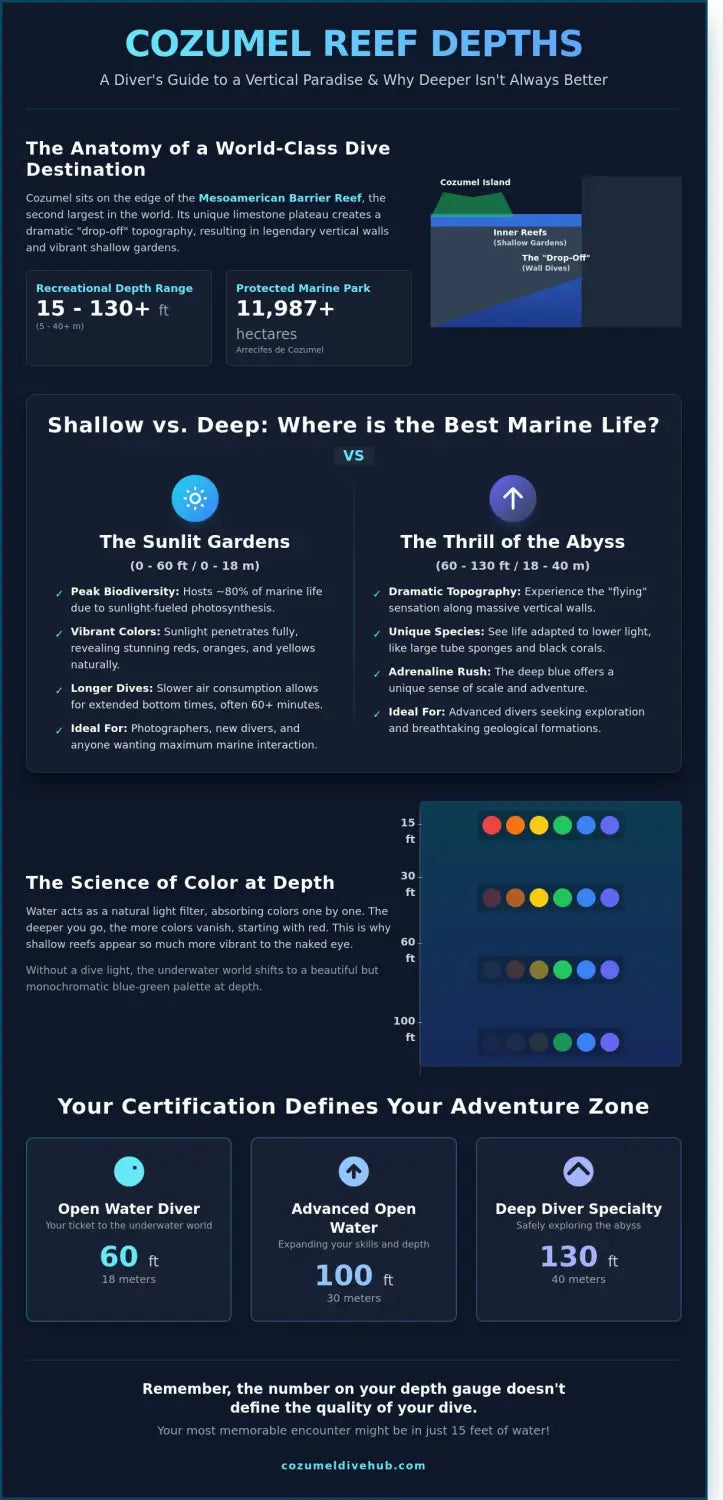
Ready to dive into paradise? Our island sits like a crown jewel atop a massive undersea limestone plateau. This isn't just any rock; it's a vital part of the Mesoamerican Barrier Reef, the second largest reef system on the planet. Most of our favorite sites are protected within the Arrecifes de Cozumel National Park, which covers over 11,987 hectares of vibrant marine life. Here, the shelf drops away into the deep blue, creating the legendary walls that put Cozumel on every diver's bucket list. It's a breathtaking landscape that changes with every kick of your fins.
So, how deep are cozumel reefs exactly? For recreational divers, the depth typically ranges from 15 to 130+ feet. This specific range ensures that everyone from a first-time bubblemaker to a seasoned divemaster finds their perfect depth. Whether you want a shallow 30-foot drift or a deep wall exploration, we have it all right here in our backyard. Our local geography splits the diving into two distinct worlds. Inner reefs are found closer to the shore, where the water is calm and the sunlight is intense. Outer reefs are located further out, where the limestone plateau ends abruptly. This is the "drop-off" point. It's where the island's foundation falls away into the deep ocean. It's a thrilling sight that makes Cozumel one of the top drift diving destinations in the world.
Our founder, Memo, was born and raised on these shores, and he's seen how the topography shapes every dive. The current acts like a conveyor belt, carrying you effortlessly past these ancient coral formations. It's a mesmerizing journey that combines the thrill of the abyss with the security of a professional guide. We make sure every guest feels like part of the Dive Hub family while exploring these pristine waters. Our goal is to make you feel the same passion for the ocean that we feel every single day.
The Anatomy of a Cozumel Wall Dive
Wall diving in Cozumel is an epic experience you'll never forget. These massive vertical structures usually begin their descent between 40 and 60 feet. As you drift along the edge, the wall plunges thousands of feet into the darkness of the Cayman Trench. It feels like you're flying over an underwater mountain range! You don't need to go to the very bottom to see the best parts. Most of the colorful tube sponges, black corals, and schooling jacks live in the top 60 to 80 feet where the sun still brings out the vibrant reds and oranges.
Shallow Coral Gardens: The Hidden Gems
Don't overlook our shallow sites; they are true hidden gems. These reefs sit in just 20 to 40 feet of water, making them a paradise for underwater photographers. Sites like Palancar Gardens and Yucab offer incredible visibility and long bottom times. You'll often spend over 60 minutes exploring these vibrant nurseries. Beginners love these spots because they provide a relaxed environment to practice buoyancy while surrounded by massive brain corals and swaying sea fans. Our team loves showing off these sites because the marine life is concentrated and the colors are simply stunning in the shallow light.
Shallow vs. Deep: Where is the Best Marine Life?
One of the most common myths we hear at the shop is that you have to go deep to see the best stuff. It's simply not true! In fact, some of the most mind-blowing colors and active critters live right near the surface. When people ask us how deep are cozumel reefs, they often assume that hitting 100 feet is a requirement for a great dive. However, about 80% of the island's marine biodiversity is actually concentrated in the top 60 feet of the water column.
Coral reefs are essentially massive underwater gardens that rely on photosynthesis to survive. Just like the plants in your backyard, hard corals need plenty of sunlight to grow and maintain their health. This means the shallowest parts of the reef are usually the most crowded with life. When you stay in that sweet spot above 60 feet, you're seeing the reef in its most energetic state. It's a bustling city of activity where every single crevice holds a surprise for those who take the time to look.
Color Absorption and Depth
Water acts like a giant filter for light. As you descend, the ocean absorbs colors one by one based on their wavelength. Red is the first to go, followed quickly by orange and yellow. By the time you reach 60 feet, most red colors are already filtered out by the water, leaving everything looking blue and moody. This is why a shallow reef at 30 feet looks significantly more vibrant than a wall at 90 feet unless you're carrying a high-powered torch to bring those colors back to life.
At 30 feet, the sunlight is still strong enough to reveal the brilliant purples of sea fans and the bright oranges of tube sponges. You get the full spectrum of the rainbow without needing extra lighting equipment. If you want those "National Geographic" style photos, the shallows are your best friend. The natural light creates a shimmering effect on the white sand and coral heads that you just won't find at deeper depths. Knowing how deep are cozumel reefs in specific areas helps you plan your photography and enjoy the natural scenery to its fullest.
Who Lives Where? Marine Life by Depth
Different species have different neighborhoods they call home. Depending on what is on your bucket list, we can help you choose the right depth for your dive to maximize your sightings.
- Shallows (15-40ft): This is the playground for hawksbill sea turtles, spotted eagle rays, and massive schools of juvenile reef fish. The sunlight makes the water warm and inviting, which these active species love.
- Mid-range (40-80ft): As the reef structure gets more complex with swim-throughs and overhangs, you'll find larger residents. This is where big black groupers, green moray eels, and sleepy nurse sharks like to hang out in the shadows.
- Deep (80ft+): This is a different world entirely. Down here, you'll find specialized deep reef marine life like ancient black corals and occasional visits from larger pelagic species like reef sharks or even a passing manta ray.
Whether you're a brand new diver or a seasoned pro with thousands of logs, there's no need to rush into the deep. Our team loves showing off the hidden gems in the shallows just as much as the dramatic drop-offs. If you're ready to see these incredible creatures for yourself, you can book your next dive adventure with our local experts who know exactly where the fish are hiding. Your adventure starts here, and we can't wait to welcome you into the Dive Hub family!
Cozumel Reef Depth Chart: A Site-by-Site Breakdown
Ready to jump in? Cozumel's underwater topography is a masterpiece of nature. One of the first questions our guests ask is how deep are cozumel reefs before they book their boat seat. The reality is that Cozumel offers a massive spectrum of depths. You can find shallow coral gardens at 25 feet or plummeting walls that vanish into the blue at 3,000 feet. Our local guides love showing off this variety because it means there's a perfect spot for every single person in our Dive Hub family.
We've organized the most requested sites into a quick reference guide. This helps you match your certification level with the adventure you're craving. Most of our "deep" sites actually have shallow sections on the reef crest, allowing for long, safe multi-level profiles.
- Palancar Gardens (30-70ft): Open Water level. Best for: Vibrant photography and massive brain corals.
- Santa Rosa Wall (40-130ft): Advanced level. Best for: High-speed drift diving and spotting eagle rays.
- Columbia Deep (60-90ft): Advanced level. Best for: Towering coral pillars and deep blue vistas.
- San Francisco Reef (35-50ft): Open Water level. Best for: Turtles, moray eels, and long bottom times.
- Paso del Cedral (35-60ft): Open Water level. Best for: Macro life and schools of grunts.
The Palancar Reef Complex Depths
Palancar is the crown jewel of our island. It's incredibly versatile. If you're looking for sunlight and color, Palancar Gardens sits comfortably between 30 and 70 feet. For those seeking a thrill, Palancar Caves drops you into the 60 to 100 foot range. You'll find the famous "Palancar bricks" concrete markers at exactly 80 feet. They were placed there decades ago to help divers navigate these stunning labyrinths. It's the ultimate playground for any skill level.
Famous Wall Dive Depths
Cozumel is legendary for its vertical drops. Santa Rosa Wall is the most famous. The reef crest starts at a mere 40 feet. This means even if you're on a "deep" dive, you can finish your safety stop while still watching colorful reef fish. Columbia Deep is where you'll see the most impressive architecture. Its massive coral pillars rise from the depths to about 60 feet. San Francisco Reef offers a different vibe. It's a steep slope that stays between 35 and 50 feet, making it perfect for a second dive of the day.
When you're planning your trip, don't worry too much about the technicalities. Our team, led by Memo, knows exactly where to take you based on the day's current and your comfort level. Understanding how deep are cozumel reefs is just the first step. The real magic happens when you're neutral, hovering alongside a wall that drops into the abyss while the Caribbean sun dances on the coral. It's an experience that stays with you forever. We can't wait to share these pristine reefs with you!
How Your Certification Level Dictates Your Dive Depth
Your certification card is more than just a piece of plastic; it's your passport to specific underwater zones. If you hold a PADI Open Water certification, your training limits you to 60 feet (18 meters). Divers who step up to the Advanced Open Water level earn the right to explore down to 100 feet (30 meters). These boundaries exist for your safety. They aren't meant to restrict your fun. Instead, they ensure you have the skills to handle increased pressure and faster air consumption. When asking how deep are cozumel reefs, remember that the ocean doesn't care about your ego. It cares about your preparation.
Safety is the primary driver behind these depth limits. As you go deeper, your body absorbs nitrogen faster. This increases the risk of decompression sickness if you don't follow your dive computer's instructions. You also face the possibility of nitrogen narcosis. This "rapture of the deep" can make you feel lightheaded or confused. It usually kicks in around 80 or 90 feet. By sticking to your certification level, you stay within a "safety envelope" where you can easily manage your gear and your breathing. You won't miss out on the magic by staying shallow. In fact, 80% of Cozumel’s marine life and the most vibrant coral colors live in the top 50 feet where sunlight is strongest.
Diving Cozumel as a Beginner
If you have fewer than 10 logged dives, Cozumel is the ultimate classroom. You'll spend most of your time on stunning shallow reefs like Yucab, Cardona, or Palancar Gardens. These sites offer incredible visibility and max out around 45 to 55 feet. One of the best parts about Cozumel is the drift. A steady current, often moving at 1.5 knots, carries you effortlessly over the reef. You cover more ground without ever needing to go deep. To ensure a great experience, equalize your ears every 3 feet during your descent. Don't wait until you feel pressure. If you equalize early and often, you'll avoid the ear squeeze that ruins a dive before it starts.
Going Deep: The Advanced Experience
Crossing the 60-foot threshold changes the game entirely. Your air consumption can increase by 50% compared to a shallow dive. This is where your training pays off. Advanced certification allows you to visit the C-53 Felipe Xicoténcatl. This 184-foot minesweeper was intentionally sunk in 1999 and sits at a maximum depth of 82 feet. It's a hauntingly beautiful site that requires excellent buoyancy to navigate. If you're looking for the ultimate thrill, the Advanced level also opens up the "Devil’s Throat" at Punta Sur. This famous tunnel starts at 90 feet and drops you out into the deep blue at 130 feet. It is an intense, bucket-list experience that demands total focus and calm breathing.
While the depth gauges are fun to watch, the best divers focus on their buoyancy and air consumption instead. Mastering your trim at 30 feet makes you a much better diver than struggling at 90 feet. When you stop worrying about how deep are cozumel reefs and start focusing on your breathing, the reef truly opens up to you. You'll see more fish, stay down longer, and finish every dive feeling energized rather than exhausted. Ready to see what the Caribbean has to offer? Come join our family and book your next Cozumel dive adventure with Memo and the team today!
Plan Your Underwater Journey with Cozumel Dive Hub
You've explored the data and mapped out the vertical walls in your mind. Now it's time to actually feel the salt water on your skin and see the colors for yourself. At Cozumel Dive Hub, we transform those depth charts into real-world adventures that stay with you forever. We don't believe in one-size-fits-all diving. Instead, we take a deeply personalized approach to both depth and safety. Whether you are aiming for your first 30-foot shallow reef or looking to explore the 90-foot depths of a dramatic wall, we ensure you're prepared for every meter of the descent. Our mission is to bridge the gap between your current skill level and the breathtaking beauty of the Mesoamerican Reef. We want you to experience the thrill of the abyss without ever feeling out of your element.
Local Knowledge, Personalized Dives
Memo was born and raised on these very shores. For him, these reefs aren't just a workplace; they are home. With over 20 years of experience navigating these specific currents, he knows the secret spots that aren't found on any tourist map. When people ask how deep are cozumel reefs, they are often looking for a simple number. But Memo knows the real answer involves the daily rhythm of the tides and the shifting sands. We choose our dive sites every morning based on real-time data and diver feedback. If the current is pushing 3 knots at the southern tip, we find a sheltered alcove where you can drift peacefully. Understanding how deep are cozumel reefs helps you set expectations, but our local expertise ensures those expectations are met with safety and joy.
Our commitment to your safety is absolute and unwavering. Our divemasters have logged thousands of hours in these specific waters and know every coral head, swim-through, and cleaning station. By keeping our groups small, usually capped at 6 divers, we maintain a 1:6 ratio that guarantees your peace of mind. You get a tailored experience where the dive plan evolves based on how you feel in the water. We prioritize your comfort, ensuring that you never feel rushed or crowded during your bottom time.
- Customized Site Selection: We match the reef's depth and current to your specific certification level and air consumption.
- Expert Eyes: Our guides are masters at spotting "the big stuff" like eagle rays and the "tiny stuff" like peppermint shrimp.
- Safety First: We carry emergency oxygen and first aid kits on every single trip, maintaining a 100% safety record over thousands of dives.
Ready to Dive into Paradise?
Your comfort on the surface is just as vital as your safety underwater. Our dive boats are equipped with twin 200-horsepower engines to ensure a smooth, fast ride to the best sites in the National Marine Park. We don't waste your precious vacation time on long, slow transits. We use professional-grade Scubapro and Mares equipment, all of which undergoes a rigorous 100-point safety inspection every quarter. You won't find worn-out wetsuits or finicky regulators in our lockers. We provide everything you need for a seamless day on the Caribbean Sea, from emergency oxygen kits on every boat to fresh pineapple and local snacks during your surface interval.
We invite you to step away from the crowded cattle boats and experience the island the way it was meant to be seen. Join the Dive Hub Family today and let's explore the blue together. Your journey into the deep starts with a single click. We can't wait to welcome you to our beautiful island and show you the magic hidden beneath the waves.
Start Your Underwater Journey in Cozumel Today
Cozumel offers a world of underwater diversity that fits every skill level. You can glide through shallow 25-foot coral gardens teeming with juvenile fish or challenge yourself against the massive 100-foot drop-offs at Santa Rosa Wall. Understanding how deep are cozumel reefs helps you match your PADI certification to the perfect site for your experience level. Our born and raised dive guides have spent over 15 years navigating these specific currents and hidden swim-throughs. We keep our groups small, typically limited to 6 divers per boat, to ensure you get a personalized and safe adventure. Whether you want to photograph macro life in 30 feet of water or drift along 90-foot cliffs, we have the local expertise to lead the way. It's time to see why these waters are world-famous. Your adventure starts here, and we're ready to make some bubbles with you!
Join the family and book your unforgettable Cozumel dive today!
Frequently Asked Questions
How deep is Palancar Reef in Cozumel?
Palancar Reef ranges from 25 feet at the top of the coral heads to depths exceeding 100 feet along the famous wall. This iconic site spans over 3 miles of the Cozumel coastline. Beginners love the 30 foot sections at Palancar Gardens. Experienced divers often explore the 80 foot swim-throughs at Palancar Deep. It's a versatile spot where everyone in our Dive Hub family finds something to love.
Do I need to be an advanced diver to see the walls in Cozumel?
You don't need an Advanced Open Water certification to experience the breathtaking walls in Cozumel. Many wall drops, like those at Santa Rosa or Cedral, start as shallow as 40 feet. We recommend having at least 15 logged dives to ensure your buoyancy is controlled. This helps you hover safely near the edge without descending past your limits or damaging the 500 year old coral structures.
What is the shallowest reef in Cozumel for scuba diving?
Colombia Shallows is the shallowest reef in Cozumel, with depths ranging from 10 to 25 feet. It's a perfect spot for beginners or photographers who want long bottom times and vibrant natural light. When people ask how deep are cozumel reefs, they're often surprised to learn you can see massive 15 foot brain corals in water shallow enough for a snorkel. It's a mesmerizing underwater garden.
What happens if I cannot equalize my ears while diving?
You must stop your descent immediately and signal your dive master if you can't equalize your ears. Ascend 3 or 4 feet until the pressure subsides, then try gently equalizing again. Never force a dive because doing so can cause a barotrauma or a ruptured eardrum. Our team at Cozumel Dive Hub monitors every guest closely to ensure you're descending at a pace that feels 100 percent comfortable.
Are there sharks in the shallow reefs of Cozumel?
You'll frequently spot Nurse sharks resting under ledges in shallow reefs like Yucab or San Francisco at depths of 30 feet. These sharks are generally docile and grow up to 10 feet long. While Caribbean Reef sharks usually stay deeper than 60 feet, the shallow areas are teeming with life. Seeing a shark in the wild is a thrilling highlight for 95 percent of our visiting divers.
How deep is the C-53 shipwreck in Cozumel?
The C-53 Felipe Xicotencatl shipwreck sits on a sandy bottom at 82 feet deep. This 184 foot long minesweeper was intentionally sunk in June 2000 to create an artificial reef. Divers can explore the exterior or penetrate the hull if they have the right training. The top of the wreck reaches up to 40 feet, making it accessible for divers of various skill levels who want a thrilling adventure.
Can I see sea turtles at shallow depths in Cozumel?
You can absolutely see Hawksbill and Green sea turtles at depths as shallow as 20 feet. Sites like Tikila or Cardona are famous for these encounters. Cozumel protects these species, and it's common to see 3 or 4 turtles on a single 50 minute dive. They love munching on sponges in the shallow, sunlit areas where the current is gentle and the water is crystal clear.
What is the maximum depth for recreational diving in Cozumel?
The maximum depth for recreational diving in Cozumel is 130 feet, following standard PADI and NAUI safety limits. Most of our guided tours stay between 30 and 80 feet to maximize your air and bottom time. Understanding how deep are cozumel reefs helps you plan your adventure safely. We always prioritize your well-being, ensuring every dive stays within no-decompression limits while still delivering an epic underwater experience.