

How to Get the Best Underwater Photos in Cozumel: A Pro’s Guide (2026)
The secret to capturing Cozumel’s vibrant reefs isn't found in your camera settings; it's in your ability to fly through the water without moving a muscle. If you've ever returned from a dive only to find your SD card filled with blurry blue smudges instead of the vivid corals you remember, you're not alone. Learning how to get the best underwater photos in Cozumel requires a unique set of skills tailored to our world famous drift diving. Whether you're using the latest OM System TG-7, a GoPro HERO13, or a Sony RX100 VII, the challenge remains the same: staying steady while the current carries you past 100 foot walls of pristine reef.
We understand the frustration of losing those brilliant reds and oranges to the depths or scaring away a rare Splendid Toadfish before the shutter clicks. This guide promises to help you master the art of underwater photography in our crystal clear 80 foot visibility. You'll discover expert secrets for restoring color, techniques for rock solid stability in the drift, and buoyancy tips that make you a better photographer and a more respectful guest in our marine park. Let's dive into the professional secrets that will make your next gallery of images truly unforgettable!
Key Takeaways
- Master your buoyancy to "fly" with the current while keeping your camera rock steady for sharp, blur free images.
- Discover how to get the best underwater photos in cozumel by using the "Get Close, Then Get Closer" rule to minimize color loss.
- Choose between macro and wide angle setups based on the specific topography and light of the Mesoamerican Barrier Reef.
- Leverage Cozumel's legendary 100 foot visibility by balancing natural light with external strobes for professional results.
- Learn why small group dives with local experts provide the time and positioning needed to capture rare species like the Splendid Toadfish.
Understanding Cozumel’s Underwater Environment (Visibility & Light)
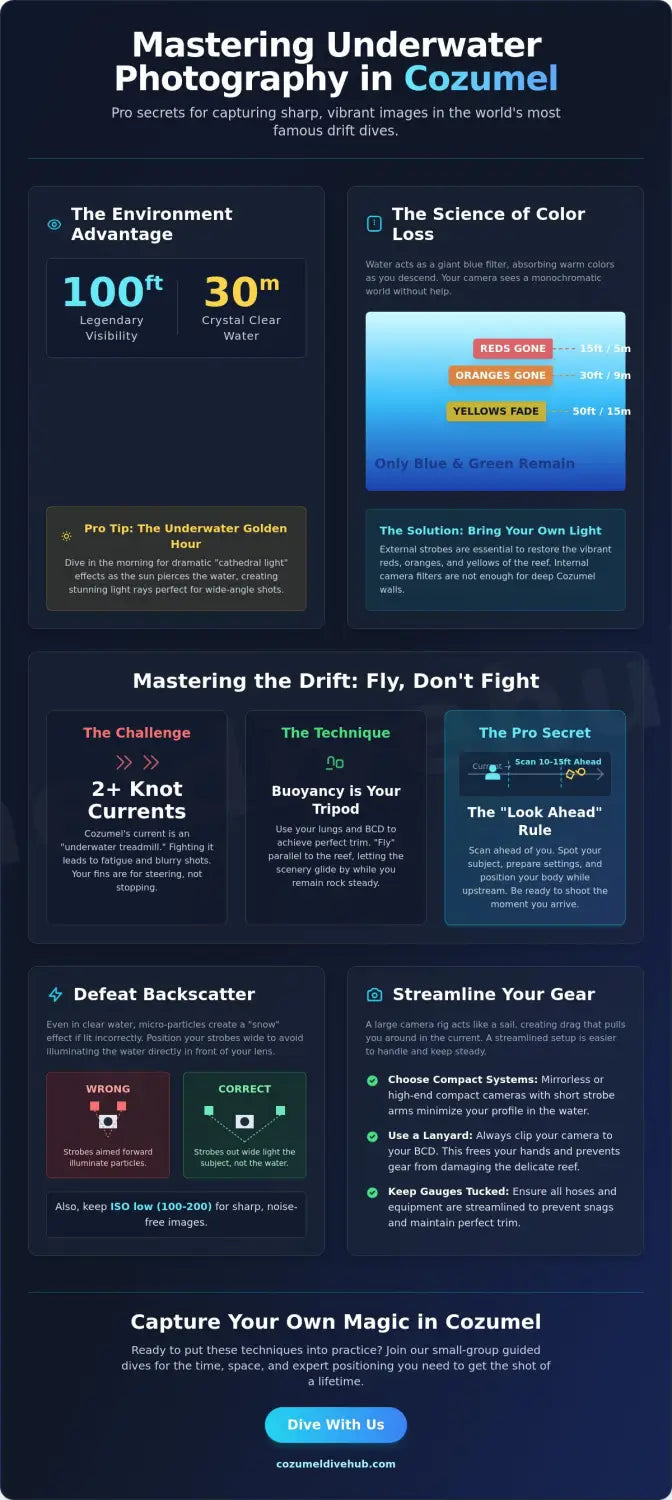
Cozumel is legendary for its crystal clear water, where visibility often exceeds 30 meters (100 feet) on a standard day. This incredible clarity is a massive blessing for wide angle enthusiasts, but it presents a unique challenge for exposure. Your camera's light meter can easily get confused by the intense Caribbean sun reflecting off white sand patches. Mastering how to get the best underwater photos in Cozumel requires you to balance this ambient light with your own equipment to avoid washed out backgrounds.
The geography of the Arrecifes de Cozumel National Park plays a starring role in your compositions. Because the Mesoamerican Barrier Reef features massive coral pinnacles and deep swim-throughs, you'll encounter dramatic light and shadow play. These "cathedral light" effects are most stunning during morning dives, which we consider the underwater golden hour. During these early trips, the sun sits at a perfect angle to pierce through the water column, creating those mesmerizing rays that every photographer loves to capture.
The Science of Color Loss in the Caribbean
Water acts like a giant blue filter. As you descend, the dense liquid absorbs light wavelengths one by one. You'll notice reds disappear at just 15 feet, followed quickly by oranges at 30 feet. Without a plan, your photos will look dull and monochromatic. While internal red filters are a quick fix for shallow snorkeling shots, they're less effective than external strobes on deeper wall dives. To get that "pop" of color back into the coral, you must learn to shoot at an upward angle. Aiming your lens toward the surface helps regain natural contrast and creates a professional silhouette effect for larger marine life.
Visibility vs. Backscatter
It's a common mistake to think clear water means no backscatter. Even in Cozumel’s pristine environment, micro particles can create a "snow" effect if your lighting is off. If you point your strobes directly forward, you'll illuminate the gunk right in front of your lens. Instead, position your light sources out to the sides and slightly behind the camera plane. Because the visibility is so high, you can keep your ISO settings low, typically around 100 or 200, to ensure your images stay sharp and noise free. This setup allows the natural beauty of the reef to shine through without distracting white dots cluttering your frame.
Mastering Photography in the Drift (Buoyancy & Stability)
Cozumel is often described as an underwater treadmill, and for a photographer, this movement is your biggest challenge. If you want to know how to get the best underwater photos in Cozumel, you must first accept that you cannot fight the ocean. In currents that often reach 2 knots, your fins are no longer your primary tool for stability. Instead, your lungs and your BCD become your tripod. Perfecting your trim allows you to "fly" parallel to the reef wall, keeping your camera steady while the scenery glides past your lens.
The "Look Ahead" technique is a pro secret that separates snapshots from gallery-quality images. Because the current carries you in one direction, you can't simply stop to compose a shot. You must scan the reef 10 to 15 feet ahead of your position. Once you spot a subject, like a giant anemone or a resting nurse shark, you prepare your settings and position your body while you're still "upstream." By the time the current brings you into range, you're ready to fire the shutter without frantic, last-minute movements that might scare the marine life.
Safety is always our priority at Cozumeldivehub. No photo is worth damaging the delicate coral or compromising your dive profile. We always remind our family of divers that world-class scuba diving in Cozumel relies on reef conservation. Keep your gauges tucked in and maintain a safe distance from the Mesoamerican Barrier Reef to ensure these pristine walls remain healthy for the next generation of explorers.
Streamlining Your Gear for Current
Large camera rigs act like sails in the water, creating drag that can pull you off course. We recommend using compact or mirrorless systems with short strobe arms to minimize your profile. Always use a heavy duty lanyard to clip your camera to your BCD during descents and ascents. This keeps your hands free for safety and prevents your gear from swinging into the reef. If you feel your skills need a boost, our Advanced Open Water Cozumel course offers dedicated training to help you achieve the surgical buoyancy control required for elite photography.
Using the Current to Your Advantage
You can actually use the flow to create smoother cinematic shots. By positioning yourself slightly higher than your subject and drifting downward at a 45 degree angle, you create a natural "glide" effect. If you find a macro subject in a high-flow area, look for a patch of dead rock or sand where you can use a "one-finger pivot" to anchor yourself without touching live coral. Don't be shy about signaling your divemaster; a quick "camera" hand signal lets us know you've found something special, and we can often help guide the group to a sheltered eddy where the current slows down. Ready to test these techniques? Join us for a private dive trip where we can focus entirely on your portfolio.
Macro vs. Wide-Angle: Best Sites for Every Shot
The first rule for how to get the best underwater photos in Cozumel is to commit to a single vision before you roll off the boat. While our reefs are home to over 260 fish species and 100 types of coral, trying to capture a tiny nudibranch and a massive coral pinnacle on the same dive is a recipe for frustration. Most underwater housings require you to choose a lens on the surface, and Cozumel’s varied topography means your choice will change depending on the site. If you're heading to the deep walls of the south, think big; if you're exploring the shallow reefs near town, it's time to think small.
Palancar Gardens and Columbia Deep are the crown jewels of wide angle photography. These sites feature towering coral buttresses and "cathedrals" of rock that disappear into the deep blue. On the flip side, sites like Paradise Reef and Tikila offer a shallower, calmer environment. These spots are perfect for macro enthusiasts who want to spend 60 minutes hovering over a single coral head to find the perfect angle on a cleaner shrimp or a juvenile trunkfish. By matching your gear to the reef's architecture, you ensure every click of the shutter captures the true spirit of the Mesoamerican Barrier Reef.
Wide-Angle: Capturing the Breathtaking Walls
When you're drifting past the massive structures of Palancar Gardens, your goal is to convey the sheer scale of the environment. One of our favorite pro tips is to include your dive buddy in the frame. Having a "model" positioned near a coral arch provides a sense of perspective that makes the reef look as grand as it feels in person. To keep your backgrounds looking like a vibrant Caribbean blue rather than a dark void, aim slightly upward and use a faster shutter speed. This technique preserves the natural light rays we discussed earlier while letting your strobes handle the color on the foreground coral.
Macro: Hunting for the Splendid Toadfish
If you have a passion for the small stuff, you're in for a treat. Cozumel is the only place on Earth where you can photograph the endemic Splendid Toadfish. These beautiful, shy creatures hide deep under rocky ledges, so you'll need a focus light to help your camera lock onto their vibrant yellow fins. For the best results at sites like Paradise Reef, set your camera to a small aperture (high f-stop) to ensure the entire subject stays in sharp focus. You can learn more about where these unique creatures hide in our Scuba Diving Cozumel Guide. Whether you're hunting for seahorses or colorful nudibranchs, patience is your best friend. Our small groups at Cozumeldivehub ensure you have the time and space to get that perfect, sharp shot without feeling rushed by a crowd.
Pro Techniques for Vibrant Colors and Sharp Focus
The golden rule of underwater photography is simple: "Get close, then get closer." Even in Cozumel’s legendary visibility, water is 800 times denser than air. Every inch of space between your lens and your subject acts as a filter that steals color and sharpness. To truly master how to get the best underwater photos in Cozumel, you should aim to be within 3 feet of your subject. This minimizes the amount of water your light has to travel through, ensuring that the brilliant purples of a giant sea fan or the neon yellow of a Queen Angelfish actually make it onto your sensor.
While some competitors suggest fixing colors with an app after the dive, we believe in getting it right in the camera. Manual White Balance is your best friend. By "telling" your camera what white looks like at your current depth, you can achieve natural skin tones and vibrant corals without heavy editing. If you’re shooting fast-moving marine life, like the Spotted Eagle Rays that frequent our reefs from December to February, you'll need to adjust your shutter speed. Setting your camera to at least 1/250 of a second is essential to freeze their majestic "flight" and avoid motion blur.
Lighting Strategies for the Reef
Choosing between dual strobes and a single video light depends on your goals. For wide-angle reef shots, dual strobes are the professional choice because they provide a massive burst of light that covers a wide area. To avoid the backscatter particles we mentioned earlier, follow the "arms-length" rule: extend your strobe arms out wide and slightly behind the camera housing. This ensures you only illuminate the subject and not the water column directly in front of your lens. If you’re staying shallow (above 20 feet), don't be afraid to turn off the lights and use the powerful Mexican sun to your advantage for a more natural look.
Focus and Composition
Composition is what turns a snapshot into a story. Use the Rule of Thirds by placing the eye of a fish or the center of a coral head on one of the intersecting lines of your viewfinder. You can also use "leading lines," such as the natural curve of a reef wall or a long sponge, to guide the viewer’s eye through the frame. Because fish are unpredictable, always use burst mode. Taking 10 photos of a single subject increases your chances of getting that one perfect frame where the fish is looking directly at you. Ready to put these pro tips into practice? Book your next dive trip with our family and let’s capture some magic together!
Capture Magic with the Cozumeldivehub Family
Your journey to professional-level imagery doesn't happen in a vacuum. It happens in the water, guided by people who love these reefs as much as you do. Learning how to get the best underwater photos in cozumel is significantly easier when you have a local guide who knows exactly which crevice a Splendid Toadfish called home this morning. At Cozumeldivehub, we’ve spent over 25 years exploring these waters. Memo and our team are passionate about sharing the hidden corners of the Mesoamerican Barrier Reef that most divers simply drift past.
We believe that high-quality photography requires time and space. That’s why we focus on small, personalized groups, typically limited to 6 divers or fewer. You won't find yourself in a "bubble curtain" created by a dozen other divers. Instead, you'll have the freedom to hang back, adjust your strobes, and wait for that perfect eye-contact shot with a Hawksbill turtle. Our family atmosphere means we treat your portfolio with the same care we give our own, ensuring every dive is a productive step toward your creative goals. We don't just lead dives; we share an adventure.
Photo-Friendly Dive Charters
Our boats are designed with the modern underwater photographer in mind. We provide dedicated fresh-water rinse tanks to keep your gear salt-free between dives, preventing the mineral buildup that can jam buttons and dials. Before we even hit the water, our briefings include specific photography tips tailored to the site’s topography. If we’re heading to Palancar, we’ll discuss the best angles for those towering pinnacles. On "Macro Days," we focus on sheltered reefs like Paradise, where the current is light and the subjects are tiny. You can even customize your trip to focus entirely on one style, ensuring you never have the wrong lens for the reef architecture.
Start Your Adventure Today
We are deeply committed to the health of the Arrecifes de Cozumel National Park and the conservation of our 12,000 hectares of protected reef. As a member of our family, we’ll help you navigate the important park regulations, from using mineral-based sunscreens to respecting the no-gloves policy. These rules ensure the marine life you’re here to photograph remain vibrant for years to come. Whether you’re a beginner looking to take your first Scuba dive course or a seasoned pro seeking the "express" currents of the south, your adventure starts here. We can't wait to see the magic you capture under the waves. Ready to dive? Book your Cozumel dive trip with the Hub!
Ready to Build Your 2026 Underwater Portfolio?
You've learned that mastering your trim in the drift and closing the gap between your lens and the reef are the fundamental steps to success. By choosing the right lens for Cozumel’s unique topography and using the morning "golden hour" light, you can transform a simple dive into a professional photography expedition. This guide has laid the foundation for how to get the best underwater photos in Cozumel by focusing on the harmony between stability and light.
Now, it's time to take those skills into the 12,000 hectare Arrecifes de Cozumel National Park. Our born and raised local guides know the secret hideouts of the 260 fish species that call these reefs home. With our small group sizes and camera-safe boat procedures, including specialized rinse tanks, we provide the perfect environment for your creativity to thrive. We are passionate about helping you capture the vibrant beauty of our island home.
Join the Cozumel Dive Hub Family and capture your best shots yet! We can't wait to see your stunning images of the Mesoamerican Reef. Your next great adventure starts right here in paradise!
Frequently Asked Questions
What is the best camera for underwater photography in Cozumel?
The OM System TG-7 and GoPro HERO13 are the top choices for 2026 due to their ruggedness and specialized underwater modes. For those seeking professional manual control, the Sony RX100 VII remains a favorite in our community. These cameras handle the high contrast environment of the Caribbean beautifully. They allow you to capture the fine details of our 100 types of coral with ease.
Do I need a strobe for diving in Cozumel, or is natural light enough?
You should use a strobe for any dive deeper than 15 feet to restore the warm colors absorbed by the ocean. While our 100 foot visibility is stunning, natural light alone can't bring back the brilliant reds and oranges of the reef. A strobe or a powerful video light is essential for professional results. It makes your subjects pop against the deep blue background.
How do I stop my photos from looking all blue?
Using Manual White Balance or a red filter is the most effective way to stop your images from looking overly blue. This technique is a vital part of learning how to get the best underwater photos in cozumel. By calibrating your camera to a white slate at your current depth, you tell the sensor how to interpret color correctly. It results in vibrant, true to life photos of our Mesoamerican Reef.
Is it hard to take photos while drift diving?
Drift diving is not difficult for photography once you master your buoyancy and learn to "fly" with the current. Instead of swimming against the flow, you position yourself upstream and let the water carry you past the subject. It takes a bit of practice to time your shots. Our local guides are experts at helping you find the right rhythm in the current.
Can I take my iPhone or GoPro diving in Cozumel?
You can absolutely use an iPhone or GoPro, provided you have a high quality underwater housing rated for at least 130 feet. For iPhones, we recommend a specialized housing like the DiveVolk to maintain touchscreen functionality. Pair your device with a stabilizer tray and a video light. This setup is perfect for capturing the high energy action of a Cozumel drift dive.
Where can I find the Splendid Toadfish for a photo?
You can find the endemic Splendid Toadfish hiding under rocky ledges at shallow sites like Paradise Reef and Tikila. These fish are found almost nowhere else in the world, so they are a "must see" for your portfolio. Look for their distinctive yellow fins peeking out from the shadows. Our "Dive Hub Family" guides are masters at spotting these shy creatures for you.
What is the best time of day for underwater photography in Cozumel?
The best time for photography is during our morning dives, typically between 8:30 AM and 11:30 AM. During these hours, the sun is high enough to pierce the water column but still creates beautiful, dramatic rays. This light highlights the 260 fish species in our marine park perfectly. It provides the high contrast and clarity needed for those "National Geographic" style shots.
Do I need a special certification to take a camera underwater?
You don't need a specific photography certification, but being a confident diver is the most important requirement. We highly recommend our Peak Performance Buoyancy or Advanced Open Water course to sharpen your skills. Good buoyancy ensures you can hover steadily for a shot without touching the reef. It makes the whole experience much more fun and productive for your photography journey.