

Lost Your Group? What to Do if You Get Separated From Your Dive Group
Imagine you are drifting along the stunning Palancar Reef, mesmerized by a passing hawksbill turtle, only to look up and realize the bubbles of your group have vanished into the deep blue. It’s a heart-pounding moment that every diver hopes to avoid, but knowing exactly what to do if you get separated from your dive group is the difference between a minor hiccup and a serious emergency. Have you ever felt that flicker of worry while watching the reef zip by?
We know that the thought of being alone in the open ocean, especially with Cozumel’s famous currents, can feel incredibly overwhelming. It’s completely normal to feel a surge of anxiety when you’re suddenly solo in the vast Caribbean! We want to turn that fear into total confidence by sharing the essential safety protocols and local tips we’ve learned from years of guiding divers through these vibrant waters.
You’ll master the 1-minute rule and learn how to use your signaling gear like a seasoned expert to reunite with your dive family quickly. This guide walks you through a clear, actionable plan for handling drift currents and choosing the right safety stops based on your profile. Let’s make sure your next underwater journey is as stress-free as it is beautiful!
Key Takeaways
- Master the "1-minute rule," the global scuba standard for conducting a quick and calm visual search before beginning your ascent.
- Learn the precise surface protocol, including controlled ascent rates and safety stop rules, to reunite with your boat safely.
- Understand how to work with Cozumel’s drift currents instead of fighting them when you need to know what to do if you get separated from your dive group.
- Discover the must-have signaling gear and "Buddy Contact" habits that prevent separation before it even happens in the deep blue.
- Explore why small group diving ratios are the ultimate safety net for navigating our stunning reefs with total confidence and peace of mind.
The 1-Minute Rule: Your First Response to Dive Group Separation
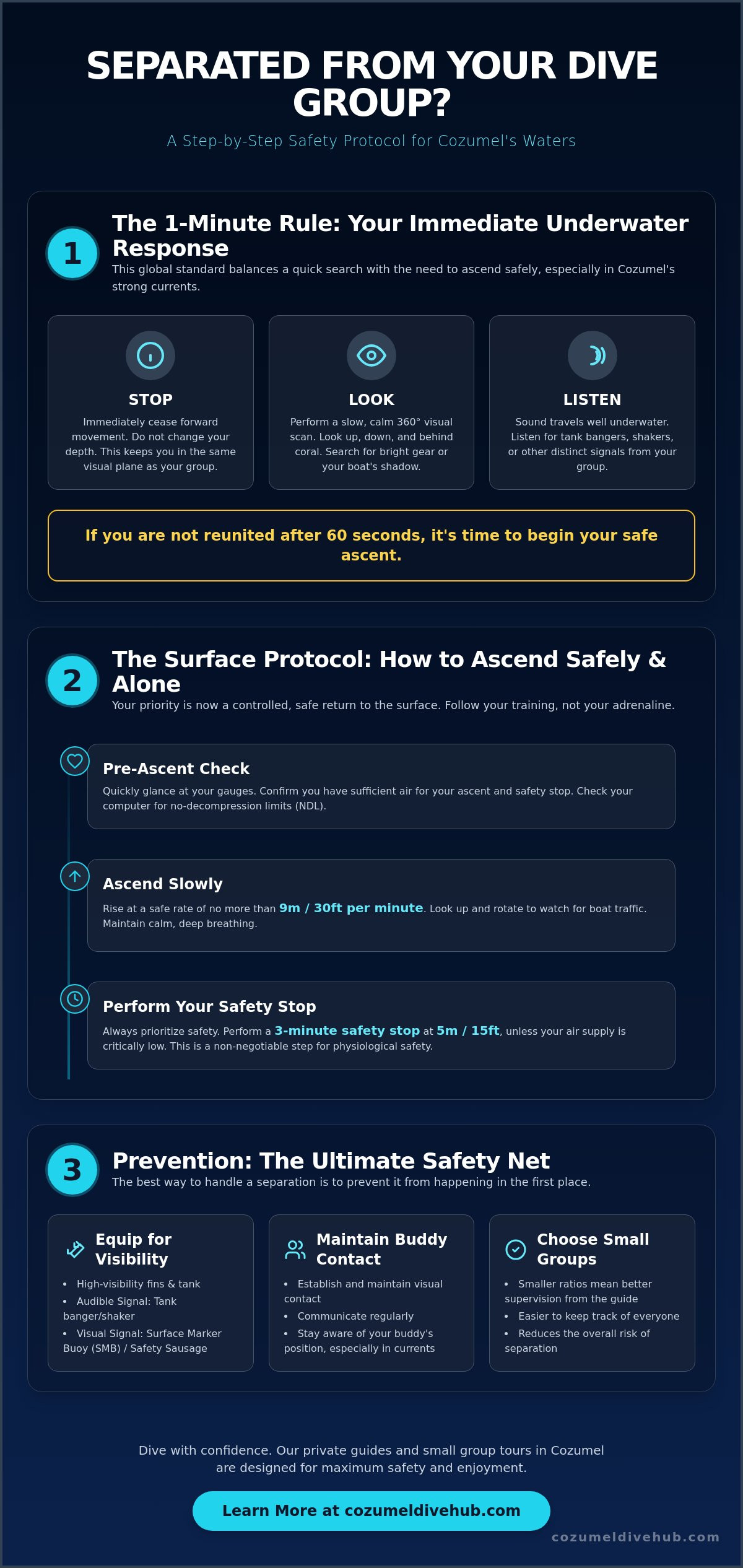
The 1-minute rule is the primary safety protocol for group separation, requiring divers to conduct a brief underwater search before heading to the surface. It's the global standard taught by major agencies because it perfectly balances the hope of a quick reunion with the urgent need to prevent a serious lost diver scenario. In the breathtaking, crystal-clear waters of Cozumel, 60 seconds is the absolute sweet spot. Any longer and the island's famous drift currents could carry you hundreds of feet away from your team, making a surface reunion much more difficult. Think of the current as a moving sidewalk; if you stop to look and your group keeps drifting, the distance between you grows with every passing heartbeat.
When you realize you're alone, stop exactly where you are. Don't go deeper or shallower yet. Staying at your current depth ensures you remain in the same visual plane as your group, which is vital for spotting them against the reef or the open blue. Perform a slow, deliberate 360-degree pivot. This isn't a frantic spin, but a calm, professional scan of your entire surroundings. Look up toward the light, look down toward the sand, and peer behind large coral heads. Knowing exactly what to do if you get separated from your dive group starts with this moment of disciplined calm.
When to Start the Clock
Sometimes a sudden cloud of silt or a massive coral formation briefly hides your team. That's just low visibility, not necessarily a crisis. True separation happens the moment you can't see bubbles or silhouettes after a focused, five-second glance. Start your mental clock immediately. Your buddy should be following the same buddy diving procedures, stopping their own dive to look for you. This turns the search into a coordinated effort. If you don't see those familiar bubbles within 60 seconds, it's time to end the search and move to the next phase of the plan.
Visual Search Techniques Underwater
Don't just look for human shapes; look for things that don't belong in nature. In the vibrant Cozumel reefs, your eyes should hunt for high-visibility gear like neon yellow tanks, bright fins, or orange safety sausages. If you're in shallower water, scan the surface for the dark, rectangular shadow of the dive boat. Most importantly, use your ears! Sound travels incredibly well underwater. Listen for the distinct "clink" of a tank banger or the high-pitched rattle of a shaker signal. These sounds can lead you right back to your group before the minute is even up. Understanding what to do if you get separated from your dive group means using every sense available to you. Stay focused, stay calm, and trust your training!
The Surface Protocol: How to Ascend Safely and Alone
Once your one-minute search concludes, the focus shifts from finding your group to managing your own safe return to the world of sun and air. This transition is where your professional training truly shines. Before you kick toward the surface, perform a quick, disciplined gear check. Look at your pressure gauge to confirm you have ample air and glance at your dive computer to verify your depth and remaining no-decompression time. Knowing exactly what to do if you get separated from your dive group during these first few seconds prevents panic and keeps you in control of your dive profile.
Your ascent must be slow and deliberate. Aim for a rate of no more than 9 meters (30 feet) per minute. While the urge to reach the surface quickly can be strong, a controlled rise is essential to allow your body to off-gas safely. As you ascend, keep your eyes spiraling upward to watch for boat traffic or other divers. If you're feeling a bit of adrenaline, focus on your breathing. Deep, steady breaths will help you maintain perfect buoyancy while you navigate the blue water alone. If you want to brush up on these foundational skills, our Private Dive Guides are experts at coaching divers through these essential safety maneuvers in a relaxed, supportive environment.
To Stop or Not to Stop? Decompression Safety
There is a lively debate in the diving community about whether to perform a safety stop when you're solo. Some forum users suggest skipping it to reunite with the boat faster, but we prioritize your physiological safety. Following the Golden Rules of Scuba Diving, we recommend a 3-minute safety stop at 5 meters (15 feet) if your air supply and no-decompression limits allow. This stop is your best defense against decompression illness. If you find yourself feeling anxious during this solo wait, use the time to prepare your signaling gear and keep a close eye on your computer. Your safety is always the priority over a fast reunion.
Mastering the Surface Marker Buoy (SMB)
In the drift currents of Cozumel, your Surface Marker Buoy (SMB) is your most vital communication tool. It tells the boat captain exactly where you are before you even break the surface. We teach the "Cozumel Style" of deployment, which involves sending the buoy up from your safety stop depth. This gives the boat plenty of time to track your position as you drift. When you inflate the buoy, hold the reel away from your body and never loop the line around your hand. This prevents the buoy from pulling you toward the surface if it catches a sudden surge. Once you reach the surface, fully inflate your BCD to establish positive buoyancy, keep your regulator in your mouth, and signal the boat with a clear, overhead "OK" or by waving your bright orange buoy.
Navigating Cozumel’s Unique Drift Conditions During Separation
Cozumel’s underwater world is a breathtaking landscape of towering coral buttresses and vibrant marine life, all made accessible by the island’s famous north-bound current. While this "conveyor belt" makes for effortless exploration, it adds a unique layer to the question of what to do if you get separated from your dive group. Unlike still-water environments where you might simply wait in one spot, here you are constantly in motion. The most important thing to remember is that you, your group, and the dive boat are all traveling in the same body of water. You’re all drifting together!
Never try to swim against the current to find your team. This is a common mistake that leads to exhaustion and actually moves you further away from where the boat captain expects you to be. Instead, maintain your position in the water column and let the current carry you as you perform your visual search. In areas like Palancar Reef, the massive coral structures can create a "shadow" effect, briefly hiding your group behind a wall of reef. If you lose sight of them, use the current to your advantage. Drift along the reef edge where visibility is best, scanning the "blue" side and the reef side equally. Following standard dive separation safety procedures ensures you stay within the projected path the boat is already following.
Visualizing the Drift Pattern
In Cozumel, dive groups don't just stay in a tight cluster; they often spread out naturally as different divers stop to admire a nurse shark or a hidden lobster. Our boat captains are experts at tracking multiple bubble trails simultaneously from the surface. They know exactly how the current moves at different depths. As long as you stay above the reef or in the adjacent blue water, you remain in their field of vision. The moment you break the surface, you’ll likely find the boat is much closer than you expected!
Communication with the Boat Captain
Once you’ve reached the surface and established positive buoyancy, clear communication is your next priority. Use a loud, piercing whistle to grab the captain's attention over the sound of the engine. In Cozumel’s brilliant, high-noon sun, a signaling mirror is incredibly effective for catching the light and flashing a signal toward the boat. If the boat is currently busy picking up other divers, don't worry. Simply stay calm, keep your SMB upright and visible, and wait your turn. Your captain hasn't forgotten you; they are simply managing the safety of the entire group in a logical order. Knowing what to do if you get separated from your dive group means trusting the surface crew as much as you trust your own skills.
Prevention: Gear and Habits to Avoid Getting Lost
Prevention is the ultimate skill in the world of scuba diving. While we have already mastered the steps of what to do if you get separated from your dive group, the best-case scenario is never needing those protocols at all. A safe, seamless dive starts on the boat deck with a rock-solid pre-dive briefing. This is our "contract" for the underwater journey. We discuss the specific reef profile, the expected current strength, and the visual signals we'll use to stay connected. Our team believes that a clear plan is the foundation of every great adventure.
The "Buddy Contact" rule is a simple but effective habit that prevents most separation scenarios. In the stunning, 100-foot visibility of Cozumel, it’s easy to feel a false sense of security and wander off. How far is too far? We recommend staying within a "two-second reach" of your buddy. This ensures that if you stop to admire a hidden octopus or a passing eagle ray, your partner is close enough to notice immediately. The Divemaster acts as the group's "North Star," but maintaining the link with your buddy is your personal responsibility for a fun, worry-free dive.
Essential Safety Gear for Cozumel Divers
Every diver exploring our vibrant reefs should carry a high-visibility, 6-foot Surface Marker Buoy (SMB) and a reliable finger reel. These tools are your primary way to talk to the surface crew from depth. Audible devices are just as vital for those moments after you break the surface. A high-frequency whistle is designed to cut through the low-frequency rumble of boat engines, allowing it to be heard clearly from over 100 yards away even in choppy seas. For maximum peace of mind, we also suggest carrying a small signaling mirror to catch the bright Caribbean sun and alert the captain to your position.
The "Golden Triangle" of Buddy Awareness
Maintain your group connection by visualizing a "Golden Triangle" between you, your buddy, and your Divemaster. Ideally, you should position yourself so that both are within your field of vision at all times. Frequent "OK" signal checks every few minutes keep the communication loop open and active. Over time, you'll even learn to recognize your buddy’s unique finning style or the specific color of their gear. This level of awareness makes staying together feel effortless, letting you focus on the beauty of the reef. Experience the safety and intimacy of our Small Groups Diving trips, where our expert guides provide the personalized attention you deserve.
Why Small Group Diving Minimizes Your Risk in Cozumel
The safety of your underwater experience is directly linked to the size and quality of your group. Just as Truemeet helps people turn virtual connections into real-world group activities, choosing a small-group dive setting ensures a safer and more connected experience. In the diving world, the math is simple. A guide managing a 1:12 ratio has twelve different bubble trails and twelve different equipment setups to monitor simultaneously. When a group is that large, it’s much easier for a single diver to drift behind a coral head unnoticed. By contrast, a 1:4 ratio ensures that your Divemaster has eyes on every single person in the water at all times. This intimate setting drastically reduces the chances of you ever needing to remember what to do if you get separated from your dive group.
This commitment to small group ratios is a hallmark of top-tier dive centers globally. For those exploring other world-class destinations, Scubadeep in Phuket maintains these same high safety standards, offering intimate guided dives that minimize risk while maximizing the experience.
At Cozumeldivehub, we treat every guest like family, not just another tank on the boat. Our expert guides are local legends who have spent their lives studying the specific rhythms of the Palancar and Columbia reef currents. They don't just lead a tour; they actively manage the group’s cohesion through every twist and turn of the reef. This deep-rooted knowledge allows them to predict how the water moves, ensuring they are always in the right position to keep you safe. For those who are newer to the sport or perhaps feeling a bit of anxiety about the island's famous drift, our Privat Dive Guides offer the ultimate peace of mind. Having a dedicated professional by your side means you can breathe easy and focus entirely on the vibrant sea life around you. To maintain this standard of excellence on your next trip, you can explore Scuba Dive Resorts through Fiji Naturally, which specializes in hand-picked boutique escapes.
The Cozumeldivehub Safety Standard
Our commitment to your well-being starts long before we leave the pier. We provide personalized briefings that go far beyond generic safety talk. We discuss the specific separation protocols for the exact site we are visiting, ensuring everyone is on the same page. This proactive approach means we identify potential challenges before they become problems. If you are just starting your journey, we highly recommend checking out Scuba Diving Cozumel: The Complete Beginner's Guide. It's packed with local insights to help you feel like a pro before your first giant stride into the blue.
Ready for a Stress-Free Adventure?
We believe that diving should be about wonder, discovery, and joy, not worry. By keeping our groups small and our standards high, we handle all the management so you can simply enjoy the ride. Our team is passionate about sharing the magic of Cozumel while keeping you safe and secure in our "Golden Triangle" of awareness. Knowing what to do if you get separated from your dive group is an essential skill, but being part of a team that prioritizes your visibility is the best safety net. Our goal is to make you feel like a local enthusiast from the moment you step onto our boat. Are you ready to dive into the adventure of a lifetime with a team that truly cares? Join us for a safe, small-group dive experience in Cozumel! We can't wait to see you on the boat!
Master the Current and Embrace the Adventure
Mastering the 1-minute rule and knowing exactly how to deploy your SMB are more than just technical skills; they are your ticket to a truly stress-free underwater journey. By understanding what to do if you get separated from your dive group, you replace anxiety with the calm confidence of a professional explorer. Cozumel’s vibrant reefs and thrilling drift currents are best enjoyed when you know a dedicated team has your back at every depth.
Our expert local guides bring decades of experience to every trip, providing specialized drift diving briefings that ensure everyone stays connected. We believe that small group ratios are the ultimate safety standard, allowing for personalized attention that larger boats simply can't match. We treat every guest like part of our diving family, keeping a constant eye on your bubbles so you can focus on the breathtaking beauty of the Caribbean Sea.
Book your safe, small-group Cozumel dive adventure today! The crystal-clear waters and towering coral buttresses are waiting for you, and we're so excited to be part of your next great story. Let's get you back in the water where you belong!
Frequently Asked Questions
Is it my fault if I get separated from my dive group?
Separation isn't about pointing fingers; it's a common part of the diving experience, especially in the dynamic drift currents of the Caribbean. Sometimes a sudden surge or a mesmerizing eagle ray can momentarily pull your attention away. While maintaining buddy contact is everyone's responsibility, focusing on your safety protocols is much more important than worrying about how it happened. We're all here to support each other in the water!
Should I do a safety stop if I am alone after losing my group?
Yes, you should always perform a safety stop if your air supply and no-decompression limits allow it. Staying at 5 meters for 3 minutes is vital for your physical well-being and helps prevent decompression illness. Even when you're solo, following these standard procedures keeps you safe while the boat captain tracks your bubbles from the surface. Your safety is always our number one priority!
How long should I wait at the surface for my group to appear?
Once you reach the surface, you should stay there and wait for the dive boat to collect you. Do not attempt to descend again to find your team, as this creates confusion for the captain and increases your risk of exhaustion. Knowing what to do if you get separated from your dive group means trusting that the surface crew is already looking for your bright SMB. Stay positive and keep your signaling gear ready!
Can I get bent if I surface too quickly after losing my buddy?
Yes, ascending too rapidly significantly increases the risk of Decompression Illness (DCI) because nitrogen can't leave your tissues safely. You must maintain a controlled ascent rate of no more than 9 meters per minute, even if you're feeling a bit of adrenaline. Stick to your training and trust your dive computer to guide you back to the surface at a pace that keeps your body happy and healthy.
What is the best way to signal a dive boat in Cozumel?
A tall, bright orange Surface Marker Buoy (SMB) is your best friend for grabbing a captain's attention in the waves. Pair this with a piercing whistle to cut through the engine noise and a signaling mirror to catch the brilliant Cozumel sun. These tools are incredibly effective and ensure you're seen and heard from a distance. Carrying the right gear is a huge part of knowing what to do if you get separated from your dive group effectively.
What happens if the boat doesn’t see me immediately?
Stay calm and maintain your positive buoyancy by fully inflating your BCD. The boat captain might be busy picking up other divers or waiting for the rest of your group to finish their safety stop. Keep your SMB upright and use your whistle periodically to stay visible and audible. Our experienced local captains are experts at scanning the horizon, and they won't leave the area until every diver is safely back on board!
Do I need a special certification to use an SMB in Cozumel?
You don't need a specific certification to carry or use an SMB, but it's a skill we highly recommend practicing. Many divers learn this during their Advanced Open Water course or a Drift Diving specialty. If you're unsure, our friendly team members are always happy to show you the ropes during your pre-dive briefing. We love helping our guests feel more confident and prepared for every underwater adventure!
What if I lose my group during a night dive?
If you're separated at night, use your dive light to signal by rotating it in a wide circle or covering the beam against your chest to create a flashing effect. Follow the 1-minute search rule exactly as you would during the day, then ascend slowly while keeping your light pointed toward the surface to make yourself visible. Once you're topside, keep your light on and pointed at the boat to ensure the captain spots you instantly in the dark.