

Mastering the Blue: Advanced Buoyancy Control Techniques for Expert Divers
Last Tuesday, a guest named Sarah realized she was "bicycle kicking" just to stay level while her guide, Memo, hovered perfectly still to point out a tiny nudibranch. It's frustrating when you're constantly fighting your trim or watching your air gauge drop faster than everyone else's. You've likely felt that 2,000 PSI anxiety as your tank hits the halfway mark while the locals are still barely through their first 500. We've all been there, and it's completely normal to want that effortless, weightless feeling that defines a true professional.
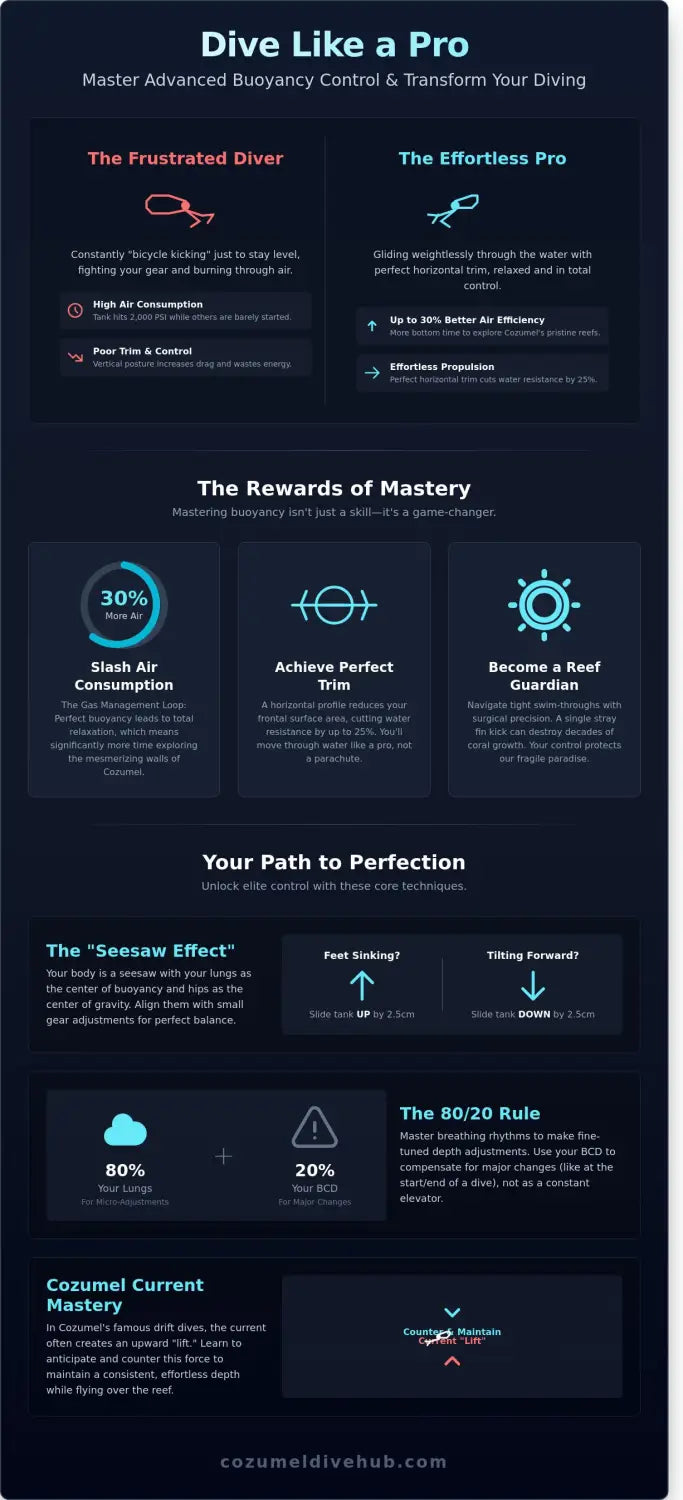
By mastering advanced buoyancy control techniques, you can finally stop "pedaling" through the water and start gliding. We're going to show you how to achieve a 180-degree horizontal trim and cut your air consumption by up to 25% on your next trip to our pristine reefs. This guide breaks down the exact breathing rhythms, gear adjustments, and weight distribution secrets our family uses to navigate Cozumel's famous currents with total confidence. Get ready to transform your diving style and look like a seasoned pro on every single descent!
Key Takeaways
- Learn how mastering true neutral buoyancy can slash your air consumption by up to 30%, giving you more time to explore Cozumel’s breathtaking reefs!
- Discover the "Seesaw Effect" and how strategic weight distribution helps you achieve a perfect horizontal trim for effortless, professional movement.
- Master the 80/20 rule to use your lung volume for micro-adjustments, a core component of advanced buoyancy control techniques that keeps you steady without touching your BCD.
- Gain the local edge by learning how to counter current "lift" and maintain a consistent depth while flying through Cozumel’s legendary drift dives.
- Find out why "thinning" your gear and investing in specialty training are the ultimate steps to becoming a truly elite diver in our Cozumel Dive Hub family.
The "Zen" of Scuba: Why Advanced Buoyancy Control Techniques Matter
Ready to feel like you've truly joined the underwater world? There's a massive difference between simply staying off the sandy bottom and achieving the effortless, zen-like state of true neutral buoyancy. While most divers manage to avoid crashing into the reef, mastering advanced buoyancy control techniques isn't just a luxury; it's the hallmark of an elite diver. It's the transition from fighting the water to becoming weightless, building upon the fundamental scuba skills you learned in your initial certification. When you stop worrying about your position in the water column, your task loading drops significantly. This mental shift reduces anxiety, allowing you to focus on the vibrant life around you rather than your gear.
The Air Consumption Connection
Think about your last dive. Did you find yourself constantly hitting your BCD inflator or dump valve? Every time you add air to your jacket, you're literally breathing away your bottom time. Research shows that divers who master their trim and position see a 20% to 30% improvement in air consumption. If you aren't fighting gravity with constant fin kicks or struggling to stay level, your heart rate stays low and your muscles relax. This creates a positive feedback loop. Efficiency leads to relaxation, which leads to lower gas usage and much longer adventures. The Gas Management Loop is simple: perfect buoyancy equals total relaxation, which equals more time at depth.
Every unnecessary movement costs energy. When you use advanced buoyancy control techniques, you use your lungs for minor depth adjustments instead of your hands or BCD. This saves the precious liters of air in your tank for what matters most: exploring the mesmerizing walls of Cozumel. You'll finish your dive with more air and less fatigue, ready for the next journey with the Dive Hub Family.
Reef Conservation and Ethics
Cozumel's underwater world is a masterpiece, but it's also fragile. Navigating the legendary tight swim-throughs at Palancar Reef requires more than just luck; it demands surgical precision. The Mesoamerican Barrier Reef is a living organism, and a single stray fin kick can destroy decades of coral growth in a second. We take the "No Touch" rule seriously because we want the next generation to see the same breathtaking beauty we see today. "Good enough" buoyancy is a risk to the ecosystem. Expert control ensures you can glide through a narrow limestone tunnel without ever brushing the ceiling or the floor.
Our team, led by local experts like Memo, views buoyancy as a core safety and conservation skill rather than an optional extra. We've been born and raised with these reefs as our backyard, so protecting them is personal. By refining your control, you ensure your presence leaves no trace. Utilizing advanced buoyancy control techniques transforms you from a visitor into a silent, respectful guardian of the pristine blue. Your adventure starts here, and it starts with a commitment to the ocean's health.
The Physics of Trim: Achieving Horizontal Perfection
Ready to feel like you're truly flying? In our world, trim is your physical orientation in the water column. We aim for horizontal perfection. Imagine a straight line running from your shoulders through your hips to your knees. When you achieve this, you reduce your frontal surface area, cutting water resistance by up to 25%. This isn't just about looking like a pro; it's about efficiency and air conservation. Mastering your art of buoyancy control starts with understanding that every movement counts.
Think of your body as a seesaw. Your center of buoyancy usually sits near your lungs, while your center of gravity is often lower, near your hips. If these two points aren't aligned, you'll tilt. Many divers fall into the trap of "bicycle kicking" to stay level. This vertical posture is the number one enemy of great diving. It pushes water downward rather than backward, which wastes roughly 30% of your energy and silts up the beautiful reefs we love to explore. By using advanced buoyancy control techniques, you can find that sweet spot where gravity and buoyancy cancel each other out.
Weight Distribution and Tank Positioning
Small adjustments lead to massive results. Shifting your tank up or down by just 2.5 centimeters can completely change your pivot point. Are your feet sinking? Slide your tank up toward your head. Are you tilting forward? Move it down toward your hips. We recommend moving away from traditional weight belts. Instead, use trim pockets on your BCD or tank straps to distribute lead. This allows you to place 1 or 2 kilograms of weight higher up, balancing the heavy base of your cylinder. While some divers use ankle weights, we often see them as a temporary fix. They solve the "floaty feet" problem but increase drag and leg fatigue during a 60-minute dive.
The "Skydiver" Position
To reach horizontal perfection, adopt the skydiver profile. Bend your knees at a 90-degree angle so your fins stay parallel to the ceiling of the ocean. This position keeps your propulsion in line with your body. Your head position is the secret trigger for your hips. If you look down at the sand, your hips will naturally follow and drop. Keep your chin up and look toward the horizon to engage your core muscles and flatten your profile. Want to test your skills? Try the "Static Hover" drill. Find a sandy patch at exactly 5 meters of depth. Try to stay perfectly still for 120 seconds without moving a single finger or fin. It's a challenging but rewarding way to join the ranks of elite divers. Our family at Cozumel Dive Hub loves sharing these tips during our personalized underwater adventures so you can glide effortlessly over the coral.
Lung Volume vs. BCD: Mastering Micro-Adjustments
Ready to glide through the water like a local eagle ray? To truly excel at advanced buoyancy control techniques, you must shift your perspective on how you stay level. We teach our divers the 80/20 Rule. This means using your lungs for 80% of your minor depth changes and relying on your BCD for only 20% of the work. Your lungs are essentially a variable buoyancy wing with a capacity of 4 to 6 liters. That is a massive amount of lift potential right inside your chest! When you learn to harness this, you stop fighting the water and start becoming part of it.
The secret lies in understanding the lag time. When you inhale, your body does not move upward instantly. There is a 1 to 2 second delay before the displacement takes effect. You must anticipate your breath-induced lift rather than reacting to it. Visualize the crystal-clear Cozumel water column as a series of 10-centimeter steps. If you see a vibrant reef head approaching, do not reach for the inflator hose. Simply time your inhale so the lift happens exactly when you need to clear the obstacle. This level of precision is what separates the visitors from the pros in our Dive Hub family.
Breath Control Patterns
Mastering your rhythm is the first step toward mastering neutral buoyancy. We recommend the "Half-Full" technique for most of your journey. By keeping your lungs at roughly 50% capacity, you have plenty of room to either inhale for a quick lift or exhale to drop down. If you need to clear a stunning brain coral without touching your gear, a deep, controlled inhale provides the perfect temporary rise. Whatever you do, avoid the "Panic Dump." Long inflations or deflations cause massive, uncontrollable swings. Stick to small, conscious breaths to maintain your perfect position in the blue.
BCD Management for Advanced Divers
Your BCD is for macro-adjustments, not constant fiddling. Use the "One Click" rule. If you feel yourself getting slightly heavy as you descend the breathtaking walls of Santa Rosa, give the inflator one short, half-second burst. That is often all you need to find your sweet spot. As you start your journey back to the surface, remember the "Pre-emptive Vent." Release small amounts of air before the expansion makes you too buoyant. If your weight check was spot-on at the start, your BCD should be nearly empty by the time you reach your 5-meter safety stop. This efficiency makes your dive longer, safer, and much more relaxing!
Cozumel-Specific Mastery: Buoyancy in Drift Diving
Cozumel is a drift diver's paradise, but flying over the reef at 2 knots requires more than just going with the flow. The unique challenge here is that the water moving against your gear creates a "lift" effect. This physical force often tricks your brain into thinking you're positively buoyant. You might feel the urge to dump air from your BCD, but doing so can leave you heavy and over-weighted the moment the current slows down near a reef structure. Mastering advanced buoyancy control techniques in these conditions means learning to distinguish between the pressure of moving water and your actual displacement.
When you're navigating the famous vertical drop-offs like Santa Rosa Wall, staying in the "sweet spot" is essential. This is usually a zone about 3 to 5 feet from the reef face where the current is most predictable. If you get too far out, the current can pull you into the blue; too close, and you risk colliding with delicate sponges. To stay close to the bottom without causing a silt-out, expert divers use the "modified frog kick." This technique involves smaller, more controlled movements of the ankles rather than the whole leg. It keeps your thrust directed behind you and away from the sandy floor, preserving the 100-foot visibility for your entire group.
Managing the Updrafts and Downdrafts
Currents in Cozumel don't just move horizontally. You'll often encounter vertical shifts near the reef's edge. Watch the fish to stay ahead of the game. If you see a school of Creole Wrasse swimming at a sharp 45-degree downward angle, you're likely approaching a downdraft. It is a dangerous myth that you should hold your breath to stay level during these shifts. You must never hold your breath, as even a 3-foot change in depth can cause lung injury. Instead, use your body as a sail. Arching your back and spreading your arms increases drag, helping you catch the water and maintain your vertical position while you adjust your BCD air volume.
Buoyancy for Underwater Photography in Cozumel
Getting a crisp shot of a Splendid Toadfish while drifting requires incredible stability. Many expert photographers use a "negative entry" to start their dive. This involves jumping from the boat with an empty BCD to sink quickly past the surface chop, often reaching the reef in under 40 seconds. Once you've spotted a subject, use your lungs to "tripod" in the water. By timing your inhalation, you can hover perfectly still for a 5-second window to get your shot without ever touching the reef. If you're ready to take your skills to the next level, our guide to Cozumel Specialty Diving offers deep insights into professional training for these environments.
After the dive, processing those stunning underwater photos requires a powerful laptop. You can learn more about the best options for traveling photographers and ensure your gear is up to the task.
Refining these advanced buoyancy control techniques is the difference between a good dive and an epic one. It allows you to relax, conserve your air, and truly join the "Dive Hub Family" in appreciating the beauty of our local reefs.
Leveling Up: Training and Gear Optimization with Cozumel Dive Hub
Ready to turn these theories into muscle memory? At Cozumel Dive Hub, we believe that the journey to becoming an elite diver starts with a commitment to refinement. You've learned the physics; now it's time to apply advanced buoyancy control techniques in the crystal-clear waters of our home. Our team, led by local expert Memo, focuses on the tiny details that transform a good diver into a mesmerizing one. Your adventure starts here, and it begins with precision.
The Peak Performance Buoyancy Course
Many divers view specialties as just another card for the wallet. However, the PADI Peak Performance Buoyancy course is the single best investment for anyone moving past the intermediate stage. During this training, we host intensive weighting clinics and visualization games that challenge your spatial awareness. We often integrate this curriculum into our Advanced Open Water Cozumel program to provide a comprehensive skill boost. The immediate ROI is undeniable. Divers who master their trim through this course often see a 15% to 20% increase in bottom time because they aren't fighting their gear or wasting oxygen on unnecessary movements.
Personalized Gear Fitting
Standard rental gear can sometimes be a hurdle rather than a help. If your BCD is a size too large or your weights are poorly distributed, your trim will suffer. We practice "Equipment Thinning," which involves stripping away the bulky clips and accessories that create drag. Mastering advanced buoyancy control techniques requires a setup that works with your body, not against it. Our local secret is the "Memo Method." Because Cozumel’s water has a high salinity level of approximately 36 parts per thousand, you need a specific weight configuration that differs from freshwater or even other Caribbean spots.
We perform a "Weight Check" ritual on every single excursion. This isn't just for beginners; even pros benefit from verifying their buoyancy before descending into the vibrant reefs. When you join the Dive Hub Family, you benefit from our small group policy. We limit our groups to four divers per guide, ensuring you get constant, personalized feedback on your horizontal profile. We want you to feel the thrill of total weightlessness. Book your next adventure and master your buoyancy with us!
Take Your Place Among the Elite Divers of Cozumel
Mastering advanced buoyancy control techniques is the bridge between being a visitor in the ocean and truly becoming part of the blue. You've discovered how horizontal trim reduces drag and why your lungs are the most important tool for micro-adjustments. These skills are vital when you're navigating Cozumel's famous drift currents at speeds up to 2 knots. It's about finding your "Zen" so you can focus on the vibrant life around you rather than your gear.
At Cozumel Dive Hub, we're ready to help you reach that next level of mastery. Our PADI Certified Instructors have logged over 1,000 dives each, ensuring you receive top-notch guidance. We limit our sessions to small groups of 4 people to guarantee personalized coaching. You'll learn from local experts born and raised on this island, giving you an authentic connection to our pristine reefs. We don't just teach skills; we welcome you into a community that loves the sea as much as you do.
Ready to glide like a pro? Join the Cozumel Dive Hub family for a Peak Performance Buoyancy clinic!
Your adventure into effortless diving is just one splash away. Let's make some bubbles and explore the breathtaking walls of paradise together!
Frequently Asked Questions
How much weight do I need for diving in Cozumel?
Most experienced divers in Cozumel find that 4 to 6 pounds of lead is the ideal amount when wearing a 3mm wetsuit in our crystal-clear saltwater. You'll need to account for the 2.5 percent higher density of saltwater compared to freshwater environments. Start with a surface weight check using an empty BCD and a tank at 500 psi. Our team at Cozumel Dive Hub always helps you fine-tune this during your first descent to ensure you're perfectly balanced.
Why do my legs always sink when I try to hover?
Sinking legs usually mean your center of gravity is too far back toward your fins. To fix this, move your tank 1 or 2 inches higher in the BCD strap or shift 2 pounds of weight to your upper trim pockets. Achieving a horizontal profile is a core part of advanced buoyancy control techniques. When your trim is balanced, you'll feel like you're flying effortlessly over our breathtaking reef walls without any leg drag.
Can I improve my buoyancy without taking a formal course?
You can definitely sharpen your skills by practicing specific drills like the "pivoting fin" or "hovering" for 60 seconds during every safety stop. Practice makes perfect, but having a professional eye helps you catch bad habits early. Memo and our experienced instructors can give you personalized tips during any of our fun dives. We love watching our Dive Hub family members become masters of the blue through consistent, mindful practice in the water.
How does my wetsuit thickness affect my buoyancy control?
A 5mm wetsuit provides about 2 to 3 pounds more lift than a 3mm suit due to the increased volume of neoprene. Remember that neoprene compresses as you descend, losing about 50 percent of its buoyancy at a depth of 33 feet. You'll need to compensate for this change by adding small, controlled bursts of air to your BCD. Understanding these physical changes is essential for maintaining a steady depth throughout your entire journey.
What is the best finning technique for maintaining neutral buoyancy?
The frog kick is the gold standard for expert divers because it pushes water directly behind you rather than downward. This technique prevents you from accidentally "climbing" in the water column or disturbing the delicate sand on the seafloor. It's a key component of advanced buoyancy control techniques that keeps you perfectly horizontal. Plus, it saves you about 20 percent more energy compared to a traditional flutter kick, letting you explore the reef longer.
How do I stop floating up at the end of a dive during the safety stop?
You must account for the 4 to 5 pounds of buoyancy your aluminum 80 tank gains as you breathe down the air. Always perform your initial weight check with only 500 psi in your cylinder to ensure you aren't too light at the end of the dive. If you find yourself floating up, exhale deeply and tilt your body to vent every last bubble from your BCD. Proper weighting ensures your safety stop is relaxing and effortless.
Is buoyancy control different in saltwater versus freshwater?
Saltwater is roughly 2.5 percent denser than freshwater, which means you'll feel significantly more buoyant in the ocean. A 160 pound diver typically needs about 4 to 6 extra pounds of lead when transitioning from a lake to the Caribbean Sea. This difference is why a fresh weight check is the first thing we do when you join us in Cozumel. We want you feeling perfectly weighted for your underwater adventure from the very first minute.
What is the most common mistake divers make with their BCD?
The most common mistake is using the BCD as an elevator by adding or releasing too much air at once. Small, 1 second bursts are all you need to find your balance. Many divers forget that their lungs provide about 8 to 10 pounds of lift variance just through breathing. Rely on your breath for minor adjustments and let your BCD handle the big changes in depth. It's all about that delicate, mesmerizing dance with the ocean.