

Mastering the Lens: The Ultimate Underwater Photography Course in Cozumel
You finally spot the elusive Splendid Toadfish at 60 feet, but when you check your camera screen, it's just a muddy green blur peppered with white spots. It's frustrating when your memories of the reef are vibrant and electric, yet your photos look like they were taken through a dusty basement window. We know that feeling because we've been exactly where you are. Most divers find that 90 percent of their shots end up in the digital trash bin due to backscatter or boring compositions.
Our underwater photography course cozumel is designed to transform those blue, blurry snapshots into professional, vibrant underwater art. We promise to give you the tools to master lighting and color correction while building 100 percent confidence in your gear and buoyancy. Your adventure starts here with Cozumeldivehub's local experts, who've spent decades exploring these walls. In this guide, we'll preview the essential techniques for capturing Instagram-worthy shots, managing your strobes, and getting close to marine life without scaring them away. Let's make some bubbles and capture the magic together!
Key Takeaways
- Discover why Cozumel’s legendary 100ft+ visibility and unique "Cozumel Blue" light spectrum create the ultimate natural studio for your underwater art.
- Elevate your skills with an underwater photography course cozumel that focuses on buoyancy mastery and the core fundamentals of the exposure triangle.
- Learn how to maximize any camera, from entry-level GoPros to advanced mirrorless rigs, to capture the breathtaking beauty of the Caribbean.
- Explore a personalized roadmap that takes you from expert-led theory sessions to hands-on reef practice in small, intimate groups.
- Gain the "local's edge" by training with passionate instructors who know exactly where the light hits the reefs for that perfect, vibrant shot!
Why Cozumel is the World's Best Classroom for Underwater Photography
Ready to turn your dive memories into gallery-worthy art? Cozumel isn't just another dive destination; it's a high-definition studio with the best lighting in the Caribbean. For anyone looking to level up their skills, an underwater photography course cozumel offers a controlled, breathtaking environment that you won't find anywhere else. We've spent years exploring these waters, and we can tell you that the island's unique geography creates the perfect conditions for learning both macro and wide-angle techniques.
The first thing you'll notice is the unrivaled visibility. On a typical day, you can expect 100ft or more of horizontal clarity. This isn't just a luxury. It's a critical tool for photographers. High visibility means less particulate matter between your lens and your subject, which reduces the "haze" that ruins shots in murkier waters. You can practice your composition from a distance without losing the crisp details of the reef. This clarity is paired with the legendary "Cozumel Blue," a specific light spectrum caused by the deep, surrounding trenches. The water acts as a natural filter, providing a vibrant, cobalt backdrop that makes the colors of the sponges and fish pop with incredible contrast.
Don't let the famous currents intimidate you. In fact, drift diving is a secret weapon for stability. During our underwater photography course cozumel, we teach you how to use the steady 1 to 2 knot flow to your advantage. Instead of struggling with kick cycles that stir up sand, you'll learn to neutralize your buoyancy and glide. The current acts like a moving sidewalk; it carries you at a constant speed, allowing you to focus entirely on your framing and trigger timing. It’s like having a professional camera dolly move you through the water.
Then there are the residents. Cozumel is home to over 260 species of fish, including the Splendid Toadfish (Sanopus splendidus). This endemic species is found nowhere else on the planet. Its vibrant yellow fins and zebra-striped head provide a magnificent challenge for macro enthusiasts. Finding one tucked under a coral ledge at 50 feet requires patience, but the reward is a shot that is truly unique to your portfolio.
The Perks of Shooting in Cozumel Marine Park
Since its establishment in 1996, Cozumel's protected reef system has allowed the local ecosystem to flourish across 12,000 hectares. At sites like Palancar Gardens, you'll find towering coral buttresses that create dramatic shadows for wide-angle shots. The conditions are remarkably predictable, with water temperatures hovering between 26°C and 29°C year-round. This consistency means you can focus on your ISO settings and aperture rather than worrying about sudden thermoclines or weather shifts. Whether you're at a 25-foot shallow reef using natural sunlight or an 80-foot wall requiring powerful strobes, the diversity of depths provides a full spectrum of learning opportunities.
Common Frustrations of the 'Vacation Photographer'
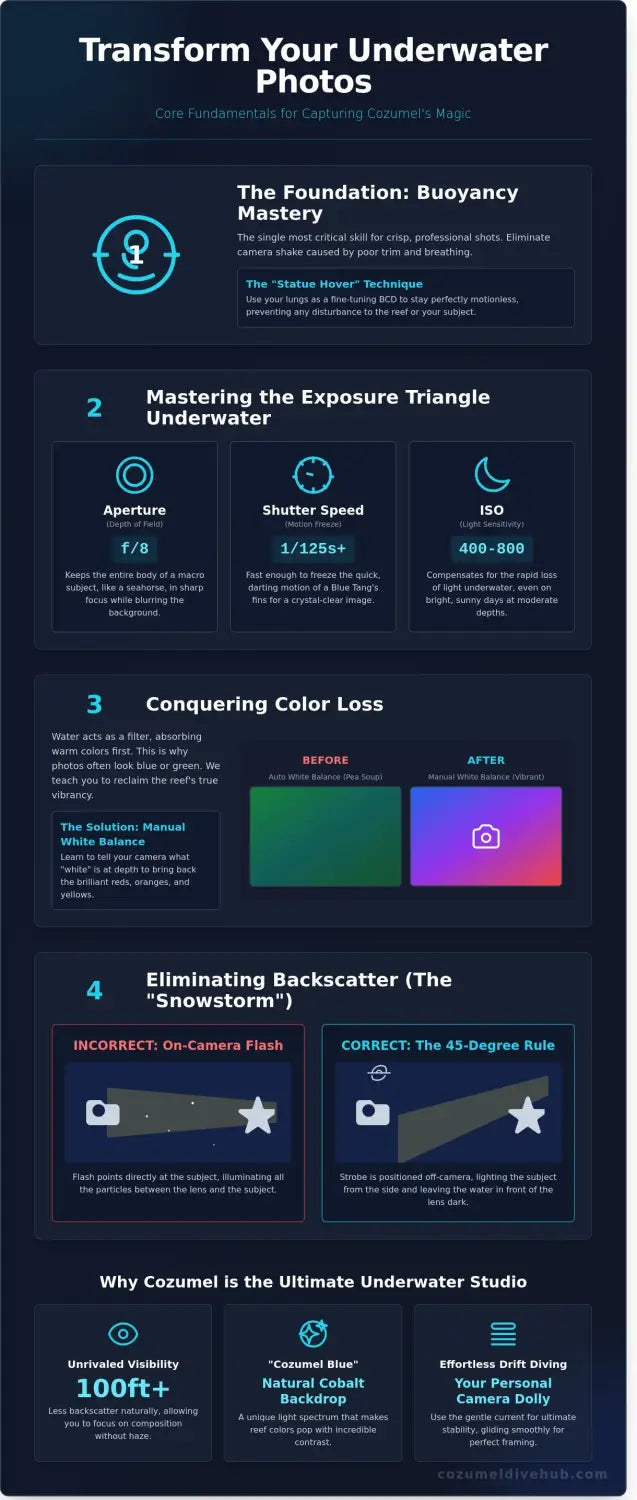
We've all been there. You get home, look at your GoPro footage, and everything looks like pea soup. This happens because water absorbs red light first; by the time you hit 15 feet, those warm tones are gone. Another common headache is the "snowstorm" effect, or backscatter. This occurs when your flash hits tiny particles in the water and reflects back into the lens. In our course, we'll show you the 45-degree lighting rule to eliminate these white spots. You'll learn why your camera "sees" differently than your eyes and how to use manual white balance to bring the fire-red sponges and orange anemones back to life.
Core Fundamentals of Our Underwater Photography Course
Ready to level up your dive game? Our underwater photography course cozumel begins with the most critical, yet often ignored, skill: buoyancy mastery. If you're drifting up and down by 2 feet every time you inhale, your camera won't stay still enough for a crisp shot. We focus on the "statue hover" technique. You'll learn to use your lungs as a fine-tuning tool, allowing you to stay perfectly motionless just inches from a coral head without ever touching the reef. This stability is the 100% foundation for every professional image we produce at Cozumel Dive Hub.
Once you've nailed your trim, we dive deep into the Exposure Triangle. Light behaves differently under 30 feet of saltwater. You'll learn why we often push our ISO to 400 or 800 even on sunny days. We'll practice setting your shutter speed to at least 1/125 of a second to freeze the fast-moving fins of a Blue Tang. You'll also master aperture settings, like using f/8 to ensure the entire body of a Seahorse stays in sharp focus against a blurred background.
Color loss is your biggest enemy in the Caribbean. By the time you hit 5 meters, the red spectrum has already vanished. We'll show you the exact moment to swap your red filter for manual white balance. Filters work wonders in the top 15 feet of water, but deeper dives require custom white balance settings to stop your photos from looking like a giant soup of blue and green. It's about bringing those 20 different shades of sponge back to life!
Composition is where your artistic voice starts to sing. We'll move you past the "fish from behind" shots that fill most beginners' SD cards. You'll practice the Rule of Thirds and learn to shoot from a low angle, looking up toward the surface. This technique creates a sense of scale and majesty, making a 2-foot Grouper look like a titan of the deep. If you're ready to start your journey, check out our available course dates and join the family.
Lighting Techniques: Natural vs. Artificial
Natural light is a gift in Cozumel's 100-foot visibility. We teach you to keep the sun at your back, using it as a massive, free studio light. However, when you're exploring the shadows of the Palancar Caves, you'll need strobes. We'll show you how to position dual strobes at 45-degree angles to eliminate backscatter. This ensures you illuminate the subject without lighting up every tiny particle of sand in the water column.
Marine Life Etiquette and 'The Approach'
Being a great photographer means being a respectful guest. We follow the official data on the national park to ensure our 12,000-hectare marine sanctuary stays pristine. You'll learn the "slow-blink" approach, moving at a pace of 1 foot per minute to get close to shy subjects like the Splendid Toadfish. By predicting fish behavior, you'll be ready for that split-second moment of eye contact that turns a simple snapshot into a prize-winning portrait. We maintain a strict zero-impact policy, ensuring our fins never touch the floor while we wait for the perfect shot.
Our underwater photography course cozumel isn't just about pushing a button; it's about becoming a better, more aware diver. We've spent 15 years exploring these reefs, and we can't wait to show you the secrets of the "Big Blue" through your own lens. Let's make some bubbles and capture some magic together!
Gear Guide: From GoPros to Mirrorless Rigs
Ready to build your dream underwater rig? At Cozumel Dive Hub, we believe the best camera is the one you already own. You don't need a $5,000 professional setup to start our underwater photography course cozumel; you just need to know how to maximize your current tool. Whether it's a smartphone in a specialized housing or a high-end Sony Alpha, the magic happens when you understand the behavior of light. Most 1-inch sensor compacts, like the Canon G7X Mark III, offer incredible results for 85% of recreational divers. If you find yourself hitting the limits of your shutter speed or wanting more "bokeh" in macro shots, it's likely time to look at mirrorless systems with interchangeable lenses.
Essential accessories transform a basic camera into a storytelling machine. A simple tray and dual-handle setup adds the stability you need to fight the gentle currents at sites like Cedral. Adding a single 2,500-lumen video light or a strobe will bring back the vibrant reds and yellows that disappear once you drop below 15 feet. When you're ready to dive deeper into technical specs like aperture and shutter speed, this underwater photography guide from Wild Eye Magazine provides a solid foundation for understanding how water affects your lens.
Saltwater is the natural enemy of electronics. In Cozumel, our water has a salinity of approximately 36 parts per thousand, which is highly corrosive. A single grain of sand or a stray hair on an O-ring can cause a total flood in seconds. Maintenance is non-negotiable for our "Dive Hub Family." You should always soak your gear in a fresh water rinse tank for at least 15 to 20 minutes after every boat exit. We recommend using a vacuum seal system, which allows you to test the integrity of your housing's seal before you ever hit the water. It's a small investment that saves thousands of dollars in gear damage.
Optimizing Your Action Cam (GoPro/Insta360)
GoPros are absolute powerhouses in our 100-foot visibility. To get the best results, set your GoPro Hero 12 to 5.3K at 60fps for the smoothest footage. Use a "Snorkeling" or "Dive" red filter if you're exploring depths between 20 and 50 feet to avoid that washed-out blue look. Keep your arms tucked in and move slowly. Shaky footage is the number one reason great dive clips get deleted. Practice your buoyancy first; a steady diver always gets the best shot.
Renting vs. Buying Gear in Cozumel
Dragging a 15-pound camera housing through Cancun airport isn't for everyone, especially with a 23kg checked bag limit. Renting a TG-7 setup at a local shop for $50 to $70 a day lets you test the waters without the heavy investment. If you bring your own rig for an underwater photography course cozumel, always do a "dry run" shore dive at a spot like Tikila Beach first. Testing your seals in 10 feet of water is much safer than discovering a leak at 80 feet on Palancar Reef. This allows you to check your buttons and dials in a controlled environment before the boat adventure begins.
The Course Roadmap: What Your Day with Cozumel Dive Hub Looks Like
Your journey begins at 8:00 AM at our marina base, where the air smells of salt and excitement. We start with a 45 minute morning briefing that serves as the foundation for your entire day. Our team helps you assemble your housing, ensuring every O-ring is lubricated and every strobe is synced perfectly. This dry theory session covers the physics of light underwater, specifically how water absorbs red and orange wavelengths within the first 15 feet. We don't just talk at you; we show you exactly how to navigate your camera menus so you're ready before your hair even gets wet.
By 9:30 AM, we're splashing into the crystal-clear waters of the Cozumel Reefs National Park for Dive 1. This first immersion focuses on wide-angle landscapes and the technical mastery of buoyancy. You'll practice hovering 3 feet above the sand to capture the massive seafans of Palancar Gardens without disturbing the delicate ecosystem. We emphasize the 45-degree shooting angle, which uses the natural sun to illuminate the reef while avoiding the "snowstorm" effect of backscatter in your frames. It's a hands-on lesson in stability and light placement.
During our 60 minute surface interval, we swap stories and SD cards over fresh fruit and local snacks. This is where the magic happens. We review your "hits and misses" on a tablet right there on the boat. Seeing your 1/125 shutter speed results in real-time allows us to make instant adjustments for the next dive. If your blues look washed out, we'll tweak your white balance settings before we head back down. This immediate feedback loop is why our underwater photography course cozumel produces such rapid results for our students.
Dive 2 moves us into shallower, sun-drenched sites like Yucab or Tormentos, typically at depths of 35 to 50 feet. Here, the focus shifts to macro photography and capturing the intricate details of Cozumel's vibrant marine life. We spend 50 minutes hunting for the small stuff, teaching you how to use focal points to make a tiny shrimp pop against a busy background. After we head back to shore, our 90 minute afternoon workshop introduces you to the digital darkroom, turning those raw files into works of art.
Cozumel-Specific Subjects: The 'Big Five' to Capture
Cozumel offers unique wildlife encounters that require specific technical approaches. To capture the Splendid Toadfish, an endemic species found in 95% of our coral crevices, you'll learn low-light focus tracking. For Hawksbill Turtles, we practice timing the "flying" silhouette against the sun. Nurse sharks require wide-angle composition while they rest on the sandy bottom. During the winter months from December to March, we focus on shooting Eagle Rays from below to create dramatic, high-contrast silhouettes against the surface light.
From SD Card to Social Media: Basic Post-Processing
Great photos aren't just taken; they're made. We spend the final portion of the day using Adobe Lightroom to bring back the colors the ocean tried to hide. You'll learn a 30-second color correction workflow that restores vibrant reds and yellows to your reef shots. We also cover professional cropping techniques to improve composition and sharpening tools that make fish scales look tactile. By the time you leave this underwater photography course cozumel, you'll have a curated gallery ready for your social media feed.
Once your photos are ready, you'll have a stunning gallery to share. For ideas and inspiration on capturing travel memories, check out Tripaholics to see their collection of photos and videos from around the globe.
A reliable laptop is the heart of any traveling photographer's digital darkroom. For those looking to upgrade or find the perfect machine for photo editing on the go, resources like laptastic.com offer comprehensive reviews and guides.
When a passion for photography evolves into a profession, a dedicated workspace becomes as crucial as the right camera gear. For the modern digital nomad or traveling creative, finding a productive hub is key. To see what a premier business incubator and workspace offers to support such journeys, you can learn more about The Co-Spaces, which provides an inspiring example even for those outside of Dubai.
For those serious about taking that professional leap, especially in a global business hub like Dubai, it's essential to understand the setup process. You can find out more about the specific steps involved.
Why Join the Cozumel Dive Hub Family for Your Training?
Choosing where to invest your time and energy is a big decision. At Cozumel Dive Hub, we don't just see you as a student on a roster; we see you as a new member of our aquatic family. Our approach is built on the belief that the best photos happen when you feel relaxed, supported, and inspired by your surroundings. We've designed our underwater photography course cozumel to be an intimate experience that prioritizes your growth over a standardized checklist. You aren't just buying a certification; you're joining a crew that lives and breathes the Caribbean Sea.
Personal attention isn't just a marketing slogan for us. We guarantee small groups with a maximum of 3 students per instructor. This 3:1 ratio means your instructor is always nearby to adjust your strobe arm or suggest a better aperture setting the moment a Queen Angelfish swims into view. You won't find yourself in a crowd of 10 divers kicking up silt and ruining your visibility. Instead, you get a calm, controlled environment where you can focus entirely on your craft without the pressure of keeping up with a large pack.
Our team brings deep local expertise that only comes from being born and raised on this island. We know that the light hits the Palancar Horseshoe best at 10:30 AM; we know exactly which crevices hide the elusive Splendid Toadfish. We adapt every dive to your specific comfort level. If you're a beginner who needs 15 extra minutes to dial in your buoyancy before turning on the camera, we take that time. If you're an advanced shooter looking to master backlighting, we head straight to the deep walls where the blue water provides the perfect high-contrast background. The "Dive Hub" vibe is all about passion. We're the team that stays underwater until the last safe bar of air just to help you get that perfect shot, and we're the ones cheering the loudest when we review your memory card back at the shop over a cold drink.
Your Adventure Starts Here: Beyond the Certification
Completing your course is just the beginning of our journey together. Every graduate gains lifetime access to our exclusive "Dive Hub Family" digital community. This group of 250 plus active divers is a goldmine for real world gear reviews and trip planning. Plus, you'll receive a 15% discount on all future photo-dedicated dive trips with us. If you're looking to upgrade your rig, our instructors provide unbiased advice based on thousands of hours of field use to ensure you don't waste money on gear you don't need.
Safety and Professionalism in Paradise
Your safety is our absolute priority while you're busy looking through the viewfinder. Our PADI-certified instructors have logged over 9,000 combined dives in Cozumel, ensuring they know these currents like the back of their hands. Every boat is equipped with dual DAN oxygen kits and GPS tracking for total peace of mind. We also maintain a 100% commitment to reef conservation. We teach sustainable shooting techniques that protect the delicate coral, ensuring our underwater photography course cozumel leaves the environment exactly as we found it.
Start Your Underwater Creative Journey Today
You've discovered why these vibrant reefs and crystal-clear walls make this island a world-class classroom. Now it's your turn to freeze those moments in time. Our underwater photography course cozumel transforms shaky GoPro clips into professional-grade gallery pieces through 100% PADI Certified instruction. You'll master everything from lighting fundamentals to advanced mirrorless rig settings during your training. We believe your education shouldn't be crowded; that's why we maintain a strict 4-person small group guarantee for every session. You'll dive alongside born and raised Cozumel local guides like Memo who know every hidden crevice of the reef. Whether you're a total beginner or looking to sharpen technical skills, our family is ready to help you succeed. Your journey to becoming a master of the lens begins the moment you hit the water with us. Let's make some bubbles and capture something truly epic together.
Ready to capture the magic? Book your Cozumel Photo Course today!
Frequently Asked Questions
Do I need to be an advanced diver to take a photography course?
You don't need to be an advanced diver to start your journey. A PADI Open Water certification is the only requirement for our entry-level sessions. We spend 100% of the first hour focusing on buoyancy control. This ensures you stay steady while capturing the vibrant marine life. It's the perfect way to build confidence while exploring our crystal-clear waters.
What is the best time of year for underwater photography in Cozumel?
The months of March through June offer the most consistent conditions for your lens. During this 4-month window, water temperatures stay at 27 degrees Celsius and visibility often exceeds 30 meters. If you want to photograph eagle rays, plan your trip between December and February. You'll find the lighting is most vibrant during the 10:00 AM dive slots.
Can I take the course if I only have a GoPro?
You can absolutely join our underwater photography course cozumel with just a GoPro. In fact, 75% of our current students use action cameras to document their adventures. We'll show you how to use red filters and external video lights to bring back the reds and oranges. Your Hero camera is a powerful tool for capturing the breathtaking walls of Cozumel.
How much does an underwater photography course in Cozumel cost?
A professional underwater photography course cozumel typically ranges from $250 to $480 USD. A single-day workshop costs $250; while the full two-day PADI specialty certification is $480. These prices include your boat fees, tanks, and weights. We keep our groups small with a 4:1 student-to-instructor ratio to ensure you get personalized attention from Memo and our team.
Is gear rental included in the course price?
Standard scuba gear is included in your course fee, but camera equipment usually requires a separate rental. We provide the BCD, regulator, and fins at no extra cost to 100% of our students. If you need a high-end camera housing or external strobes, we offer daily rentals for $45. This allows you to test professional-grade gear before you invest in your own setup.
Will I get a certification at the end of the course?
You'll earn a PADI Digital Underwater Photographer specialty certification upon successful completion of the two-day program. This rating is recognized by dive centers in 186 countries worldwide. To qualify, you must complete two open water dives and pass a knowledge review. It's a fantastic way to turn your passion into a formal skill while joining the Dive Hub Family.
What happens if the visibility is poor on my course day?
If visibility drops, we pivot our teaching strategy to focus on macro photography techniques. Cozumel boasts 30-meter visibility on 340 days of the year, so poor conditions are rare. If the water is hazy, we'll teach you how to capture 2-centimeter nudibranchs or tiny cleaner shrimp. These close-up shots look stunning even when the wide-angle views are obscured by sediment.
Can I do a private photography course just for my family?
We love hosting private family sessions for groups of 4 or more divers. Your adventure starts here with a dedicated boat and a private instructor tailored to your family's pace. We customize the itinerary to visit shallow, 12-meter reefs that offer the best natural light for younger photographers. It's an intimate way to create unforgettable memories together in paradise.