

Responsible Diving Practices in Cozumel: A 2026 Eco-Guide for Conscious Divers
What if the secret to witnessing Cozumel's most elusive marine life isn't about getting closer, but about how you move through the water? Many divers arrive at our docks feeling a bit of "reef guilt," worried that a stray fin kick in our famous currents might damage the very coral they came to admire. You might even feel confused by the endless "reef-safe" claims on sunscreen bottles or anxious about keeping your trim while drifting over the Mesoamerican Reef. We get it, because we live and breathe these waters every single day!
The truth is that adopting responsible diving practices cozumel doesn't just protect our vibrant ecosystem; it actually transforms you into a more skilled and confident adventurer. We're here to show you how to protect our underwater home while enhancing your own journey through expert-led sustainable techniques. You can see amazing marine life up close responsibly while mastering the thrill of the drift. In this 2026 guide, we'll preview essential buoyancy tips for our unique currents, clarify the latest park regulations, and show you how to support local teams that truly care for the island. Let's dive into how you can explore Cozumel's beauty with a clear conscience and professional precision!
Key Takeaways
- Learn how your daily park fee directly supports reef restoration efforts and the vital role of the CONANP wristband system in protecting our waters.
- Master the art of drift buoyancy to perfect your trim and ensure your responsible diving practices cozumel keep the Mesoamerican Reef safe from accidental damage.
- Identify the specific chemicals to avoid in 2026 and why switching to physical barriers like rash guards is the most effective way to protect coral health.
- Understand why small group diving is the gold standard for eco-conscious travelers, offering closer supervision and a much smaller environmental footprint than "cattle boats."
- Discover how partnering with local guides who have a lifelong connection to the island enhances both your safety and your contribution to conservation.
Understanding the Arrecifes de Cozumel National Marine Park Rules
Cozumel isn't just a world-class dive destination; it's a living, breathing treasure that we're all lucky to visit. Most of the stunning sites you'll explore fall under the jurisdiction of the Arrecifes de Cozumel National Park. This protected area covers nearly 12,000 hectares of the Mesoamerican Reef. It's managed by CONANP, Mexico's national commission for protected areas, to ensure our corals stay vibrant for generations to come. Embracing responsible diving practices cozumel starts with understanding that these rules aren't just suggestions. They're the blueprint for keeping our underwater home healthy!
The CONANP Wristband: Your Contribution to Conservation
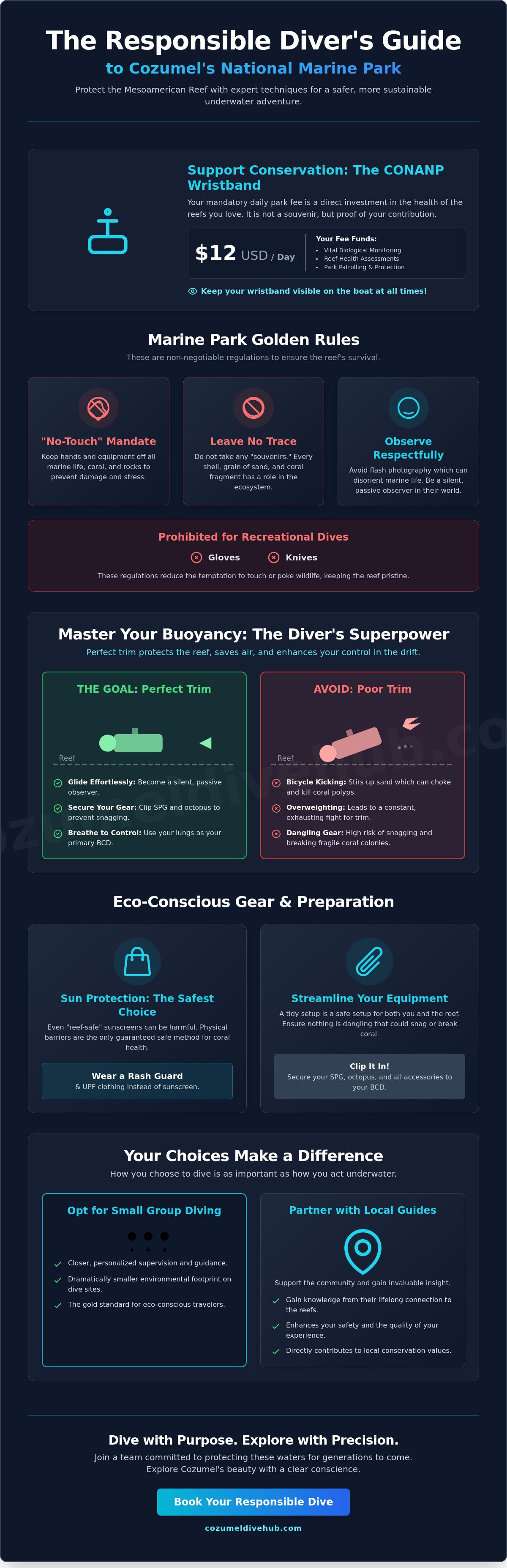
Ever wonder about that colorful band attached to your gear? It's much more than a souvenir! Every diver entering the National Park pays a mandatory daily fee, which is approximately $12.00 USD. This money goes directly back into the water you love. It funds vital biological monitoring, reef health assessments, and constant patrolling to keep illegal activities at bay. It's a small price to pay for the massive impact it has on conservation. We ask all our friends to keep their wristbands visible on the boat at all times. It shows the park rangers that we're a community of divers who truly care about the island's future.
Local Regulations Every Diver Must Know
Our reefs are breathtaking, but they're also surprisingly fragile. Cozumel's unique volcanic and coral structures can take decades to recover from a single misplaced hand or a heavy fin kick. That's why we follow a strict "No-Touch" mandate. Whether it's a curious sea turtle, a swaying sea fan, or a seemingly sturdy rock, please keep your hands to yourself. This zero-contact policy prevents us from accidentally stressing marine life or breaking delicate coral colonies. It's all about being a silent observer in their world.
We also have firm rules against taking "souvenirs." Every shell, grain of sand, and coral fragment plays a role in the ecosystem's balance, so everything stays exactly where you found it. If you're a photographer, be mindful of your gear too. Flash photography can be extremely disorienting for our nocturnal species. We want you to capture the beauty of the reef, but never at the expense of its inhabitants' well-being. Using these responsible diving practices cozumel ensures the magic remains for the next boatload of adventurers.
You might also notice that we don't allow gloves or knives for recreational dives here. It sounds simple, but it's very effective. If you aren't wearing gloves, you're much less likely to grab onto the reef for stability. Without a knife, there's no temptation to poke or prod the wildlife. These regulations help us maintain the pristine quality of our dive sites while keeping you safe and focused on the thrill of the drift!
Mastering Buoyancy: The Key to Protecting the Mesoamerican Reef
While understanding the park rules is the first step, buoyancy is the physical skill that brings those regulations to life. In Cozumel, mastering your trim is the ultimate superpower for conservation. When you achieve perfect neutral buoyancy, you become a silent observer, gliding effortlessly past towering brain corals and vibrant sea fans without ever needing to touch the substrate. This precision is vital because even a tiny scrape can remove the protective mucus layer of a coral colony, leaving it vulnerable to disease. Adopting responsible diving practices cozumel means your gear is tucked in tight, your SPG and octopus are clipped, and nothing is left dangling to snag on the fragile reef.
The physics of the Cozumel Drift add an exciting layer to this challenge. Because the current often moves at different speeds at different depths, your trim determines how much energy you expend. If you're overweighted, you'll constantly fight to keep your fins up, which often leads to accidental "bicycle kicking" that stirs up sand. This silt can settle on coral polyps and literally choke them. By fine-tuning your lung volume, you can use your breath as your primary BCD. A deep inhale provides a temporary lift to clear a reef head, while a controlled exhale helps you settle into a deeper drift. It's a rhythmic dance that saves your air and protects the environment at the same time.
Drift Diving with a 'Leave No Trace' Mindset
Weighting is everything when the current picks up. We always recommend a check-out dive, especially if you're trying out new 2026 gear like limestone-based wetsuits, which have different buoyancy characteristics than traditional neoprene. The goal is to stay "neutral" so you can glide with the water rather than fighting against it. If you find yourself needing to slow down, look for "eddies" behind large formations instead of grabbing onto the reef. This is a core pillar of responsible diving practices cozumel, ensuring our reefs remain untouched while you enjoy the ride of a lifetime.
Advanced Skills for Conscious Divers
If you're ready to truly refine your technique, many divers choose to level up their skills with Advanced Open Water Cozumel. This training emphasizes the "frog kick," a technique that pushes water behind you rather than down toward the reef. It's the preferred stroke for conscious divers because it prevents siltation and offers much better control in tight spaces. Following PADI's guide to responsible diving practices, we focus on using air and positioning for depth control, never our hands. If you want to see the most spectacular marine life while keeping the ecosystem pristine, our team at Cozumeldivehub is ready to help you nail that perfect trim on your next adventure.
Beyond Reef-Safe Sunscreen: Sustainable Gear and Prep for 2026
Preparing for your underwater adventure involves more than just checking your regulator and packing your fins. In 2026, the gear you choose and how you prep your body for the sun are central to responsible diving practices cozumel. While we've mastered the art of buoyancy and understood the park rules, the chemicals and plastics we bring onto the boat can have a lasting impact on the Mesoamerican Reef. It's time to look beyond the marketing labels and embrace a truly eco-conscious approach to our equipment.
The term "reef-safe" has become a common buzzword, but not all labels are created equal. Many sunscreens still contain harmful chemicals like Oxybenzone and Octinoxate, which can cause coral bleaching even in tiny concentrations. In fact, Cozumel enforces a ban on products containing these ingredients, along with Octocrylene and Parabens. Instead of relying solely on creams, we're seeing a massive shift toward physical barriers. Rash guards and leggings are the gold standard for protection. They don't wash off, they don't pollute the water, and they provide consistent UPF 50+ coverage throughout your entire two-tank dive.
Choosing Your Sun Protection Wisely
If you do need to use sunscreen on your face or hands, timing is everything! Always apply your mineral-based, non-nano zinc oxide sunscreen at least 30 minutes before you jump in. This allows the product to actually absorb into your skin rather than sliding off the moment you hit the water. Look for certified biodegradable brands available locally on the island. These products are designed to break down safely without stressing our delicate coral polyps. Better yet, embrace the "cool" factor of a high-quality rash guard; it's the most effective way to protect both the reef and your skin from the intense Mexican sun.
Sustainable Gear Maintenance
Your commitment to responsible diving practices cozumel continues even after the boat returns to the pier. How you care for your kit matters! When rinsing your wetsuits and regulators, skip the harsh chemical soaps. Use biodegradable, non-toxic cleaners that won't harm maritime life when they eventually wash down the drain. We're also encouraging all our divers to join the "bring your own bottle" movement. Most dive boats now provide large water carboys for refills, so bringing a reusable stainless steel bottle is an easy way to eliminate single-use plastics. Every small choice helps keep our turquoise waters pristine and our marine life thriving!
- Avoid Oxybenzone, Octinoxate, and Octocrylene in all personal care products.
- Switch to biodegradable mask defog or even simple "green" soaps.
- Invest in durable, modular gear that can be repaired rather than replaced.
- Properly dispose of old neoprene at specialized recycling centers to prevent microplastic pollution.
How Small Group Diving Enhances Conservation and Your Experience
We've all seen them; the massive "cattle boats" packed with dozens of divers all splashing into the water at once. While these big operations might seem efficient, they often create a chaotic environment that is incredibly tough on our delicate reefs. When a single guide is tasked with watching twelve or fifteen people, it's impossible to catch every stray fin or heavy landing. Choosing a more intimate boat is one of the most impactful responsible diving practices cozumel has to offer, simply because it prioritizes quality over quantity.
In a smaller group, your Divemaster acts as a true "Reef Guardian." They have the time and space to provide real-time buoyancy coaching. If they see your trim is slightly off or your fins are getting too close to a coral head, they can give you a quick signal to adjust. This personalized attention doesn't just protect the Mesoamerican Reef; it makes you a much better diver! You'll find yourself feeling more relaxed and in control, which is the heart of responsible diving practices cozumel.
The Benefits of a Low Diver-to-Guide Ratio
A low ratio means your guide is focused on your safety and your environmental footprint. They can spot potential issues before they become problems. You can see why we prioritize small group diving in Cozumel to ensure every guest feels like part of the family rather than just a number. This setting allows for faster reaction times and ensures that no one is accidentally silting up the bottom, which we know can choke fragile coral polyps. If you're ready for a more personal adventure, book your next small group dive trip with our local experts today.
Quiet Diving: Intimate Marine Life Encounters
The ocean is a world of sound, and large, noisy groups often scare away the very creatures you came to see. Our famous Splendid Toadfish and tiny seahorses are shy! They'll stay deep in their crevices if they feel the vibration of twenty sets of fins. Small groups create less bubble noise and less physical disturbance, which leads to much more intimate wildlife encounters. You get to witness natural behaviors rather than seeing an animal in flight.
This setting also makes underwater photography much more ethical. In a small group, there's no "crowding" the wildlife. Everyone gets a chance to see the animal without stressing it out or blocking its path. This fosters a wonderful community of like-minded, eco-conscious divers who share a deep respect for the natural world. It’s about sharing the passion for the ocean while ensuring we leave it exactly as we found it. We believe that by diving small, we're making a big difference for Cozumel's future.
Join the Journey: Responsible Scuba Adventures with Cozumeldivehub
Choosing your operator is the final, most important piece of your eco-conscious puzzle. At Cozumeldivehub, we don't just follow responsible diving practices cozumel because it's a trend; we do it because these reefs are our home. Our commitment to 100% CONANP compliance is the foundation of every trip we run. We believe that every time we slide into the crystal-clear waters of the National Park, we're acting as ambassadors for the Mesoamerican Reef. When you dive with us, you're joining a community that values the health of the ocean as much as the thrill of the adventure!
We've integrated environmental education into every single pre-dive briefing. Before we even hit the water, our team walks you through the specific topography of the site, the marine life we expect to encounter, and the best ways to maintain your trim in the local current. This isn't just a safety talk; it's an invitation to understand the delicate balance of our underwater ecosystem. We want you to leave the boat not just with great photos, but with a deeper appreciation for the vibrant life that calls Cozumel home.
Why Dive with Cozumeldivehub?
Our passion for the ocean is part of our heritage. Our Divemasters have a lifelong connection to these waters, having grown up watching the reefs change and thrive over decades. This deep-rooted knowledge allows us to offer a truly authentic experience that big, impersonal operations simply can't match. We specialize in small groups and private guides, allowing us to focus on the art of the drift. This means we spend more time helping you perfect your buoyancy and less time worrying about a crowded boat deck. Whether you're a seasoned pro or just starting out, we're here to guide you. You can start your path today with Cozumel beginner diving and learn the right habits from your very first breath underwater!
Book Your Eco-Friendly Dive Adventure
We've made our booking process simple and transparent for eco-conscious travelers. When you reserve your spot, you're not just booking a boat seat; you're starting a lifelong journey in marine conservation. On your first "Responsible Dive" with us, you can expect a warm welcome, expert gear checks, and a team that is genuinely excited to share the magic of the reef with you. We'll show you the hidden corners of the park that only locals know, all while ensuring our presence leaves no trace behind. Are you ready to experience the best of the island while protecting its future? Reserve your spot on our next sustainable dive trip! We can't wait to welcome you to the family and head out into the blue together!
Your Next Chapter in Marine Conservation Starts Here
Cozumel's underwater world is a masterpiece that deserves our deepest respect. By mastering your buoyancy in the drift and swapping chemical sunscreens for high-quality rash guards, you're doing more than just diving; you're actively preserving a global treasure. These responsible diving practices cozumel are the keys to unlocking more intimate wildlife encounters while ensuring the Mesoamerican Reef stays vibrant for years to come. Remember, diving small means making a big impact on conservation!
We're so excited to welcome you into our community of eco-conscious explorers. With our CONANP Certified Guides, small group guarantee, and deep local heritage, we'll make sure your journey is as safe as it is breathtaking. Our expert knowledge of these currents ensures you'll glide with confidence and care. Are you ready to dive with a purpose and see the ocean through the eyes of a local?
Start your responsible dive adventure in Cozumel today! We can't wait to share the magic of the blue with you and show you why we're so passionate about protecting our island home. Let's make your next descent the most meaningful one yet!
Frequently Asked Questions
Is it really illegal to wear gloves while diving in Cozumel?
Yes, wearing gloves is strictly prohibited for recreational divers within the Arrecifes de Cozumel National Park. This regulation is designed to discourage divers from touching or holding onto the delicate coral structures. By keeping your hands bare, you're much more likely to maintain a safe distance and rely on your buoyancy skills rather than grabbing the reef for stability. It's a simple rule that makes a massive difference!
What happens if I accidentally touch the coral during a drift dive?
Don't panic, but do take it as an immediate signal to check your buoyancy and trim. If you make contact, use your breath to lift yourself away gently rather than pushing off the reef with your hands. Please let your Divemaster know so they can help you adjust your weighting for the next dive. Practicing responsible diving practices cozumel means learning from these moments to become a more precise explorer.
Why is reef-safe sunscreen required if I'm wearing a full wetsuit?
Even with a full suit, your face, neck, and hands are still exposed to the water, and chemicals can wash off during your surface interval. Many divers also peel down their suits between dives, allowing lotions to rub off on the boat deck and eventually wash into the sea. Using mineral-based protection ensures that no matter how you're dressed, you aren't introducing harmful toxins like Oxybenzone into our vibrant ecosystem!
Does the Marine Park fee go toward local conservation efforts?
Absolutely! Your daily fee of approximately $12.00 USD is collected by CONANP and used for essential activities like reef monitoring, biological research, and park surveillance. This funding is what allows the island to maintain its protected status and fight against modern threats like Stony Coral Tissue Loss Disease. It's a direct and vital investment in the future of the Mesoamerican Reef that we all love so much.
Can I participate in lionfish hunting in Cozumel to help the reef?
Yes, but you must do so through authorized programs with permitted guides. Lionfish are an invasive species, and culling them is a fantastic way to support local biodiversity! However, you cannot hunt on your own; you must join a specialized trip where the operator has the proper permits and safety equipment. It's a thrilling way to give back to the environment while enjoying a unique and purposeful underwater challenge.
What is the best way to handle trash on a dive boat?
The best strategy is to prevent trash from ever reaching the boat by using reusable water bottles and containers. If you do have waste, ensure it's placed in a secured bin with a lid so the wind doesn't blow it into the ocean. We always encourage our guests to pick up any stray plastics they see on the deck; every little bit helps keep our turquoise home pristine and beautiful!
Are there specific areas of the reef that are closed for restoration in 2026?
Yes, CONANP frequently implements a rotational "resting" schedule where certain sections of the reef are closed to allow for natural recovery. These closures are based on current reef health assessments and vary throughout the year. Your dive operator will always have the most up-to-date list of open sites to ensure we are following responsible diving practices cozumel and giving the coral the quiet break it needs to thrive.
How can I report irresponsible diving behavior I see in the water?
If you witness someone damaging the reef or harassing wildlife, the best first step is to inform your Divemaster or the boat captain. They can address the situation immediately or report the offending operator to the National Park authorities. You can also contact the CONANP office in Cozumel directly to file a formal report if you have the boat name and date of the incident. We all have a role in protecting this paradise!