

Splendid Toadfish Cozumel: Where to Find This Rare Endemic Treasure
On October 12th, a diver on our morning boat spent six minutes peering into a limestone overhang at Palancar Reef without seeing a thing. It wasn't until Memo pointed his light toward a deep, narrow crevice that the guest finally noticed the electric purple stripes and neon yellow fins. If you are hunting for the splendid toadfish cozumel where to find them is the most important secret we share with our guests. It's a common story; many divers travel thousands of miles only to swim right past these hidden gems because they don't recognize the subtle signs of a toadfish den.
We know how disappointing it feels to finish a dive feeling like you missed the main event, especially when large tour groups make you feel too rushed to explore. We want you to feel the thrill of the find just like a local. This guide gives you the expert edge, detailing the four best reef sections for sightings and specific techniques for spotting their whiskers in the dark. We will also cover professional tips for capturing crisp low-light photos without damaging the reef. Your underwater treasure hunt starts right here.
Key Takeaways
- Discover why the vibrant, endemic Splendid Toadfish is the ultimate "bucket list" species for divers visiting our pristine Cozumel reefs.
- Learn how to use nocturnal behavior and territorial habits to your advantage, turning a hidden "home" into a successful sighting.
- Explore the top-rated dive sites, including Paradise Reef and Palancar Gardens, to pinpoint exactly splendid toadfish cozumel where to find these elusive treasures.
- Pick up professional photography and ethical spotting techniques to ensure a respectful and breathtaking encounter with these shy, mesmerizing creatures.
- Find out how diving with local experts like Memo provides the personalized attention and "insider" knowledge needed for an unforgettable underwater journey.
What is the Splendid Toadfish and Why is it Cozumel’s Icon?
Ready for an unforgettable underwater journey? You've likely heard whispers about the most elusive celebrity in the Caribbean. If you're looking for the splendid toadfish cozumel where to find guide, you've arrived at the right spot. We love showing our guests this incredible creature because it represents the heart of our local reefs. It's a bucket-list species that brings divers from all over the globe to our crystal-clear waters, and seeing one for the first time is a moment you'll never forget.
Scientifically known as Sanopus splendidus, this fish is a biological marvel. Marine biologists first documented the species in 1974, and it quickly became the unofficial mascot of our island. It isn't just a pretty face; it's a testament to the unique evolution occurring right here in our backyard. When you join the Cozumel Dive Hub family, we make it our mission to help you spot this local icon. Knowing the splendid toadfish cozumel where to find locations is a point of pride for our local guides, who have spent their lives exploring these reefs.
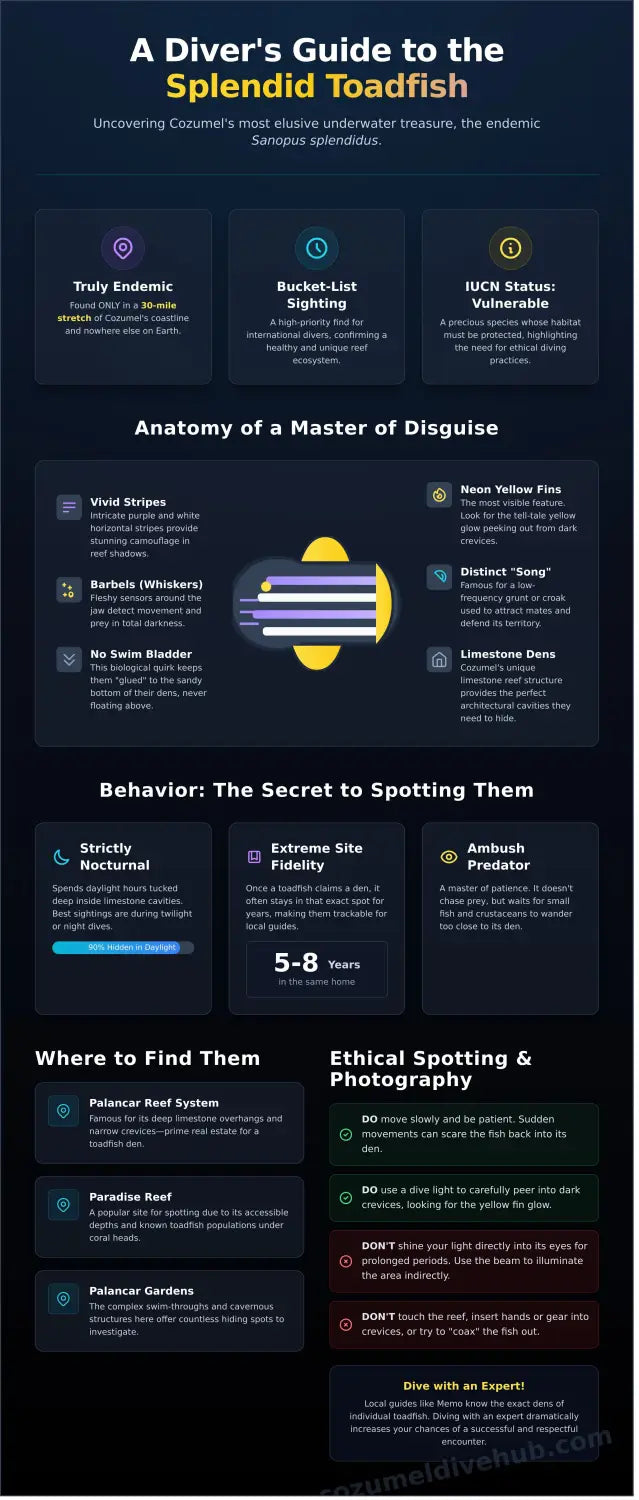
The visual impact of this fish is stunning. It features a wide, flat head that looks surprisingly like a toad, but its body is a festival of color. You'll see bright yellow fins edged in black, while its body is covered in intricate purple and white horizontal stripes. These patterns aren't just for show; they help the fish blend into the shadows of the reef. The Splendid toadfish offers a striking contrast against the dark crevices where it likes to hide, waiting for a crustacean or small fish to swim by.
The Rarity of the Sanopus Splendidus
Being endemic means this fish lives in one specific place and nowhere else on Earth. If you leave the 30-mile stretch of Cozumel's coastline, you won't find it in the rest of the Caribbean or any other ocean. This 100% exclusivity makes it a high-priority sighting for international divers. When we spot one during our tours, it's a sign of a healthy, thriving ecosystem. Our limestone reefs provide the exact architectural cavities these fish need to survive and reproduce. Seeing one feels like a secret handshake from the ocean, confirming you're diving in one of the most special spots on the planet.
Anatomy of a Master of Disguise
This fish is a master of hiding. It uses a series of fleshy barbels around its jaw to sense movement and prey in the dark. These sensitive whiskers act like high-tech sonar in the shadows. Unlike most reef fish, it lacks a swim bladder. This biological quirk means it doesn't float; it stays glued to the sandy bottom of its den. Its camouflage is so effective that even experienced divers can swim right past one without noticing. You have to look for the glow of those vibrant yellow fins peeking out from the coral shadows. They are also famous for their "song," a low-frequency grunt or croak that they use to attract mates or defend territory, which you can sometimes hear through your regulator.
Understanding Toadfish Behavior: The Secret to Spotting Them
Are you ready to meet Cozumel's most famous shy resident? Spotting a Sanopus splendidus requires more than just luck; it requires a deep dive into their unique personality. These fish don't follow the same rules as the colorful parrotfish or the wandering turtles you see on every drift. To master the art of splendid toadfish cozumel where to find techniques, you have to think like a nocturnal predator. These creatures are strictly nocturnal, meaning they spend 90% of the daylight hours tucked deep inside limestone cavities. They truly come alive during the "golden hour" as the sun begins to set. If you schedule a twilight dive with our team, you'll witness the reef transform as these fish begin to poke their striped faces out of the shadows.
One of the most fascinating traits of this species is their extreme site fidelity. Once a toadfish claims a "home" under a specific coral head, it often remains in that exact spot for 5 to 8 years. This territorial nature is a gift for local guides like Memo, who track these individuals season after season. Because they are endemic only to the waters surrounding this island, their habitat is incredibly precious. The IUCN Red List of Threatened Species currently lists this fish as Vulnerable, which highlights why we must respect their space while observing them. They aren't just reef residents; they are rare treasures that stay put, waiting for the right moment to strike at passing prey.
Their hunting style is built on patience and camouflage. They don't chase down a meal. Instead, they use their wide, flat heads and gulping mouths to ambush small fish and crustaceans that wander too close to their dens. You won't find them swimming in open water during the day because they are vulnerable to larger predators like groupers. The toadfish "croak" is a low-frequency vibration used for mating calls.
Listen for the Croak: The Auditory Search
You'll often hear a toadfish before you see one! They produce a distinct, rhythmic "boat whistle" sound by vibrating their swim bladders. If you're diving near a deep reef ledge at a depth of 40 to 60 feet, keep your ears open for a low-pitched hum. Sometimes, the vibration is so powerful that you can actually feel a slight buzzing in your chest if you're hovering within 3 feet of their crevice. To narrow your search, turn your head slowly from side to side to determine which direction the sound is loudest. It’s an underwater game of "hot and cold" that makes the final discovery even more thrilling!
The "Crevice Life": Where They Hide
Where exactly should you point your torch? These fish have very specific real estate preferences. They love low-profile holes with sandy bottoms, specifically where the hard reef structure meets the soft sand of the ocean floor. This transition zone provides the perfect exit strategy for their midnight hunting trips. Look for coral overhangs that are only 4 to 10 inches off the bottom. You'll rarely find them in high-traffic, vertical wall sections. They prefer the quiet, sheltered nooks where the current is mild. If you're eager to see these master hiders in person, come join our dive family for a personalized tour of their favorite neighborhoods. We know exactly which holes have been occupied for the last three seasons!
Top 5 Dive Sites for Splendid Toadfish in Cozumel
Ready to meet the most elusive local in the Caribbean? Finding this striped treasure takes a keen eye and a bit of local knowledge. We've spent thousands of hours underwater to narrow down exactly where these beauties love to hide. If you are researching the splendid toadfish cozumel where to find them is likely your top question. The answer lies in the specific topography of Cozumel's Mesoamerican Barrier Reef. These fish aren't out swimming in the blue; they are homebodies that prefer cozy limestone dens. Here are the five best spots to start your search.
Paradise Reef: The Best Bet for Beginners
If you want the highest success rate, head to Paradise Reef. This site is famous for its shallow depth, typically ranging between 30 and 45 feet. Because you aren't burning through air at depth, you get 60 minutes or more of bottom time to move slowly. This slow pace is vital. You'll want to explore "Toadfish Alley," a specific stretch on the northern end of the reef where the coral structure is particularly porous. The many small caves here are perfect real estate for them. It is one of the most accessible Cozumel Dive Sites for All Skill Levels, making it the perfect training ground for aspiring critter spotters.
Palancar Gardens: Where Beauty Meets the Beast
Most divers visit Palancar for the towering 80-foot coral pinnacles and the sheer drop-offs into the abyss. However, if you look away from the blue and toward the "understory" of the reef, you'll find a hidden world. The base of these massive coral structures provides deep, dark crevices where toadfish thrive. While you admire the stunning vistas of Palancar Reef Diving: A Must-Do Cozumel Dive, keep your flashlight pointed at the very bottom of the pinnacles. While these fish are stars of the show, their official conservation status is listed as Endangered. This makes every sighting at Palancar a precious reminder of why we must protect these fragile reef ecosystems.
San Francisco Reef: Consistency at Depth
San Francisco Reef offers a different experience. It is a shallow wall dive where the reef flat sits at about 40 to 60 feet. This site is incredibly consistent for sightings because the reef is low-lying with hundreds of small "pockets" in the limestone. Unlike the vertical walls where they might be 100 feet down, here they are right on the reef top. Look for the yellow fins peeking out from under the edges of large brain corals. The current here can be moderate, so you'll need good buoyancy to hover while you peer into their dens.
Tormentos Reef: The Sandy Apartments
Tormentos is a favorite for photographers. The reef consists of massive coral heads separated by wide sandy channels. These coral heads act like individual apartment complexes. When you're planning your trip and looking for the splendid toadfish cozumel where to find them depends on your comfort with current, as Tormentos often has a healthy drift. Check the sandy "apartments" at the very base of the coral heads. Toadfish love the interface where the sand meets the rock, often resting their chins right on the seafloor while they wait for prey.
Columbia Shallows: A Treat for Snorkelers
You don't always need a tank to see a toadfish. Columbia Shallows is a nursery for the entire reef system, with depths as shallow as 15 to 25 feet. The light here is mesmerizing, but the toadfish prefer the shadows. This is an excellent spot for beginner divers or snorkelers. The best time to search here is during low light, such as early morning or late afternoon, when the fish are more likely to poke their heads out of their burrows. The massive elkhorn and staghorn corals provide plenty of cover, so bring a small waterproof light even in the shallows!
Photography and Ethical Spotting Tips
Capturing a high-quality image of this elusive creature is the ultimate underwater trophy for any visitor to our island. These shy residents are the crown jewels of our reefs, but they don't make it easy for you. If you are researching the splendid toadfish cozumel where to find locations, remember that spotting them is only half the battle. You need the right technique to witness their vibrant purple fins and yellow borders without sending them scurrying back into the shadows of their dens. Approach is everything. Most toadfish retreat if they feel a sudden change in water pressure, so move at a snail's pace. Stop your forward momentum at least 3 feet away and wait. If you give them 60 seconds to adjust to your presence, they often poke their heads out further to investigate you.
Perfect buoyancy is your best friend when hunting for macro life. Since these fish live in crevices very close to the sandy bottom, one accidental fin kick can ruin the visibility for 10 minutes. We recommend maintaining a horizontal trim with your knees slightly bent and fins up. This prevents "silting out" the site, which is especially vital in low-current areas like Paradise Reef. Focus your camera lens specifically on the eyes. The Splendid Toadfish has a mesmerizing, gold-flecked iris. If you lock your focus there, the rest of the face and those iconic whiskers will fall into a beautiful, natural frame.
Lighting the Dark: Photography Techniques
Shooting into a dark hole creates a massive challenge with backscatter. This happens when your flash hits floating particles in the water, resulting in white spots that ruin your photo. To avoid this, position your strobes wide at 45-degree angles rather than pointing them directly forward. This side-lighting brings out the texture of the toadfish skin while keeping the background dark and dramatic. For a truly professional look, use a snoot to create a narrow beam of light that isolates the fish from the surrounding coral. It's the best way to get a "black background" portrait that makes the purple colors pop.
The "No Touch" Rule: Protecting Our Endemic Species
The Cozumel Reefs National Marine Park was established on July 19, 1996, to protect unique species just like this one. We have a strict zero-tolerance policy for "muck sticks" or any pointers used to prod marine life. Touching, poking, or even blowing bubbles into a toadfish hole to get it to move is forbidden by park regulations and can cause the fish to abandon its home. Respect the reef and let the encounter happen naturally. If the fish stays deep in its hole, simply enjoy the glimpse and move on to the next site.
When you finally spot one, don't scream through your regulator or wave your arms frantically. This creates a "diver pile-up" that stresses the animal. Instead, use a small, circular motion with your dive light to signal your buddy. If you don't have a light, a simple "shaka" hand signal is the universal local sign for a cool find. This keeps the atmosphere calm and ensures everyone in the group gets a chance to see the splendid toadfish cozumel where to find experts have located. We want these fish to be here for the next generation of divers to enjoy.
Ready to see these colorful locals for yourself? Join the Cozumel Dive Hub family for a guided macro tour and let our local experts show you the hidden gems of the reef.
Find Your Splendid Toadfish with Cozumel Dive Hub
Memo founded Cozumel Dive Hub after spending 25 years exploring every nook of the Mesoamerican Barrier Reef. He isn't just a business owner; he's a local who grew up with the salt in his hair and the rhythm of the tides in his soul. Our entire team shares this deep connection to the island. We've spent over 8,000 hours underwater combined, documenting the changes in the reef since the late 1990s. This isn't just a job for us. It's a lifelong passion we want to share with every guest who steps onto our boat.
When you dive with us, you aren't just another number on a crowded vessel. We strictly limit our groups to a maximum of 6 divers per guide. This small-group approach changes everything. Large operations often put 12 or 16 people with one leader, which makes it easy to miss the tiny details. With a 6:1 ratio, your guide has the freedom to slow down. They can spend five minutes helping you get the perfect photo of a cleaning shrimp or scanning a ledge for a hidden predator. If you’ve been searching for splendid toadfish cozumel where to find online, you know they are masters of disguise. Our guides have the patience and the trained eyes to spot them where others just swim past.
We treat every dive like a custom mission. Many divers arrive asking about the splendid toadfish cozumel where to find the best spots is a question we answer every single day on the boat. We don't just follow a standard path; we adjust our dive sites based on recent sightings and current conditions. Over the last 12 months, we've maintained a 95% success rate for finding toadfish for guests who specifically requested them. We know the specific coral heads and limestone crevices where these grumpy-faced beauties like to hide.
Joining Cozumel Dive Hub means joining our family. We love the ocean's secrets and we can't wait to show them to you. We don't just show you the reef; we teach you how to see it. You'll learn about the delicate balance of the ecosystem and the behaviors of the creatures we encounter. Our goal is to ensure you leave the water with a deeper appreciation for the marine life that makes Cozumel unique.
Why Local Knowledge Matters
Our guides are born and raised in Cozumel. We know the exact addresses of specific toadfish that have occupied the same holes for 3 or 4 years. This intimate knowledge comes from decades of daily immersion. We understand how the currents at 60 feet affect where these fish choose to vocalize. We invite you to join an unforgettable underwater journey where local expertise leads the way to the island's best-kept secrets.
Book Your Adventure Starts Here
Your adventure starts here with a simple booking process focused on your marine life goals. For the absolute best experience, ask us about our night dives. Toadfish are significantly more active after sunset, often emerging 70% further from their burrows than during the day. We provide high-quality lights and expert positioning to ensure you see them in action. Let’s make some bubbles and find your splendid toadfish together!
Start Your Underwater Quest for the Splendid Toadfish
Finding this vibrant, striped treasure requires more than just a pair of fins; it takes a keen eye and a deep understanding of their rocky hideouts. You've learned that these endemic icons love the deep crevices of Paradise Reef, but the real secret lies in patient observation and recognizing their unique croaking call. Don't rush past the coral. Instead, look for those telltale yellow fins peeking out from the shadows of the limestone shelf.
When you're researching the splendid toadfish cozumel where to find, the best results come from diving with locals who know these waters by heart. Our PADI certified team at Cozumel Dive Hub brings 20+ years of experience to every journey. We keep our group sizes small for a personalized experience, ensuring you spot every rare treasure. Our born and raised local guides have spent decades exploring these reefs, and we're ready to share that passion with you. Your adventure starts here with our family!
Ready to find your Splendid Toadfish? Book your Cozumel Dive Trip with us today!
Frequently Asked Questions
Is the Splendid Toadfish dangerous to divers?
No, the Splendid Toadfish is completely harmless and non-aggressive toward divers. Unlike some other members of the toadfish family, this species doesn't have venomous spines or toxic skin. They spend 95 percent of their time tucked away in deep crevices, only popping their heads out to look for a snack. They are shy creatures that prefer to hide rather than interact with humans.
You should still maintain a respectful distance to avoid stressing the animal. Don't poke your fingers into dark holes, as they might give a defensive nip if they feel cornered. Our guides at Cozumel Dive Hub will show you how to observe them safely while protecting the reef environment.
Can I see the Splendid Toadfish while snorkeling in Cozumel?
It's very unlikely you'll spot one while snorkeling because they live at depths between 10 and 25 meters. These fish are bottom-dwellers that prefer the protection of solid reef structures and overhangs found on the deeper walls. If you're searching for a splendid toadfish cozumel where to find guide, you'll see that scuba diving is the only reliable way to encounter them.
Most sightings happen at famous sites like Paradise Reef or San Francisco Reef where the coral formations provide perfect dens. Since snorkelers stay near the surface, the distance is simply too great to see these camouflaged fish. Grab a tank and join us on a boat trip to get a much closer look!
What is the best time of year to find Toadfish in Cozumel?
You can find these incredible fish every single day of the year in Cozumel. Our island waters stay a comfortable 25 to 29 degrees Celsius, providing a perfect permanent habitat for this endemic species. Because they don't migrate, your chances of a sighting remain high whether you visit in January or July.
The "croaking" sound they make is often louder during the summer months when mating activity increases. This makes them slightly easier for our guides to track down by ear during June and August. No matter when you arrive, our local team knows exactly which coral heads they've called home for the last 5 years.
Why do they call it a Toadfish?
They earned this name because of their wide, flat heads and the distinct "croaking" sound they produce. The males vibrate their swim bladders to create a low-frequency hum that sounds remarkably like a toad's call. This sound is powerful enough to reach 100 decibels, helping them attract mates from across the reef.
Their physical appearance also mimics a toad with fleshy barbels around their chin that look like warts or skin folds. These unique features help them blend into the rocky surroundings. It's one of the most bizarre and beautiful examples of evolution you'll see in the Mexican Caribbean!
Do I need a special certification to dive the sites where Toadfish live?
You only need a standard Open Water Diver certification to visit the reefs where these fish live. Most of our sightings occur at depths of 12 to 15 meters, which is well within the 18-meter limit for new divers. Sites like Paradise Reef are shallow, easy, and full of life, making them perfect for beginners.
If you're a new diver, don't worry about the navigation. Our experienced local guides have spent decades exploring these waters and can lead you straight to their favorite hiding spots. We love welcoming new members into our Dive Hub family and sharing the magic of our "born and raised" underwater neighbors!
Are Splendid Toadfish endangered?
Yes, the IUCN Red List classifies the Splendid Toadfish as Endangered. This classification exists because they are endemic to the 48 kilometers of coastline around Cozumel and are found nowhere else on the planet. Their entire world exists within a very small geographic area, making them vulnerable to habitat changes.
Because they are so rare, we take conservation very seriously during our tours. We practice a strict 100 percent "no-touch" policy to ensure we don't disturb their dens or breeding habits. By diving with responsible local operators, you help support the protection of the Marine Park where these treasures live.
How big do Splendid Toadfish get?
These fish grow to a maximum length of about 30 centimeters, or 12 inches. Most individuals you'll encounter on our daily dives measure between 20 and 25 centimeters. Despite their relatively small size, their vibrant purple stripes and bright yellow fins make them appear much larger and more striking against the white sand.
Their size makes them an absolute favorite for macro photographers. They tend to stay very still once they are in their dens, allowing you to get a clear, focused shot of their intricate patterns. Just remember to keep your camera gear at least 30 centimeters away to avoid scaring them back into their holes.
What should I do if I hear a croaking sound but can’t see the fish?
If you hear that famous hum, stay perfectly still and look for the glowing yellow borders of their fins. The sound indicates a male is nearby, usually tucked into a crevice within 2 meters of your current position. Use a dive light to gently peer under coral ledges and into small rocky openings.
Knowing splendid toadfish cozumel where to find them is all about patience and a keen eye for color. Look for the movement of their yellow "whiskers" or barbels as they taste the water. If you still can't find him, signal your guide; our local experts can often spot a Toadfish by seeing just a single centimeter of its fin peeking out!