

What It Feels Like to Breathe Underwater for the First Time: A Sensory Guide
What if your most profound moment of peace happened not on a yoga mat, but while suspended thirty feet below the Caribbean surface? It's completely natural to feel a bit of nervous energy or worry about things like claustrophobia and heavy equipment. You're likely wondering what it feels like to breathe underwater for the first time and if that first inhale will feel as calm as it looks in the photos of the Mesoamerican Barrier Reef.
We understand those jitters because our team has spent a lifetime exploring these vibrant waters, and we're here to tell you that it's actually the ultimate "meditation hack." This experience mutes the world's noise and unlocks a state of effortless, weightless flight that truly changes your perspective. It is like finding a second home. In this sensory guide, we'll walk you through the surreal shift of the underwater world to give you the confidence to take that first life-changing plunge into the blue.
Key Takeaways
- Understand the "Threshold Moment" and how your brain quickly adapts to the surreal transition from the surface to the deep.
- Learn why modern regulator technology puts you in complete control, delivering crisp and satisfying air with every inhale.
- Discover what it feels like to breathe underwater for the first time and why it is often described as a state of meditative flight.
- Overcome common anxieties by exploring the fail-safe engineering designed to keep you safe and relaxed throughout your dive.
- Find out why Cozumel’s warm, crystal-clear waters offer the most welcoming environment for your first Discover Scuba session.
The First Breath: What to Expect When You Sink Beneath the Surface
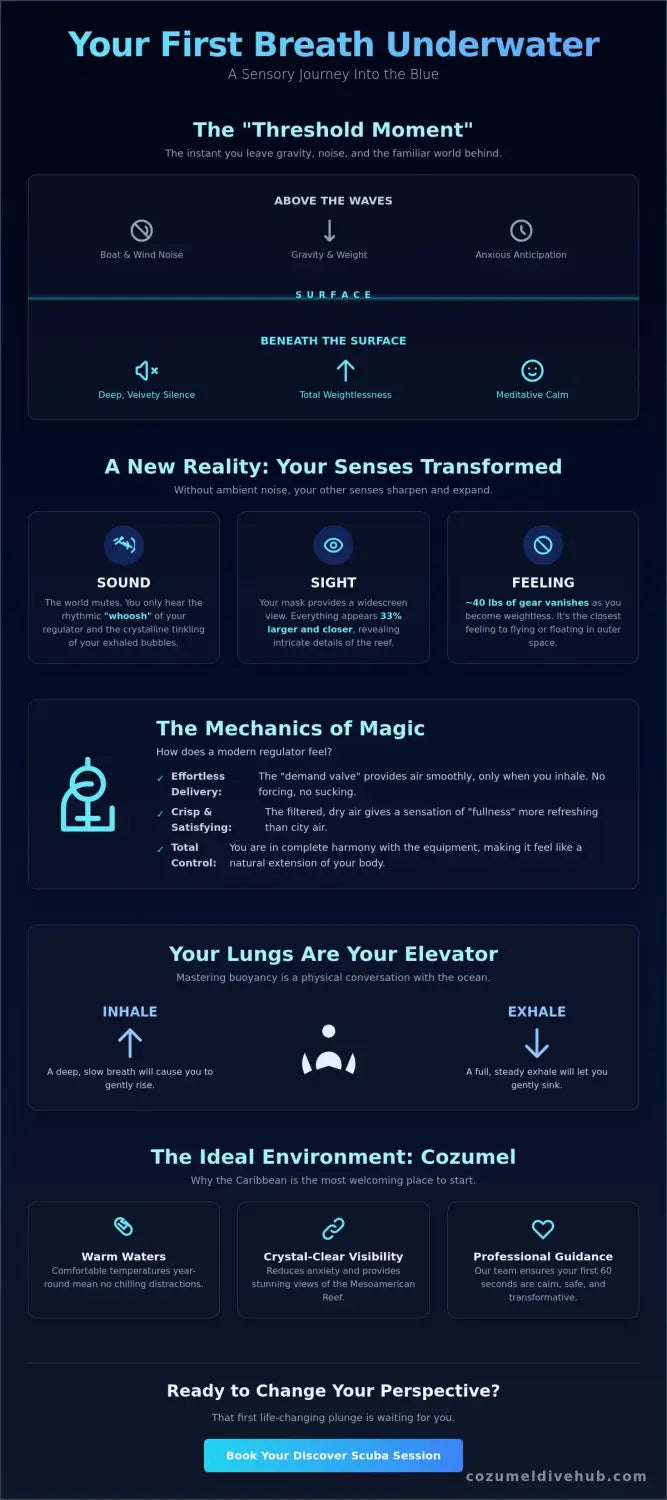
Imagine the moment your mask dips below the surface. The world above simply vanishes. It is the "Threshold Moment," a split second where you leave gravity and the familiar world behind. For most people, the first instinct is to hold their breath. Your mind is hardwired to believe that water equals a lack of air. However, as you take that first tentative inhale, the regulator provides a cool, dry, and rhythmic flow of air that immediately counters that survival instinct. This is what it feels like to breathe underwater for the first time; it's a surprising, mechanical reassurance that tells your body you're safe in a place humans weren't built to go.
The transition is almost magical. Your brain initially screams "no," but the equipment used in Scuba diving is designed to work in harmony with your natural rhythm. As you exhale, you'll see a cloud of silver bubbles rush past your face, and the realization hits: you're actually doing it. You are breathing beneath the waves. The immediate "hush" that follows is perhaps the most addictive part of the experience. The heavy roar of the wind and the chatter of the boat disappear instantly, replaced by a deep, velvety silence that lets you truly connect with the ocean.
The Sound of Silence (And Your Own Breath)
The most striking change is the audio. You'll hear a distinct "whoosh" as the demand valve opens, followed by the crystalline tinkling of your exhaled bubbles dancing toward the surface. Without the distraction of ambient noise, your other senses sharpen. You become acutely aware of the light filtering through the water and the gentle pressure of the sea against your skin. You'll find a profound peace in hearing only the steady rhythm of your own heartbeat and the soft sigh of your bubbles.
Breaking the 'Surface Tension' of Anxiety
It's perfectly normal to feel your heart racing as you prepare to descend. That's just your body's excitement disguised as nerves. The key to moving past this is focusing on your instructor's eyes. Our team is right there with you, providing a calm, professional presence that helps you find your focus. Most divers find that the first 60 seconds are the only "hard" part of the entire journey. Once you realize the air is there and you aren't going anywhere, the anxiety melts away. You're no longer a visitor; you're part of the sea.
The Mechanics of Magic: How It Actually Feels to Breathe Underwater
Forget the common myth that you'll be sucking air through a tiny, restrictive tube. In reality, the "demand valve" in a modern regulator delivers a smooth, effortless flow of air exactly when you want it. It doesn't feel forced; it feels like a gentle, natural breeze being offered to your lungs. Understanding the technical side helps you relax so you can focus on the pure joy of what it feels like to breathe underwater for the first time. The air itself is filtered and dry, giving you a sensation of "fullness" that is surprisingly crisp and satisfying. It's often cleaner and more refreshing than the air we breathe on a busy city street!
You'll quickly discover that your lungs are more than just air sacs; they are your primary tools for movement. Inhale deeply, and you'll feel yourself gently lift toward the sun. Exhale, and you settle back down toward the white sand. It's a physical conversation with the ocean where your breath dictates your position in the water column. This unique connection is a huge part of why many people find their first time scuba diving to be such a transformative life event. It turns a simple biological function into an act of grace.
Weightlessness: The Closest You'll Get to Outer Space
On the boat, you might feel the weight of the tank and vest, which can be about 40 pounds of gear. The moment you submerge, that weight simply evaporates. You are weightless. It's the closest most of us will ever get to being an astronaut exploring a distant planet. You can move in three dimensions without any pressure on your joints or muscles. Every kick is deliberate, and every turn is effortless. It feels like a beautiful, slow-motion dream where gravity no longer applies to your body.
The Visual Expansion of Your World
Your mask doesn't just protect your eyes; it provides a widescreen view of a hidden kingdom. Because of how light travels through water, everything is magnified by about 33 percent. Tiny neon gobies look like vibrant giants, and the textures of the coral appear more detailed than any high-definition screen could replicate. You'll stop just looking around and start truly observing the intricate, pulsing life of the reef. If you're ready to experience this sensory shift for yourself, booking a scuba dive course is the best way to start your journey into the blue.
Quiet Minds and Full Lungs: Overcoming the Fear of the Regulator
It is perfectly natural to feel a flicker of anxiety when you think about relying on a piece of equipment for every breath. Most new divers worry about what happens if the air stops or if they can't "pull" enough oxygen from the tank. Here is the beautiful truth: modern scuba regulators are "fail-safe" by design. This means if a mechanical malfunction were to occur, the valve is engineered to stay open, providing a constant flow of air rather than shutting it off. Understanding the physiology of breathing underwater helps you realize that your body is capable of incredible things when supported by the right technology. When you finally relax and stop "trying" to breathe, you'll find that the gear does all the work for you.
The secret to a perfect dive is a long, slow, and deep inhale. On land, we often take shallow breaths without thinking, but underwater, a rhythmic cycle keeps you calm and helps you conserve your air supply. Discovering what it feels like to breathe underwater for the first time is really a lesson in mindfulness. It is about trusting the mechanical "whoosh" of the regulator and letting your lungs expand fully. Once you find that rhythm, the fear of the equipment vanishes, replaced by a deep sense of security and wonder.
The Truth About Claustrophobia Underwater
Many people assume that being submerged will feel like being trapped in a small room. In reality, the ocean offers a sense of vastness that land rarely provides. In the gin-clear waters of the Caribbean, you can often see 100 feet or more in every direction. There are no walls, no ceilings, and no boundaries. Instead of feeling boxed in, most divers describe a sensation of total freedom. By focusing on the distant blue horizon, you expand your mental space and realize that the entire world has just become much, much larger.
Trusting the Technology of 2026
Scuba equipment has come a long way, and the gear we use in 2026 is more ergonomic and intuitive than ever before. Regulators are now designed to feel like a natural part of your jaw, reducing fatigue and making every breath feel effortless. We also prioritize redundancy. Every diver carries an "octopus," which is a completely independent backup air source ready for use at any second. Your gear is a high-tech extension of your body. When you realize how many safety nets are in place, you can stop worrying about the mechanics and start enjoying the magic of the reef.
Your First Dive in Cozumel: Why the Caribbean is the Best Place to Start
Cozumel is legendary for a reason. When you're trying to figure out what it feels like to breathe underwater for the first time, you want an environment that works with you, not against you. Here, the water is "gin-clear," often boasting visibility of 100 feet or more. This transparency is a massive stress-relief for beginners. You can see your instructor, your buddy, and the vibrant reef all at once. There is no murky green to trigger that "boxed-in" feeling. Instead, you're greeted by a vast, blue cathedral that invites you to explore.
The temperature is another secret weapon for a calm first dive. With the water hovering around a blissful 80°F, your body stays relaxed. Cold water can sometimes trigger a sharp, shallow breathing pattern; however, the Caribbean warmth allows you to maintain that slow, deep rhythm essential for a great experience. You aren't shivering or fighting the elements. You're simply existing in a liquid paradise. Discovering what it feels like to breathe underwater for the first time in these conditions feels less like a challenge and more like a homecoming.
Then there is the "drift." Cozumel is famous for its gentle currents that carry you along the reef like an underwater conveyor belt. Instead of kicking hard and getting winded, you simply float. You're flying past the towering coral formations at Palancar Reef while barely moving a muscle. This effortless movement makes the mechanical act of breathing through a regulator feel even more natural. It is pure, unadulterated flight.
Meeting the Locals: Your First Marine Life Encounters
The moment a Hawksbill sea turtle glides past your mask, your brain stops worrying about the technicalities. You become so captivated by the way its flippers move through the blue that you forget you're even wearing gear. Seeing a vibrant Queen Angelfish dart between coral fans is the ultimate distraction from any lingering nerves. If you want to know more about the colorful neighbors you'll meet, check out our guide to Cozumel Marine Life.
Small Groups, Big Confidence
We believe your first breath should be shared with friends, not a crowd. At Cozumel Dive Hub, we keep our groups small, typically with a 1:2 or 1:4 ratio. This allows your guide to give you undivided attention. They can literally "read" your bubbles; they know if you're nervous or relaxed just by watching your exhale. This personalized care builds a bridge of trust that makes the transition into the deep feel safe and familial. Ready to see the cathedrals of Palancar for yourself? Book your next Dive Trip with us and let our local experts guide your journey.
From Curious to Certified: Taking Your First Breath with Cozumel Dive Hub
The leap from curiosity to your first descent is shorter than you think. Our Discover Scuba Diving (DSD) experience is the ideal low-pressure introduction for anyone who has ever stared at the ocean and wondered. You don't need to be a competitive swimmer or a gear expert to start. This program is all about the "try dive." It lets you discover what it feels like to breathe underwater for the first time in a controlled, supportive environment. We take the mystery out of the equipment so you can focus on the sheer wonder of the Caribbean reefs.
Our process is designed to build your confidence layer by layer. We begin with a beach briefing where we break down the basics of your gear and the hand signals we use to communicate. Next, we move into waist-deep, calm water to practice a few simple skills. You'll learn how to clear your mask and find your regulator if it ever slips away. This shallow-water session ensures you feel completely in control before we head out to the reef. By the time you reach the coral, you aren't thinking about the mechanics. You're just living the adventure.
For many, that initial inhale is the start of a lifelong obsession. There is something about the silence and the weightlessness that changes your perspective forever. Once you understand what it feels like to breathe underwater for the first time, you'll realize why we are so passionate about protecting this blue world. If you fall in love with the experience, you can easily transition from your "try dive" to your full PADI Open Water Certification. We'll even count your DSD skills toward your certification course so you can keep the momentum going.
Your Journey Starts at the Hub
We believe in the "slow" learning method. No one is ever rushed or pushed past their comfort zone. At the Hub, we explain the technical "how" in simple terms so you can fully enjoy the "wow" of the reef. Let our lead instructor guide your first descent with the personalized care you deserve. We treat every guest like family, ensuring you feel safe, heard, and excited from the moment you step onto our boat.
Ready to Join the Family?
The experience doesn't end when you climb back onto the boat. There is a specific "post-dive high" that only divers understand. We love sharing those first-breath stories over a cold drink back at the shop. It's where strangers become dive buddies and memories are cemented for a lifetime. Our calendar for the 2026 season is filling up fast, so don't wait to claim your spot in the blue. Book Your First Underwater Adventure with Cozumel Dive Hub Today! We can't wait to show you our home.
Your Underwater Journey Awaits
You've explored the science behind the demand valve and the weightless freedom of neutral buoyancy. You've seen how the crystal-clear waters of Cozumel turn a nervous first breath into a lifelong memory. Now that you understand what it feels like to breathe underwater for the first time, the only thing left is to experience that magic in person. This isn't just about learning a new skill; it's about joining a global community of explorers who find profound peace beneath the waves.
We're here to make your transition into the blue as smooth as possible. With our expert local guides, small group sizes for maximum safety, and top-tier 2026 rental equipment included, you're in the best hands in the Caribbean. We treat every guest like family and take the time to ensure you're comfortable every step of the way. Whether you're curious about a single dive or ready to start a full certification, your adventure begins the moment you step onto our boat.
Start Your Journey: Book Your Discover Scuba Experience!
The reef is vibrant, the water is warm, and a whole new world is waiting for you to take that first inhale. We'll see you at the Hub!
Frequently Asked Questions
Is it hard to breathe through a scuba regulator?
Not at all! Modern regulators are designed to deliver air effortlessly with every single breath. You don't have to "pull" the air; the second stage of the regulator provides a smooth flow the moment you begin to inhale. It feels quite natural once you get past the initial novelty of being submerged.
What happens if I panic during my first dive?
Our instructors are experts at managing nerves and will be right by your side the entire time. If you feel overwhelmed, we'll signal to stop, focus on slow breathing, and ascend slightly if needed. You are never forced to stay down, and we prioritize your comfort and safety above everything else during your journey.
Can I dive if I'm not a strong swimmer?
You don't need to be an Olympic athlete to enjoy a Discover Scuba session with us. While you should be comfortable in the water and able to maintain yourself at the surface, the gear actually does the work of keeping you buoyant. Most of your movement underwater comes from gentle kicks rather than traditional swimming strokes.
Do I have to go deep for my first time?
Absolutely not! Most beginner experiences take place in shallow water between 20 and 40 feet deep. This is where the sunlight is brightest and the marine life is most abundant. Staying in the shallows helps you feel secure while you're learning what it feels like to breathe underwater for the first time.
Will my ears hurt when I go underwater?
Your ears won't hurt as long as you "equalize" early and often during your descent. We'll teach you simple techniques, like pinching your nose and blowing gently, to balance the pressure. It is just like the sensation you feel when a plane takes off, and we move slowly to ensure your ears stay comfortable.
How long does a tank of air last for a beginner?
Most beginners enjoy between 30 and 50 minutes of bottom time on a single tank of air. Your air consumption depends on how deep you go and how relaxed your breathing remains. As you settle into the rhythm of the ocean and relax your muscles, you'll find your air lasts much longer.
What does scuba air taste like?
Scuba air is filtered to be incredibly pure, so it has no real taste or smell at all. However, because the filtration process removes almost all moisture, the air can feel very dry. This is why many divers look forward to a refreshing drink of water or a tropical fruit snack immediately after surfacing.
Can I breathe through my nose while diving?
You'll breathe exclusively through your mouth while using a standard scuba regulator. Your nose will be inside the mask, which actually helps prevent water from entering your nasal passages. Learning to separate your nasal and oral breathing is a key part of discovering what it feels like to breathe underwater for the first time, but it becomes second nature quickly.