

What PADI Course to Take After Advanced Open Water? Your Next Epic Adventure
What if your next dive certification wasn't just another plastic card in your wallet, but the moment you truly transformed into a confident leader underwater? During our 2024 dive season, we've seen that many divers reach their Advanced Open Water milestone and suddenly feel like a permanent student without a clear destination. You've explored the breathtaking walls and vibrant reefs, yet you're likely asking yourself what PADI course to take after Advanced Open Water to keep the excitement alive. It's a common crossroads, especially when you're staring at a list of over 25 different specialties and wondering which one actually adds value to your skills.
We completely understand that feeling of uncertainty, and we're here to help you map out your next epic adventure. In this guide, you'll discover the best path forward, from the life-saving skills of the Rescue Diver course to the specific training that makes Cozumel's famous drift dives even more thrilling. We'll break down the most rewarding options so you can stop guessing and start diving with purpose. Get ready to find your focus and join the Cozumel Dive Hub family for your most rewarding training journey yet!
Key Takeaways
- Escape the "Post-Advanced Plateau" by mapping out a personalized journey that keeps your skills sharp and your passion for exploration alive.
- Learn why the PADI Rescue Diver course is considered the most rewarding step in your training, building the confidence to handle any underwater situation.
- Discover exactly what padi course to take after advanced open water to begin your path toward the prestigious Master Scuba Diver rating.
- Explore how Cozumel’s legendary visibility and thrilling drift dives provide the ultimate high-definition classroom for mastering advanced specialties.
- Find out how joining the Cozumel Dive Hub family for small-group training ensures you receive the personalized attention needed for an epic underwater adventure.
Beyond Advanced Open Water: Mapping Your Scuba Journey
You've done it! Earning your Advanced Open Water (AOW) certification is a massive achievement that opens up 70% of the world's dive sites. You're no longer restricted to shallow reefs; you can now drop down to 30 meters and navigate back to the boat with precision. It's an epic milestone. However, many divers hit what we call the "Post-Advanced Plateau." Statistics from global training organizations show that a significant number of divers stop their education here, thinking they've seen it all. Don't let your skills stagnate. If you're asking yourself what padi course to take after advanced open water, you're already ahead of the curve.
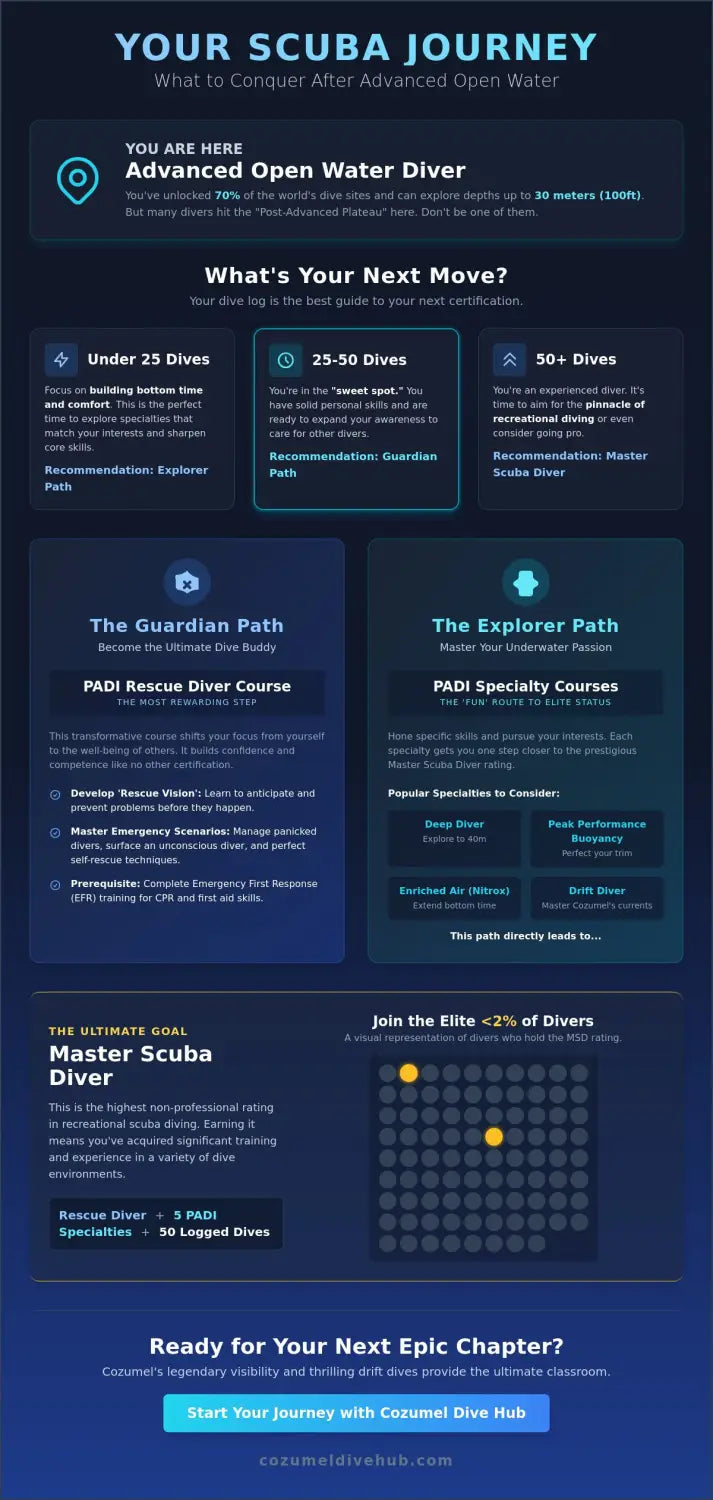
The Professional Association of Diving Instructors (PADI), which has issued over 28 million certifications since 1966, offers a structured path that branches into two main directions. Some divers feel ready to take on more responsibility, while others want to master a specific niche. Your current dive count is a great indicator of your next step. We typically recommend different paths based on your experience level:
- Under 25 dives: Focus on Specialties to build bottom time and comfort in the water.
- 25 to 50 dives: You're in the "sweet spot" for the Rescue Diver course.
- 50+ dives: It's time to look toward the Master Scuba Diver rating or even the professional ranks.
Deciding what padi course to take after advanced open water is really about choosing how you want to spend your time in the blue. Whether you want to be the hero of the boat or the master of the reef, your next adventure starts with a single choice.
The "Guardian" Path: Prioritizing Safety and Maturity
This path is for divers who want to be the ultimate teammate. It centers on the PADI Rescue Diver course. You stop focusing only on your own buoyancy and start looking at the bigger picture. You learn to spot stress in others before it becomes a problem. The "Guardian" mindset is the transition from being a guest in the ocean to becoming a proactive protector of your dive community.
The "Explorer" Path: Refining Specific Skills
If you have a specific passion, like underwater photography or exploring wrecks, this is your route. Specialties like Deep Diver or Peak Performance Buoyancy allow you to refine technical skills in challenging environments. These courses are the most direct way to earn your Master Scuba Diver rating, a title held by fewer than 2% of divers. It’s the "fun" route where you pick exactly what you want to learn.
The PADI Rescue Diver Course: The Most Rewarding Step
Ask any professional instructor which certification changed their life, and 90% will point to the Rescue Diver course. When planning what padi course to take after advanced open water, this certification stands out as the most transformative experience you can have. This is the moment you stop focusing only on your own buoyancy and start becoming a true guardian of the reef. Before you jump in, you'll complete your Emergency First Response (EFR) primary and secondary care training, plus oxygen provider basics. These skills are vital tools for any serious adventurer.
The most significant shift during this course is psychological. We call it "Rescue Vision." You'll learn to scan the boat and the reef to spot a loose tank strap or a nervous diver before they even hit the water. You'll master handling real-world emergencies, including:
- Calming a panicking diver at the surface
- Safely surfacing an unconscious diver from depth
- Perfecting your own self-rescue techniques
- Managing complex dive accidents from the shore or boat
It’s demanding, but it’s easily the most rewarding step in your diving journey. By the time you earn this certification, your confidence levels will soar.
What to Expect in the Rescue Course
Get ready for a high-energy mix of serious skill-building and adrenaline-pumping scenarios. Many divers ask if the course is as "tough" as people say. It is physically engaging, but you don't need to be an elite athlete. You just need focus and a willingness to try. The course builds toward a final "scenario day" where your instructors stage realistic emergencies. You'll lead the response and manage the scene. It’s a massive confidence booster that changes your underwater perspective forever.
Why Take Rescue with the Cozumel Dive Hub Family?
At Cozumel Dive Hub, we live by a "Safety First" philosophy. We keep our training groups small and personalized so you get the direct attention you need to master these life-saving skills. Our local experts, like Memo, bring 20 years of real-world experience from Cozumel's unique currents to your training. We don't just teach the manual; we share the wisdom of thousands of dives. If you're still reflecting on your journey, read our Scuba Diving Cozumel: The Complete Beginner’s Guide to see how your skills have evolved. Join our family and start your next chapter as the diver everyone wants as a buddy.
PADI Specialty Courses: Polishing Your Underwater Passion
Ready to level up your skills? PADI Specialty courses are where you truly find your niche and transform from a student into a confident explorer. If you are wondering what padi course to take after advanced open water, specialties are the perfect answer. These certifications act as the essential building blocks for the Master Scuba Diver rating. This is the highest non-professional level in recreational diving, a prestigious title held by fewer than 2 percent of divers globally. To reach this peak, you need five specialty certifications and 50 logged dives.
Focusing on the "Big Three" specialties allows you to tackle more complex environments with total confidence. These courses do not just add a plastic card to your wallet. They refine your trim and buoyancy, which naturally reduces your air consumption. When you are comfortable and efficient in the water, you stay down longer and see more. You can even combine courses like Deep Diver and Nitrox during a single holiday in Cozumel to maximize your time in the sun and sea. It is an epic way to turn a standard vacation into a major milestone in your diving career.
Enriched Air (Nitrox) Diver: The Essential Specialty
This is the most popular specialty on the planet for a very good reason. It is almost always the first recommendation we give when guests ask what padi course to take after advanced open water. Nitrox increases your no-decompression limits by replacing some of the nitrogen in your tank with extra oxygen. This means you get significantly more time exploring the reefs before your computer tells you it is time to head up.
In a world-class destination like Cozumel, where our team often leads multi-dive days, Nitrox is a game changer. It helps you stay safer on repetitive dives and many divers report feeling much less tired after a long day in the water. For a full breakdown of how to start this journey, check out our guide to Cozumel Specialty Diving: Your Guide to Unforgettable Underwater Adventures.
Deep Diver and Wreck Diver: Pushing the Limits
The Deep Diver specialty expands your horizon from the standard 30-meter limit to 40 meters, which is the absolute limit for recreational diving. During this training, you will learn how to manage nitrogen narcosis and plan for the faster air consumption that occurs at depth. You will practice using redundant air sources and fine-tune your safety stop procedures, ensuring every deep descent is as safe as it is thrilling.
- The Thrill of the Wreck: Once you have the depth training, the Wreck Diver course is your next logical step.
- Cozumel's Sunken Treasure: We love taking students to the C-53 Felipe Xicotencatl. This 56-meter long minesweeper was intentionally sunk in 2000 and sits upright in about 24 meters of water.
- Advanced Safety: You will master the protocols for overhead environments, including how to use reels to navigate and how to manage your gas supply in confined spaces.
These skills turn a simple sightseeing trip into a true underwater expedition. Managing your buoyancy around fragile wreck structures and understanding the psychological effects of depth makes you a more elite member of the dive community. Our family at Cozumel Dive Hub is ready to show you these hidden corners of the Caribbean with the local expertise you deserve.
Why Cozumel is the Ultimate Classroom for Your Next Course
Cozumel isn't just a vacation spot; it's a world-class training ground. When you're deciding what padi course to take after advanced open water, the environment matters as much as the instructor. Our crystal-clear water often offers visibility exceeding 30 meters (100 feet). This makes it the perfect setting for practicing Rescue Diver scenarios where you need to spot your buddy from a distance. Choosing what padi course to take after advanced open water becomes an easy decision when you see our vibrant reefs and breathtaking walls.
At Cozumel Dive Hub, our team is born and raised on these shores. Memo and the rest of our family bring local knowledge that you won't find in a textbook. We know exactly which reefs provide the best conditions for specific skills. Learning here means you're training among pristine coral gardens that make every lesson feel like an epic exploration. Your adventure starts here, surrounded by the most stunning marine life in the Caribbean!
Mastering the Drift: Cozumel’s Unique Specialty
We are the drift diving capital of the world. Mastering this skill is a total game-changer for your confidence. You'll learn negative entries to get down to the reef quickly; you'll also master how to deploy a surface marker buoy (SMB) while moving with the current. These skills make you a more relaxed diver in any ocean across the globe. Once you've handled Cozumel's famous currents, you'll feel ready to dive anywhere on the planet.
The Master Scuba Diver Challenge
Are you ready for the "Black Belt" of recreational diving? The Master Scuba Diver rating is the highest non-professional level you can achieve. To get there, you need 50 logged dives, your Rescue Diver certification, and five PADI specialty courses. It's a prestigious milestone that fewer than 2% of divers ever reach. It shows the world you've spent significant time underwater and have a wide range of experience.
Our team loves helping divers plan this journey. We can help you pick specialties that match your interests, like Deep Diving, Underwater Navigation, or Peak Performance Buoyancy. We'll map out your path so you can reach your goal in a single trip if you're ambitious. It’s a thrilling way to sharpen your skills while enjoying the most beautiful reefs in Mexico. Join us and let's make some bubbles together!
Ready for Your Next Epic Chapter with Cozumel Dive Hub?
Choosing your next step is about more than just checking a box on a certification card. It's about who you dive with and how you grow as an underwater explorer. At Cozumel Dive Hub, we believe that small groups lead to better, more confident divers. When you aren't just a face in a large crowd, you get the direct, hands-on feedback you need to master complex skills. Our team is passionate about sharing the magic of the Caribbean with you. We treat every guest like part of our local dive family. Safety isn't just a protocol for us; it's the foundation of every adventure we lead.
Your Personalized Dive Plan
If you are still wondering what padi course to take after advanced open water, Memo and our team are here to help you decide based on your specific goals. We don't believe in one-size-fits-all training. We'll work with you to build a custom schedule that fits your vacation timeline perfectly. Before you even touch the water, you can get a head start with PADI E-learning. This system lets you handle the theory at home so you can spend your time in Cozumel doing what you love: diving. We also ensure your gear is top-notch and fits comfortably for every session. If you haven't finished your previous step yet, check out our guide on Advanced Open Water Cozumel: Your Epic Next Chapter Underwater to see how we begin the journey.
Let’s Make Some Bubbles Together!
The crystal-clear waters of the Cozumel Marine Park are waiting for you. Deciding what padi course to take after advanced open water is the first step toward exploring deeper walls and more vibrant ecosystems. Imagine finishing your Rescue Diver or Deep Diver specialty and then heading out to celebrate at Palancar or Columbia reefs. These sites offer breathtaking drop-offs and towering coral structures that are truly world-class. They are the ultimate reward for your hard work and dedication to the sport. You'll see why these reefs have made Cozumel a top-tier destination for decades.
Don't wait to start your next chapter. Our local experts, born and raised on these shores, are ready to show you the hidden secrets of the reef. You can book your next PADI course and dive trip together to maximize your time in paradise. Your adventure starts here! Let's get in the water and create some unforgettable memories together.
Start Your Next Underwater Chapter Today
Your journey beneath the waves is just beginning. Whether you choose the life-changing PADI Rescue Diver course to master safety or dive into specialties like Deep Diver or Peak Performance Buoyancy, your skills are about to reach new heights. Deciding what padi course to take after advanced open water depends on your personal goals; however, the objective is always to become a more confident explorer. At Cozumel Dive Hub, our local guides were born and raised on these shores, bringing decades of intimate knowledge to every training session.
We keep our groups small with a maximum of 6 divers to ensure you get the personalized attention you deserve while we explore the Arrecifes de Cozumel National Park together. We're deeply committed to protecting these pristine reefs, ensuring they stay vibrant for generations. Memo and the entire team are ready to show you the magic of our underwater backyard. Don't let your training stall when the world's most beautiful walls are waiting for you. Join the Cozumel Dive Hub family and level up your skills today!
We can't wait to see you in the water and share an unforgettable adventure together!
Frequently Asked Questions
Do I need a certain number of dives before starting the PADI Rescue Diver course?
No minimum number of logged dives is required beyond having your Advanced Open Water certification to begin this training. You simply need to be 12 years old and hold a current EFR (Emergency First Response) certification completed within the last 24 months. Our team sees students start this journey with 20 dives or 200 dives. It is all about your readiness to look beyond yourself and help others in the water.
How long does the PADI Rescue Diver course take in Cozumel?
The PADI Rescue Diver course typically takes 2 to 3 days to complete with the Cozumel Dive Hub family. You will spend day one practicing 10 essential rescue exercises in shallow water to build your confidence. The following days involve 2 realistic rescue scenarios where you apply everything you have learned in open water. This timeline ensures you master every skill while still enjoying the vibrant energy of our island.
Can I take the Enriched Air (Nitrox) course at the same time as my Rescue course?
Yes, you can absolutely combine these two certifications to maximize your time in paradise. Many divers choose this path when deciding what padi course to take after advanced open water because Nitrox is a "dry" course with no required dives. You can finish the theory and gas analysis at our shop in about 3 hours while completing your Rescue training. It is a smart way to upgrade your skills.
What is the Master Scuba Diver rating and is it worth it?
The Master Scuba Diver rating is the highest non-professional level in recreational diving, earned by fewer than 2 percent of divers worldwide. To reach this milestone, you need 50 logged dives, your Rescue Diver certification, and 5 specialty ratings. It is a prestigious achievement that proves you have explored diverse underwater environments and built a top-notch skill set. Joining this elite group shows your deep commitment to the sport.
Do I need my own gear to take advanced PADI courses?
You do not need to own your gear, as we provide high-quality rental equipment for all our students. However, 75 percent of divers find that owning a personal mask and computer improves their comfort during advanced training. If you are wondering what padi course to take after advanced open water, having familiar gear helps you focus on new skills like navigation or search and recovery. Your comfort is our priority.
Is the PADI Rescue Diver course scary or physically demanding?
The course is challenging and rewarding rather than scary, focusing on building your problem-solving skills. You will practice lifting divers and managing simulated emergencies, which requires a moderate level of physical effort. Our experienced instructors, like Memo, guide you through every step with patience and encouragement. You will leave the water feeling 100 percent more confident in your ability to handle any situation that arises during your journey.
Which specialty is most useful for diving in Cozumel?
The PADI Drift Diver specialty is the most valuable choice for Cozumel because 90 percent of our local sites involve currents. Learning to glide effortlessly along our breathtaking walls makes your experience much more relaxing and fun. You will master entries, exits, and buoyancy control in moving water. This skill is essential for exploring the Mesoamerican Barrier Reef like a true local guide while keeping the environment safe.
Can I start my PADI course online before I arrive in Mexico?
You can start your journey immediately by signing up for PADI eLearning from the comfort of your own home. This allows you to complete 100 percent of the classroom theory before you even land in Cozumel. By finishing the digital manuals and exams early, you save 8 to 10 hours of vacation time. Your adventure starts here the moment you jump into our crystal-clear water for the practical sessions.