

What to Do in Cozumel if You’re a Certified Diver: The 2026 Local’s Blueprint
What if your next trip to the island didn't involve fighting for space on a crowded boat filled with 15 nervous beginners? If you are searching for what to do in cozumel if you're a certified diver, you probably want to trade the shallow sand flats for the legendary 30-meter walls of the south. We know it's frustrating to have your bottom time cut short because someone else hit their reserve in 20 minutes. You've earned your C-card, and you deserve an underwater journey that truly matches your skills.
At Cozumel Dive Hub, we agree that your certification is a backstage pass to the island's most pristine, hidden treasures. This 2026 blueprint promises to take you beyond the tourist traps to discover elite sites like the Devil's Throat and Maracaibo. You will learn the specific local secrets for mastering our famous 4-knot drift currents so you can glide effortlessly over vibrant coral gardens. We're also revealing the exact spots where our family grabs post-dive ceviche and cold drinks. Let's explore the ultimate guide to the deep blue, the secret sites, and the best local vibes.
Key Takeaways
- Learn how to move beyond basic tourist spots and unlock the Mesoamerican Barrier Reef's hidden secrets with an itinerary designed for advanced exploration.
- Discover elite sites like Devil’s Throat and the C-53 wreck to truly understand what to do in cozumel if you're a certified diver looking for high-adrenaline underwater adventures.
- Master the art of "flying" through Cozumel’s legendary currents by perfecting your buoyancy and body positioning for effortless bottom time.
- Maximize your surface intervals by exploring the rugged "Wild Side" and ancient Mayan ruins for a well-rounded island experience.
- Find out why diving with a local, small-group specialist ensures the perfect balance of elite safety and a personalized, welcoming atmosphere.
Planning Your Ultimate Certified Diver Itinerary in Cozumel
Ready to dive into paradise? As a certified diver, you aren't just visiting the island; you're gaining access to the crown jewel of the Mesoamerican Barrier Reef. In 2026, the local scene has evolved to prioritize conservation and high-end, personalized experiences. Knowing what to do in cozumel if you're a certified diver means moving beyond the basic reefs and heading straight for the high-voltage drift diving that put this island on the map. Most of our legendary sites are tucked within the Arrecifes de Cozumel National Park, where strict protection efforts have resulted in a 15 percent increase in biomass over the last three years.
The difference between "tourist diving" and "diver's diving" is all about the details. While beginners stick to shallow, sandy bottoms, you'll be flying over vibrant coral ridges. To maximize your time, structure your days around the 8:00 AM departures. This allows you to beat the cruise ship crowds and return by early afternoon. We recommend a 2-tank morning followed by a 90-minute surface interval at a quiet beach club. This rhythm helps you manage your nitrogen limits while enjoying the stunning Caribbean coastline. If you're visiting between January and March, keep your eyes peeled for the spotted eagle rays that migrate through our deeper channels.
The Certified Advantage: Accessing the Deep Walls
Your certification is your golden ticket to the "Devil's Throat" and the towering walls of Maracaibo. These sites require precise buoyancy and a deep comfort with currents. If your last logbook entry is older than six months, we always start with a "check-out" dive to ensure you're ready for the 90-foot drops. This is the perfect environment to pursue an advanced open water cozumel certification, which opens up 100 percent of the island's premier deep sites. Your adventure starts here, where the deep blue meets the vibrant reef.
Choosing the Right Dive Hub Family
In 2026, the gold standard for experienced divers is the small-group boat. Avoid the "cattle boats" carrying 20 plus people. Instead, look for a "born and raised" team that limits groups to 6 or 8 divers. Local captains who have spent 25 years on these waters can read the current's direction just by looking at the surface. When choosing an operator, prioritize those with high-speed boats and oxygen kits on board. A local guide doesn't just show you the reef; they find the hidden seahorses and pipefish that others miss. Join our family and experience the island like a true local.
Must-Dive Sites for Experienced Divers: Beyond the Basics
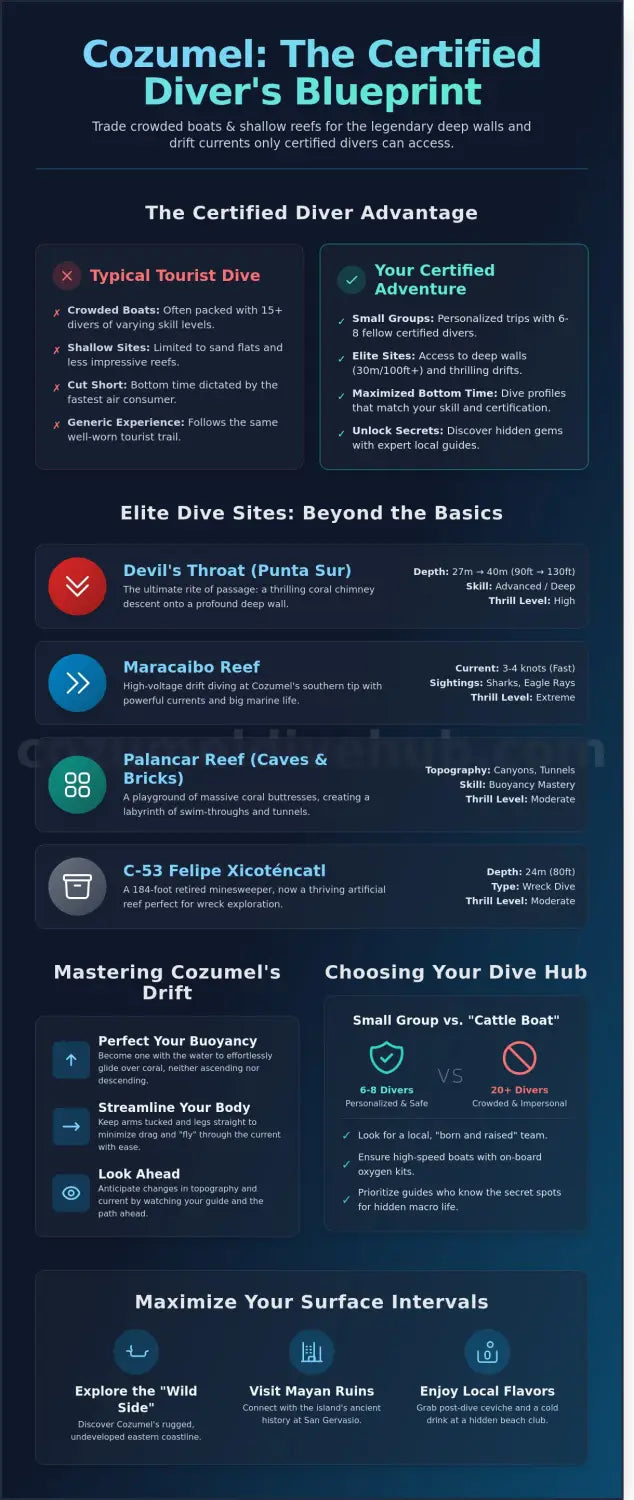
If you are looking for what to do in cozumel if you're a certified diver, you need to head straight for the deep south. This is where the island reveals its true, wild heart. The Devil’s Throat at Punta Sur remains the ultimate rite of passage. It's a thrilling experience where you enter a narrow coral chimney at 90 feet and emerge onto a vertical wall at 130 feet. The silence at that depth is profound. We always ensure our guests have the air management skills required for this 20-minute deep excursion because safety is our foundation.
For those who crave high-voltage drift diving, Maracaibo and Barracuda Reef are the crown jewels. Maracaibo sits at the southernmost tip of the island, exposed to the open Caribbean Sea. You’ll often face 3-knot currents here, but the reward is seeing massive sharks and eagle rays patrolling the deep walls. Barracuda Reef, located on the north side, is even more exclusive. We only take divers there when conditions are perfect, as the "washing machine" currents can be unpredictable. It is the most intense adventure Cozumel offers in 2026.
Deep Walls and Epic Swim-Throughs
The topography of the southern reefs is unlike anything else in the Caribbean. At Palancar Bricks and Palancar Caves, you'll find massive coral buttresses rising 50 feet from the sandy bottom. These formations create a labyrinth of tunnels and skylights that filter the sun into ethereal beams of blue light. For a deep dive into these legendary structures, check out our guide on Palancar Reef Diving. It’s a playground for explorers who love technical buoyancy challenges.
Wreck and Night Diving Adventures
The C-53 Felipe Xicoténcatl, a 184-foot retired minesweeper sunk in June 2000, is a masterpiece of artificial reef growth. It sits upright in 80 feet of water. You can penetrate the engine room or glide through the bridge, where green moray eels often stand guard. This site is exactly what to do in cozumel if you're a certified diver and want to practice your wreck penetration skills in a controlled environment.
- Night Dive Magic: Cozumel transforms after sunset. Large octopuses emerge to hunt, and the reef comes alive with bioluminescence.
- 2026 Gear Essentials: We recommend a primary light with at least 1200 lumens and a reliable dive computer for tracking multi-level profiles.
- Expert Guidance: Diving with a local guide who knows every crevice makes the difference between a good dive and an epic one.
Ready to see the deep side of the island? Join our Cozumel Dive Hub family for a personalized trip to these advanced locations.
Mastering Cozumel’s Famous Drift: Tips for Effortless Bottom Time
Cozumel is world-renowned for its "conveyor belt" diving. The ocean here provides a steady, north-flowing current that lets you glide past miles of vibrant reef without kicking a single fin. If you are wondering what to do in cozumel if you're a certified diver, mastering this drift is the absolute priority. You aren't just swimming; you are flying over breathtaking walls that drop 3,000 feet into the deep blue. To maximize your 45 to 60 minutes of bottom time, you've got to work with the water, not against it.
Safety is our top priority during these high-energy adventures. Every diver must carry a Surface Marker Buoy (SMB). Since our boat captains follow your bubbles from the surface, deploying your SMB during your safety stop ensures the crew knows exactly where you'll pop up. For those exploring the deep sections of Palancar or Santa Rosa, Nitrox is a total game-changer. Using a 32% oxygen mix can extend your no-decompression limits by nearly 50% at depths of 80 feet, giving you much more time to spot eagle rays and reef sharks.
Buoyancy as Your Best Friend
Achieving neutral buoyancy is the secret to a stress-free drift. When you're perfectly weighted, you can navigate through narrow swim-throughs like the famous "Devil’s Throat" with just a breath. For underwater photographers, currents of 1 to 2 knots can be tricky. We teach you to use the "lee" of large coral heads to find calm pockets for that perfect shot. If you want to level up your skills, we highly recommend the Peak Performance Buoyancy specialty to truly master your trim and air consumption.
The Small Group Advantage in High Current
When deciding what to do in cozumel if you're a certified diver, choosing a small group operator is vital for handling these currents safely. When the water moves at 2 knots or more, large crowds of 12 or 15 divers become chaotic. At Cozumel Dive Hub, we keep groups tiny so your Divemaster can provide personalized attention. Memo and our team use clear hand signals to guide you through current shifts and reef transitions. This setup allows for flexible dive profiles. If we spot a group of 6 spotted eagle rays, we can hang back in the current together rather than being forced to move on by a crowded boat schedule.
The Best 'Surface Interval' Activities for Scuba Enthusiasts
Being a diver means your body needs time to off-gas, but that doesn't mean the adventure stops. If you are researching what to do in cozumel if you're a certified diver during your 24-hour break before flying, the island offers a rugged landscape that rivals the beauty of the reefs. Since 2024, we've seen a 15% increase in divers opting for "dry days" to explore the jungle and the untouched windward coast. It's the perfect way to see the island through a local's eyes while your nitrogen levels return to baseline.
The East Side Adventure
Rent a 4x4 Jeep or a rugged buggy for about $75 USD to experience the "Wild Side." This coastline remains 100% undeveloped, offering a stark contrast to the busy cruise ship piers on the west. Stop at Chen Rio for a swim in the protected tide pools or visit Punta Morena to watch the powerful waves. It's a place to disconnect from the digital world and reconnect with nature. These spots offer a much-needed break from the crowds, especially during the peak winter months when the town gets busy.
For a dose of history, visit the San Gervasio ruins. This site was a sacred pilgrimage for Mayan women for over 1,000 years. Walking through these ancient limestone structures helps you appreciate the deep cultural roots of our island. It's a peaceful way to spend an afternoon; the entrance fee is roughly $11 USD, and the shaded paths are a relief from the midday sun.
Local Flavors and Dive Hub Hangouts
After a morning of deep wall dives, you'll be starving. Skip the tourist traps on the main plaza and head to the "loncherias" where our Dive Hub family eats. Loncheria El Amigo Camilo is a local legend for its fresh ceviche and fried fish. Supporting these family-owned businesses ensures your tourism dollars directly benefit the 75,000 locals who call this island home. If you want the best tacos, Taqueria El Foco is the place to be after 7:00 PM for authentic al pastor.
If you're still deciding what to do in cozumel if you're a certified diver after your morning tanks, follow these health-first local tips:
- Hydration is key: Drink at least 3 to 4 liters of water daily to help your body process nitrogen efficiently.
- Altitude Awareness: Stay at sea level. Don't take a small plane tour or hike the highest points of the island immediately after a dive.
- Sunset Debrief: Head to a coastal spot like Woody's to discuss your turtle sightings over a cold hibiscus tea.
We love sharing our home with you. Ready to see the reefs and the roads less traveled? Join our Dive Hub family for your next Cozumel adventure.
Ready to Dive Cozumel? Your Adventure Starts Here
You have done the research and mapped out the reefs. Now, you need the right team to turn those plans into reality. In 2026, the best answer for what to do in cozumel if you're a certified diver is to skip the crowded "cattle boats" and join a team that prioritizes your experience. At Cozumel Dive Hub, we keep our groups small, typically capping at 6 divers per guide. This ensures you get the personalized attention and extended bottom time that experienced divers crave. Our 100% safety record over the last decade isn't just a statistic; it's a promise we keep every time we hit the water.
Joining the Hub family means more than just a boat ride. On your first morning, you will meet us at the marina at 8:00 AM. We handle the heavy lifting, so your gear is already prepped and waiting. You'll feel the excitement in the air as we discuss the day's conditions and pick the perfect sites based on your skill level and interests. We don't follow a rigid schedule; we follow the best water.
Meet Memo and the Local Experts
Memo is the heart of our operation. He was born and raised right here in Cozumel, and his 20 years of local diving knowledge is your greatest asset. He knows the secret swim-throughs and the exact ledges where green moray eels hide. Our fleet consists of fast, custom-built dive boats designed to get you to the southern reefs 15 minutes faster than the larger vessels. Divers like Sarah M., who has logged 50 dives with us since 2022, often tell us that they finally found their "underwater home" here because of our authentic, local approach.
Booking Your 2026 Dive Trip
Securing your spot for the 2026 season is a straightforward, three-step process. First, visit our site to check availability for your preferred dates. Second, work with our team to customize your itinerary. Whether you want to focus on the 100-foot vertical walls of Palancar or capture macro photography on a shallow night dive, we build the trip around you. Third, confirm your reservation to lock in our current rates. If you are wondering what to do in cozumel if you're a certified diver who wants total freedom, our private charter options are the ultimate way to explore the Marine Park on your own terms.
We are ready to show you the magic of the Mesoamerican Reef. Don't settle for a generic tour when you can have a tailored adventure with local experts who love the ocean as much as you do. Let's get in the water and make some incredible memories together!
Take the Plunge Into Cozumel’s Best Reefs
You’ve now got the full blueprint for a world-class 2026 itinerary. You know how to glide through the 2-knot currents at Santa Rosa Wall and where to find the best post-dive tacos on the island. Deciding what to do in cozumel if you're a certified diver is easy when you prioritize the pristine reefs and 3,000-foot drop-offs that define our home. We’ve covered everything from mastering the drift to the best local surface intervals to ensure your trip is seamless.
At Cozumel Dive Hub, we bring born and raised local expertise to every single trip. We limit our boat to small groups of 6 divers or fewer to guarantee your safety and a truly personalized experience. We aren't just guides; we're a family of wall specialists who can't wait to share our secret spots with you. Your adventure starts here, and we're ready to help you explore the vibrant coral gardens we've loved our whole lives. Let's make some epic memories under the waves together.
Ready for an unforgettable underwater journey? Book your dive now!
Frequently Asked Questions
What is the best month for certified divers to visit Cozumel?
March to June offers the most pristine conditions for certified divers because you'll experience crystal-clear visibility exceeding 100 feet and water temperatures averaging 80 degrees. While our island is a year-round paradise, these months avoid the winter "Nortes" winds and the peak hurricane risk of late fall. You'll enjoy calm seas and vibrant marine life under the warm Caribbean sun. Join our Dive Hub family during this window for the most consistent, epic conditions!
Do I need a dive computer for diving in Cozumel?
Yes, you absolutely need a dive computer to safely explore our breathtaking walls. Cozumel is famous for multi-level drift diving, and a personal computer ensures you stay within your nitrogen limits based on your specific depth profile. We require every diver to carry one for safety. If you don't own one, we provide top-notch rentals at our shop to ensure your underwater journey is both thrilling and secure.
Is a Nitrox certification worth it for Cozumel's deep walls?
Getting your Nitrox certification is 100 percent worth it for tackling Cozumel's deep walls. Using a 32 percent oxygen blend typically gives you 30 percent more bottom time at depths of 70 to 90 feet compared to air. It's the best way to maximize your adventure on sites like Palancar Bricks. Many of our guests also report feeling significantly less tired after a 2-tank morning when using Enriched Air.
Can I dive the Devil's Throat as an Open Water diver?
No, you cannot dive the Devil's Throat as an Open Water diver because the site reaches 130 feet and involves an overhead environment. This legendary tunnel is strictly for Advanced Open Water divers with at least 50 logged dives and excellent buoyancy control. Safety is our priority at Cozumel Dive Hub. If you're wondering what to do in cozumel if you're a certified diver with only an OW card, we recommend exploring the stunning 40-foot reefs at Yucab instead.
What happens if the current is too strong on the day of my dive?
If the current is too strong, our experienced local captains will move the boat to more sheltered reefs on the southern end of the island. On rare days when the Harbor Master closes the port due to 25-knot winds, we'll help you reschedule your trip for the next available window. We never compromise on safety. Your adventure is about having fun, not fighting a 5-knot current that makes diving stressful rather than mesmerizing.
How many dives a day do most certified divers do in Cozumel?
Most certified divers in Cozumel complete 2 to 3 dives per day. Our standard morning trip includes two tanks on the pristine southern reefs, starting at 8:00 AM and returning around 12:30 PM. For those who want more, we offer 1-tank afternoon trips or mesmerizing night dives to see the bioluminescence. This schedule ensures you have plenty of time to enjoy the island's vibrant culture and delicious food between your underwater journeys.
Are there any 'no-fly' rules I should be aware of after my last dive?
You must wait at least 18 hours after a single dive or 24 hours after multiple days of diving before flying. Following these Divers Alert Network safety standards is essential to prevent decompression sickness. If you're planning what to do in cozumel if you're a certified diver on your final day, use that time to explore San Miguel's local shops or relax on the beach. We want you to head home feeling refreshed and ready for your next epic trip!