

What to Expect on Your First Drift Dive: A Beginner’s Guide to Cozumel’s Underwater Flight
Last December, a diver named Sarah sat on our boat deck at Palancar Gardens with wide eyes, gripping her fins as she stared at the moving surface of the Caribbean Sea. Like 85% of new visitors to Cozumel, she was worried about being swept away or losing sight of the boat in the legendary current. It's completely natural to feel a bit of "current anxiety" before you jump in. Understanding what to expect on your first drift dive is the secret to turning that nervous energy into pure excitement. You aren't fighting the ocean here; you're joining it.
We've spent over 15 years guiding divers through these pristine waters, and we promise that once you master the "underwater flight," you'll never want to kick again. This guide will show you exactly how to handle a negative entry without stress and how to use the current to glide effortlessly past our breathtaking walls. We'll walk you through the boat briefing details and the simple tricks our local guides use to keep the group together. Your adventure starts here, and by the end of this page, you'll be ready to dive into paradise with total confidence.
Key Takeaways
- Experience the magic of "underwater flight" as you learn how Cozumel’s unique currents turn a standard dive into an effortless, gliding journey.
- Master the essential procedures and learn exactly what to expect on your first drift dive, including the critical "negative entry" technique.
- Stop fighting the water and start drifting by discovering why the #1 beginner mistake is trying to swim against the current.
- Preview the breathtaking coral pinnacles and vertical drops of Palancar and Columbia Wall that make this island the world’s drift diving capital.
- See how diving with local experts like Memo in a small group setting provides the safety and personal connection needed for a truly epic adventure.
What is Drift Diving? Welcome to Underwater Flight
Imagine floating through a vibrant liquid world without moving a muscle. That's the magic of a drift dive. To understand the basics, What is Drift Diving? is essentially a technique where the ocean current acts as your personal conveyor belt. Instead of fighting the water, you simply relax and let the flow carry you along the reef. Our boat captains at Cozumel Dive Hub are experts at tracking your bubbles from the surface. They follow the group's progress closely, so the boat is always right there when you're ready to surface.
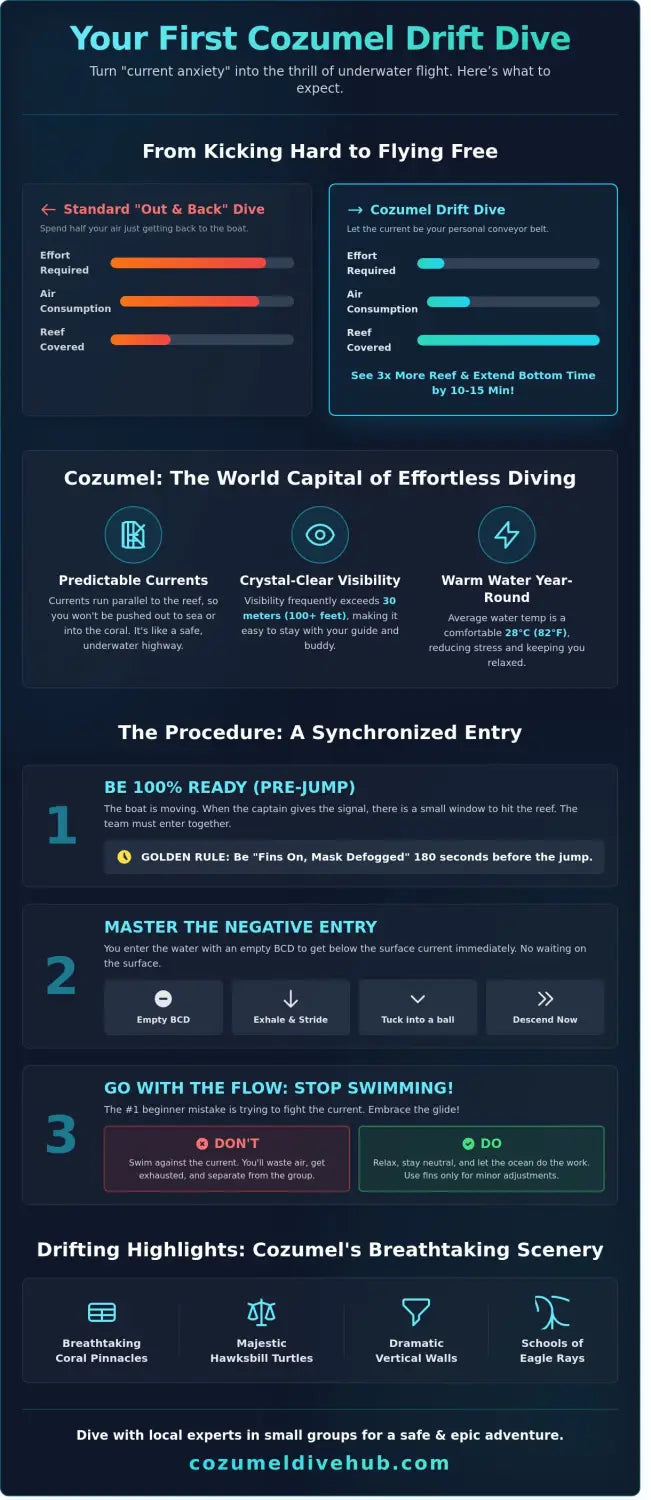
You won't find any "out and back" swimming here. In a standard dive, you often spend half your air just getting back to the anchor line. Here in Cozumel, you start at point A, glide for 45 to 60 minutes, and finish at point B. It's the ultimate way to see more of our 27-kilometer reef system with zero effort. We make sure every guest feels like part of our dive family from the moment they step onto the deck. We want you to feel the same passion for these waters that we do.
Many beginners feel nervous about currents at first. They quickly realize it's actually more relaxing than stationary reef diving. You don't have to kick constantly to stay in one place or navigate your way back to a fixed point. This is why our island is recognized as the world capital of effortless drift diving. When you're wondering what to expect on your first drift dive, think of it as a guided tour where nature does all the heavy lifting. Our team ensures you feel safe and supported every step of the way.
Why Cozumel is the Perfect Place for Your First Drift
The Mesoamerican Barrier Reef provides a unique underwater geography that makes learning easy. Our currents typically run parallel to the massive coral walls. This means you won't get pushed out into the deep blue or into the reef itself. You'll enjoy crystal-clear visibility that frequently exceeds 30 meters. This visibility is vital for keeping an eye on your dive buddy and your guide. Plus, with water temperatures averaging 28 degrees Celsius (82 degrees Fahrenheit) year-round, your body stays relaxed. This warmth reduces the physical stress of the environment and keeps your mind focused on the beauty around you.
The Sensation of Flying
There's nothing quite like the feeling of hovering motionless while the scenery changes around you. It feels exactly like underwater flight. Because you aren't fighting a current, your heart rate stays low and you use much less air. This often extends your bottom time by 10 or 15 minutes compared to a standard shore dive. Drift diving is an effortless journey where the ocean provides the propulsion.
It allows you to cover three times more reef area than a traditional stationary dive. You'll see schools of eagle rays, hawksbill turtles, and massive groupers pass by as you simply "hang" in the water. Understanding what to expect on your first drift dive starts with embracing this total lack of physical exertion. It's a peaceful experience that leaves you energized rather than exhausted. Most of our divers find that once they try the Cozumel style, they never want to go back to kicking against the current again.
The Procedure: Stepping into the Blue
The boat ride toward the southern reefs of Cozumel is an experience in itself. As the turquoise water turns a deep, royal blue, the energy on the deck shifts. Unlike a standard reef dive where the boat anchors and you casually roll in, drift diving requires a synchronized rhythm. Understanding what to expect on your first drift dive starts with the realization that the boat is constantly moving. You aren't just a passenger; you are part of a team. At Cozumel Dive Hub, we’ve refined this process since 2018 to ensure every guest feels like a pro from the moment they stand up.
Being 100% ready before the boat reaches the drop zone is the golden rule. When the captain cuts the engines, there is a small window of opportunity to hit the target reef. If one person is still searching for a stray fin or adjusting a weight belt, the entire group might drift past the best coral formations. We ask our divers to be "fins on and masks defogged" at least 180 seconds before the jump. This readiness allows for a calm, professional entry rather than a rushed scramble. If you want to prepare your skills before your trip, the PADI Drift Diver course offers a fantastic foundation for these specific procedures.
Mastering the Negative Entry
A negative entry means you enter the water with an empty BCD and immediately begin your descent. You don't wait at the surface to check your gauges. Instead, you exhale, take your giant stride, and tuck into a ball to get below the surface current. This technique is essential in a 2-knot current to keep the group together. A common mistake is fiddling with a mask or snorkel upon entry. In Cozumel, 20 seconds of hesitation on the surface can result in drifting 50 feet away from your dive buddies.
Once you are submerged, the chaos of the surface disappears. You will meet the rest of the group at a pre-determined depth, usually around 15 or 20 feet. This "meeting at depth" strategy is far more comfortable than fighting waves and boat exhaust at the surface. It’s the moment where the adrenaline of the entry transforms into the weightless peace of the dive. You are now part of the current, moving at the same speed as the water around you. It’s one of the most exhilarating parts of what to expect on your first drift dive.
The Role of the Divemaster and Captain
Our captains were born and raised on these shores, and their expertise is your greatest safety net. They use a technique called "bubble watching" to track our path. Since the boat isn't anchored, the captain follows the group's bubbles from above. The Divemaster carries a bright orange Surface Marker Buoy (SMB) throughout the entire journey. This acts as our group flag, showing the boat exactly where we are at every second. You never have to worry about swimming back to a parked boat; the boat follows you.
The pickup is the ultimate valet service. When the dive concludes and we complete our safety stop, we surface as a group. Within moments, the boat will approach. The captain maneuvers the vessel so the ladder is within easy reach, usually less than 30 feet away. You simply hand up your weights, climb aboard, and start sharing stories about the eagle rays you just saw. It’s a seamless, high-energy process that makes you feel like a VIP. Ready to feel the rush? You can explore our Cozumel dive packages to find the perfect underwater adventure for your skill level.
The Golden Rule: Stop Swimming and Start Drifting
The absolute biggest mistake 90% of beginners make during their first drift is trying to fight the ocean. It's a natural instinct to want to kick when you feel yourself moving, but swimming against or even across a 2-knot current is a losing battle. You'll quickly find yourself exhausted and low on air before the 20-minute mark. When you learn what to expect on your first drift dive, you'll realize that the current is your friend. It's an underwater conveyor belt designed to show you the reef with zero effort. Your job is to relax and let the water do the heavy lifting while you enjoy the scenery.
Think of your fins as rudders rather than propellers. Instead of big, powerful kicks, use small, intentional movements of your ankles to tilt your body. If you want to move closer to the reef wall, angle your fins at a 45-degree slope to catch the water flow. This subtle technique allows you to navigate the terrain without breaking a sweat. In a drift, your fins are for steering, not for speed.
Buoyancy control is the real secret to mastering the "ups and downs" of a Cozumel drift. As the current pushes you over a reef structure or down a wall like Palancar, the depth can change by 5 or 10 meters in seconds. You must anticipate these changes. If you see a coral head approaching, add a tiny burst of air to your BCD early. If you wait until you're right on top of it, the current might pin you against the structure. Mastering this "neutral glide" keeps you safe and protects our delicate coral ecosystems.
Streamlining your gear is another non-negotiable step for a successful drift. Every dangling gauge or loose strap creates drag, which can pull you out of position. Use clips to keep your SPG and octopus within a 30-centimeter profile of your body. This prevents "snags" on the reef and ensures you move through the water like a sleek Caribbean reef shark rather than a parachute.
Managing Your Position in the Group
Stay roughly 2 to 3 meters down-current of your Divemaster at all times. This ensures you're the first to see the eagle rays or turtles they point out. If you need a break, look for "eddies" behind large coral heads or limestone outcroppings. These 1-meter pockets of still water offer a perfect spot to adjust your mask or wait for your buddy. Always stay side-by-side with your buddy; if you go front-to-back, the person in front will quickly disappear into the blue.
Air Consumption and Relaxation
One of the best parts of what to expect on your first drift dive is the incredible bottom time. Because you aren't constantly kicking, your heart rate stays low. This often leads to a 15% to 20% reduction in air consumption compared to stationary dives. Focus on slow, deep breathing as you glide over the vibrant Palancar gardens. When you stop working against the environment, you'll find that a standard 80-cubic-foot tank can easily last 50 to 60 minutes of pure, effortless exploration. Welcome to the easiest "flight" of your life!
What You’ll See: Cozumel’s Drifting Highlights
Get ready for a visual feast that most divers only dream about. When you start wondering what to expect on your first drift dive, think of it as a front-row seat to a high-speed underwater movie. In Cozumel, our reefs aren't just static rocks; they're bustling cities of life that you glide through with zero effort. We've spent decades exploring these waters, and the thrill of the "Mexican drift" never gets old for our family at Cozumel Dive Hub.
Palancar Reef is often the first stop for many of our guests. You'll glide past towering coral pinnacles that rise from 80 feet up to just 20 feet below the surface. These structures look like underwater cathedrals. The current carries you through wide swim-throughs and limestone arches where sunlight filters down in shimmering beams. It's a surreal experience that makes you feel weightless and powerful at the same time.
Columbia Wall offers a different kind of rush. Here, the reef edge drops off into a 3,000-foot abyss of deep, royal blue. You'll hover along the vertical precipice, watching massive barrel sponges that have lived for over 100 years. The scale is immense. It's common to see 85% of our divers emerge from this site with wide eyes, completely mesmerized by the sheer magnitude of the drop-off.
The marine life here has adapted perfectly to the moving water. You'll notice Hawksbill turtles tucking their flippers to "fly" alongside you. They use the current to conserve energy, just like we do. Keep your eyes peeled for the Splendid Toadfish, a species found 100% exclusively in Cozumel. These vibrant, yellow-finned treasures hide in small crevices. Since we drift at a steady 1 to 2 knots, your guide will point out these endemic beauties as you pass by their rocky dens.
Spotting Large Pelagics
Currents are the ocean's nutrient highways, and they attract the big players. Between November and March, we enter Eagle Ray season. It's common to see schools of 10 to 15 Spotted Eagle Rays soaring against the current like a squadron of underwater gliders. If a 6-foot Nurse Shark or a Caribbean Reef Shark enters the drift, stay calm. Maintain your buoyancy and enjoy the show. These animals are indifferent to divers; they're simply navigating the same blue road you are.
Photography Tips for Drift Divers
Capturing the perfect shot during a "drive-by" dive requires a specific strategy. Ditch the bulky camera rigs with long strobe arms. In a current, these act like sails and will pull you off course. We recommend a compact camera with a 10-inch tray or a short selfie stick for stability. Roughly 70% of great drift photos are ruined by motion blur, so use a fast shutter speed. Most importantly, never let the lens distract you from your depth or your buddy. Safety is always our top priority, so keep your eyes on the reef as much as the viewfinder.
Are you ready to witness the magic of the Mesoamerican Reef for yourself? Book your drift diving adventure with our local experts and let Memo and the team show you the best of Cozumel!
Join the Hub: Your Adventure Starts Here
Your journey into the deep blue should never feel like a factory assembly line. At Cozumel Dive Hub, we treat every descent like a shared mission among friends. Memo and our dedicated team of instructors grew up in these waters, literally. We've spent over 25 years studying how the Caribbean current hugs the island's limestone coast. This deep-rooted local expertise is the secret to a stress-free experience. When you dive with us, you're not just a customer; you're part of our dive family. We've built our reputation on the idea that the best dives happen in small, intimate groups where everyone feels seen and supported.
We focus on quality over quantity, capping our groups at 6 divers per guide. This ratio is vital for understanding what to expect on your first drift dive. Our briefings go far beyond the standard hand signals. We explain the "why" behind every move we make. You'll learn how the current interacts with specific reef structures like the towering pinnacles of Palancar. We'll show you how to use the water's energy to glide rather than fight. Our boats are specifically customized for Cozumel's unique conditions. They feature low-profile platforms and reinforced, deep-reach ladders that make getting back on board simple and safe, even if the surface gets a bit choppy.
Safety is our baseline, but joy is our goal. We want you to feel the same thrill we felt when we first saw the vibrant eagle rays gliding past the walls. Our equipment is serviced every 6 months to ensure peak performance. We don't just hand you a tank; we ensure your weight is perfectly balanced so you can achieve that effortless neutral buoyancy that drift diving requires. You'll feel the difference that 100% local knowledge makes from the moment you step onto the dock.
The Cozumel Dive Hub Family Difference
We strictly avoid the "cattle boat" model where 20 divers jump in at once, creating a chaotic underwater environment. Instead, we hand-pick dive sites based on the morning's real-time current report and your specific comfort level. If you're a beginner, we might start your morning at Yucab Reef, where the flow is predictable and the colors are stunning. Our "born and raised" advantage means we know the hidden crevices where nurse sharks sleep and the exact spots where the sunlight hits the coral just right for photos.
Ready to Make Some Bubbles?
Booking your trip is a straightforward process that takes less than five minutes on our website. On your first day, just bring your certification card, reef-safe sunscreen, and a sense of wonder. We handle the heavy lifting, including gear setup and tank swaps, so you can focus entirely on the scenery. We've guided over 10,000 successful dives, and we can't wait to show you why we love this island. Your underwater journey is waiting for you right now. Book your Cozumel drift dive adventure with us today!
Take Your First Flight Beneath the Waves
Now that you understand the golden rule of letting the current carry you, you're ready to experience the effortless magic of Cozumel. You've learned how to enter the water safely and why keeping your fins still is the secret to a long, relaxing air supply. Understanding what to expect on your first drift dive transforms any initial nerves into pure excitement. It's about trusting the ocean and your guide as you glide past 50 foot coral walls and vibrant sea turtles.
At Cozumel Dive Hub, we keep our groups small with a strict maximum of 6 divers per guide to ensure your safety and comfort. Our team consists of 100% local experts who were born and raised on these shores, giving you access to secret spots the big boats miss. We're passionate about reef conservation and follow strict ecological guidelines to protect our underwater backyard for the next generation. We don't just lead tours; we invite you into our family to share the ocean we love.
Ready to dive into paradise? Join the Cozumel Dive Hub family!
The crystal clear water is waiting for you. Let's get out there and make some bubbles together!
Frequently Asked Questions
Is drift diving dangerous for beginners?
Drift diving is very safe for beginners when you join a professional team like ours. In fact, 95% of the dives we lead at Cozumel Dive Hub are drift dives, and we've successfully guided over 10,000 divers through these currents. You don't have to fight the water; you just relax and glide. It's like being on an underwater conveyor belt where the ocean does all the work for you.
Do I need a special certification to drift dive in Cozumel?
You don't need a specific "Drift Diver" certification to enjoy most sites in Cozumel. An Open Water Diver certification from a recognized agency like PADI or SDI is all you need to get started. When learning what to expect on your first drift dive, you'll find that our local experts provide a detailed 15 minute briefing before every jump. We make sure you feel confident and ready to explore our vibrant reefs.
What happens if I get separated from the group during a drift?
If you lose sight of the group, look around for 60 seconds and then begin a slow, controlled ascent. This is a standard safety procedure we teach all our divers. Once you reach 15 feet, perform your 3 minute safety stop before surfacing. Our boat captains are experts at spotting bubbles from the surface, so they'll be waiting right there to pick you up safely.
How do I stop or slow down if I see something cool?
You can slow down by moving closer to the reef or ducking behind a large coral formation where the current is weaker. These "eddies" provide a pocket of calm water where you can hover to snap a photo of a hawksbill turtle. Never grab the reef to stop yourself. Instead, use your buoyancy to find the sweet spots where the water moves at a 50% slower pace.
Will I get seasick if the boat is moving while I'm underwater?
You won't feel any boat motion once you are below the surface. Seasickness is caused by the rocking of the boat on the waves, but the water 30 feet down is perfectly steady. Even if the surface is choppy, the underwater environment remains calm and mesmerizing. Most divers find that their nausea disappears the moment they descend into the crystal-clear Caribbean Sea.
What is a 'negative entry' and will I have to do one?
A negative entry means jumping into the water with all the air exhausted from your BCD so you sink immediately. We use this technique on about 20% of our dives, specifically at sites like Columbia Deep, to avoid being pushed off the reef by surface currents. Don't worry if it sounds intense. Memo and our team will guide you through the process step by step so you feel like a pro.
Do I need to bring my own Surface Marker Buoy (SMB)?
You don't need to bring your own SMB because our professional guides carry a high-visibility 6 foot orange buoy on every single dive. However, we highly recommend that every diver eventually owns one as part of their standard safety kit. If you want to practice deploying one, just ask us. We love helping our Dive Hub family sharpen their skills while exploring our stunning underwater world.
How strong are the currents in Cozumel typically?
Currents in Cozumel typically range from a gentle 1 knot to a more exciting 3 knots. This variety is exactly what to expect on your first drift dive with us. We check the conditions at 8:00 AM every morning to select the perfect site for your experience level. Whether it's a relaxing float over Palancar Gardens or a fast-paced ride, the flow is always manageable and thrilling.