Dive Special
Cozumel Cenote Diving: Best Cenotes, Dive Shops & Day Trip Guide
Cozumel has its own cenotes - Aerolito and Jade Cavern - but they are cave sites for certified cave divers, not guided day trips. The cenotes most visiting divers want are on the mainland around Playa del Carmen, Puerto Aventuras and Tulum, reached by ferry as a full-day trip from the island.
Overview
Cozumel Cenote Diving: Best Cenotes, Dive Shops & Day Trip Guide
Cozumel Cenote Diving: What Divers Need to Know First
Cozumel cenote diving is one of the best special dive trips to add to a Cozumel vacation, especially if you want something completely different from reef walls, drift dives, coral formations, and open-ocean marine life.
The important thing to know is that the famous recreational cenotes are not on Cozumel itself. Cozumel does have freshwater and cave systems — Cenote Aerolito and Jade Cavern among them — but they are specialist sites rather than the guided cavern routes most visiting divers are looking for. The cenotes that fill the guidebooks are on the mainland, mainly around the Riviera Maya, Playa del Carmen, Puerto Aventuras, Akumal, and Tulum. For divers staying on Cozumel, cenote diving is still very doable as a day trip.
Most divers travel from Cozumel to Playa del Carmen by ferry, then continue by road to the cenotes with a dive shop, guide, or organized transfer. It takes more planning than a normal Cozumel reef dive, but the experience is completely different: clear freshwater, limestone caverns, light beams, haloclines, rock formations, and a quieter, more atmospheric type of diving.
Are There Cenotes on Cozumel Itself?
Yes — and this is the part most guides get wrong.
Cozumel sits on the same limestone platform as the Yucatán mainland, so the island has its own freshwater systems. Two are known to divers:
Cenote Aerolito — a brackish system near the Laguna Ciega area on the island's south-west side. It is known for a pronounced halocline where fresh water meets salt water, and for an unusual mix of freshwater and marine species in the same system. It is a cave environment, not a guided cavern tour, and access is restricted.
Jade Cavern — the island's other named system, a cavern site that appears in cave-diving literature rather than in recreational day-trip itineraries.
Both are genuine Cozumel cenotes. Neither is a beginner site. They require cave or cavern certification, appropriate equipment, and a guide who knows the system. They are not the sort of dive you add to a two-tank reef morning, and no reputable operator will take an open water diver into either.
So the honest answer is: Cozumel has cenotes, but it does not have cenote day-trip diving. If you want the classic guided cavern experience — Dos Ojos, The Pit, Chac Mool — you are going to the mainland.
The Best Cenotes to Dive from Cozumel
These are the mainland systems Cozumel divers most often reach on a day trip. All are cavern routes unless noted, meaning you stay within the natural light zone and follow a guideline with a guide.
Dos Ojos
Two connected sinkholes near Tulum, and the most popular first cenote for almost everyone. Two standard cavern routes run from the entry: the Barbie Line, which is bright and open with strong light beams, and the Bat Cave line, which is darker and ends in an air dome. Shallow, high visibility, and forgiving. If you are diving one cenote in your life, this is usually it.
The Pit (El Pit)
Part of the same Dos Ojos system, and an entirely different dive. A deep vertical shaft with a hydrogen sulphide cloud suspended partway down that looks like a layer of smoke, with tree branches and rock protruding through it. Light beams from the surface reach a long way down. This is a deep dive and generally requires advanced or technical certification — it is not an entry-level cavern route.
Angelita
South of Tulum. A single circular shaft with a dense hydrogen sulphide layer and a submerged island of branches rising through it. Visually the most striking cenote in the region and the most photographed. Deep, and normally restricted to advanced or technical divers.
Chac Mool
Near Puerto Aventuras, so one of the shorter drives from the Playa del Carmen ferry. Known for dramatic light effects, a strong halocline, and large cavern chambers with stalactite and stalagmite formations. A common second cenote after Dos Ojos.
Tajma Ha
Also near Puerto Aventuras. A cavern route with heavy formations, a distinct halocline, and several light shafts. Popular with photographers.
Casa Cenote (Manatee Cenote)
An open, mangrove-lined channel near Tulum rather than an enclosed cavern. Shallow, bright, and often used as a relaxed second dive or a snorkel option for non-diving partners. A resident crocodile is sometimes present and is a known feature of the site, managed by guides.
Car Wash (Aktun Ha)
Shallow and open, with an algae bloom in summer that creates a green layer near the surface and clear water beneath it. Often used for training.
Dreamgate
A dense, highly decorated cavern with extremely fragile formations. Buoyancy control matters more here than anywhere else on this list, and guides are strict about it.
Cavern Diving vs Cave Diving — The Distinction That Matters
This is the single most important thing to understand before booking, and it is where most confusion comes from.
Cavern diving keeps you within the natural light zone, with the surface visible or reachable in a direct ascent, following a permanent guideline. Standard recreational limits apply: within the light zone, a maximum depth around 30 metres / 100 feet, and no decompression. An Open Water certification plus a guide is enough for most cavern routes. Some operators prefer Advanced Open Water, and many require a minimum number of logged dives.
Cave diving goes beyond the light zone into full overhead environment. It requires dedicated cave certification, redundant gas supply, redundant lights, and specific training. It is not something you try on holiday.
Almost every "cenote dive" sold to visiting divers is a cavern dive. If an operator offers to take an uncertified or open-water diver into a true cave, that is the point to walk away.
How a Cenote Diving Day Trip from Cozumel Works
A typical cenote diving day from Cozumel starts early. You leave the island by ferry, meet the dive operator or driver in Playa del Carmen, and continue by road to the cenote area. Depending on the cenote, the drive can be short or much longer, especially for sites closer to Tulum.
A typical day may include:
- Morning ferry from Cozumel to Playa del Carmen
- Pickup or meeting point with the dive operator
- Drive to one or two cenotes
- Briefing, equipment setup, and entry fee handling
- One or two guided cenote dives
- Snacks, lunch, or surface interval depending on the operator
- Return transfer to Playa del Carmen
- Ferry back to Cozumel
This is not a quick half-day activity if you are starting from Cozumel. Treat it as a full special dive day, and expect to be away from the island from early morning until evening.
Planning notes
- Book the cenote day at the start of your trip, not the end. Cenotes are freshwater and shallow on cavern routes, but you should still leave a comfortable surface interval before flying.
- Ferries run frequently between Cozumel and Playa del Carmen, but schedules change seasonally. Confirm the current timetable with the ferry operator rather than relying on a printed guide.
- Cenote entry fees are paid per site and are separate from the dive itself. Ask your operator whether fees are included when you book.
- Bring your certification card and logbook. Cenote guides check them, and some sites have minimum logged-dive requirements.
What Makes Cenote Diving Different from Cozumel Reef Diving?
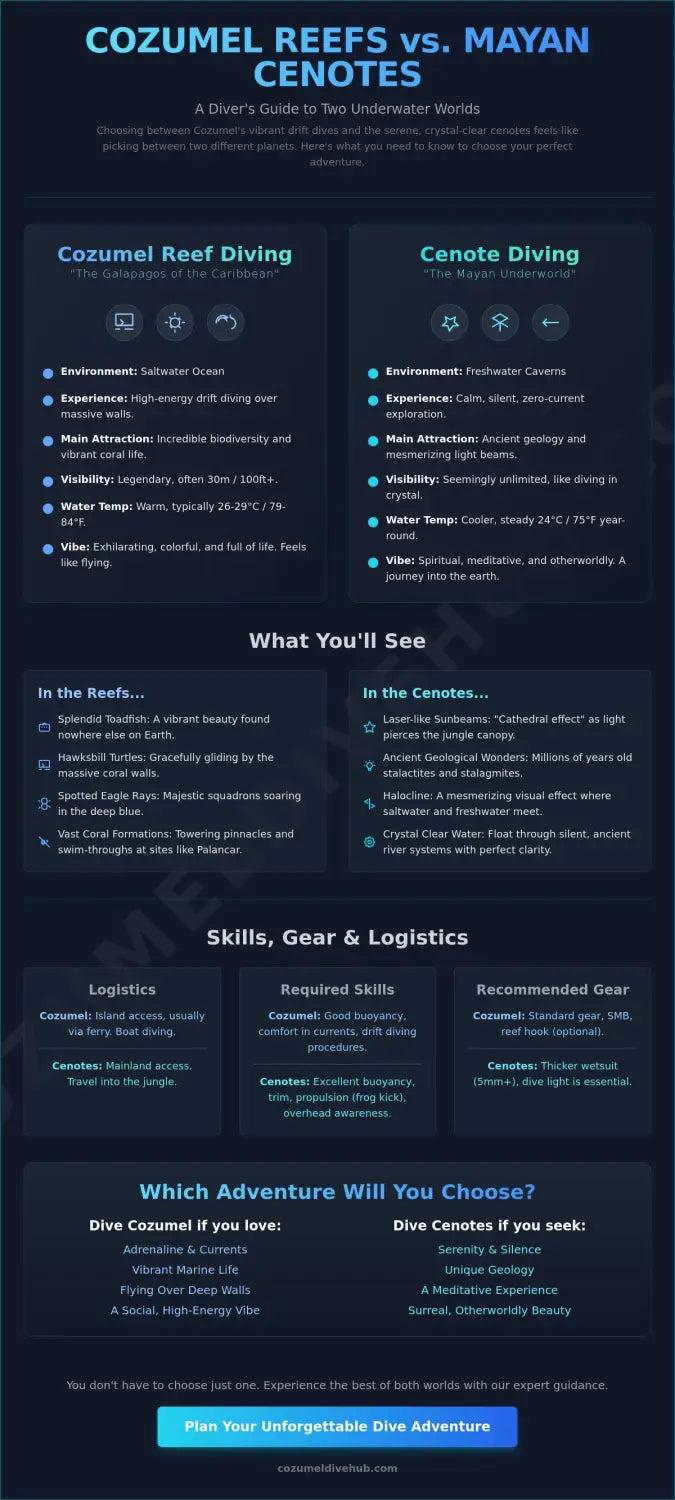
Cenote diving feels completely different from diving in the ocean. Instead of drifting over reefs with current, you are diving in freshwater cavern systems formed in limestone. The water is often extremely clear, the light can be dramatic, and the scenery is about rock formations, openings, shadows, and atmosphere rather than coral or fish life.
Cozumel reef diving usually gives you:
- Saltwater ocean diving
- Drift diving with the current doing the work
- Reefs, walls, swim-throughs, and coral formations
- Turtles, rays, nurse sharks, moray eels, and reef fish
- Bright Caribbean colors and open-water visibility
- Boat entries, two-tank mornings, short surface intervals
Cenote diving usually gives you:
- Freshwater, or brackish water where a halocline forms
- No current at all — you swim, nothing carries you
- Limestone caverns, stalactites, stalagmites, and collapsed chambers
- Light beams cutting through the water from surface openings
- Very little marine life; small freshwater fish at most
- Haloclines that blur the water like heat haze where fresh and salt water meet
- Shore entries, guideline-following, and single-file formation diving
- A slower, quieter, more deliberate style of diving
Divers who love Cozumel's reefs sometimes find cenotes eerie. Divers who find drift diving passive often find cenotes the most memorable diving they have ever done. Most people who do both say they are not really the same sport.
Conditions and What to Expect
Water temperature in the mainland cenotes is stable year-round, noticeably cooler than the Caribbean and consistent across seasons. Many divers who are comfortable in a shorty on Cozumel's reefs want a full wetsuit in a cenote, and a hood is common on longer dives.
Visibility is typically exceptional — cenote water is filtered through limestone and often clearer than open ocean. It is easily degraded by silt, which is why buoyancy control and fin technique matter so much. A single careless fin kick can reduce visibility for everyone behind you for the rest of the dive.
Depth on standard cavern routes is modest. The dramatic depth profiles belong to The Pit and Angelita, which sit outside recreational cavern limits.
Equipment differs from reef diving. Expect a guideline, and a torch per diver as standard rather than optional. Most operators supply lights for cenote dives; confirm when booking.
Skills that matter: buoyancy, trim, frog kick, and staying in formation. Cenote guides brief these before entry, and they will end a dive early if a diver is silting the cavern.
Who Cenote Diving Is Right For
It suits you if you like unusual environments, you have good buoyancy, you are comfortable with an overhead above you, and you want something in your logbook that is nothing like your other dives.
Think carefully if you are newly certified with few logged dives, you are uneasy in enclosed spaces, or you are hoping to see marine life — cenotes are geology, not biology.
Cozumel first, cenotes second is the order most experienced divers recommend. Get comfortable in the water on the reefs, then add the cenote day once your buoyancy is dialled in.
Booking a Cenote Day from Cozumel
Cenote trips from Cozumel are run by mainland operators, sometimes booked through a Cozumel dive shop and sometimes directly. Either route works. What matters is that the guide is cavern or cave certified for the specific system, that group sizes are small, and that the operator is explicit about which cenotes you are diving and what certification each requires.
Ask before booking:
- Which specific cenotes, and are they cavern or cave routes?
- What certification and minimum logged dives do they require?
- Are entry fees, equipment, lights and transfers included?
- What is the group size per guide?
- What is the ferry and pickup timing, and who arranges it?
We can help arrange a cenote day around your Cozumel diving. Get in touch and tell us your certification level and how many days you have.
What's Included
- • The cenotes are on the mainland, not on Cozumel itself
- • Reached by ferry to Playa del Carmen and then overland
- • Freshwater cavern diving — a completely different experience from Cozumel's drift reefs
- • Budget a full day for the round trip
- • This is the day trip that fills the gap, because there is no cave diving on Cozumel
Reviews
Reviews Coming Soon.
Frequently Asked Questions
Is There Cenote Diving in Cozumel?
What Makes Cenote Diving Different from Cozumel Reef Diving?
Plan Your Dive Trip
Tell us your dates, certification level and what you want to see — we'll match you with the right dive special.
Plan Your Dive Trip