
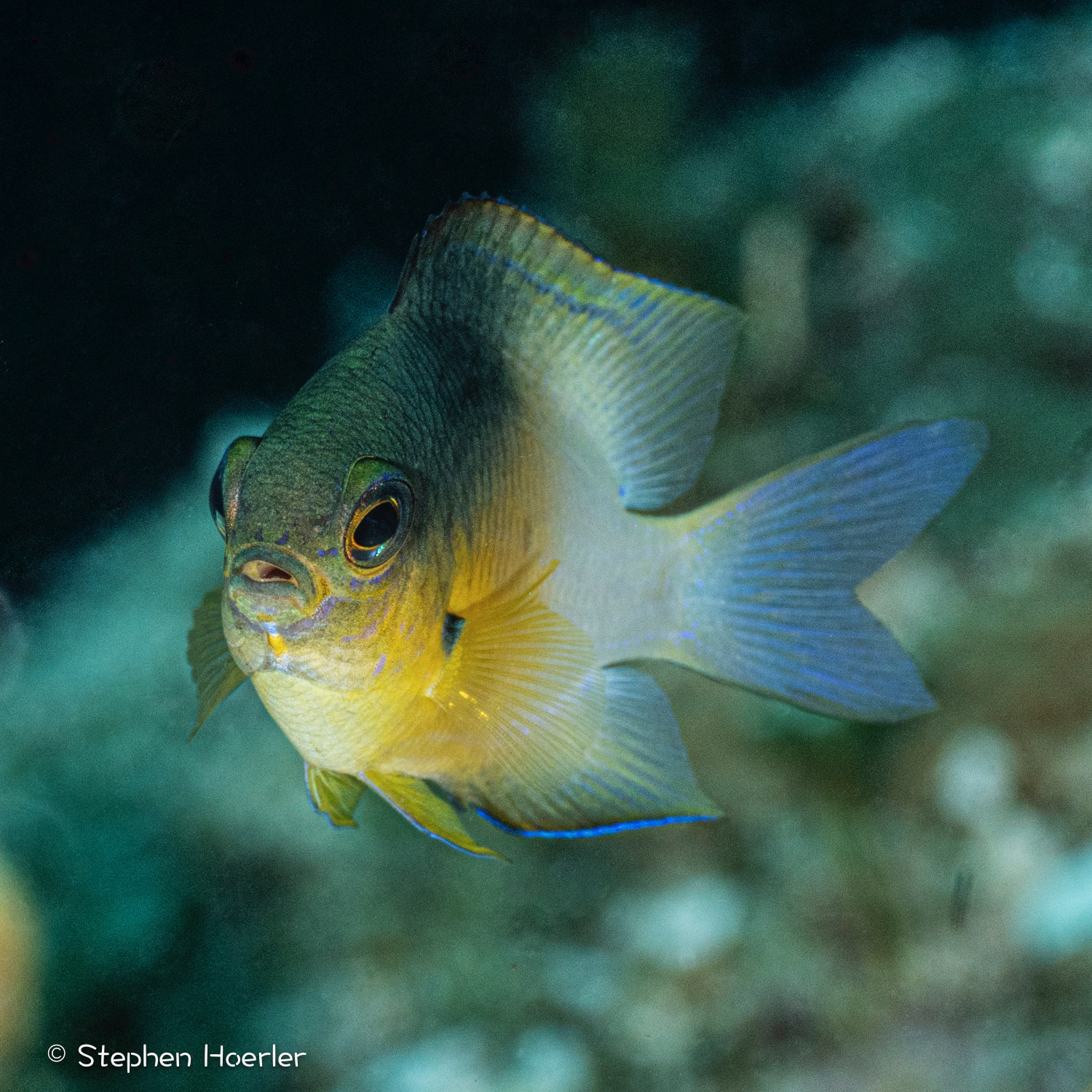
Bicolor Damselfish in Cozumel
Bicolor Damselfish (Stegastes partitus) in Cozumel: how to identify it, where it is reliably seen, and what it is commonly confused with.
Dark at the front, pale at the back, and completely out of proportion in attitude to its size. Bicolor damselfish defend a patch of reef against anything, divers included.
Quick ID
| Scientific name | Stegastes partitus |
|---|---|
| Group | Colourful Reef Fish |
| Typical size | Up to 10 cm |
| Depth range | 2–55 m |
| When to see it | Year-round |
| Active | Day |
| Conservation status | Least Concern |
How To Identify It
The front half is black or dark brown, the rear white to pale yellow, with the division usually sharp. Colour proportions vary between individuals and with mood.
Where You Will See It In Cozumel
Bicolor Damselfish works the 6 to 110 foot band. On this island that means the sheltered west-coast reefs, and the shallow east-side entries when the sea is flat — these are the sites where the depth and the habitat line up for it.
Without a boat. It is worth looking for at Chen Rio, Coral Princess and El Islote — all shore entries, so you dive them on your own schedule.
On an ordinary beginner boat dive. It should be within reach at El Cielo, La Francesa, Las Palmas, Molas Shallow and Palancar Gardens. No advanced certification needed.
Deeper, and on the walls. It is also plausible on Punta Sur, Punta Tunich, San Francisco Wall and San Juan.
Conditions change the odds more than the site does — the current, the time of day and how much the group has already stirred up the sand. Ask your guide what they have been seeing that week.
Behaviour
Territorial. Each fish holds a small area of reef, farms algae on it, and drives off intruders many times its size — including parrotfish, and occasionally a diver's fingers or camera dome.
Males guard nests of eggs laid on cleared hard surfaces and become noticeably more aggressive while doing so.
Commonly Confused With
- Threespot damselfish — Adults have a dark spot at the tail base and on the dorsal fin.
- Cocoa damselfish — Yellow lower body and a blue-edged dark region.
- Dusky damselfish — Uniformly dark, without the sharp two-tone split.
Diving Etiquette And Safety
Keep fins off the reef and hands to yourself. Nothing here needs to be touched, moved or provoked to be seen well.
Part of the Cozumel marine life guide · see Cozumel dive sites · plan your Cozumel dive trip
Photo © Stephen Hoerler, courtesy of the Cozumel Coral Reef Restoration Program, used with permission.
Bicolor Damselfish Photos
Frequently Asked Questions
Why do damselfish attack divers?
How big do bicolor damselfish get?
What do bicolor damselfish eat?
Diving Cozumel soon?
Tell us your dates — we'll send options and connect you with the right dive shop.