Caribbean Spiny Lobster in Cozumel
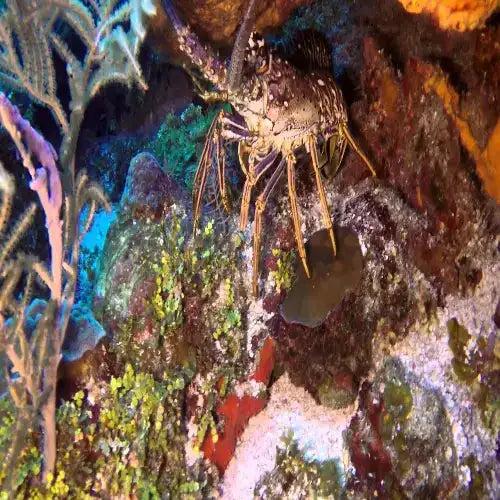
Caribbean Spiny Lobster (Panulirus argus) in Cozumel: how to identify it, where it hides, and why it has no claws.
No large claws — this is not a clawed lobster. Long thick spiny antennae, a mottled body with pale spots, and two prominent horns above the eyes.
Quick ID
| Scientific name | Panulirus argus |
|---|---|
| Group | Crustaceans — Lobster, Shrimp & Crabs |
| Typical size | 20–45 cm |
| Depth range | 2–30 m |
| When to see it | Year-round |
| Active | Night |
| Conservation status | Vulnerable |
| Notes | Best seen on night dives |
Where You Will See It In Cozumel
Caribbean Spiny Lobster is tagged on reef profiles right along the west coast, across a depth band of roughly 6 to 98 feet.
Without a boat. It turns up at El Presidente and Playa Corona — all shore entries, so you dive them on your own schedule.
On an ordinary beginner boat dive. It is recorded at La Francesa, Palancar Gardens, San Clemente and Chankanaab Bolones. No advanced certification needed.
Deeper, and on the walls. It also shows up on C-53 Wreck and Barracuda Reef.
Conditions change the odds more than the site does — the current, the time of day and how much the group has already stirred up the sand. Ask your guide what they have been seeing that week.
Behaviour
Hides by day and forages at night. Produces a rasping alarm sound by rubbing the antenna base, audible underwater. Famous for single-file queuing migrations, though those are seasonal and rarely witnessed on a dive.
Commonly Confused With
- Slipper lobster — Slipper lobsters are flattened with broad plate-like antennae and no long spines.
- Clawed lobsters — No clawed lobsters occur on Cozumel reefs.
Diving Etiquette And Safety
Do not touch, and do not pull one out for a photograph. Taking lobster inside the marine park is prohibited.
Part of the Cozumel marine life guide · see Cozumel dive sites · plan your Cozumel dive trip
Frequently Asked Questions
Do Caribbean spiny lobsters have claws?
When are they active?
Can you catch lobster in Cozumel?
What is the rasping sound?
Diving Cozumel soon?
Tell us your dates — we'll send options and connect you with the right dive shop.