
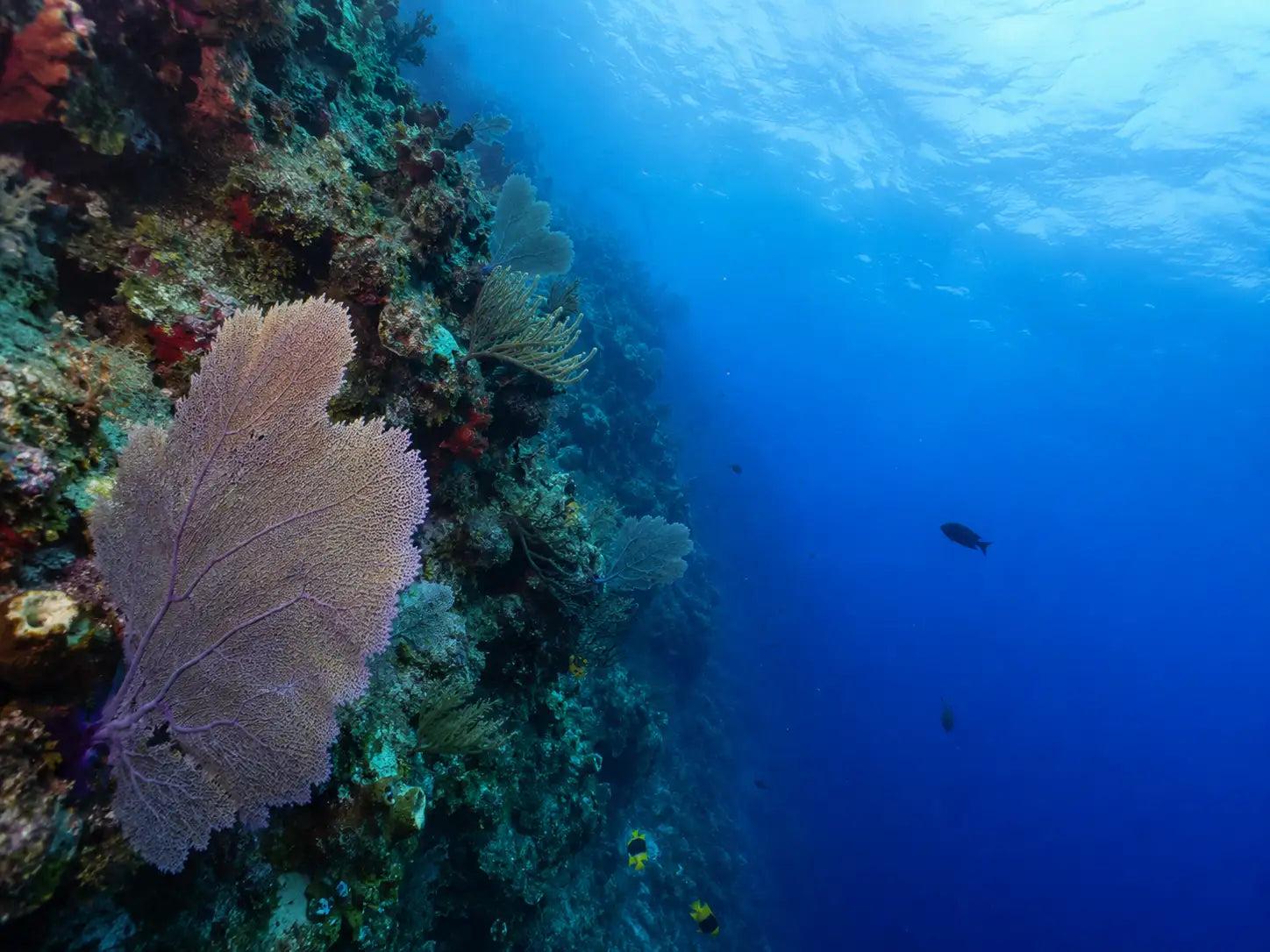
Sea Fan in Cozumel
Common Sea Fan (Gorgonia ventalina) in Cozumel: how to identify it, why fans all face the same way, and what lives on them.
A flat purple mesh fan, always oriented across the current rather than along it, with a fine net-like structure.
Quick ID
| Scientific name | Gorgonia ventalina |
|---|---|
| Group | Soft Corals & Sea Fans |
| Typical size | Fans to 1.5 m across |
| Depth range | 2–25 m |
| When to see it | Year-round |
| Active | Polyps feed day and night |
| Conservation status | Least Concern |
| Notes | — |
Where You Will See It In Cozumel
Sea Fan works the 6 to 82 foot band. On this island that means the sheltered west-coast reefs — these are the sites where the depth and the habitat line up for it.
Without a boat. It is worth looking for at El Presidente, Money Bar and Playa Corona — all shore entries, so you dive them on your own schedule.
On an ordinary beginner boat dive. It should be within reach at Casa Blanca, Chankanaab Bolones, Columbia Shallows, El Cielo and La Francesa. No advanced certification needed.
Deeper, and on the walls. It is also plausible on Santa Rosa Wall, Tormentos, Villa Blanca Wall and Barracuda Reef.
Conditions change the odds more than the site does — the current, the time of day and how much the group has already stirred up the sand. Ask your guide what they have been seeing that week.
Behaviour
A colonial soft coral that filters plankton from moving water, which is why every fan on a reef faces the same way. Host to flamingo tongue snails and, on many Cozumel reefs, to small brittle stars sheltering in the mesh.
Commonly Confused With
- Sea plume — Sea plumes are feathery and three-dimensional rather than a flat mesh.
- Sea rod — Sea rods are thick stiff branches without a mesh.
Diving Etiquette And Safety
Fragile and directly in the current line where divers get pushed. This is the animal most often broken by a diver who fails to control a drift.
Part of the Cozumel marine life guide · see Cozumel dive sites · plan your Cozumel dive trip
Sea Fan Photos


Frequently Asked Questions
Why do sea fans all face the same direction?
What lives on sea fans?
What is the difference between a sea fan and a sea plume?
Are sea fans corals?
Diving Cozumel soon?
Tell us your dates — we'll send options and connect you with the right dive shop.