
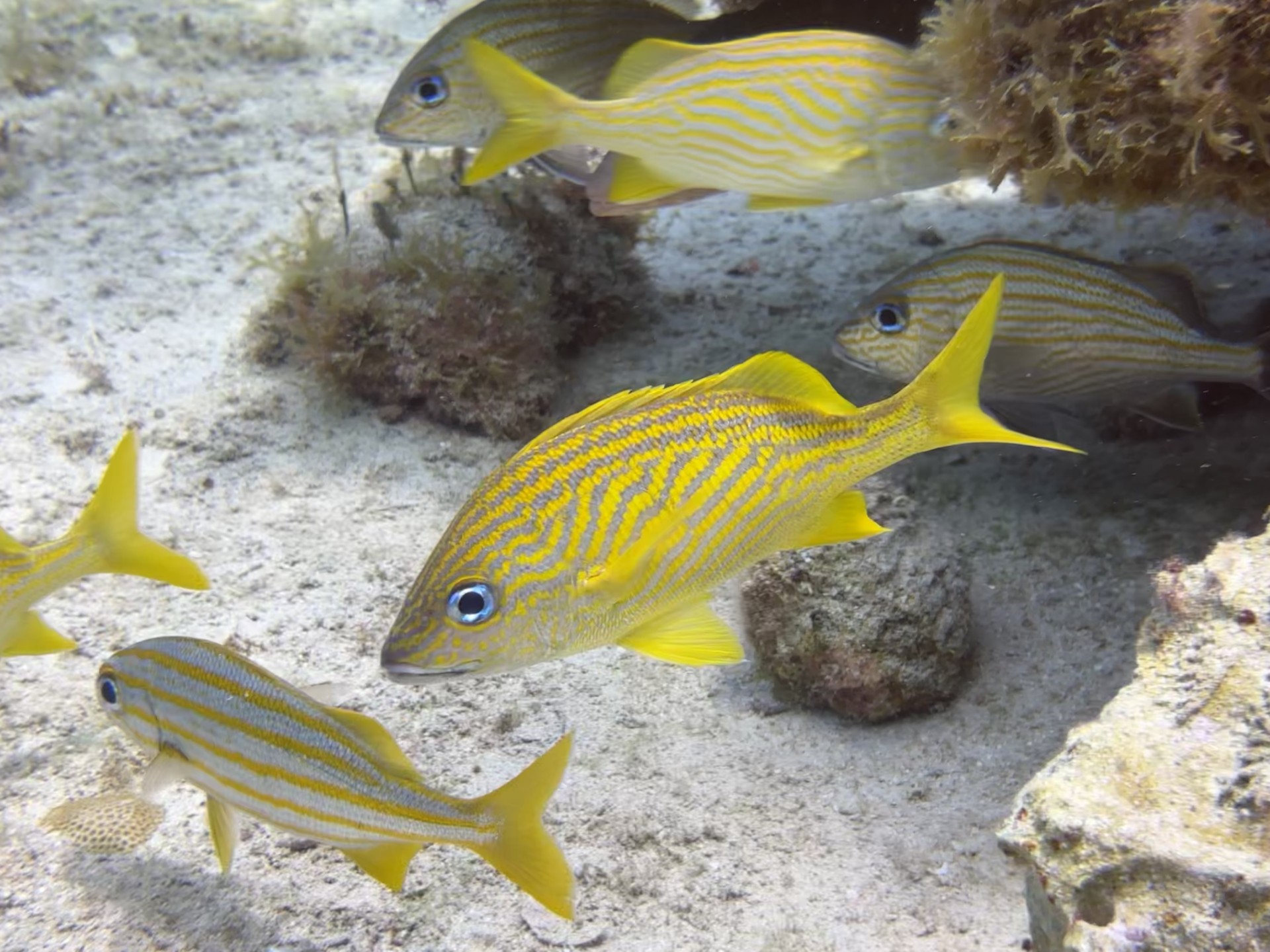
French Grunt in Cozumel
French Grunt (Haemulon flavolineatum) in Cozumel: how to identify it, where it is reliably seen, and what it is commonly confused with.
Yellow stripes on a pale body, stacked motionless in the shade under a coral head by day. Grunts are one of the easiest reef fish to approach because their whole daytime strategy is to sit still.
Quick ID
| Scientific name | Haemulon flavolineatum |
|---|---|
| Group | Colourful Reef Fish |
| Typical size | Up to 30 cm, usually 15–20 cm |
| Depth range | 2–40 m |
| When to see it | Year-round |
| Active | Night feeder; rests by day |
| Conservation status | Least Concern |
How To Identify It
Yellow horizontal stripes running the length of a whitish body, the stripes below the lateral line running diagonally. The inside of the mouth is bright red — visible when two fish face off.
Where You Will See It In Cozumel
French Grunt is tagged on reef profiles right along the west coast, across a depth band of roughly 6 to 131 feet.
Without a boat. It turns up at Chankanaab Shallow and Playa Corona — all shore entries, so you dive them on your own schedule.
On an ordinary beginner boat dive. It is recorded at Yellow House, Yucab, Chankanaab Bolones, Columbia Shallows and La Francesa. No advanced certification needed.
Deeper, and on the walls. It also shows up on Tormentos, Cantarel (Eagle Ray Wall), Chun-Chacaab and Maracaibo.
Conditions change the odds more than the site does — the current, the time of day and how much the group has already stirred up the sand. Ask your guide what they have been seeing that week.
Behaviour
They rest through the day and move out onto sand and seagrass at night to feed on small invertebrates.
The name is literal: grunts make an audible noise by grinding the teeth in the back of the throat, amplified by the swim bladder. Two fish disputing space will face each other with mouths wide open, showing the red lining.
Commonly Confused With
- Bluestriped grunt — Blue stripes on yellow, not yellow on white.
- Smallmouth grunt — Similar yellow striping but all stripes run straight, and the mouth is noticeably smaller.
- White grunt — Bluish and yellow head striping, plain body.
Diving Etiquette And Safety
Keep fins off the reef and hands to yourself. Nothing here needs to be touched, moved or provoked to be seen well.
Part of the Cozumel marine life guide · see Cozumel dive sites · plan your Cozumel dive trip
Photo courtesy of the Cozumel Coral Reef Restoration Program, used with permission.
French Grunt Photos
Frequently Asked Questions
Why are they called grunts?
What is the red inside their mouth for?
Where do French grunts go at night?
Diving Cozumel soon?
Tell us your dates — we'll send options and connect you with the right dive shop.