
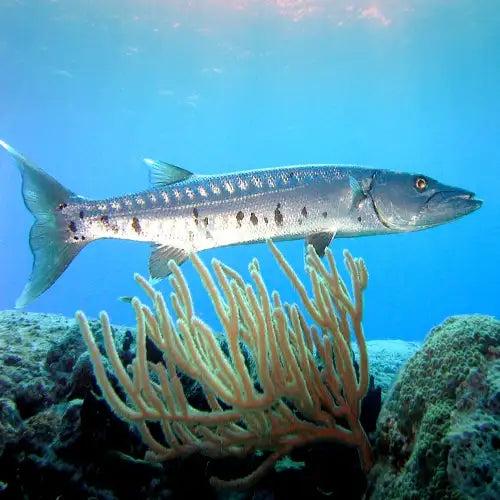
Great Barracuda in Cozumel
Great Barracuda (Sphyraena barracuda) in Cozumel: how to identify it, where it is reliably seen, and what it is commonly confused with.
A long silver torpedo with a pointed head, an underslung jaw full of visible teeth, and a deeply forked tail. Adults carry scattered dark blotches on the lower flanks. Almost always motionless in mid-water, holding position while the reef drifts past.
Quick ID
| Scientific name | Sphyraena barracuda |
|---|---|
| Group | Predators & Big Fish |
| Typical size | 60–150 cm on Cozumel reefs |
| Depth range | Surface to 30 m |
| When to see it | Year-round |
| Active | Daytime |
| Conservation status | Least Concern |
| Notes | — |
Where You Will See It In Cozumel
Great Barracuda is tagged on reef profiles right along the west coast, across a depth band of roughly 3 to 98 feet.
Without a boat. It turns up at Playa Corona and Chankanaab Shallow — all shore entries, so you dive them on your own schedule.
On an ordinary beginner boat dive. It is recorded at Paradise, Punta Dalila, Yellow House, Chankanaab Bolones and Columbia Shallows. No advanced certification needed.
Deeper, and on the walls. It also shows up on Maracaibo, Palancar Bricks, Palancar Caves and Palancar Horseshoe.
Conditions change the odds more than the site does — the current, the time of day and how much the group has already stirred up the sand. Ask your guide what they have been seeing that week.
Behaviour
Ambush predators that hover rather than patrol. The stare that unsettles new divers is curiosity and reflex-tracking, not stalking. They are drawn to flashes of silver, which is why shiny jewellery and dangling metal are worth stowing.
Commonly Confused With
- Cero mackerel — Mackerel swim continuously and in loose groups; a barracuda hangs still and alone.
- Houndfish / needlefish — Needlefish sit right at the surface and have a thin beak rather than a jaw with teeth set behind a blunt snout.
Diving Etiquette And Safety
No reason to avoid them and no reason to approach. Remove or cover shiny jewellery, especially when snorkelling in cloudy water near the surface.
Part of the Cozumel marine life guide · see Cozumel dive sites · plan your Cozumel dive trip
Frequently Asked Questions
Are barracuda dangerous to divers in Cozumel?
Why do barracuda follow divers?
Where are barracuda most reliable in Cozumel?
How big do they get here?
Diving Cozumel soon?
Tell us your dates — we'll send options and connect you with the right dive shop.