Lionfish in Cozumel
Lionfish (Pterois volitans) in Cozumel: how to identify it, where it is reliably seen, and what it is commonly confused with.
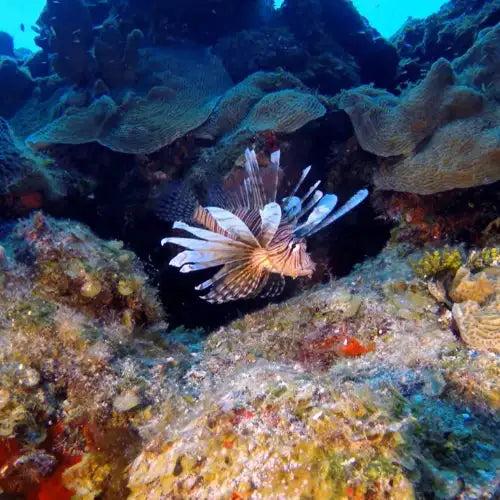
Unmistakable: red-brown and white banding with long fan-like pectoral fins and a crown of venomous dorsal spines. Nothing native to Cozumel looks remotely like it.
Quick ID
| Scientific name | Pterois volitans |
|---|---|
| Group | Camouflaged & Odd-Shaped Fish |
| Typical size | 20–40 cm |
| Depth range | 2–60 m and deeper |
| When to see it | Year-round |
| Active | Mostly dusk and night |
| Conservation status | Invasive in the Caribbean |
| Notes | Venomous — do not touch · Invasive in the Caribbean |
Where You Will See It In Cozumel
Lionfish works the 6 to 120 foot band. On this island that means the sheltered west-coast reefs — these are the sites where the depth and the habitat line up for it.
Without a boat. It is worth looking for at El Presidente, Money Bar and Playa Corona — all shore entries, so you dive them on your own schedule.
On an ordinary beginner boat dive. It should be within reach at Palancar Gardens, Paradise, Punta Dalila, San Clemente and Yellow House. No advanced certification needed.
Deeper, and on the walls. It is also plausible on Barracuda Reef, C-53 Wreck, Cantarel (Eagle Ray Wall) and Chun-Chacaab.
Conditions change the odds more than the site does — the current, the time of day and how much the group has already stirred up the sand. Ask your guide what they have been seeing that week.
Behaviour
An Indo-Pacific species established across the Caribbean since the 1990s. It has no natural predators here, breeds year-round and eats juvenile reef fish at a rate native populations cannot absorb. That is the comment on its profile, not a category of animal: it is a reef fish that happens to be in the wrong ocean.
Commonly Confused With
- Scorpionfish — Scorpionfish are camouflaged and flattened against the substrate; the lionfish is boldly striped with long open fins.
Diving Etiquette And Safety
Venomous spines cause intense pain. Do not touch, do not corner, and do not attempt removal without training and a proper containment tube — culling in the Cozumel Reefs National Park is regulated and requires authorisation.
Part of the Cozumel marine life guide · see Cozumel dive sites · plan your Cozumel dive trip
Lionfish Photos

Frequently Asked Questions
Are lionfish dangerous to divers?
Why are lionfish a problem in Cozumel?
Can I spear a lionfish myself?
Where do you usually see them?
Diving Cozumel soon?
Tell us your dates — we'll send options and connect you with the right dive shop.