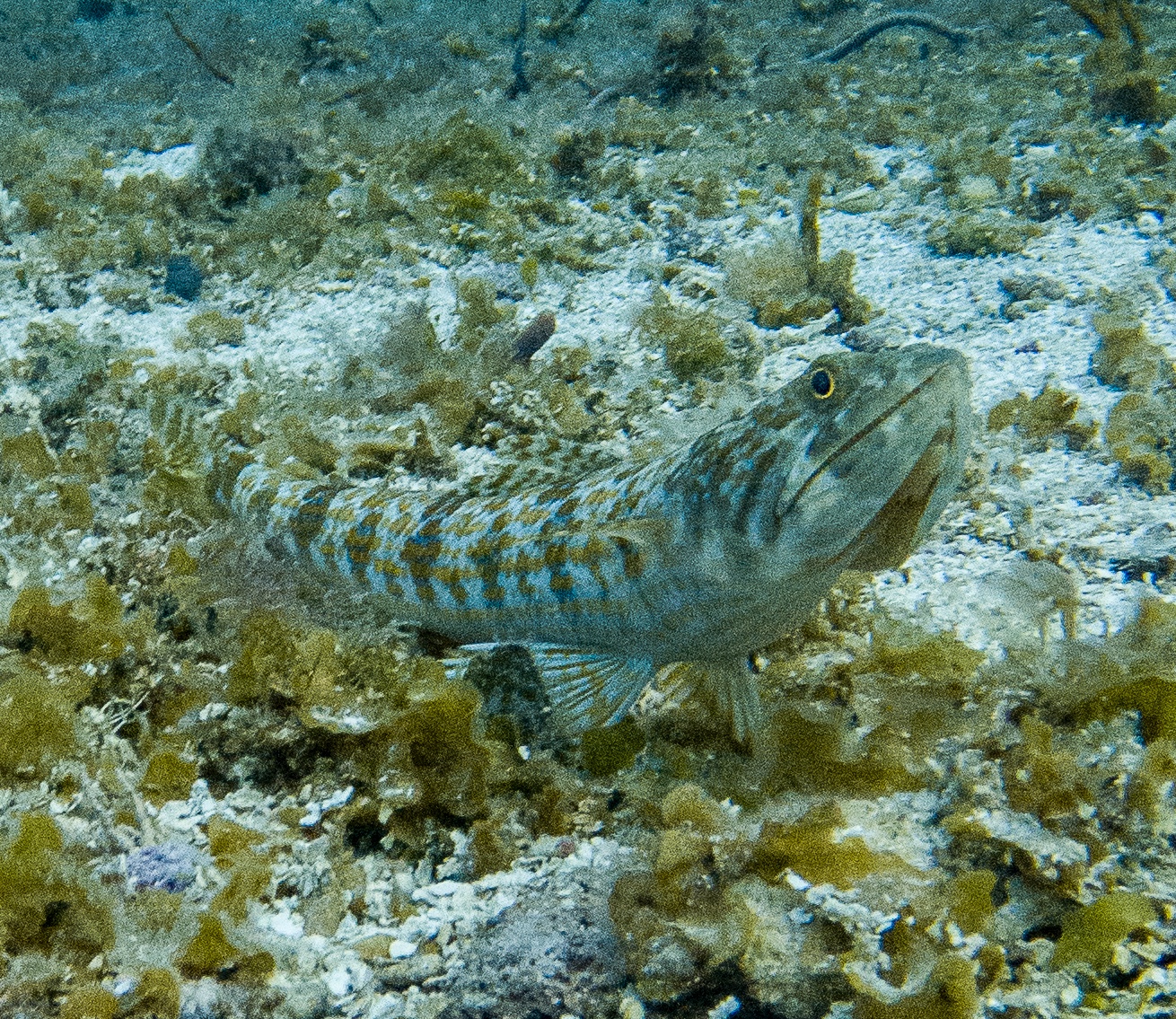
Sand Diver in Cozumel
Sand Diver (Synodus intermedius) in Cozumel: how to identify it, where it is reliably seen, and what it is commonly confused with.
A cigar-shaped lizardfish that lies on open sand, propped on its pelvic fins, and does not move until something swims past. Most divers only notice it when it launches.
Quick ID
| Scientific name | Synodus intermedius |
|---|---|
| Group | Camouflaged & Odd-Shaped Fish |
| Typical size | Up to 46 cm, usually 20–30 cm |
| Depth range | 2–60 m |
| When to see it | Year-round |
| Active | Day and night |
| Conservation status | Least Concern |
How To Identify It
Mottled brown and white with faint bars, a long cylindrical body, a large mouth full of fine teeth, and a dark shoulder spot. Often half-buried with only the eyes and back showing.
Where You Will See It In Cozumel
Sand Diver works the 6 to 120 foot band. On this island that means the sheltered west-coast reefs, and the shallow east-side entries when the sea is flat — these are the sites where the depth and the habitat line up for it.
Without a boat. It is worth looking for at Punta Morena, Tikkila Shallow and Chankanaab Shallow — all shore entries, so you dive them on your own schedule.
On an ordinary beginner boat dive. It should be within reach at Columbia Shallows, El Cielo, La Francesa, Las Palmas and Molas Shallow. No advanced certification needed.
Deeper, and on the walls. It is also plausible on Punta Sur, Punta Tunich, San Francisco Wall and San Juan.
Conditions change the odds more than the site does — the current, the time of day and how much the group has already stirred up the sand. Ask your guide what they have been seeing that week.
Behaviour
An ambush predator. It rests on or buries into sand and strikes upward at small fish passing overhead, often burying again immediately after.
It will hold position until a diver is very close, which is what makes it worth looking for once you know the outline.
Commonly Confused With
- Bluestriped lizardfish — Slimmer, with blue lines along the body.
- Spotted goby and other sand gobies — Far smaller, and they perch rather than bury.
- Peacock flounder — Flat and asymmetrical, both eyes on one side.
Diving Etiquette And Safety
Keep fins off the reef and hands to yourself. Nothing here needs to be touched, moved or provoked to be seen well.
Part of the Cozumel marine life guide · see Cozumel dive sites · plan your Cozumel dive trip
Photo courtesy of the Cozumel Coral Reef Restoration Program, used with permission.
Sand Diver Photos
Frequently Asked Questions
What is a sand diver?
Do sand divers bite divers?
How do you spot a sand diver?
Diving Cozumel soon?
Tell us your dates — we'll send options and connect you with the right dive shop.