
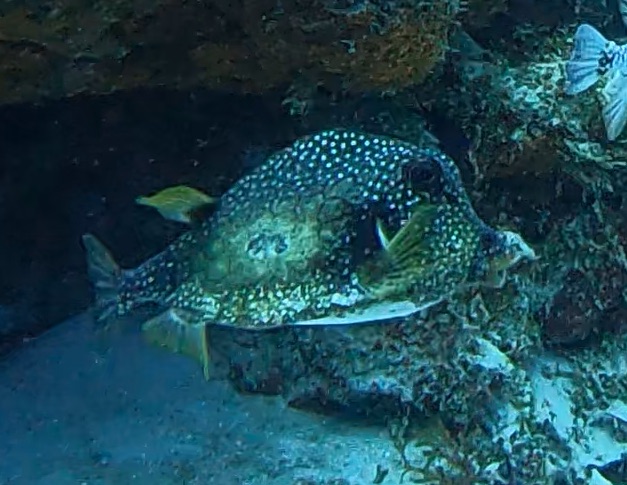
Smooth Trunkfish in Cozumel
Smooth Trunkfish (Lactophrys triqueter) in Cozumel: how to identify it, where it is reliably seen, and what it is commonly confused with.
Dark, boxy and covered in a honeycomb of pale spots, with a pursed mouth that gives it a permanently surprised expression. It hovers nose-down over sand, blowing water at the bottom.
Quick ID
| Scientific name | Lactophrys triqueter |
|---|---|
| Group | Camouflaged & Odd-Shaped Fish |
| Typical size | Up to 47 cm, usually 20–30 cm |
| Depth range | 2–50 m |
| When to see it | Year-round |
| Active | Day |
| Conservation status | Least Concern |
| Notes | Skin secretion is toxic — do not handle |
How To Identify It
Dark brown to black with white or yellowish honeycomb spotting, densest on the flanks. Rigid triangular body, and no spines in front of the anal fin.
Where You Will See It In Cozumel
Smooth Trunkfish works the 6 to 100 foot band. On this island that means the sheltered west-coast reefs, and the shallow east-side entries when the sea is flat — these are the sites where the depth and the habitat line up for it.
Without a boat. It is worth looking for at Playa Corona, Punta Morena and Tikkila Shallow — all shore entries, so you dive them on your own schedule.
On an ordinary beginner boat dive. It should be within reach at Yellow House, Yucab, Casa Blanca, Chankanaab Bolones and Columbia Shallows. No advanced certification needed.
Deeper, and on the walls. It is also plausible on Maracaibo, Palancar Bricks, Palancar Caves and Palancar Horseshoe.
Conditions change the odds more than the site does — the current, the time of day and how much the group has already stirred up the sand. Ask your guide what they have been seeing that week.
Behaviour
Feeds by directing a jet of water at the sand to expose small invertebrates, then picking them out. It moves slowly and steadily, and tolerates a close, calm approach better than almost any other reef fish.
Commonly Confused With
- Spotted trunkfish — White with round black spots, and two spines before the anal fin.
- Honeycomb cowfish — Similar pattern but with horns above the eyes.
Diving Etiquette And Safety
Skin secretion is toxic — do not handle. Keep fins off the reef and hands to yourself — nothing here needs to be touched or provoked to be seen well.
Part of the Cozumel marine life guide · see Cozumel dive sites · plan your Cozumel dive trip
Photo courtesy of the Cozumel Coral Reef Restoration Program, used with permission.
Smooth Trunkfish Photos
Frequently Asked Questions
What is the difference between a smooth and a spotted trunkfish?
Are smooth trunkfish safe to approach?
How do smooth trunkfish eat?
Diving Cozumel soon?
Tell us your dates — we'll send options and connect you with the right dive shop.