Southern Stingray in Cozumel
Southern Stingray (Hypanus americanus) in Cozumel: how to identify it, where it is reliably seen, and what it is commonly confused with.
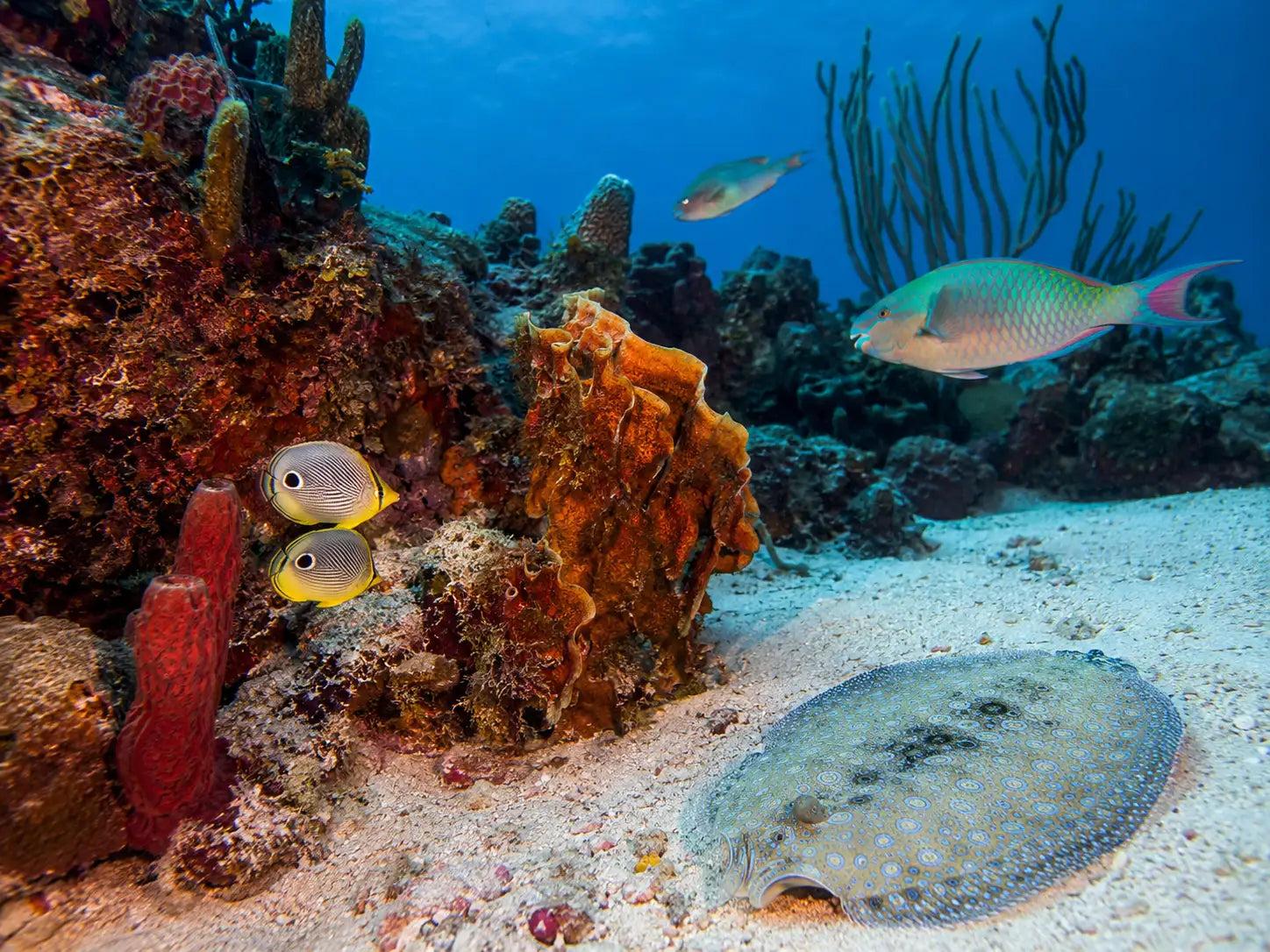
A broad grey-brown diamond with a long whip tail carrying a serrated barb near the base. Usually seen half-buried in sand with only the eyes and spiracles showing.
Quick ID
| Scientific name | Hypanus americanus |
|---|---|
| Group | Sharks & Rays |
| Typical size | 60–150 cm across the disc |
| Depth range | 2–30 m |
| When to see it | Year-round |
| Active | Day and night |
| Conservation status | Near Threatened |
| Notes | Venomous — do not touch |
Where You Will See It In Cozumel
Southern Stingray is tagged on reef profiles right along the west coast, across a depth band of roughly 6 to 98 feet.
On an ordinary beginner boat dive. It is recorded at La Francesa and Palancar Gardens. No advanced certification needed.
Deeper, and on the walls. It also shows up on Palancar Bricks and Paso del Cedral.
Conditions change the odds more than the site does — the current, the time of day and how much the group has already stirred up the sand. Ask your guide what they have been seeing that week.
Behaviour
Feeds by blowing water into the sand to expose buried molluscs and worms. Buries itself to rest and to ambush, which is why almost all injuries happen to people walking on sand rather than to divers.
Commonly Confused With
- Yellow stingray — The yellow stingray is much smaller with a dense pattern of yellow-brown spots and a rounder disc.
- Spotted eagle ray — Eagle rays swim in open water with white spots on a dark back and never lie buried.
Diving Etiquette And Safety
Never step down onto sand — shuffle. The barb is a defensive tail-flick, used only when the animal is trodden on or pinned.
Part of the Cozumel marine life guide · see Cozumel dive sites · plan your Cozumel dive trip
Southern Stingray Photos


Frequently Asked Questions
Are southern stingrays dangerous?
Where do you see them in Cozumel?
How do they feed?
How do you avoid being stung?
Diving Cozumel soon?
Tell us your dates — we'll send options and connect you with the right dive shop.