
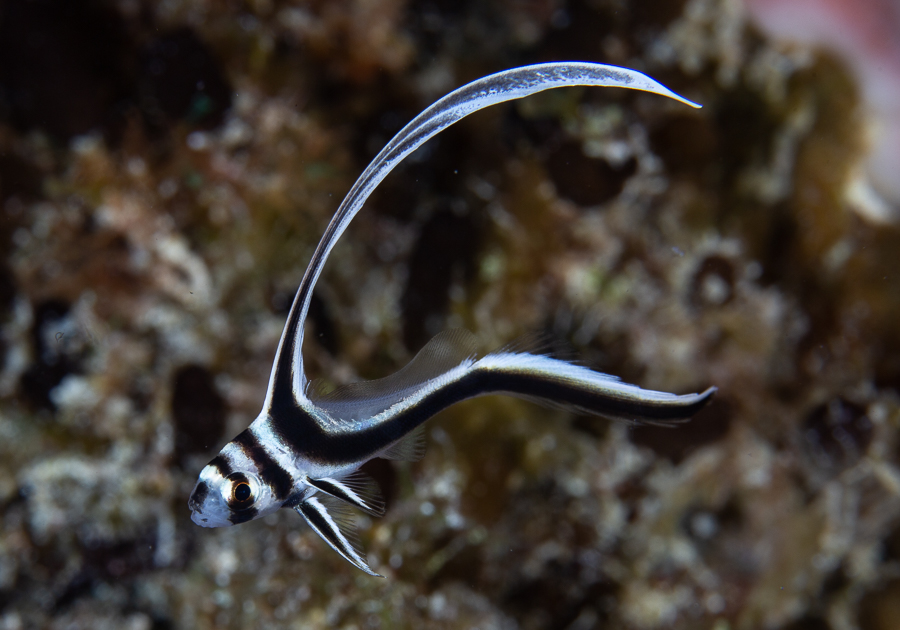
Spotted Drum in Cozumel
Spotted Drum (Equetus punctatus) in Cozumel: how to identify it, where it is reliably seen, and what it is commonly confused with.
An extraordinarily long first dorsal fin trailing above a black-and-white striped body, swimming a tight repetitive circuit under a ledge. One of the most sought-after small fish on a Cozumel dive.
Quick ID
| Scientific name | Equetus punctatus |
|---|---|
| Group | Camouflaged & Odd-Shaped Fish |
| Typical size | Up to 27 cm |
| Depth range | 3–30 m |
| When to see it | Year-round |
| Active | Night feeder; shelters by day |
| Conservation status | Least Concern |
How To Identify It
Black and white stripes on the head and body, white spots on the rear fins, and a first dorsal fin drawn out into a long ribbon — much longer in juveniles than adults.
Where You Will See It In Cozumel
Spotted Drum works the 9 to 98 foot band. On this island that means the sheltered west-coast reefs, and the shallow east-side entries when the sea is flat — these are the sites where the depth and the habitat line up for it.
Without a boat. It is worth looking for at El Islote, El Mirador and El Presidente — all shore entries, so you dive them on your own schedule.
On an ordinary beginner boat dive. It should be within reach at El Cielo, La Francesa, Las Palmas, Molas Shallow and Palancar Gardens. No advanced certification needed.
Deeper, and on the walls. It is also plausible on Villa Blanca Wall, Barracuda Reef, C-53 Wreck and Cantarel (Eagle Ray Wall).
Conditions change the odds more than the site does — the current, the time of day and how much the group has already stirred up the sand. Ask your guide what they have been seeing that week.
Behaviour
Shelters by day and feeds at night on crustaceans and worms taken from the sand nearby.
Drums are named for the sound the males make with the swim bladder. Juveniles have a proportionally enormous dorsal fin and a habit of circling a fixed patch of floor, which is why guides can return to the same fish for weeks.
Commonly Confused With
- Jackknife fish — A single bold diagonal black stripe rather than multiple stripes and spots.
- High-hat — Striped, but with a much shorter dorsal fin and no white spots.
Diving Etiquette And Safety
Keep fins off the reef and hands to yourself. Nothing here needs to be touched, moved or provoked to be seen well.
Part of the Cozumel marine life guide · see Cozumel dive sites · plan your Cozumel dive trip
Photo courtesy of the Cozumel Coral Reef Restoration Program, used with permission.
Spotted Drum Photos
Frequently Asked Questions
Why does the spotted drum have such a long fin?
Where do you find spotted drum in Cozumel?
Do spotted drums make a sound?
Diving Cozumel soon?
Tell us your dates — we'll send options and connect you with the right dive shop.