
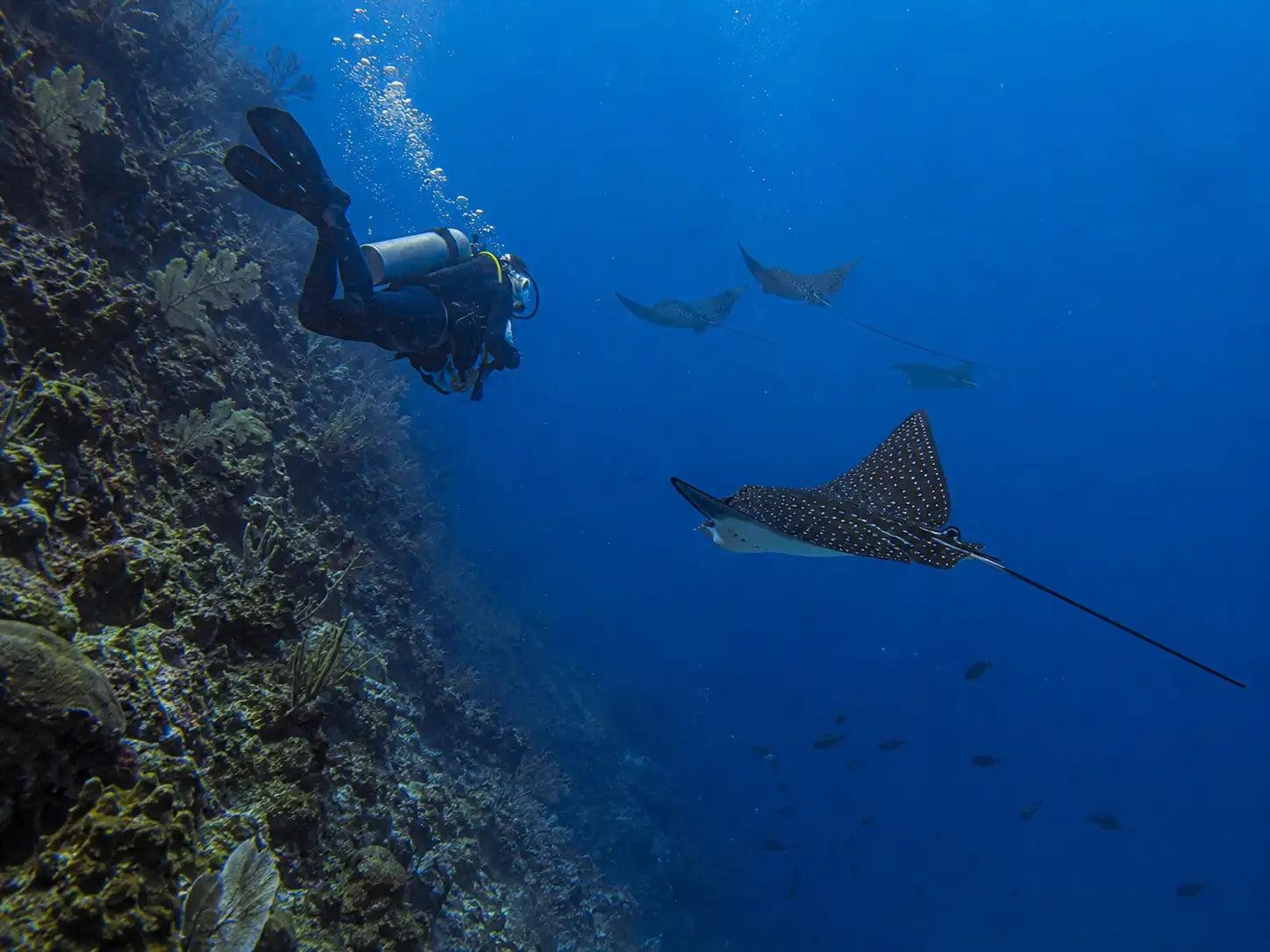
Spotted Eagle Ray in Cozumel
Spotted Eagle Ray (Aetobatus narinari) in Cozumel: how to identify it, when the season peaks, and what it is commonly confused with.
A dark back covered in clean white spots and rings, a pointed duck-like snout, and a very long thin tail. Flies through open water on pointed wings rather than lying on the bottom.
Quick ID
| Scientific name | Aetobatus narinari |
|---|---|
| Group | Sharks & Rays |
| Typical size | 100–250 cm across the wings |
| Depth range | 5–40 m |
| When to see it | Peak December–March |
| Active | Daytime |
| Conservation status | Endangered |
| Notes | Seasonal · Venomous — do not touch |
Where You Will See It In Cozumel
Spotted Eagle Ray is tagged on reef profiles right along the west coast, across a depth band of roughly 16 to 131 feet.
Without a boat. It turns up at Punta Morena, Chen Rio and El Islote — all shore entries, so you dive them on your own schedule.
On an ordinary beginner boat dive. It is recorded at Columbia Shallows, El Cielo, Molas Shallow, Palancar Gardens and Punta Dalila. No advanced certification needed.
Deeper, and on the walls. It also shows up on San Francisco Wall, Tormentos, Villa Blanca Wall and Cantarel (Eagle Ray Wall).
Conditions change the odds more than the site does — the current, the time of day and how much the group has already stirred up the sand. Ask your guide what they have been seeing that week.
Behaviour
Uses the pointed snout to dig molluscs out of sand and crushes them with plated teeth. In the winter months they gather in groups and cross the drop-off in formation, which is the encounter most Cozumel divers are hoping for.
Commonly Confused With
- Southern stingray — Southern stingrays are plain grey-brown, lie on sand and do not have white spots.
- Manta ray — Mantas have cephalic fins either side of a wide terminal mouth and are far larger; they are not a Cozumel reef animal.
Diving Etiquette And Safety
Hold position, stay low and let them pass. Swimming up at a squadron turns it away — from you and from everyone behind you.
Asking Your Dive Guide To Find One
Eagle rays are a winter animal here and a deep-water one. The squadrons cross the drop-off, not the reef top, and they pass once — there is no second look if the group is strung out or still sorting out weights at depth.
Two things to ask about between December and March: whether the boat is running the deeper wall sites rather than the shallow gardens, and where the crew drops you relative to the current. A guide who puts the group on the wall upcurrent and holds everyone together gives you a front-row view; a scattered descent means half the boat sees a shadow. Worth raising with Cozumel dive centers when you book a winter week.
The Skill That Makes The Difference
The encounter is over in about fifteen seconds, and the only way to use them is to stop moving. Divers who swim up at a squadron turn it away — from themselves and from everyone behind.
Holding position in moving water while doing nothing at all is the specific skill, and it is the subject of the Drift Diver course. On this island that is not an optional extra; the current is the reason the rays are there.
Part of the Cozumel marine life guide · see Cozumel dive sites · plan your Cozumel dive trip
Spotted Eagle Ray Photos


Frequently Asked Questions
When is eagle ray season in Cozumel?
Where is the best chance of seeing eagle rays?
How do you tell an eagle ray from a stingray?
Are they dangerous?
Diving Cozumel soon?
Tell us your dates — we'll send options and connect you with the right dive shop.