
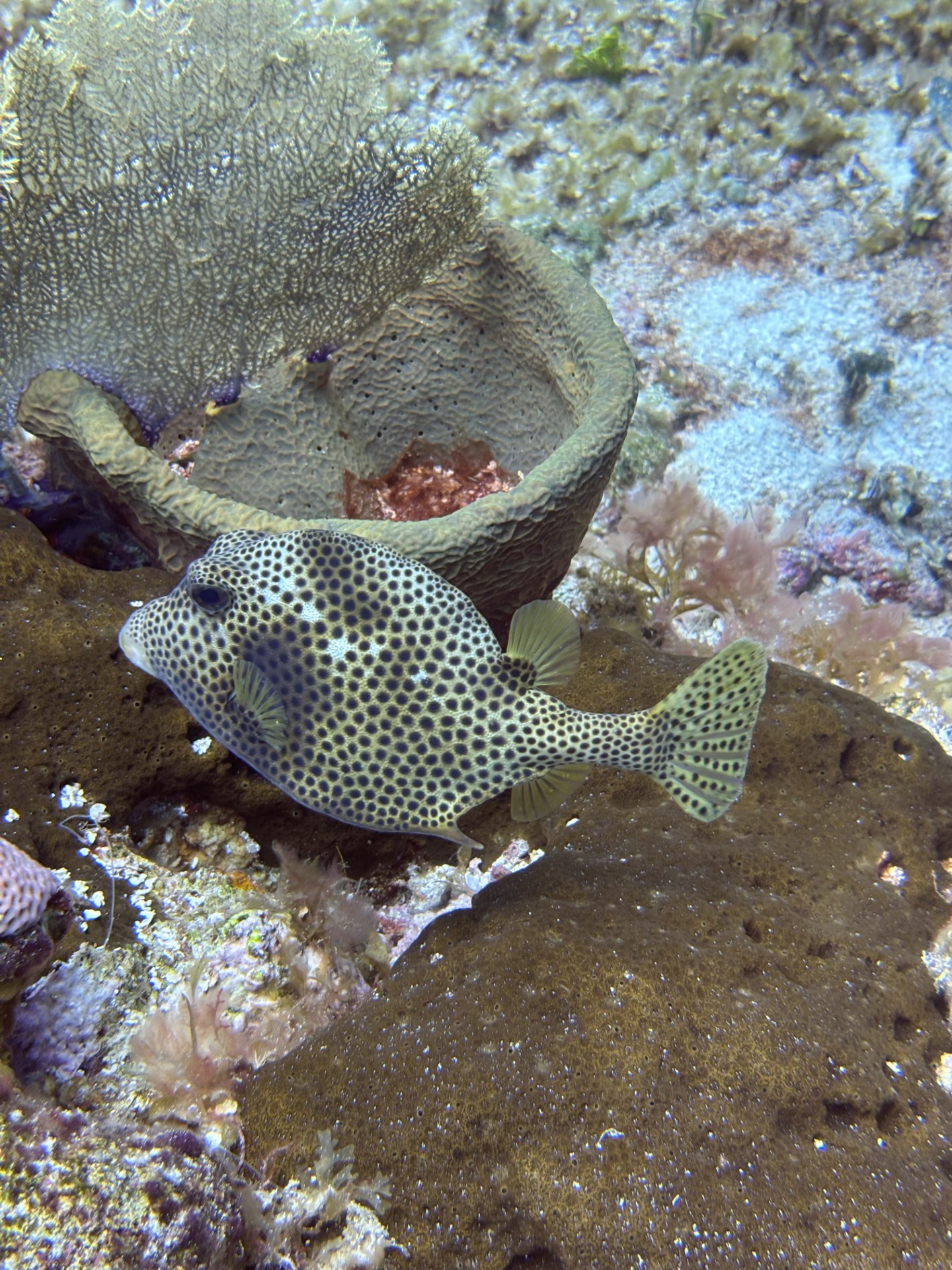
Spotted Trunkfish in Cozumel
Spotted Trunkfish (Lactophrys bicaudalis) in Cozumel: how to identify it, where it is reliably seen, and what it is commonly confused with.
A rigid box of a fish, white with black spots, sculling along just above the bottom with only its fins moving. The body is a fused bony shell, so it cannot flex — it steers rather than swims.
Quick ID
| Scientific name | Lactophrys bicaudalis |
|---|---|
| Group | Camouflaged & Odd-Shaped Fish |
| Typical size | Up to 48 cm, usually 20–30 cm |
| Depth range | 2–50 m |
| When to see it | Year-round |
| Active | Day |
| Conservation status | Least Concern |
| Notes | Skin secretion is toxic — do not handle |
How To Identify It
White to cream with round black spots over the whole body, and two short spines in front of the anal fin. The cross-section is triangular and the body plate is rigid.
Where You Will See It In Cozumel
Spotted Trunkfish works the 6 to 100 foot band. On this island that means the sheltered west-coast reefs, and the shallow east-side entries when the sea is flat — these are the sites where the depth and the habitat line up for it.
Without a boat. It is worth looking for at El Islote, El Mirador and El Presidente — all shore entries, so you dive them on your own schedule.
On an ordinary beginner boat dive. It should be within reach at Chankanaab Bolones, Columbia Shallows, El Cielo, La Francesa and Las Palmas. No advanced certification needed.
Deeper, and on the walls. It is also plausible on C-53 Wreck, Cantarel (Eagle Ray Wall), Chun-Chacaab and Colombia Deep.
Conditions change the odds more than the site does — the current, the time of day and how much the group has already stirred up the sand. Ask your guide what they have been seeing that week.
Behaviour
Blows jets of water at sand to expose worms, crustaceans and molluscs. Movement comes entirely from the fins because the body cannot bend.
When stressed it can release a toxin from the skin — one of the reasons trunkfish should never be handled or confined.
Commonly Confused With
- Smooth trunkfish — Dark with white spots, and a honeycomb pattern rather than round spots.
- Honeycomb cowfish — Has horns above the eyes.
- Scrawled cowfish — Horns and blue scrawl markings.
Diving Etiquette And Safety
Skin secretion is toxic — do not handle. Keep fins off the reef and hands to yourself — nothing here needs to be touched or provoked to be seen well.
Part of the Cozumel marine life guide · see Cozumel dive sites · plan your Cozumel dive trip
Photo courtesy of the Cozumel Coral Reef Restoration Program, used with permission.
Spotted Trunkfish Photos
Frequently Asked Questions
Are spotted trunkfish poisonous?
How does a trunkfish swim?
How do trunkfish feed?
Diving Cozumel soon?
Tell us your dates — we'll send options and connect you with the right dive shop.