
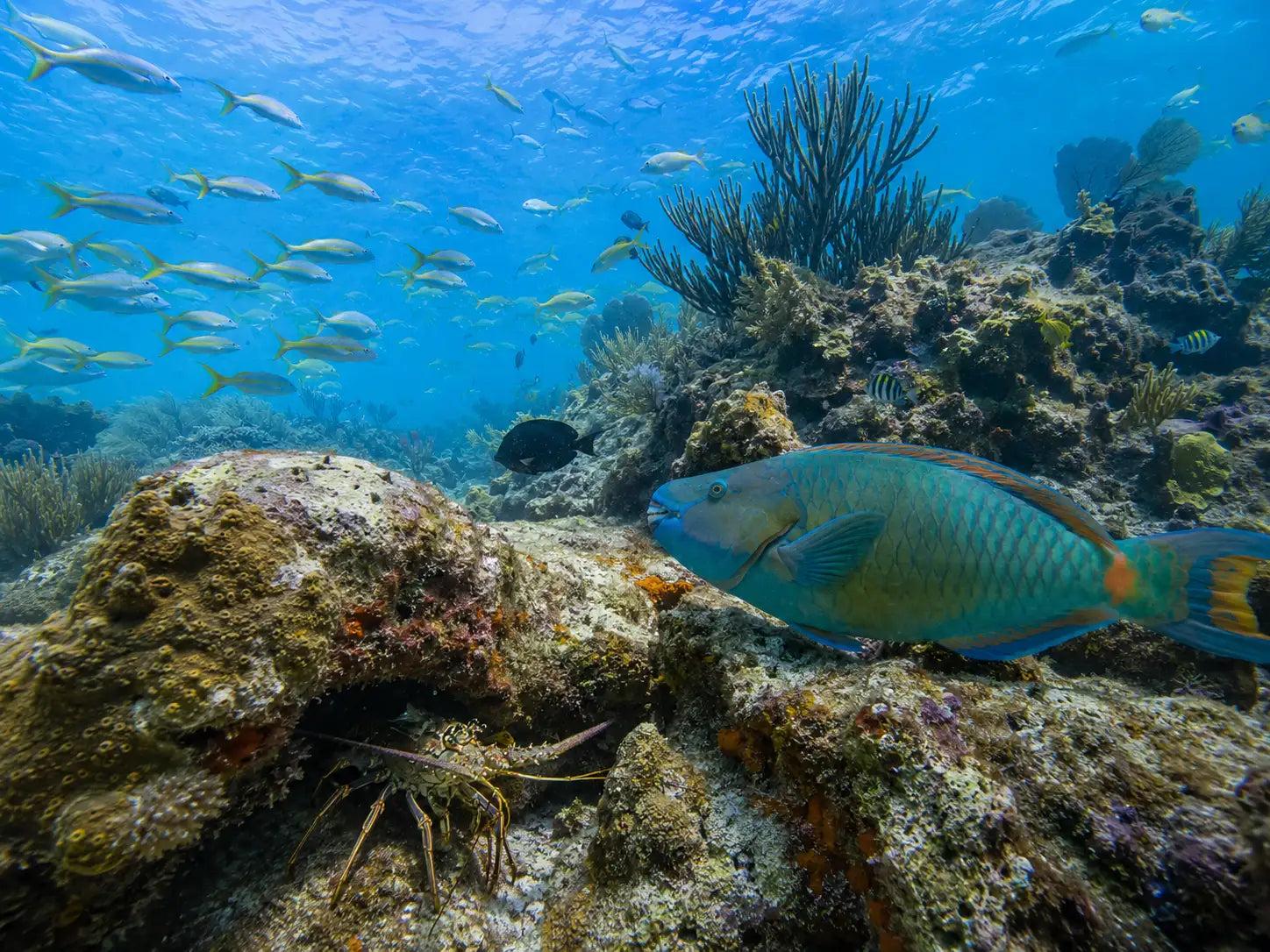
Stoplight Parrotfish in Cozumel
Stoplight Parrotfish (Sparisoma viride) in Cozumel: how to identify it, where it is reliably seen, and what it is commonly confused with.
Terminal-phase males are emerald green with a bright yellow spot behind the gill and a yellow crescent on the tail. Initial-phase fish are a completely different animal to look at: dark red-brown with a scarlet belly and a white tail band.
Quick ID
| Scientific name | Sparisoma viride |
|---|---|
| Group | Colourful Reef Fish |
| Typical size | 30–50 cm |
| Depth range | 2–25 m |
| When to see it | Year-round |
| Active | Daytime |
| Conservation status | Least Concern |
| Notes | — |
Where You Will See It In Cozumel
Stoplight Parrotfish is tagged on reef profiles right along the west coast, across a depth band of roughly 6 to 82 feet.
Without a boat. It turns up at Chankanaab Shallow, El Islote and Money Bar — all shore entries, so you dive them on your own schedule.
On an ordinary beginner boat dive. It is recorded at Palancar Gardens, Punta Dalila, Yellow House, Chankanaab Bolones and Columbia Shallows. No advanced certification needed.
Deeper, and on the walls. It also shows up on Punta Tunich, San Francisco Wall, Colombia Deep and Maracaibo.
Conditions change the odds more than the site does — the current, the time of day and how much the group has already stirred up the sand. Ask your guide what they have been seeing that week.
Behaviour
Scrapes algae off coral with a fused beak, digests the algae and passes the rock as sand. A single large parrotfish produces a meaningful share of the white sand on a Caribbean beach. At night it wraps itself in a mucus cocoon that masks its scent from predators.
Commonly Confused With
- Initial vs terminal phase — They look like two species. Red-brown with a white tail band is the same fish as the green-and-yellow one, earlier in life.
- Redband parrotfish — Redband is smaller and lacks the yellow gill spot and tail crescent.
Diving Etiquette And Safety
Do not chase for photographs at night — disturbing a cocooned parrotfish costs it its overnight protection.
Part of the Cozumel marine life guide · see Cozumel dive sites · plan your Cozumel dive trip
Stoplight Parrotfish Photos


Frequently Asked Questions
Do parrotfish make sand?
Why do the males and females look so different?
What is the crunching sound on the reef?
Why do they sleep in a bubble?
Diving Cozumel soon?
Tell us your dates — we'll send options and connect you with the right dive shop.