

Yellow Stingray in Cozumel
Yellow Stingray (Urobatis jamaicensis) in Cozumel: how to identify it, where it is reliably seen, and what it is commonly confused with.
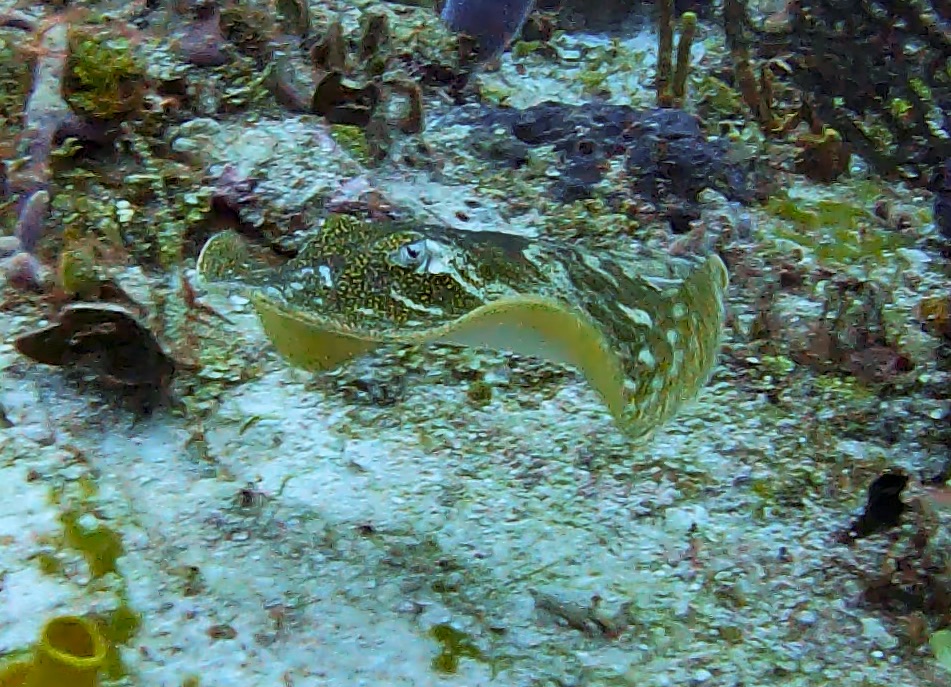
A small round ray densely patterned with yellow-brown spots and reticulations, with a short tail and a rounded rather than whip-like profile.
Quick ID
| Scientific name | Urobatis jamaicensis |
|---|---|
| Group | Sharks & Rays |
| Typical size | 25–40 cm across the disc |
| Depth range | 1–20 m |
| When to see it | Year-round |
| Active | Day and night |
| Conservation status | Least Concern |
| Notes | Venomous — do not touch |
Where You Will See It In Cozumel
Yellow Stingray works the 3 to 65 foot band. On this island that means the sheltered west-coast reefs, and the shallow east-side entries when the sea is flat — these are the sites where the depth and the habitat line up for it.
Without a boat. It is worth looking for at El Islote, El Mirador and El Presidente — all shore entries, so you dive them on your own schedule.
On an ordinary beginner boat dive. It should be within reach at Punta Dalila, San Clemente, Yellow House, Yucab and Casa Blanca. No advanced certification needed.
Deeper, and on the walls. It is also plausible on Villa Blanca Wall, Barracuda Reef, C-53 Wreck and Cantarel (Eagle Ray Wall).
Conditions change the odds more than the site does — the current, the time of day and how much the group has already stirred up the sand. Ask your guide what they have been seeing that week.
Behaviour
Hunts small invertebrates in shallow sand. Its dense mottling matches broken rubble so closely that most divers swim straight past.
Commonly Confused With
- Southern stingray — Southern stingrays are much larger, plain grey-brown and have a long whip tail.
- Peacock flounder — A flounder is flat with both eyes on the upper side and no tail spine.
Diving Etiquette And Safety
Small, shallow and easily trodden on in snorkelling depth. Shuffle rather than step.
Part of the Cozumel marine life guide · see Cozumel dive sites · plan your Cozumel dive trip
Photo: Andy Blackledge, CC BY 2.0, via Wikimedia Commons.

Yellow Stingray Photos


Frequently Asked Questions
How big do yellow stingrays get?
Are yellow stingrays venomous?
Where do you see them?
How do you tell one from a southern stingray?
Diving Cozumel soon?
Tell us your dates — we'll send options and connect you with the right dive shop.