PADI eLearning for Cozumel: How It Works and Why It Saves You Days
Doing the theory before you travel converts two days of classroom into two days of diving. How PADI and SSI eLearning work, what they cost, and what still has to happen on the island.
Carmen Novelo · March 25, 2026 · 8 min read
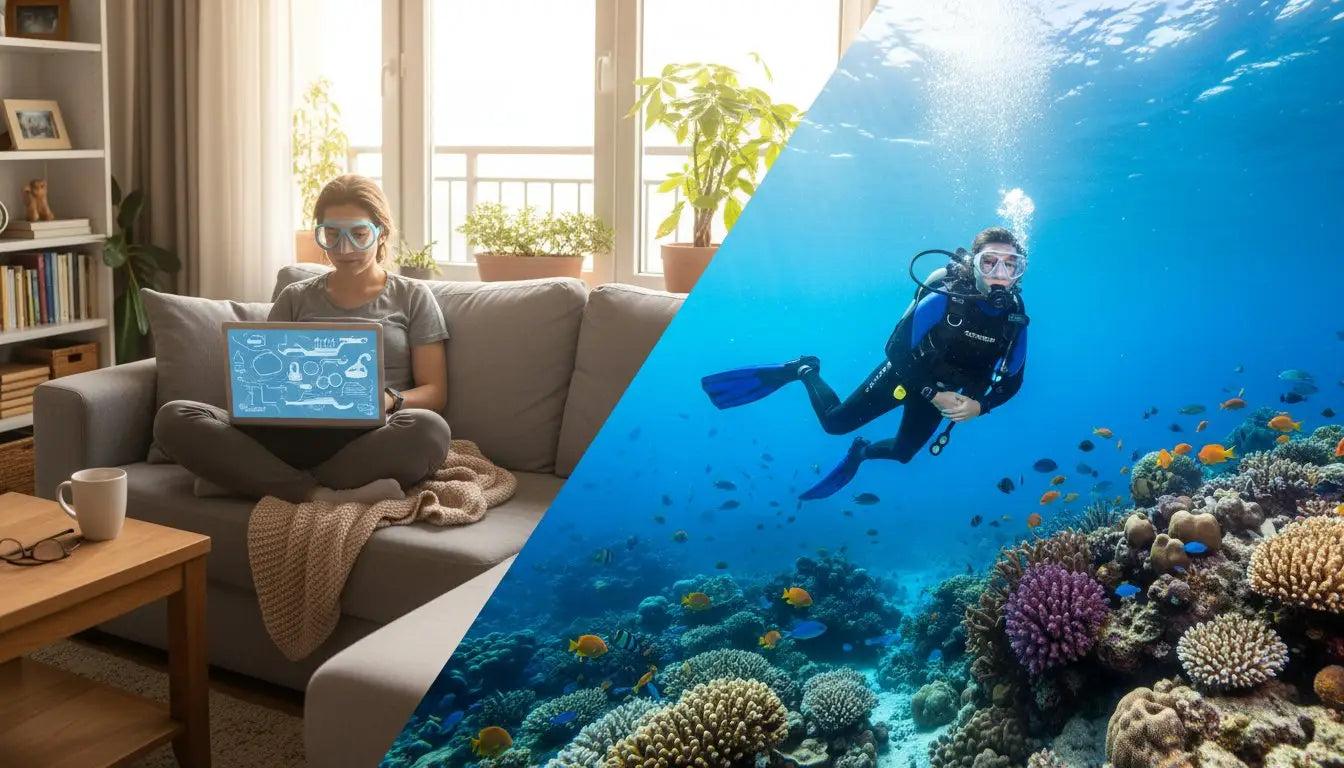
Doing the theory online before you travel turns a four to five day Open Water course in Cozumel into a two to three day one.
That is the entire argument for eLearning, and on a week-long trip it is a strong one. Two days of classroom becomes two days of diving on reefs you have flown a long way to see.
Both PADI and SSI offer it. The cost is typically $200–250 and it is normally deducted from the course price rather than added to it, so the total lands in much the same place.
What The Theory Actually Covers
Five sections, each with a knowledge review, and a final exam.
The underwater world and your body in it. Pressure, buoyancy, what happens to air spaces as you descend, why you equalise.
Equipment. What each piece does and how it fits together.
Planning a dive. Depth and time limits, using tables or a computer, buddy checks.
Problem management. Cramps, low air, separation from your buddy, and what to do about each.
Continuing on. Care of equipment, and where the certification takes you next.
Budget 8–12 hours across a few evenings. It is not difficult material and the platform will not let you skip ahead, so pacing it over a week is easier than doing it in one sitting.
What Still Has To Happen In Cozumel
The theory is the portion that moves. Everything wet stays.
Confined water. Half a day in a pool or a sheltered shallow entry, running through the core skills — mask clearing, regulator recovery, buoyancy control, controlled ascent, sharing air. This is where the instructor time is concentrated.
Four open water dives. Two days on the reef, repeating the skills at depth and then diving properly. Typically at Paradise or Chankanaab — shallow, sheltered and forgiving.
The watermanship assessment. Either a 200 metre continuous swim unaided, or a 300 metre swim with mask, fins and snorkel. No time limit on either. Plus a 10 minute float or tread. It is a competence check, not a fitness test.
The Practical Sequence
Four to six weeks before you fly: buy the eLearning directly from PADI or SSI, or through the dive center you have booked. Buying through the center sometimes gets it discounted against the course.
Over the following weeks: work through the five sections. Do it on a laptop rather than a phone — there is a lot of diagram work.
Before you travel: complete the final exam. Screenshot or download your completion record. Do not rely on having signal at the dive center.
Day one on the island: medical questionnaire, equipment fitting, confined water session, watermanship assessment.
Days two and three: four open water dives across two days. Certified at the end of dive four.
Day four onwards: actual diving, on the reefs you came for.
What To Bring With You
Your completion record, downloaded rather than streamed.
The medical questionnaire, already reviewed. If any answer is yes, you need a physician's sign-off — and getting that done at home is far easier than finding a doctor on the island the day before your course. This is the single most common cause of a course being delayed.
Your own mask if you own one. A leaking rental mask is the most reliable way to make a first dive unpleasant.
Certification for anyone else in your group, if they are already qualified.
Does It Cost More Or Less?
Broadly neutral on money, substantial on time.
The eLearning fee is usually taken off the course price. What you are buying is the two days back, not a discount.
What is not normally included in either route: equipment rental, the certification processing fee, and the marine park fee. Those are the three extras that turn a $450 quote into a $550 one, and they apply whichever way you do the theory. The full cost breakdown covers the detail.
Referral — The Step Beyond eLearning
If you want to compress it further: complete the theory and the confined water sessions at home, then do only the four open water dives in Cozumel.
That is a referral. It costs roughly $350–450 here on top of what you paid at home, takes two days rather than four, and is the right answer if your trip is short or you are travelling with certified divers who will be diving daily without you.
The referral paperwork has a validity window, so check it before you book flights.
PADI Or SSI eLearning
Functionally equivalent. Both are WRSTC members, both certifications are recognised worldwide, and the course content maps to the same standards.
PADI materials you purchase and keep access to. SSI materials are free but tied to the center you train with, so pick the center first.
Either way, buy the eLearning for the agency your chosen dive center teaches. Buying PADI eLearning and then booking an SSI-only center is an avoidable and expensive mistake. The full comparison covers the rest.
Common Mistakes
Leaving it until the flight. Eight to twelve hours of theory on a plane, jet-lagged, is a poor start.
Not sorting the medical. The single most common cause of a delayed course.
Buying the wrong agency's eLearning. Book the center first.
Assuming it replaces the pool session. It does not. Only a referral does that.
Not downloading the completion record. Assume no signal.
The Short Version
Eight to twelve hours of theory before you fly turns four or five days of course into two or three. The cost is roughly neutral because the fee comes off the course price.
Sort the medical questionnaire at home, buy the eLearning for the agency your center teaches, and download the completion record before you leave.
Frequently Asked Questions
How long does PADI eLearning take?
Does eLearning make the Cozumel course cheaper?
How many days is the Open Water course if I do eLearning first?
What is the swimming requirement for Open Water?
Should I buy PADI or SSI eLearning?
What should I sort out before flying to Cozumel?
Does eLearning replace the pool session?
What is a referral and is it worth it?
Share This Article
Carmen Novelo
Carmen Novelo is a Cozumel native and an active scuba instructor and dive guide on the island. She has spent twelve years diving the Cozumel reef system, and writes about its dive sites, conditions and marine life for Cozumel Dive Hub.