What Open Water Certification Costs in Cozumel
Open Water certification in Cozumel runs $450–650. Here is what that covers, the three costs that are usually extra, and why the cheapest quote on the island is cheap for a reason.
Carmen Novelo · February 16, 2026 · 9 min read
Open Water certification in Cozumel runs $450–650 USD. The spread is not about quality — it is about what is bundled into the number you are quoted.
The three things that most often sit outside the headline price are equipment rental, certification processing and the marine park fee. Together they can add $80–100, which is most of the gap between the bottom and the top of that range.
This applies to both PADI and SSI. Course prices between the two agencies are effectively identical here.
What The Price Should Include
Ask for these specifically. A straight operator lists them without being pushed:
| Item | Usually included? |
|---|---|
| Instruction, all sessions | Yes |
| Tanks and weights | Yes |
| Boat for the open water dives | Yes |
| Digital learning materials | Usually |
| Full equipment rental — BCD, regulator, wetsuit | Often not |
| Certification processing fee | Often not |
| Marine park fee | Often not |
| Mask, fins, snorkel | Rarely — often expected to be yours |
The last four are where a $450 course becomes a $550 course. None of it is a scam — it is how the industry prices — but you want the total before you commit, not on the morning of day three.
The Three Extras, Explained
Equipment rental. A full set is roughly $25–40 a day. Over a four-day course that is $100–160 if it is not included. Many centers bundle it into course pricing and some do not.
Certification processing. The fee the agency charges to issue your certification and put you on the database. It is charged by the dive center and passed on. Modest, but it is real and it appears at the end.
Marine park fee. Everyone diving inside Parque Nacional Arrecifes de Cozumel pays a daily fee, including students. Some operators fold it into the course price, some add it separately as a government charge. Either is fine — vagueness about it is the warning sign.
What The Four Days Actually Look Like
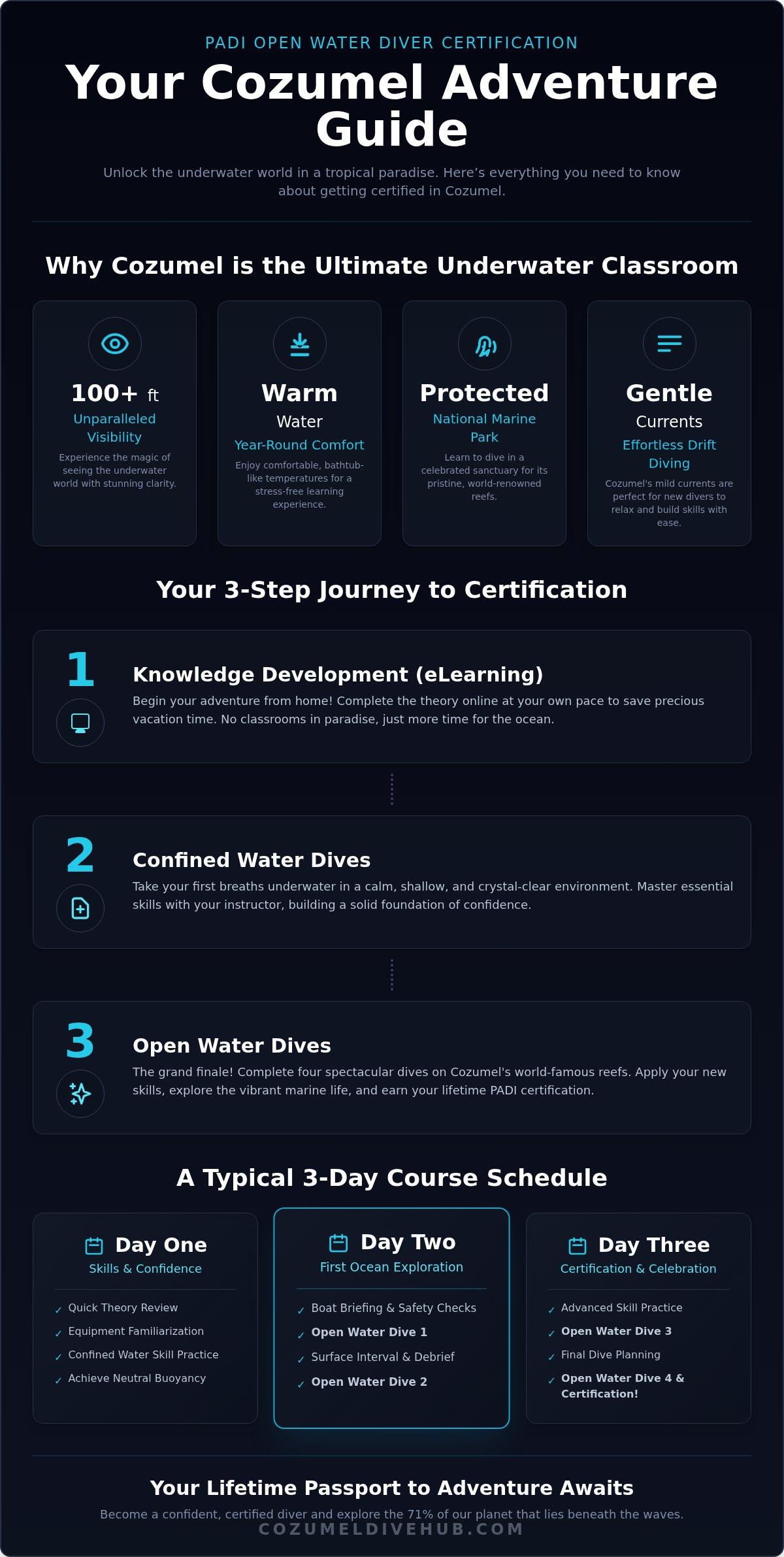
Understanding the shape of the course makes the pricing make sense.
Knowledge development. Five sections of theory with a quiz after each, and a final exam. Online before you travel, or in a classroom on the island. Roughly 8–12 hours either way.
Confined water. Half a day in a pool or a sheltered shallow entry, working through the basic skills — mask clearing, regulator recovery, buoyancy, controlled ascent, sharing air with a buddy. This is where the instructor time is concentrated, and it is why group size matters so much to the price.
Open water dives one and two. A shallow reef, typically 12–18 m. You repeat the confined water skills on the bottom, then tour the reef.
Open water dives three and four. Deeper, to the 18 m certification limit, with navigation and a controlled emergency swimming ascent. You are certified at the end of dive four.
The water work is two days. The theory is what stretches it to four or five if you have not done it in advance.
Doing The Theory Before You Travel
This is the single biggest lever on both cost and time.
Both PADI and SSI sell the theory portion online. You complete it at home over a few evenings, arrive having done the knowledge development, and the in-water portion takes two to three days instead of four to five.
The eLearning is usually $200–250 and is normally deducted from the course price rather than added to it — so the total is broadly the same, but you get two days of your holiday back.
On a week-long trip that is the difference between certifying and then having two days of fun diving, or certifying and going home.
The Referral Route
A step further: complete the theory and the confined water sessions at home, then do only the four open water dives in Cozumel.
That costs roughly $350–450 here on top of what you paid at home, and takes two days instead of four.
It costs more in total. It is still the right call if your trip is short, because it converts course days back into diving days on reefs you are paying to be near.
Why The Cheapest Quote Costs More
An operator well below the range is recovering it somewhere, and it is usually one of four places:
Group size. Eight students to one instructor is permitted. It also means you spend the confined water session waiting your turn, and the open water dives moving at the pace of whoever is struggling most.
Older equipment. A leaking mask or a regulator that free-flows is a genuinely bad introduction to breathing underwater.
A slower boat. Not a safety issue, but it eats the day.
The extras. The cheap headline price with everything unbundled arrives at the same total by day four, except now you are being asked for money you did not budget.
None of that makes a cheap operator dishonest. It makes them a different product. Just know which one you bought.
The Swimming Requirement, Since It Puts People Off
Both agencies require a watermanship assessment before certification, and it is less demanding than people assume.
Either a 200 metre continuous swim with no aids, or a 300 metre swim wearing mask, fins and snorkel. There is no time limit on either. You can breaststroke it, you can rest on your back, you can take as long as you need.
Plus a 10 minute float or tread, again with no time pressure and no particular technique required.
That is the whole assessment. It is a competence check, not a fitness test, and the mask-fins-snorkel option exists precisely for people who are comfortable in water but not strong swimmers.
What Else The Week Will Cost
The course is not the only line item.
| Item | Typical |
|---|---|
| Open Water course | $450–650 |
| Extra fun dives after certifying | $120–180 per two-tank trip |
| Equipment rental if not bundled | $25–40 per day |
| Marine park fee | Per diver, per day |
| Tips for instructor and boat crew | 10–15% is the local norm |
Tipping is expected here and worth budgeting for rather than being surprised by. The full cost breakdown covers everything else on the island.
Is Cozumel A Good Place To Do It, Price Aside?
Yes, and the conditions are the reason rather than the cost.
Water at 26–29°C year-round, visibility commonly past 30 m, and shallow sheltered reefs — Paradise, Chankanaab, Yucab — that make dive four a genuinely good dive rather than a skills test with fish.
That matters more than the price. Learning in cold, dark, low-visibility water is why a lot of people certify and then never dive again.
The honest counter-argument is in the full worth-it assessment — there are three situations where certifying here is the wrong call.
Certifying At Home Versus Here — The Real Comparison
| Route | Cost here | Days here | Trade-off |
|---|---|---|---|
| Full course in Cozumel | $450–650 | 4–5 | Best conditions, consumes most of a short trip |
| Theory online, rest here | $450–650 | 2–3 | Same total, two days back |
| Referral — theory and pool at home | $350–450 | 2 | Costs more overall, frees the most holiday |
| Fully certified at home | — | 0 | Arrive ready to dive, colder training |
The referral is the underrated option and almost nobody mentions it, because dive centers would rather sell the whole course.
If you are travelling with certified divers, it is close to the only sensible route — otherwise you spend the week on a different boat, at different sites, on a different schedule from the people you came with.
What To Ask Before You Book
Five questions. They take one email and they settle everything:
- What is the total, including everything? Equipment, certification processing, marine park fee.
- How many students per instructor? Four is comfortable. Eight is permitted and you will feel it.
- How many days, and can I do the theory online first?
- Which sites are the open water dives on?
- What happens if I need an extra session on a skill? A good center says "we do it again tomorrow" without charging for it.
Our dive center guide covers what those answers mean, and the full listing shows which centers run small classes.
PADI Or SSI For The Course
Price is the same. Standards are the same. Both are WRSTC members and the certifications are mutually recognised worldwide.
The only practical difference is materials — SSI digital materials are accessed through the center, PADI materials you buy and keep. Neither affects the diving or where the card is accepted.
Choose the center first and accept whichever agency it teaches. The full comparison covers the detail.
The Short Version
$450–650, four days, or two to three if you do the theory before you fly.
Get the total in writing including equipment, processing and park fees. Ask the student-to-instructor ratio. And if a quote is dramatically below the range, ask what is different about it — there will be an answer.
Frequently Asked Questions
How much does Open Water certification cost in Cozumel?
What is usually not included in a Cozumel Open Water course price?
Is PADI or SSI cheaper in Cozumel?
Can I save money by doing the theory online before I travel?
What is a referral and what does it cost?
Why are some Cozumel dive courses so much cheaper?
How many students will be in my Open Water class?
Do I need to tip my dive instructor in Cozumel?
Share This Article
Carmen Novelo
Carmen Novelo is a Cozumel native and an active scuba instructor and dive guide on the island. She has spent twelve years diving the Cozumel reef system, and writes about its dive sites, conditions and marine life for Cozumel Dive Hub.