
Advanced Open Water in Cozumel: What It Actually Gets You
Two days, five dives, and access to Punta Sur, Maracaibo and Colombia Deep. What each adventure dive involves, which to pick in Cozumel, and who is better off waiting.
Carmen Novelo · January 23, 2026 · 10 min read
Advanced Open Water takes two days and five dives in Cozumel, and the practical thing it buys you is access. Most operators here will not take an Open Water diver to Punta Sur, Maracaibo or Colombia Deep. Those are the sites people fly here for, and AOW is the card that opens them.
It is not a difficult course. There is no exam to fail and no skill circuit to repeat. You do five dives with an instructor, two of them mandatory, and you finish certified to 30 metres.
Whether it is worth doing here rather than at home is a different question, and the answer depends on how many dives you have logged.
What The Course Involves
Five Adventure Dives across two days. Two are compulsory:
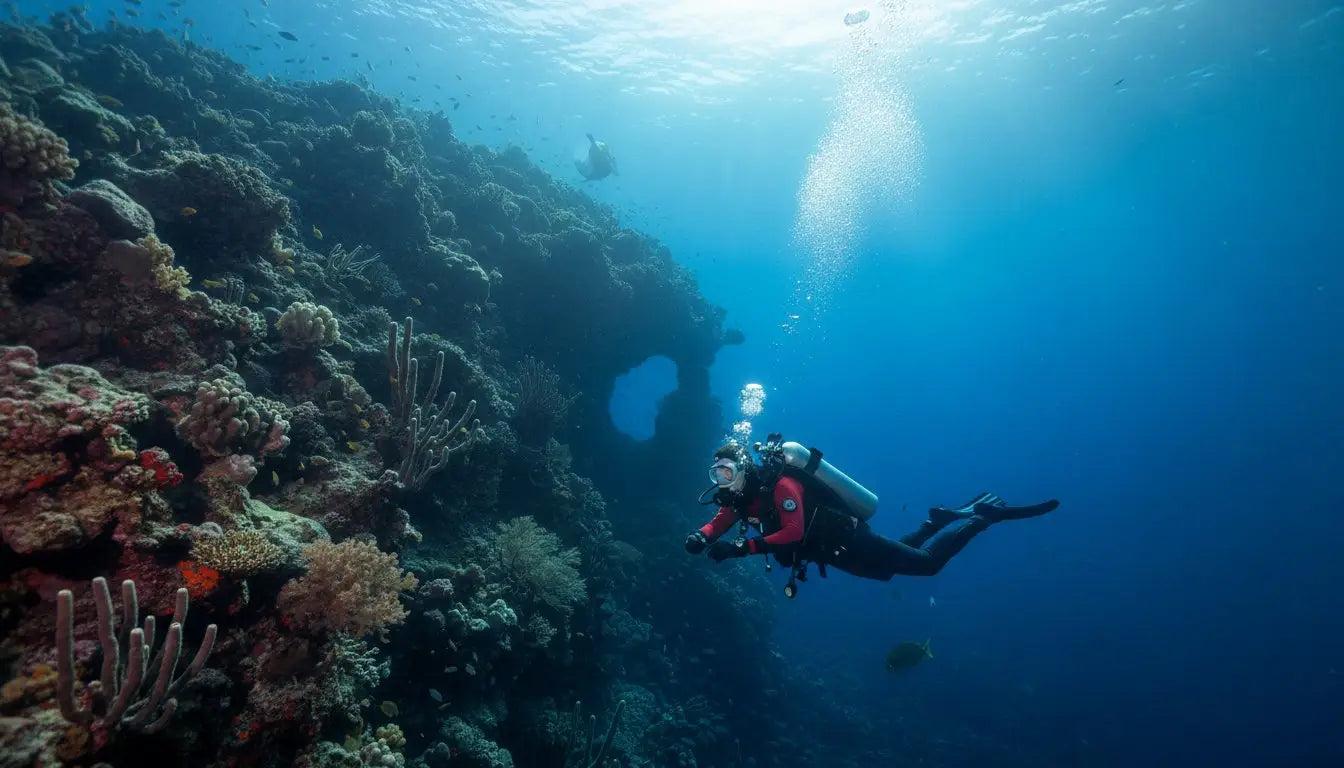
Deep Adventure Dive — to a maximum of 30 m. You will do a simple task at depth to demonstrate the effect of narcosis, and compare it against the same task at the surface. In Cozumel this usually happens on a southern wall, which is the point of the whole exercise.
Underwater Navigation — natural navigation and compass work. On a drift dive this is less about finding your way back and more about knowing where you are relative to the reef and the boat.
The other three are chosen from the specialty range. Which ones you pick matters more in Cozumel than most places, and there are three obvious choices here.
The Three Adventure Dives Worth Choosing In Cozumel
Peak Performance Buoyancy. The single most useful dive on the course for diving here. Cozumel is drift diving over living reef — good buoyancy is the difference between gliding past a coral head and kicking it. It also cuts your air consumption noticeably, which extends every dive you do afterwards.
Drift Diver. Structured practice in the conditions you will actually be diving. Covers current reading, positioning relative to the group, and SMB deployment — which is the skill that matters if you ever surface away from the boat.
Wreck Diver (Adventure Dive). The C-53 Felipe Xicoténcatl sits upright in around 24 m of sand. Worth knowing: the Adventure Dive covers the exterior of a wreck. Penetrating a wreck — going inside the hull — requires the full Wreck Diver specialty, and no responsible Cozumel operator will take you through the C-53 on an AOW adventure dive.
Night Diver and Fish Identification are also good choices here, the first because Cozumel's reef changes completely after dark, the second because the marine life is the reason most people come.
What It Certifies You To Do
30 metres, with a buddy, in conditions similar to those you trained in.
That is a meaningful jump from Open Water's 18 m, and in Cozumel it is the difference between diving the shallow mid-island reefs and diving the southern walls where the structure actually begins.
What it does not do is qualify you for overhead environments. Devil's Throat at Punta Sur is a genuine cave-like swim-through at depth. Some operators require Advanced plus a logged dive count before they will run it; others require more. It is the dive in Cozumel that gets people into trouble, and an AOW card on its own does not make you ready for it.
Prerequisites
Open Water certification from PADI, SSI or any WRSTC-member agency. Cross-agency is fine — an SSI Open Water diver can take PADI Advanced without conversion.
Minimum age 12. Divers aged 12 to 14 receive Junior Advanced Open Water, which is depth-limited to 21 m rather than 30 m. That matters here, because the deep adventure dive and the southern walls both sit below that limit. A junior diver upgrades automatically at 15.
No dive count requirement. You can go straight from Open Water into Advanced, and PADI designed it that way — the course is meant to build experience under supervision.
Whether you should is another matter.
Should You Do It Immediately After Open Water?
This is where an honest answer is worth more than a sales pitch.
If you have fewer than ten dives, wait. Not because you cannot pass — you will — but because the certification will outrun your comfort. A new diver with an AOW card can legally be taken to 30 m on a wall in current, and being legally permitted to do something is not the same as being ready for it. Do a few more dives on Paradise, Yucab and Tormentos first, get your buoyancy and your breathing settled, then take the course.
If you have twenty or more dives, do it. You will get more from it, the deep dive will feel like a step rather than a leap, and you unlock the sites you actually came for.
If your trip is short, think about it. Two days of the course is two days not spent diving the reefs you already have access to. On a five-day trip that is a real trade.
Doing It In Cozumel Versus At Home
In favour of Cozumel: warm water, 30 m visibility, and a deep dive on a genuine wall rather than a quarry or a lake. Your navigation dive happens over reef instead of silt. The conditions do a lot of the teaching.
In favour of home: it costs you no holiday time, you arrive already certified, and you can spread the five dives over several weekends rather than two consecutive days.
The middle option most people miss: do Open Water at home, arrive certified, then do Advanced here. You get the good conditions for the course that benefits from them, and you have not spent a week of your trip in class.
The Deep Dive, Honestly
The deep adventure dive is the one people remember, and it is worth knowing what actually happens.
You descend to around 30 m — in Cozumel usually along a wall, which means the bottom is a very long way below you and the visibility means you can see it. Your instructor gives you a simple task: a basic sum, or matching colours on a slate. You do the same task at the surface afterwards and compare.
Most people are slower at depth and do not notice it at the time. That is the entire lesson, and it is a better one than any amount of classroom theory about narcosis.
You will also notice your air going faster. Depth doubles consumption at 20 m against the surface and it keeps climbing — which is why a deep dive is short, and why the instructor will be watching your gauge closely.
None of this is frightening. It is a controlled introduction to something you would otherwise meet without warning on your first unguided deep dive.
What Changes About Cozumel After You Have It
The practical difference is the southern half of the island.
Palancar Caves — the swim-throughs sit deeper than Open Water limits allow for a full run.
Colombia Deep — big coral pinnacles rising from deep sand, and the site most likely to produce something large passing in the blue.
Maracaibo — the southernmost site, a long boat ride, strong current, and not somewhere any operator takes a new Open Water diver.
Punta Sur — deep structure and the entrance to Devil's Throat.
These are the reefs that built Cozumel's reputation. Without Advanced you dive the shallow mid-island reefs, which are genuinely good — but they are not what the photographs are of.
What It Costs
Advanced Open Water in Cozumel typically runs $350–500 USD, and what varies is what is bundled in.
Ask specifically whether the price includes equipment rental, the certification processing fee and the marine park fee. Those three are the usual extras. The full cost breakdown covers what everything else on the island costs.
Some operators bundle Advanced with a multi-day dive package, which usually works out better than booking the course alone and then booking fun dives separately.
The Five Dives, Day By Day
Day one, dive one — Peak Performance Buoyancy. Usually a shallow reef. Fin pivots, hovering, trim adjustment, and getting your weighting right. Most divers discover here that they have been carrying two or three kilos more lead than they need, which has been costing them air and effort on every dive they have ever done.
Day one, dive two — Underwater Navigation. Compass work and natural navigation. On a drift dive the emphasis shifts to situational awareness — knowing where the reef is, where the group is, and roughly where the boat will be.
Day two, dive one — Deep. The wall dive to 30 m, described above. This goes first on the second day because it needs the longest surface interval afterwards.
Day two, dives two and three — your remaining electives. Commonly Drift and either Wreck or Night, depending on what the operator runs and what you chose.
The order varies by center and by conditions. What should not vary is that the deep dive gets a proper briefing and a conservative profile.
Choosing Who Teaches It
The course is standardised. The instruction is not.
Ask the student-to-instructor ratio. On an Advanced course this matters less than on Open Water, because you are already certified — but a smaller group still means more attention on the deep dive, which is the one where attention counts.
Ask which sites they use for the deep dive. A southern wall is a better deep adventure dive than a sandy patch at 30 m, and not every operator plans it well.
Ask whether you choose the three elective dives. Some centers run a fixed programme. If Peak Performance Buoyancy and Drift Diver matter to you — and in Cozumel they should — you want the choice.
Our dive center guide covers what the answers tell you, and the full listing shows who runs small groups.
What Comes After
Advanced is the gateway rather than the destination. From here:
Rescue Diver is the course most experienced divers say changed how they dive. It is also the least fun and the most useful.
Nitrox is a half-day course with no dives required, and on repetitive multi-day diving it extends your no-decompression limits meaningfully. In Cozumel, where people dive two tanks a day for a week, it earns its place.
Specialty courses — Deep, Wreck, Drift, Photography — build on the adventure dives you already did. Any adventure dive completed during Advanced credits toward the full specialty.
The full course catalogue lists everything available on the island across both agencies.
Common Mistakes On The Course
Treating it as a formality. Five dives with an instructor watching is the cheapest supervised practice you will ever get. Divers who use it to fix their buoyancy and their air consumption get far more out of it than divers who treat it as a card collection.
Choosing electives for the badge rather than the diving. Deep and Wreck sound impressive. Peak Performance Buoyancy and Drift will do more for your actual diving in Cozumel than either.
Not asking about the sites. A deep adventure dive over sand at 30 m technically meets the requirement. A deep adventure dive on Santa Rosa Wall is a different experience entirely.
Booking it on arrival day. The deep dive is the second day of the course. Doing it jet-lagged and dehydrated after a long flight is a poor plan — and dehydration is a genuine factor in how you feel at depth.
Assuming it qualifies you for everything deeper. It certifies you to 30 m. Technical diving, overhead environments and decompression diving are separate training paths entirely.
The Short Version
Advanced Open Water is two days, five dives, and it opens the southern walls. It is not hard, it does not have an exam, and in Cozumel the conditions make it a genuinely good course rather than a box-tick.
Do it if you have the dives behind you and the days to spare. Wait if you have neither — the reefs you can already dive are not a consolation prize.
Frequently Asked Questions
How long does Advanced Open Water take in Cozumel?
What depth does Advanced Open Water certify you to?
Do I need Advanced to dive Punta Sur or Devil's Throat?
How much does Advanced Open Water cost in Cozumel?
What is the minimum age for Advanced Open Water?
Which adventure dives should I choose in Cozumel?
Can I penetrate the C-53 wreck on the Advanced course?
Should I do Advanced straight after Open Water?
Can I take PADI Advanced with an SSI Open Water certification?
Share This Article
Carmen Novelo
Carmen Novelo is a Cozumel native and an active scuba instructor and dive guide on the island. She has spent twelve years diving the Cozumel reef system, and writes about its dive sites, conditions and marine life for Cozumel Dive Hub.