2026 Cozumel Scuba Guide for Certified Local Divers
For a certified diver the useful question in Cozumel is not which reef is best but what order to dive them in. Start shallow while you re-find your weighting, save Punta Sur and Devil's Throat for mid-trip, finish shallow before flying.
Carmen Novelo · April 7, 2026 · 16 min read
If you are already certified, the useful question in Cozumel is not which reef is best — it is what order to dive them in. A well-built week starts shallow and mild while you re-find your weighting, moves into the mid-depth reefs and the first walls on days two and three, saves the committing southern sites like Punta Sur, Devil's Throat and Maracaibo for the middle of the trip when your air consumption and buoyancy are at their sharpest, and finishes with shallow reefs so the last day leaves plenty of margin before the eighteen-hour wait to fly. Around that spine sit the things most visitors never book: afternoon single tanks, night dives, the C-53, shore diving, and a mainland cenote day. This is a plan, not a list.
Cozumel Dive Hub is an independent editorial guide. It does not run boats, employ instructors or hold a training rating — what follows is a structure you can hand to whichever operator you choose. For a site-by-site breakdown of which reefs suit which diver, the best dive sites in Cozumel guide is the companion piece to this one and is not repeated here.
What Does A Realistic Certified Diver's Week Look Like?
Most visitors arrive with a seven-night booking and a vague plan to "dive every day". That plan almost always breaks in the same two places: too much depth too early, and a last dive day that collides with the flight home. Here is a version that does not.
| Day | Morning | Afternoon | Why It Sits Here |
|---|---|---|---|
| 1 — Arrive | Travel | Gear check, marine park wristband, walk the malecón | A long flight plus a first dive is how tired mistakes happen |
| 2 — Settle | Two-tank on shallow mid-island reef | Rest | Weight check and buoyancy reset before anything deep |
| 3 — Build | Two-tank on mid-depth reef and a first wall | Optional afternoon single tank | Moderate current, moderate depth, real drift practice |
| 4 — Walls | Two-tank on the southern walls | Night dive on a shallow reef | Deepest profiles belong mid-trip, not day one or day last |
| 5 — Peak | The committing dive of the trip | Surface interval only | Punta Sur, Devil's Throat, Maracaibo or Colombia Deep |
| 6 — Change of scene | Mainland cenote day, or the C-53 plus a shallow reef | Ferry back / early evening | Breaks the repetitive saltwater-depth pattern |
| 7 — Last diving day | Shallow two-tank, finished by early afternoon | Explore the island | Shallow profiles start the eighteen-hour clock cleanly |
| 8 — Fly | No diving | Airport | Minimum eighteen hours from the last surfacing |
Two things in that table do more work than anything else. The first is that day two is deliberately unambitious — nobody's buoyancy is where they think it is after six months out of the water. The second is that day seven is shallow and early, which is the single easiest way to stop a great trip from ending in an anxious conversation with a dive computer at the airport.
If you have four days rather than seven, cut days three and six, not day two.
Why Should You Not Start With Devil's Throat On Day One?
Because the sites that make Cozumel famous are the ones least forgiving of a rusty diver, and rustiness is invisible until you are in the water.
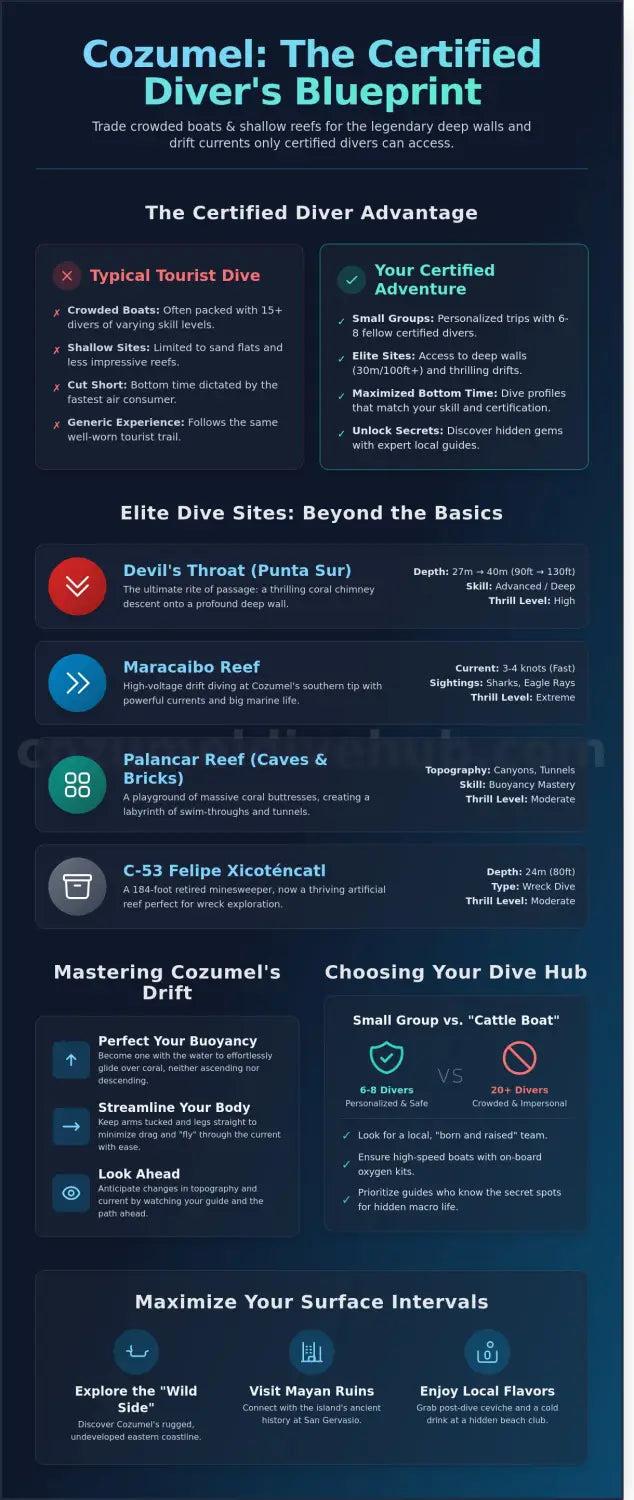
Devil's Throat runs from about 80 to 130 feet with moderate to strong current and an overhead section. Maracaibo reaches 150 feet. Punta Sur sits between 90 and 120. These are not sites where you discover that you are four pounds overweighted, that your air consumption has drifted, or that your ears are slower to clear than they used to be. Discover all of that at 40 feet on Paradise Reef instead.
There is a second reason that is purely about nitrogen. Your deepest, longest profiles create the most loading, and stacking them at the start of a week means every subsequent day starts from a higher baseline. Putting them mid-trip, with a shallower day either side, gives you a cleaner dive profile across the whole week and more usable no-decompression limit on the days that matter.
The counter-argument you will hear is that conditions might be bad later in the week and you should take the big site when it is offered. That is fair, and it is why the plan above has slack in it rather than a fixed schedule. Take Punta Sur on day four if the current is right. Do not take it on day one because it was on the boat's list.
How Should The Site Progression Actually Build?
The table below is built from depth, skill grading and current strength rather than reputation. Use it as a ladder: the operator picks the sites, but you can tell them where on this ladder you want to be on a given morning — a conversation that is easier on a small owner-run boat such as Azul Divers, which works out of Marina Fonatur without a walk-in shop.
| Stage | Representative Sites | Depth Range | Current | What You Are Proving |
|---|---|---|---|---|
| Settle in | Paradise Reef, Chankanaab Reef, Las Palmas | 30–70 ft | Mild to moderate | Weighting, trim, ear clearing |
| Build | Yucab Reef, Tormentos, Paso del Cedral | 45–100 ft | Moderate | Holding position in real drift |
| First walls | Villa Blanca Wall, San Francisco Reef, Punta Tunich | 45–120 ft | Moderate | Depth discipline beside a drop-off |
| The big walls | Santa Rosa Wall, Palancar Caves, Palancar Horseshoe | 50–120 ft | Moderate to strong | Swim-throughs with good buoyancy |
| Committing | Punta Sur, Devil's Throat, Maracaibo, Colombia Deep | 60–150 ft | Moderate to strong | Gas planning and calm at depth |
| Wind down | Colombia Shallows, Palancar Gardens, El Cielo | 5–80 ft | Mild to strong | Long, shallow, low-loading dives |
A note on the northern sites, because they get quietly skipped. Barracuda Reef and San Juan Reef are graded strong to very strong current and only run on the right days. If a northern trip is offered mid-week and you have been diving well, take it — those days do not come around often.
Before Punta Sur specifically, read the Devil's Throat site guide. It is the one dive on this island where turning up unprepared has consequences, and it is worth knowing what the swim-through actually involves before a briefing tells you.
What Can You Do Beyond The Morning Two-Tank?
This is where most certified divers leave value on the table. The standard Cozumel product is a two-tank morning boat leaving around 8:00 am and back by early afternoon, and a great many visitors book seven of those and nothing else. The island has more than that.
Afternoon single tanks. The pm boat is the most underused product in Cozumel. It is sold as one tank rather than a boat day, so it is the cheapest way to add a dive; it usually runs on the shallow mid-island reefs; and because most visitors book mornings, the boat is frequently half empty. Sun high overhead also puts more light onto a shallow reef than a low morning angle does, which is why photographers who want colour rather than silhouettes book the later slot.
| Morning two-tank | Afternoon single tank | |
|---|---|---|
| Typical departure | Around 8:00 am, back early afternoon | Early afternoon, back before dusk |
| Dives | Two, deeper profile first | One |
| Sites | The full range, including the southern walls | Usually shallow mid-island gardens such as Yucab, Tormentos and Paradise |
| Boat load | The busiest slot of the day | Often a fraction of the morning numbers |
| Price | A full trip | Priced as a single tank, so materially less |
| Light | Lower sun, longer shadows | Sun near vertical, more light and more colour at depth |
| Best for | Depth progression and the committing sites | A third dive, late starts, ferry day-trippers from Playa del Carmen, and shallow-reef photography |
It stacks. A morning two-tank plus an afternoon single is a three-dive day without chartering anything, and it is the standard way experienced visitors get more diving out of the same week. Two caveats. The first is nitrogen: three dives a day, every day, is more loading than most recreational divers want, so alternate a three-dive day with a lighter one. The second is the flight — an afternoon dive the day before an early departure is the mistake that breaks the eighteen-hour arithmetic below.
It also suits divers who are not staying on the island. If you are coming across on the ferry from Playa del Carmen, an afternoon slot means a normal breakfast and a mid-morning crossing rather than a pre-dawn start, and cruise passengers on a late docking can sometimes make it — check whether your ship is running on ship time or local time before you count the hours.
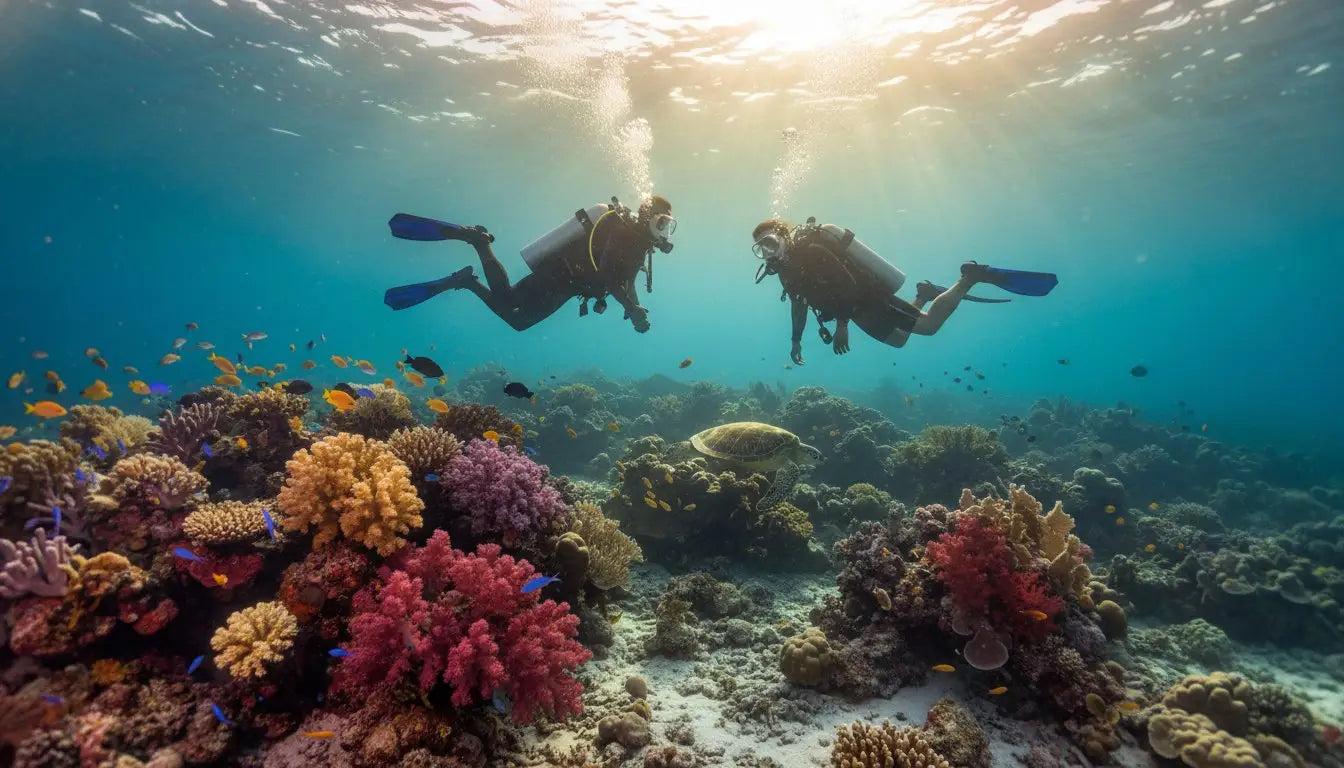
Night dives. Cozumel's reefs change species after dark — octopus out hunting, lobsters walking in the open, coral polyps extended. Most night dives run on shallow, mild sites precisely because the diving is about looking closely rather than covering ground. Start with the night dive guide, and if a full night dive feels like a step too far, the twilight dive is the sensible bridge.
The C-53. Cozumel's only wreck is a former minesweeper sitting upright in the sand off Chankanaab, with the accessible structure between roughly 40 and 55 feet. It is graded intermediate with moderate current. It is not a dramatic wreck by international standards, but it is a legitimate change of pace mid-week and the natural pairing with a shallow reef on the same tank pair. Details are in the C-53 wreck diving guide. Going inside is a separate matter — wreck penetration needs specific training, and no responsible operator will take an untrained diver into the interior.
Shore diving. Underrated and almost entirely absent from visitor itineraries. Sites like Playa Corona and Money Bar Reef sit in 10 to 40 feet with mild current, reachable from the beach. They are the perfect no-boat filler on an afternoon when the port is busy or you simply want a slow hour with a camera. The shore diving locations guide has the access details.
Seasonal add-ons. Between roughly November and March, the bull shark aggregation off Playa del Carmen runs as a mainland day trip; the bull shark season guide covers what that involves. What is available when is a function of season, and the conditions by month guide is worth checking before you build the week.
Is A Mainland Cenote Day Worth One Of Your Days?
Often, yes — and it does more for the week than an eighth reef dive would.
A cenote day means the passenger ferry to Playa del Carmen and a drive inland to the freshwater sinkholes of the Yucatán limestone. The diving is the opposite of everything Cozumel does: no current, no drift, cold fresh water, and light doing things it does not do on a reef. It is also usually an overhead environment, which is the part to take seriously — cavern-level dives stay within the daylight zone, and anything beyond that needs cave training.
Practically, it eats a full day including the ferry each way, so schedule it where the table above puts it: after the deep days, before the last shallow day. The cenote diving from Cozumel guide covers operators, logistics and what the ferry does to the timing. If you want to do it properly rather than as a guided tourist dive, the cavern diver specialty is the relevant training.
Which Certification Is Worth Adding While You Are Here?
Cozumel is an unusually good place to add a specialty, because the conditions that make the certification meaningful are the conditions you are diving in anyway. A drift specialty taught in a quarry is theory; taught here it is Tuesday morning.
| Specialty | Why Here Specifically | Time Cost |
|---|---|---|
| Enriched Air Nitrox | Repetitive multi-day diving on 60–90 ft reef profiles is exactly the case nitrox exists for | Mostly theory; fits around diving |
| Drift Diver | This is the archetypal drift destination; covers SMB use and live-boat pickup | Two dives |
| Peak Performance Buoyancy | Protected reef, close proximity, real current — trim matters more here than most places | Two dives |
| Deep Diver | Legitimises the 100–130 ft southern walls rather than fudging them | Four dives |
| Night Diver | Turns one novelty night dive into a repeatable skill | Three dives |
| Wreck Diver | The C-53 is the only wreck on the island and the obvious training platform | Four dives |
| Underwater Photographer | Visibility here is the reason people photograph the Caribbean at all | Two dives |
If you are still an Open Water diver, the highest-value upgrade is simply Advanced Open Water, which is what unlocks the deeper southern sites in most operators' eyes; the Advanced Open Water in Cozumel guide explains how it fits into a diving week. The full range is set out in the Cozumel specialty dive courses hub.
One honest caveat: a specialty consumes dives you would otherwise have spent choosing your own sites. On a four-day trip, do one at most. On a full week, two is comfortable.
What Do You Do On Surface Intervals And No-Dive Days?
A surface interval on a Cozumel boat is typically forty-five minutes to an hour, spent on the water. The interval that needs planning is the one on land — the afternoon after the boat, and the full no-dive day before flying.
The practical version:
- Straight off the boat, eat near the pier rather than trekking downtown; the post-dive lunch guide maps the options against where the boats actually dock. Keep it moderate if you have an afternoon tank.
- Stay at sea level. No small-plane tours, no altitude, and be sensible about strenuous exercise on a heavy diving day.
- Drink more water than feels necessary. Compressed air is dry, the boat deck is hot, and dehydration is the least glamorous risk factor in repetitive diving.
- On the no-dive day, the island's non-diving half is genuinely good — the windward east coast, San Gervasio, the town itself. The no-dive day guide covers it properly.
Cozumel Dive Hub is building Explore Cozumel, an independent directory of the island above the waterline — beaches, transport, places to stay and the Eat & Drink section — for exactly the hours this section is about.
How Do You Plan The Last Day Around Flying?
This is the part of the trip most worth getting right, and it is arithmetic rather than judgement.
If you have dived Cozumel the way almost everyone dives Cozumel — several dives a day, several days running — the published minimum surface interval before flying is eighteen hours from your last surfacing. The twelve-hour figure applies only to one single no-decompression dive, which describes almost no visitor here. Work backwards from the flight, not forwards from the diving.
| Flight Departs | Latest Last Surfacing (18 Hours) | What That Actually Allows |
|---|---|---|
| 8:00 am | 2:00 pm the previous day | A morning two-tank the day before, back around 1:00 pm |
| 12:00 midday | 6:00 pm the previous day | A morning two-tank, and an early afternoon single tank |
| 5:00 pm | 11:00 pm the previous day | A full morning and afternoon of diving the day before |
The arithmetic is more generous than most divers assume — an early flight still leaves room for a morning boat the day before, provided it is a shallow one that gets back on time. What it does not leave room for is an afternoon dive the day before an early flight, which is the mistake people actually make. Add margin rather than shaving it — flights get rescheduled earlier, and a marginal interval becomes a non-interval. Note also that the ferry to Playa del Carmen and the drive to Cancún airport is not a substitute for the wait; it is travel time, not surface interval, but it does at least happen at sea level. The flying after diving guidelines set out the full picture including what changes if you have been diving nitrox or running long profiles.
What Should You Sort Out Before The First Boat?
A short list that removes most of the friction from a diving week:
- Marine park fee. Diving inside the national park carries a fee, usually collected as a wristband; the marine park fees guide has the current position.
- Pick the operator on group size, not price. Group size determines whether the dive ends when you reach your reserve or when the first person does. The how to choose a dive shop guide covers what to ask.
- Breakfast, early. Most two-tank boats leave before much of the island is awake, so it is worth knowing which cafes open before the boats leave on your first morning.
- Say what you want. Operators run the sites they run partly because nobody asks otherwise. Telling a shop at booking that you want the southern walls mid-week and shallow reefs on your last day is usually enough.
- Bring or rent a dive computer. Multi-level drift profiles are exactly what computers are for, and a week of repetitive diving without one is unnecessarily conservative at best.
- Practise SMB deployment before you need it. Live-boat pickup means the surface marker buoy is how the crew finds you, and the drift diving guide explains the rest of the etiquette.
If you want more bottom time on the second and third dives of the day, nitrox is the single highest-return change you can make to a Cozumel week.
Putting The Week Together
The blueprint compresses to five rules. Build depth across the week rather than front-loading it. Put the committing southern sites in the middle, not at either end. Fill the afternoons with the diving nobody books — night dives, single tanks, the C-53, shore sites. Spend one day doing something that is not a Cozumel reef, whether that is a cenote or the east coast. And leave the last day shallow and early so the flight home is arithmetic rather than anxiety.
None of that requires a particular operator or a particular budget. It requires deciding the shape of the week before the first boat leaves, which is the one thing almost nobody does.
Ready to build yours? Start with the Cozumel dive trip planner.
Frequently Asked Questions
How many days of diving do you need in Cozumel as a certified diver?
What order should you dive Cozumel's sites in over a week?
Can you dive Devil's Throat on your first day in Cozumel?
How many dives a day do certified divers usually do in Cozumel?
How long must you wait to fly after diving in Cozumel?
Is a night dive worth doing in Cozumel?
Is the C-53 wreck worth one of your tanks in Cozumel?
Is a cenote day trip from Cozumel worth a full day?
Which specialty certification is most useful to add in Cozumel?
Are afternoon dive trips in Cozumel worth booking?
Share This Article

Carmen Novelo
Carmen Novelo is a Cozumel native and an active scuba instructor and dive guide on the island. She has spent twelve years diving the Cozumel reef system, and writes about its dive sites, conditions and marine life for Cozumel Dive Hub.