Flying After Diving in Cozumel: The Essential 2026 Safety Guidelines
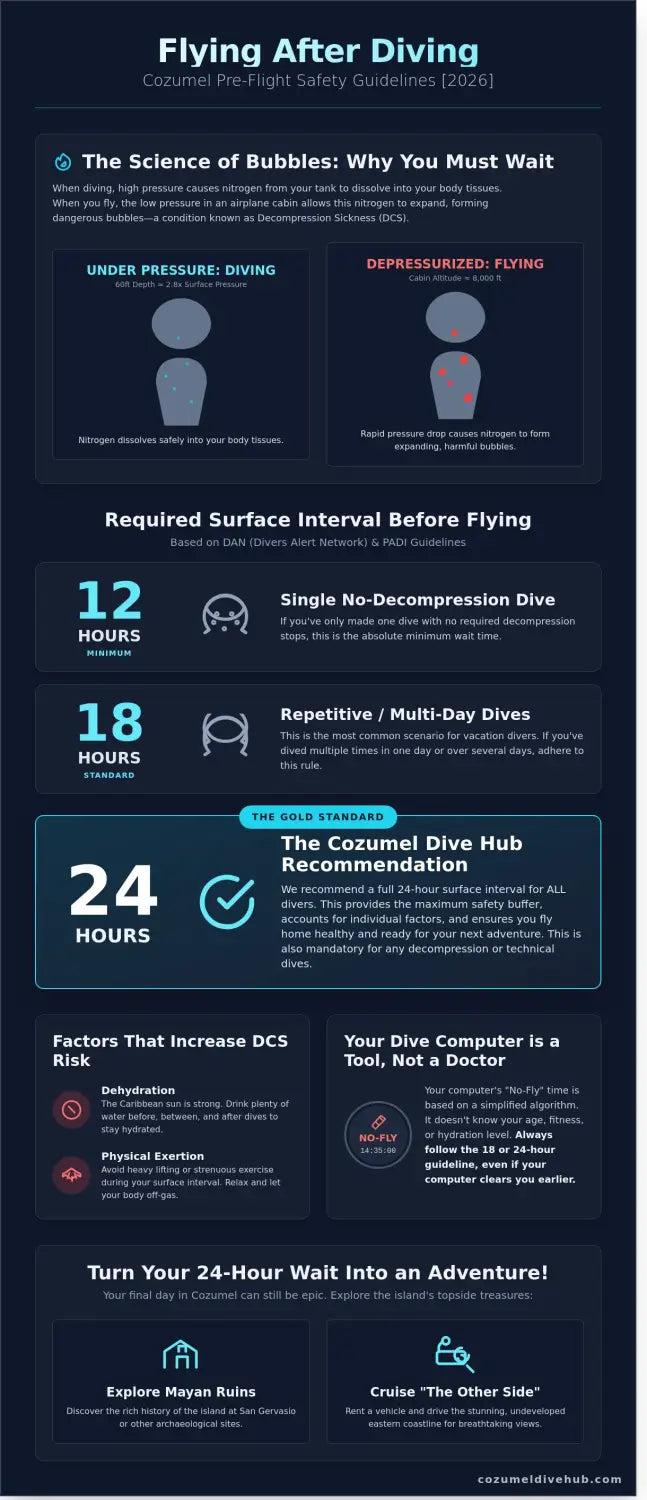
Dive Cozumel the way most people do, several dives a day over several days, and the minimum wait before boarding a plane is 18 hours from your last surfacing. The 12-hour figure applies only to one single no-decompression dive.
Carmen Novelo · March 31, 2026 · 3 min read
If you dived Cozumel the way almost everyone dives Cozumel — several dives a day, several days in a row — the minimum wait before you board a plane is 18 hours from your last surfacing. That is the figure published by both Divers Alert Network and PADI for repetitive and multi-day diving. The 12-hour number you have probably heard applies to one single no-decompression dive and nothing else, which describes hardly any visitor to this island.
Cozumel Dive Hub is an independent editorial guide to diving here. We don't run boats and we can't clear you to fly. What follows is what the two organisations divers actually rely on have published, and what those numbers mean when your last dive day and your flight day are separated by a ferry, a highway, and a hotel night.
The Numbers, and Which Organisation Publishes Each One
DAN's guidance comes out of its 2002 Flying After Diving workshop, and it is still the current consensus. PADI teaches the same thresholds in its recreational materials. Here is where they agree and where they stop agreeing.
| Your Diving | DAN Minimum Surface Interval | PADI Minimum Surface Interval | What It Actually Covers |
|---|---|---|---|
| One single no-decompression dive | 12 hours | 12 hours | A one-off dive, not part of a repetitive series |
| Repetitive dives in a day, or diving on multiple days | 18 hours | 18 hours | Essentially every Cozumel dive holiday |
| Dives requiring compulsory decompression stops, or heliox/trimix | "Substantially longer than 18 hours" — DAN declines to name a number | Not separately specified | Technical profiles; 24 hours is the figure most instructors and DAN's own diver Q&A use in practice |
Two things are worth being precise about, because the internet is sloppy with both.
First, DAN's formal consensus statement does not say 24 hours for decompression diving. It says "substantially longer than 18 hours," which is deliberately open-ended. DAN's own diver-facing answers commonly round that to a 24-hour minimum, and that is the number to plan around — but treat it as a floor someone chose, not a tested limit.
Second, these are minimums, not targets. DAN states plainly that longer surface intervals further reduce risk. The guidelines also came from dry chamber trials with resting volunteers, and DAN itself notes that divers who were immersed and exercising may need longer. Cozumel diving is immersed drift diving in warm water, often four or five days running. Nothing about that argues for shaving the number.
Where DAN and PADI differ, it is only in emphasis: PADI's consumer-facing writing sometimes collapses the whole thing into "wait 12 to 24 hours before flying after any dive." Take the more conservative end of any range you see. If you did multiple dives over multiple days, 18 hours is your floor and 24 hours is the comfortable answer.
Why 18 Hours Is the Cozumel Number, Not 12
Cozumel is built around the two-tank morning boat. You show up, you do two dives with a surface interval between them, you are back at the pier by lunch, and you do it again tomorrow. Plenty of divers add an afternoon single or a night dive on Paradise Reef. Five days of that is a normal week here.
That pattern is the textbook definition of repetitive, multi-day diving. It means nitrogen loading accumulates across days rather than clearing fully overnight, and it puts you squarely in the 18-hour column no matter how shallow or how well within the no-decompression limits each individual dive was. Staying inside your NDLs and doing a proper safety stop is what keeps you out of trouble underwater. It is not what governs your flight time.
The practical translation is blunt: your last dive day and your flight day cannot be the same day. There is no legitimate way to dive on a Saturday morning and fly on Saturday afternoon. If someone tells you otherwise, they are guessing.
Three Departure Days, Worked Through With Times
The clock starts when you surface from your last dive and stops when your aircraft takes off. Not when you leave the hotel, not when you board. Here is what that looks like against real Cozumel logistics.
Scenario One: Comfortable
Your flight leaves Cozumel International (CZM) at 2:40 p.m. Saturday. Your last dives are a Friday morning two-tank on Palancar Gardens and Columbia Shallows, and you surface from the second dive at 11:30 a.m. Friday.
Interval: 27 hours 10 minutes. You clear 18 hours with nine hours to spare, and you clear a 24-hour margin too. Friday afternoon rinses your gear, Saturday morning is breakfast and a taxi. This is the shape a Cozumel trip should have.
Scenario Two: Technically Legal, Uncomfortably Tight
Your flight leaves Cancún (CUN) at 6:20 a.m. Sunday, so you have to be off the island on Saturday and overnight near the mainland airport. You squeeze in a Saturday morning two-tank and surface at 11:30 a.m.
Interval: 18 hours 50 minutes. You are over the line by fifty minutes — and that is the entire problem. If the boat runs forty minutes late getting back, if the second dive goes long, if you say yes to a third tank at 1:15 p.m., you are now under DAN's minimum. You have built a safety plan with no slack in it, on the one day you also have to catch a ferry, cross a state, and check into a hotel. A morning two-tank the day before an early Cancún flight is not automatically safe. Do the arithmetic before you book the boat, not after.
Scenario Three: Fails
Same 6:20 a.m. Sunday CUN flight. But instead of the morning boat you take an afternoon single on Santa Rosa Wall and surface at 3:15 p.m. Saturday.
Interval: 15 hours 5 minutes. That is nearly three hours short of the 18-hour minimum for multi-day diving. It doesn't matter that it was one easy dive that afternoon — the week of diving behind it is what puts you in the 18-hour category. This is the single most common way divers here get it wrong: they apply the 12-hour single-dive rule to the last dive of a five-day trip.
The safe way to plan is backwards. Take your departure time, subtract 18 hours for the floor and 24 for the comfortable answer, and that timestamp is your hard cut-off for surfacing. Then book your last boat well before it, not just before it. If you're still sketching out the week, our trip planning guide covers how to sequence dive days against travel days.
The Ferry and the Drive to Cancún Are Not the Risk
There is a persistent myth that the Ultramar crossing to Playa del Carmen counts against your surface interval. It does not. The ferry is at sea level for the entire forty-five minute crossing. Your ambient pressure never changes. Crossing the channel the same afternoon you dive is not an altitude exposure and never has been.
The same is true of the drive up Highway 307 to Cancún airport. Playa del Carmen and Cancún both sit essentially at sea level — Cancún's elevation is around 10 metres. The road is flat the whole way. You can dive in the morning and be standing in the CUN departures hall that evening without having gone to altitude at any point. What you cannot do is get on the aircraft until your 18 hours are up.
The distinction that matters is altitude, not travel. DAN's flying-after-diving intervals apply to any ascent into roughly the 2,000-to-8,000-foot band, which includes driving and hiking, not just pressurised cabins. Nothing on Cozumel or in the northern Yucatán comes close. Cozumel's highest point is under 50 feet. Chichén Itzá is around 70 feet. Mérida is about 30 feet. You would have to leave the peninsula entirely — San Cristóbal de las Casas sits at roughly 7,200 feet and Mexico City at about 7,350 — before ground travel became an altitude exposure. If your itinerary includes either of those, the same surface interval you would apply to a flight applies to the bus.
One more logistics trap: a connecting flight does not reset anything, and neither does a layover. The clock runs from your last surfacing to your first takeoff. If you fly CZM to Mexico City and onward, it is the CZM departure that has to clear 18 hours.
Your Computer's No-Fly Timer Is Not the Guideline
Nearly every modern dive computer shows a no-fly countdown, and divers treat it as authoritative. It isn't the same thing as the DAN or PADI guidance.
Manufacturers implement no-fly timers differently. Some run a fixed 24-hour count after any dive. Some run a fixed 12. Some compute a tissue-based estimate off the decompression algorithm and will show you a number well under 18 hours after a modest repetitive day. None of them knows your age, your hydration, your body composition, a poorly healed old injury, or how hard you worked against the current. They are modelling a mathematical diver, not you.
Use the timer as a cross-check, not a permission slip. When your computer says 14 hours and DAN says 18, the answer is 18. When your computer says 24 and DAN says 18, the answer is 24. Take whichever number is longer, every time. Our rundown of dive computers that suit Cozumel diving covers how different models handle conservatism settings, which is worth understanding before you rely on any of them.
Things That Do Not Buy You Time
A few myths circulate on the boats here. None of these shortens a surface interval:
- Nitrox. Diving enriched air means you absorb less nitrogen per dive, and many divers feel better for it. It does not shorten the published preflight interval — the guidelines are written without reference to breathing gas for recreational profiles. Plan 18 hours regardless.
- Breathing oxygen on the boat. Surface oxygen speeds nitrogen washout, which is exactly why it is the first-aid response to suspected DCS. It is not a fast pass to the airport, and there is no protocol that converts a whiff of O2 into a shorter legal interval.
- Feeling fine. Asymptomatic bubbles are the whole reason these intervals exist. Feeling good at sea level tells you nothing about how you will feel at 8,000 feet of cabin altitude, which is roughly a 25 percent drop in ambient pressure compared with the beach.
- Shallow dives. A week of 40-foot reef dives is still repetitive, multi-day diving. Depth changes your NDL. It does not move you out of the 18-hour column.
- Being young and fit. Fitness helps. It is not a substitute for time, and DCS has hit plenty of fit young divers.
Hot tubs, saunas, and hard workouts in the hours after diving are all worth avoiding for the same reason — they change circulation and bubble behaviour at exactly the wrong moment. Hydration genuinely helps: dehydration slows nitrogen elimination, and Cozumel's heat dehydrates you fast. Drink more water than you think you need on dive days, and go easy on the beers the night before a flight.
If Something Goes Wrong
Cozumel is one of the better places in the world to have a decompression problem, because the island has more than one operational recompression facility rather than a single chamber a flight away. Our guide to Cozumel's hyperbaric chamber locations covers where they are, which hospitals host them, and how insurance billing typically works.
Know the symptoms of decompression sickness before you need to: joint pain, unusual fatigue, tingling or numbness, a mottled skin rash, dizziness, weakness, or anything neurological. Symptoms can appear hours after a dive, and cabin pressure changes are a classic trigger for problems that were silent on the ground.
If you suspect DCS on the island, get to medical care and a hyperbaric chamber rather than waiting to see whether it passes. If it happens in the air, tell the cabin crew immediately and ask for emergency oxygen. DAN's emergency hotline runs 24 hours a day at +1-919-684-9111; call local emergency services first for anything life-threatening. Sorting out dive-specific travel insurance before you travel is what makes any of this straightforward instead of a nightmare — standard travel policies routinely exclude scuba.
None of this is individual medical advice. If you have a cardiac or pulmonary condition, a PFO, a recent injury, or a history of DCS, the guidelines above are a starting point and your physician's advice is the one that counts. Follow your computer and follow your doctor.
Planning the Week So This Never Becomes a Problem
The whole issue disappears if you shape the trip properly from the start, and it costs you almost nothing to do so.
Build a genuine dry day at the end. Not a half day — a full one. Finish diving on your second-to-last day, ideally by early afternoon, and give yourself a clear 24 hours before wheels-up. That buffer absorbs a late boat, a schedule change, or the temptation of one more tank, and it turns your last day into a normal holiday day rather than a stopwatch.
Book your flight with this in mind rather than fixing it afterwards. An afternoon or evening departure out of CZM is far easier to plan around than a dawn flight out of CUN, which forces the tight scenario above. If you are flying out of Cancún, the hidden cost is not the drive — it is that you have to leave the island half a day earlier, which eats into your last possible dive slot.
Talk to your operator when you book, not on the last morning. Any competent shop will tell you which boats work against your flight time, and reputable ones will decline to put you on a boat that does not. If you are still choosing, our directory of Cozumel dive centers lists operators across the island, and there is more on what a good outfit looks like in the guides to drift diving here and diving Cozumel safely. Sequencing matters too — knowing how a two-tank morning boat actually runs, and when it really gets back to the pier, is half of getting this right.
The dry day is not wasted. San Gervasio, Punta Sur Eco Park, the undeveloped east coast, or simply a beach club and a long lunch all fill it perfectly, and none of them involves altitude. The reef will still be there next year. A DCS hit at 30,000 feet, with the nearest chamber several hundred miles behind you, is a much worse way to end a holiday than a slow afternoon in San Miguel.
How To Spend Your Last 24 Hours
The no-fly window is fixed, so the only question is what fills it. None of the following involves altitude or exertion at depth.
- Recovery and physiotherapy on the island — for divers who want the dry day to do something useful.
- Yoga and Pilates classes — gentle movement, easy to arrange the day before.
- Massage and spa — the most common way divers spend a dry afternoon here.
- Beach clubs for a no-dive day — a lounger, shade and shallow water, nothing that counts as diving.
- Where to eat on your last night — from a long lunch in San Miguel to somewhere worth the taxi ride.
- Where to go on your last night — the diving is finished, so the evening is genuinely free.
When it is time to leave, arrange an airport transfer rather than sorting it out on the morning of your flight.
Ready to build a dive week that ends properly? Start with our complete guide to planning your Cozumel dive trip — it walks through how many dive days to book, when to schedule them, and how to line the whole thing up against your flight home.
Frequently Asked Questions
How long should I wait to fly after diving in Cozumel?
Can I fly 12 hours after a single dive?
Can I dive in the morning and fly the same afternoon?
Does the ferry to Playa del Carmen affect my surface interval?
Can I drive to Cancun airport after diving?
Can I take a helicopter tour or small plane flight after diving?
Does a dive computer's no-fly timer replace the published guidelines?
Does diving Nitrox let me fly sooner?
What about going to altitude on the mainland after diving?
What should I do if I feel decompression sickness symptoms at the airport or in flight?
Share This Article

Carmen Novelo
Carmen Novelo is a Cozumel native and an active scuba instructor and dive guide on the island. She has spent twelve years diving the Cozumel reef system, and writes about its dive sites, conditions and marine life for Cozumel Dive Hub.