Cozumel Diving Packages: What's Usually Included and How to Choose the Right One
A shared two-tank morning boat is advertised at $90 to $150 per person, but with the park fee, rental gear, a computer, nitrox and tips the same day lands at $160 to $240. That gap is why two Cozumel diving packages rarely compare directly.
Carmen Novelo · June 26, 2026 · 14 min read
A standard shared two-tank morning boat dive in Cozumel is advertised at roughly $90 to $150 USD per person, based on operator price lists checked in August 2026. Add the marine park fee, rental gear, a computer, nitrox and normal crew tips, and the number a diver actually hands over on the pier lands closer to $160 to $240 for the same day.
That gap is the whole story. Two shops can both quote "a two-tank dive" and mean prices that are $70 apart in real money, because one of them is quoting tanks-and-a-guide and the other is quoting everything you will physically need to get in the water. This page breaks the day down line by line so you can compare quotes that are actually comparable.
Every figure below is an estimate taken from published operator rate pages in August 2026. Cozumel prices move — sometimes twice a year, and always at the December turn of the season. Confirm the current number with the shop before you send a deposit.
What a Two-Tank Day Actually Costs
This is the full line-item list for one certified diver on one ordinary morning trip. Nothing here is exotic; it is just the set of charges that most quotes leave out.
| Line Item | Typical Range (Aug 2026) | Usually Included in the Quote? |
|---|---|---|
| Two-tank morning boat dive | $90 – $150 | Yes — this is the advertised number |
| Tanks, weights, guide, boat crew | Included | Yes, essentially always |
| Marine park fee | $13 – $15 (225 pesos) | Usually extra, cash, per person per day |
| Full rental gear set | $20 – $40 per day | Usually extra |
| Dive computer | $7 – $12 per day | Often extra even inside a "full set" |
| Nitrox, two tanks | $16 – $26 per day | Extra, and needs advance notice |
| Larger 100 cf tank upgrade | $5 – $12 per tank | Extra |
| Crew tips | $25 – $30 per day | Never included, and expected |
| Hotel pier access fee | $0 – $5 | Charged by the hotel, not the shop |
| Far or premium site surcharge | $20 – $25 | Extra, on request trips only |
Two items on that list surprise people every season: the computer, which is frequently priced as a separate rental even when the BCD and regulator come as a bundle, and the tips, which are a real and normal $25 to $30 a day and not a rounding error.
Published Two-Tank Rates, Checked August 2026
These are the numbers on the shops' own public price pages in August 2026, for a standard shared morning trip. They are estimates for comparison, not quotes.
| Operator | Standard Two-Tank | What the Rate Includes | Notable Extras |
|---|---|---|---|
| Blue Project Cozumel | $105, dropping to $90 at five-plus trips | Tanks, weights, fruit, water, towels | Gear $20 – $25, nitrox $10/tank, park fee $15, pier fee $5 |
| Sand Dollar Sports | About $102 – $108 per day inside 2–5 day packages | Boat dives, guide, tanks, weights, water | Gear $25/day, wetsuit $10, nitrox $13/tank, park fee $13 |
| Dive Paradise | $118 standard AM; $149 Signature trip | Tanks, weights, belts, snacks, water | Equipment explicitly not included; park fee ~215 pesos cash |
| ScubaTony | $135, or $125 per trip at five-plus trips | Tanks, weights, guide, park fee and taxes, snacks | Gear $10 per item, mask/fins/snorkel free, nitrox $8 – $12 |
| Blue Note Scuba | $130 | Boat dives, tanks, weights, guide | Full gear $40, items $12, nitrox $12 – $25, park fee $15 |
ScubaTony is the useful outlier here: at $135 it looks like the most expensive line on the table, but it already contains the park fee and taxes that the others collect separately, so the honest comparison against a $118 quote is much tighter than it looks. That is exactly the trap this page exists to defuse.
For the wider island picture, the Cozumel dive centers directory lists what each shop is actually good at, and the full price breakdown guide covers costs beyond the boat.
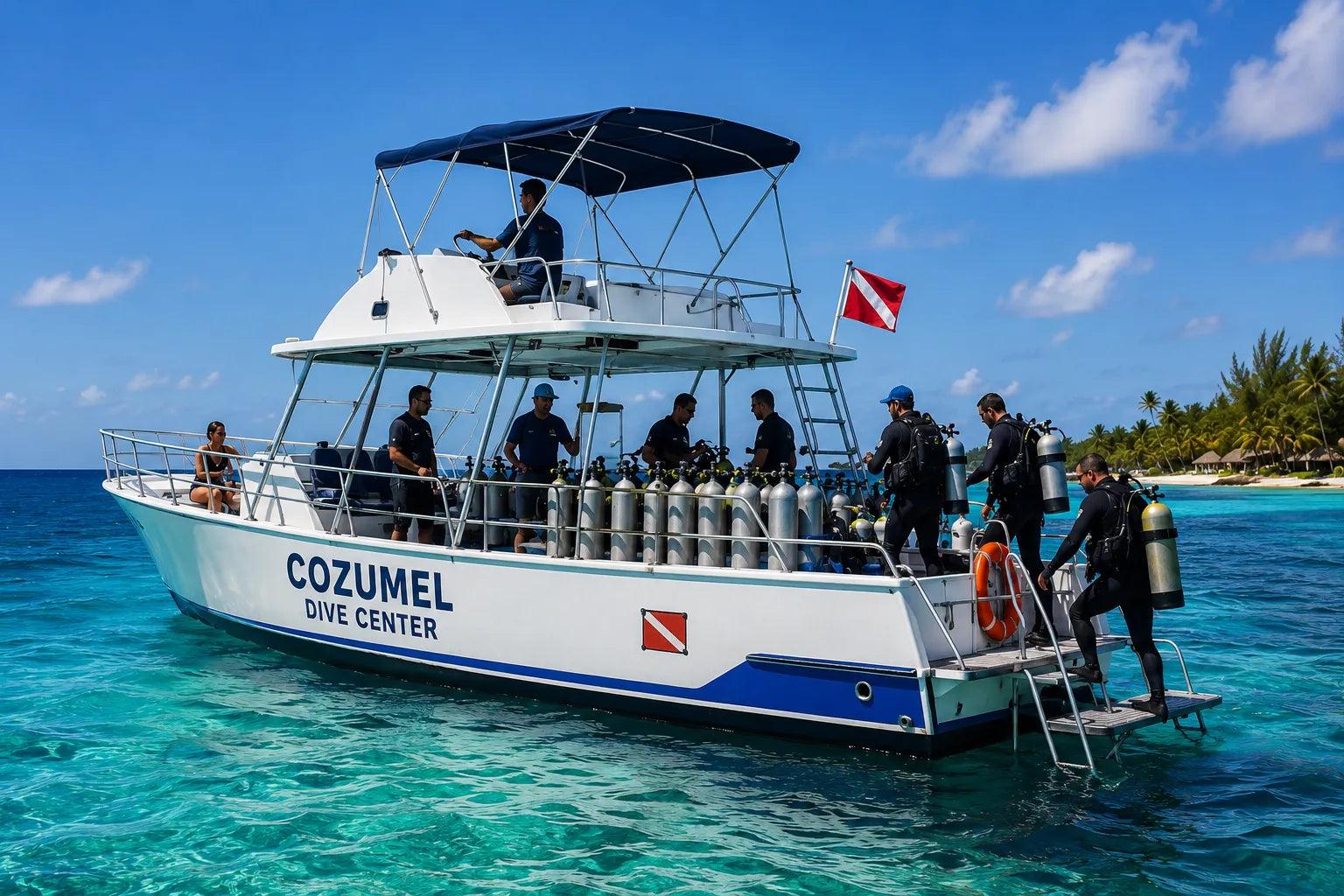
A published two-tank rate almost always covers tanks, weights, crew and a guide. Everything else on the pier is negotiable, extra, or both.
The All-In Math: Three Realistic Days
Same shop, same boat, same reef. The only variable is what you bring and what you order. Built on a $118 advertised two-tank rate, which sits close to the island median.
| Own Gear, Air | Rental Gear, Air | Rental Gear, Nitrox, Computer | |
|---|---|---|---|
| Advertised two-tank | $118 | $118 | $118 |
| Gear rental | $0 | $30 | $30 |
| Dive computer | $0 (own) | $0 (own) | $10 |
| Nitrox, two tanks | $0 | $0 | $20 |
| Marine park fee | $14 | $14 | $14 |
| Crew tips | $28 | $28 | $28 |
| All-in for the day | $160 | $190 | $220 |
Over a five-day dive trip that spread is $300 per person — more than the cost of a whole extra dive day. If you dive Cozumel regularly, bringing your own regulator and computer pays for itself faster than most people expect. The gear rental price guide and the rent-versus-bring comparison work through that trade-off properly.
The Marine Park Fee
Cozumel's reefs sit inside Parque Nacional Arrecifes de Cozumel, and every diver pays a daily entrance fee to CONANP. The rate is 225 pesos per person per day as of 2026 — roughly US$13 to US$14. It rose from 108 pesos to 218.32 on 1 January 2025, the first change since 2020, and has been adjusted again since. Treat the peso figure as the anchor and the dollar figure as an approximation.
In practice operators round it. In August 2026, published collections ranged from 212 pesos or $12 at Punta Sur Divers, to $13 at Sand Dollar Sports, to $15 or 220 pesos at Blue Note Scuba and Blue Project. The variance is exchange-rate rounding plus the shop's own handling, not a scam.
Three practical points. It is per day, not per trip — two trips in one day is one fee. It is almost always cash, collected at the boat or at check-in, and dollars are usually accepted at whatever rate the shop is using that week. And a handful of operators, ScubaTony among them, fold it into the headline rate, which is why their published number looks higher. The marine park fees guide tracks the current rate in detail.
Gear Rental and the Computer Problem
Full sets run $20 to $40 a day. Blue Note Scuba lists $40 for BCD, regulator, mask, fins and wetsuit; Blue Project charges $25 for one or two trips and $20 from three trips up; Sand Dollar lists $25 a day with the wetsuit priced separately at $10. Individual pieces are typically $10 to $12 each, so renting two or three items rarely beats the full-set price.
The detail worth checking before you book: does the set include a computer? At several shops it does not. Blue Note prices a computer as a $12 individual item, ScubaTony and Blue Project at $10, and Cozumel Dive School adds $10 on top of packages that otherwise include gear. A rented computer you have never seen before is also a real safety consideration on a drift dive — you want to know how to read it before you are in 80 feet of water with a wall going past.
A quiet cost-saver: several shops give mask, fins and snorkel away free. If you own only those three, you are not saving anything, but bringing your own regulator and computer usually knocks the rental line down to a wetsuit and BCD.
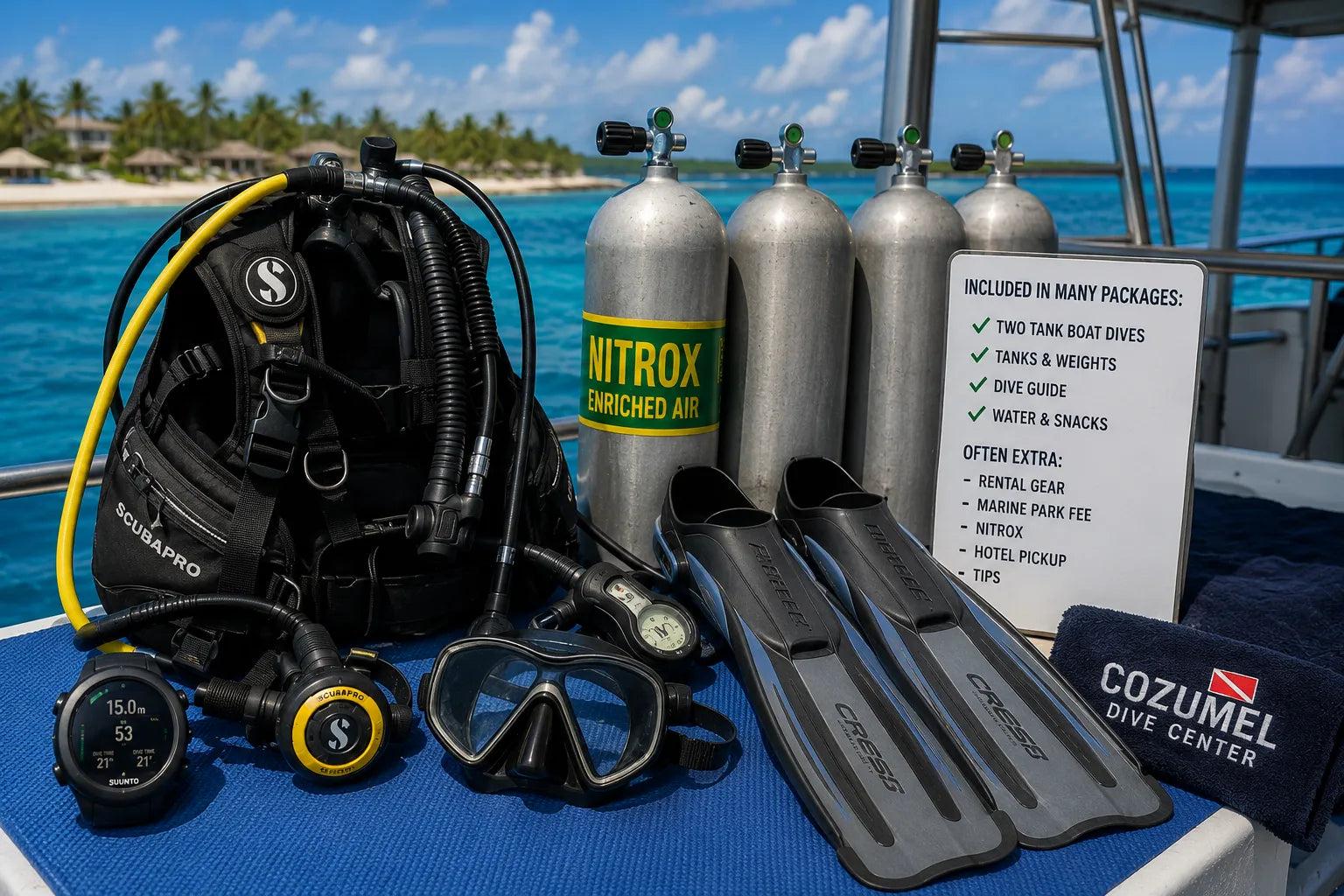
Rental gear, computers and nitrox fills are where two similar-looking quotes stop being similar.
Nitrox: When the Surcharge Pays
Enriched air runs $8 to $13 per tank in Cozumel, so $16 to $26 for a two-tank day, or roughly $80 to $130 across a five-day trip. Blue Note lists $12 for a nitrox AL80 and $25 for a nitrox AL100; ScubaTony lists $8 and $12 for the same two sizes; Blue Project and Sand Dollar sit at $10 and $13 per fill.
Whether it is worth it depends on your profile, not on marketing. Cozumel's signature dives are drift dives along walls where the first tank often starts deep, and nitrox buys back no-decompression time exactly where you are burning it fastest. Divers doing two or three dives a day for a week also tend to report feeling noticeably better by day four. On shallow reef mornings at 40 to 50 feet, air will rarely be your limiting factor and the surcharge buys you very little.
Two conditions: you need the certification, and most shops need 24 hours' notice to have the tanks blended. If you plan to add nitrox mid-trip, say so on day one. Some shops discount or waive the certification course for multi-day bookings, which is worth asking about — the nitrox guide and the dive courses index cover how that works.
Tank Size Changes the Dive More Than the Price
Most Cozumel boats hand you an aluminium 80. Some shops offer a 100 cf aluminium tank for $5 to $12 extra, and a few — Aldora Divers being the island's best-known example — build their reputation on larger steel tanks.
The difference is bottom time, not comfort. A 100 cf tank carries about a quarter more gas than an AL80, which on a deep first dive can mean the difference between a 40-minute dive and a 50-minute one. Steel also sits differently in the water and changes your weighting, so factor in a weight check on the first dive rather than assuming your usual number carries over.
If you are a heavy breather, or if you have ever surfaced early while the rest of the group kept going, the tank upgrade is a better use of $10 than almost anything else on the price list. Compare shops on the dive centers directory, and ask any operator directly which tanks are on the boat — Aldora Divers built a following on exactly this point.
Tips Are Not Optional, and They Are Not Small
Nobody advertises this line, and it is one of the largest single extras of the day. The customary tip in Cozumel is $12 to $15 per tank per person, which works out to about $25 to $30 for a standard two-tank morning, split between the divemaster and the boat crew. Blue Note Scuba's own FAQ puts the appropriate two-tank tip at approximately $30.
Bring small bills. There is no tipping line on a card terminal at the pier, and crews are usually tipped at the end of each day rather than at the end of the week. Over five dive days that is $125 to $150 per person, which belongs in your budget from the start, not as a surprise on day two. The tipping etiquette guide breaks down who gets what.
Pickup Is by Pier, Not by Curb
This one catches first-time visitors constantly. Direct hotel pickup by road is not permitted for Cozumel dive operators. What shops can do is collect divers from hotel piers inside the marine park zone — the Presidente, El Cid, Grand Park Royal, Sunscape, Dreams and Secrets piers among others — and many hotels charge their own pier access fee for the privilege, typically around $5 per person per day, paid to the hotel.
Everyone else meets at the shop or the marina and walks or taxis there. Before booking, get three things in writing: the exact meeting point, the departure time, and whether your hotel's pier is on the operator's route at all. A cheap package that requires a $10 taxi each way from the far south is not cheap.
Shops with their own pier avoid the whole problem, which is a genuine convenience worth paying for on a multi-day trip — see why a private pier changes the logistics.
What Happens If the Port Closes
Between roughly December and February, cold fronts called Nortes sweep down and the port captain closes the harbour. Nothing goes out — not dive boats, not snorkel trips, not shore diving on the west side. It is unpredictable more than a day ahead and it is not negotiable.
What varies is what your money does next. Punta Sur Divers publishes the clearest version of the good policy: if the harbour closes for weather, guests reschedule at no additional cost or take a full refund. Others offer credit toward another day, and a few pre-paid third-party packages offer nothing at all. This is the single most important question to ask before paying a deposit for a winter trip, and it is the one most people forget.
Two defensive moves. Book a trip that is at least one day longer than the number of dive days you want, so a lost day does not cost you the trip. And prefer booking directly with the shop over an intermediary, because the refund conversation is much simpler when there is only one party holding your money. The hurricane and weather season guide covers the wider seasonal picture.
Multi-Day Packages: Where the Discount Actually Is
A "package" in Cozumel usually just means several two-tank days bought at once, at a modest per-day discount. The discount is real but rarely dramatic — typically 5 to 15 percent, and sometimes zero on the first tier.
| Package (Aug 2026) | Price | Dives | Effective Per-Day Rate |
|---|---|---|---|
| Sand Dollar, 2 days | $215 | 4 | ~$108 |
| Sand Dollar, 5 days | $510 | 10 | ~$102 |
| Blue Project, 3 days | $300 | 6 | $100 |
| Blue Project, 5 days | $450 | 10 | $90 |
| Blue Note, 4 days | $480 | 8 | $120 |
| Cozumel Dive School, 3 trips | $350 | 6 | ~$117, gear and park fee included |
| Cozumel Dive School, 7 trips | $790 | 14 | ~$113, gear and park fee included |
Read that last column against what is bundled, not against itself. Cozumel Dive School's $117 a day includes gear rental, transport, lunch and marine park passes; Blue Project's $100 a day includes none of those. Once you add $25 of gear and a $15 park fee to the $100, the ranking flips.
The real advantage of a multi-day booking is usually not the money. It is that the crew learns your air consumption and your buoyancy by day two, your gear stays at the shop overnight, and the shop has an incentive to send you somewhere good on day four. If your schedule is uncertain, though, book day by day and keep the flexibility.
Resort, Course and Private Packages
Resort and dive-and-stay packages bundle rooms with diving and are genuinely convenient if your hotel has an on-site operation — Blue Angel, Dressel Divers, ProDive International Scuba Du and Babieca Dive Center at El Cid La Ceiba all run this model. Price them by unbundling: look up the room rate separately and subtract, then compare what is left against the two-tank rates above. Sometimes the bundle wins; often it is a wash with less flexibility. The resorts that bundle diving with the room are compared side by side on the dive resorts hub.
Course packages are priced on a different logic entirely, because instructor time and agency certification fees dominate the cost. Certification cards, digital learning materials and pool sessions may or may not be inside the quoted number, and that alone can swing an Open Water course by a hundred dollars. The Open Water certification cost guide covers the current spread.
Private guides are commonly $100 to $110 a day on top of the boat rate at shops that publish it, which is reasonable for a nervous diver, a photographer or a mixed-ability family. Private charters start around $590 for a two-tank day for four to six divers, so for a group of four it is closer to a modest upgrade than a luxury.
Far and premium sites carry surcharges. Blue Note, for example, adds $20 for Columbia, Barracuda and the north sites and $25 for Punta Sur, Maracaibo and Chun Chacab. These are longer boat rides with more fuel and often stricter experience requirements, and the surcharge is not padding.
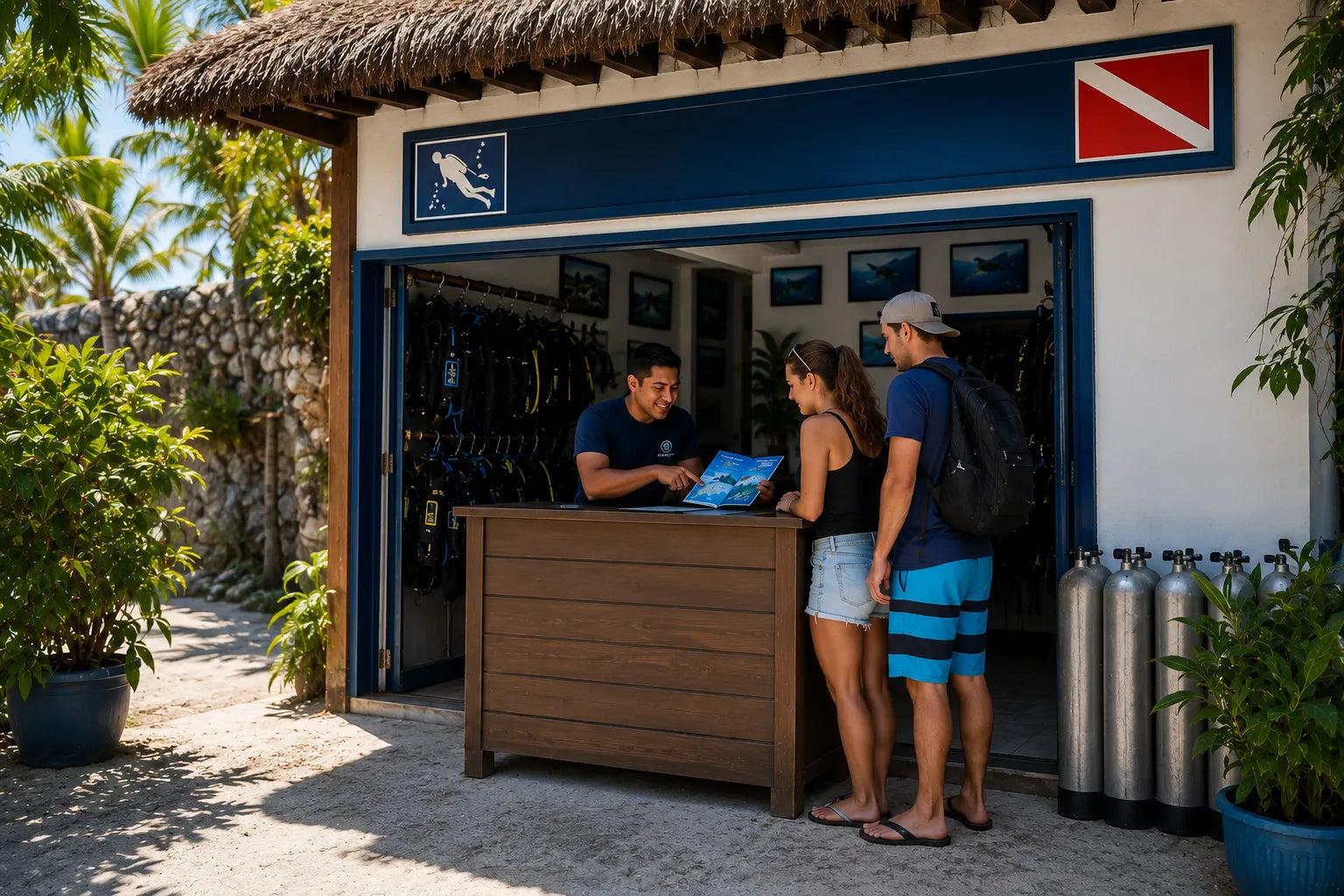
The right shop for your budget depends on what its price already contains, not on which number is smallest.
Does the Price Change by Season?
Less than most destinations. Cozumel's published two-tank rates are fairly stable year-round; the bigger seasonal move happens in December, when most shops issue a new rate card for the following year. Dive Paradise's 2026 rates, for instance, took effect on 21 December 2025.
What changes seasonally is availability, not price. Peak demand runs November through May, with March to May widely considered the best all-round diving. Boats fill, the good small-group operators book out weeks ahead, and last-minute walk-ins get whatever is left. September and October are the quietest months on the island — fewer divers per boat, easier bookings, and the highest chance of a weather-affected day. See the month-by-month diving guide for the detail.
Cruise passengers are the exception on both counts: the constraint is the return time, not the rate, and the cruise port diving guide covers the timing buffers that matter.
How Far in Advance Should You Book a Cozumel Dive?
Booking early rarely saves money in Cozumel, because published rates barely move with demand. What it buys is a seat on the boat you actually wanted, with the shop you actually chose, on the days that fit your trip. The small-group operators are the ones that fill first, and they are usually the reason people were happy with their week.
| Situation | Sensible Lead Time | Why |
|---|---|---|
| Small-group or six-pack boat, Nov–May | 4 to 8 weeks | The best-regarded small operators book out well ahead in peak season |
| Standard shared boat, Nov–May | 1 to 2 weeks | Seats are usually findable; the choice of shop is not |
| Any boat, September–October | A few days to a week | Quietest months on the island, emptiest boats |
| Christmas, New Year or Easter week | 2 to 3 months | The tightest weeks of the year for boats and hotels |
| Nitrox fills | At booking, and no less than 24 hours | Tanks have to be blended before the morning |
| Open Water or Advanced course | 3 to 4 weeks | Instructor time has to be scheduled and eLearning finished first |
| Private guide or private charter | 4 weeks or more in peak | One boat, one group, one day |
| Cruise-ship dive day | As early as possible | The return-to-ship buffer leaves no room to reschedule |
Two things shorten those windows and one lengthens them. A weekday is easier to book than a Saturday, and a single diver slots into a half-full boat far more easily than a group of five. A course, on the other hand, needs consecutive days rather than one morning, which is what makes it the booking most often left too late.
If your dates are firm, book direct with the shop rather than through a booking platform or a hotel concierge. It costs the same or less, and — as the port-closure section above sets out — it makes the refund conversation dramatically simpler when the weather turns.
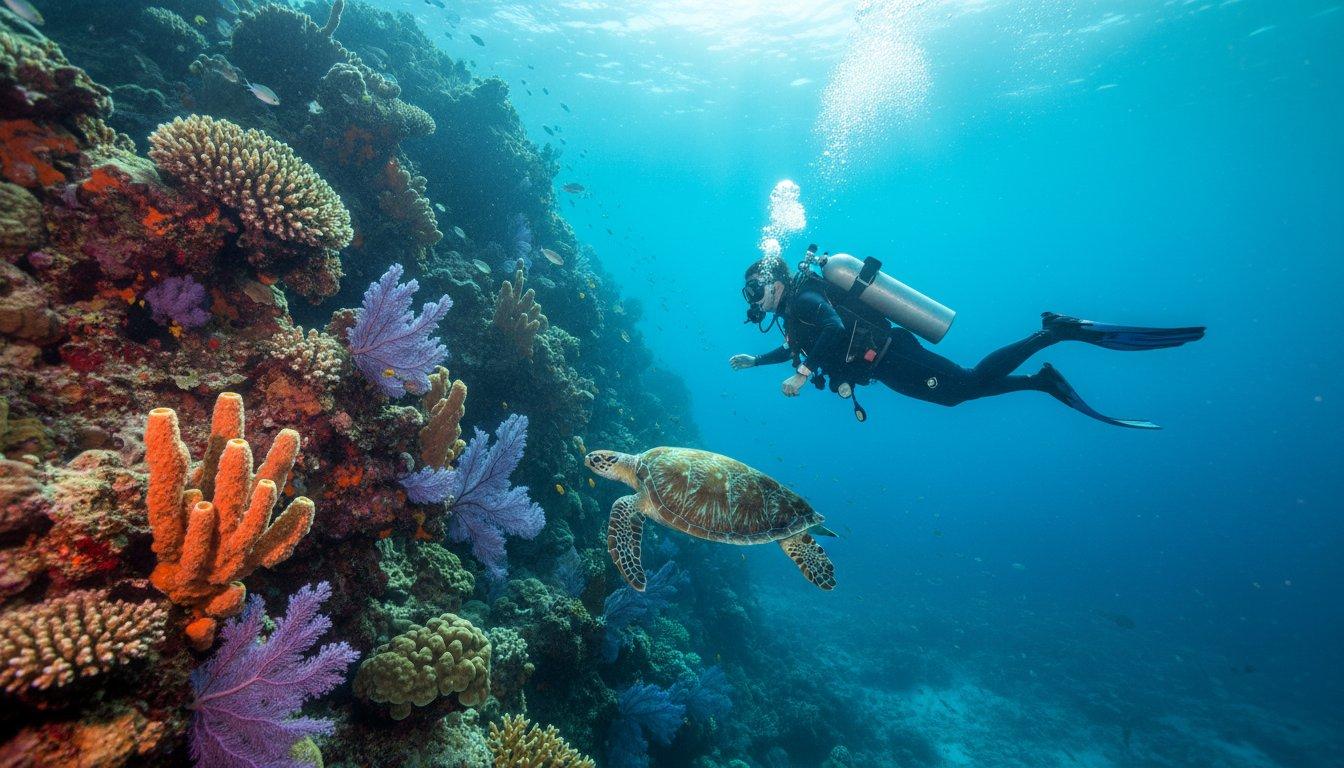
What Does a Dive Shop Need From You to Confirm a Booking?
A shop is not being nosy. Every question on this list feeds a decision the guide makes on the morning: which reef, which group, how much lead on the belt, and whether to put you at the front or the back of the drift.
| What They Ask For | Why It Matters | Have Ready |
|---|---|---|
| Certification agency and level | Sets which sites and depths you are eligible for | PADI, SSI, NAUI or equivalent, plus the level |
| Certification card | Verified before you board | The physical card or the agency app on your phone |
| Number of logged dives | Decides group placement and site choice | An honest approximate number from your logbook |
| Date of your last dive | A long gap usually prompts a refresher first | Month and year |
| Height, weight and shoe size | So a wetsuit, BCD and fins are physically on the boat | Metric or imperial, either is fine |
| Nitrox certification | Required before they will blend you a tank | The card, and 24 hours notice |
| Medical declaration | Signed before any in-water activity | Completed in advance, with a physician's note if any answer is yes |
| Emergency contact and any dive insurance | Standard paperwork; some shops require cover | Policy number if you have dive insurance |
| Hotel name and pier | Determines the meeting point | The hotel, not just the area |
The one that people fudge is the logged-dive count, and it is the one that causes the most trouble. A guide who is told twenty dives when the real number is six will plan a deeper first tank and a faster drift than the group can comfortably handle. Say the real number; a good shop will simply put you somewhere shallower and calmer.
If your last dive was more than a year ago, expect to be offered a refresher dive before the boat, and take it. It is a pool or shallow session of an hour or two, and it is far better than rediscovering how a BCD inflator works at 60 feet on a wall. The Cozumel refresher course guide covers what it involves, and the first-time diving experience guide is the equivalent for anyone who has never done this here before.
Deposits, Payment and Cancellation Terms
Practice varies more than people expect, and none of it is standardised across the island. Three questions settle it.
How is the booking held? Some shops reserve on a name and an email and take payment in full on the day. Others take a deposit by card or transfer, commonly a fixed amount per diver or the first day's rate, with the balance settled at the shop. Courses and private charters almost always take a deposit, because they commit an instructor or a whole boat.
How do they want the balance? Cash in US dollars or pesos is welcome everywhere and occasionally cheaper, because some shops add a card processing surcharge of a few percent. The marine park fee and crew tips are cash regardless, so you are drawing money out either way — plan for it rather than discovering the nearest ATM at 7am.
What is the cancellation policy, in writing? Published terms across the island cluster around a 24 to 48 hour window for a full refund, with partial or no refund inside it and nothing at all for a no-show, since the seat was held. Multi-day packages and courses often carry longer windows. Ask for it in an email or a message you can scroll back to, and read it against the port-closure policy above — a weather cancellation and a change of mind are treated completely differently, and only one of them is usually refunded in full.
Two protective habits are worth adopting. Do not pay a large sum far in advance to a party you cannot easily reach, which is the main practical argument for booking direct. And check what your travel policy actually covers before you go, because trip interruption and dive-specific medical cover are rarely the same product — the travel insurance guide for Cozumel diving sets out what to look for.
What to Ask Before You Pay
Send this list to any shop before a deposit. A good operator answers all nine in one message.
- ✓ Is the marine park fee included, or collected separately in cash?
- ✓ Does the gear set include a dive computer, or is that extra?
- ✓ What tank do I get by default, and what does a 100 cf or steel tank cost?
- ✓ What is the nitrox surcharge per tank, and how much notice do you need?
- ✓ Where exactly do we meet, and is my hotel pier on your route?
- ✓ Does my hotel charge a pier access fee?
- ✓ What is the maximum group size per guide?
- ✓ If the port closes for a Norte, do I get a refund, a credit, or nothing?
- ✓ Is there a surcharge for the sites I want to dive?
The answers to those nine questions will separate comparable quotes faster than any amount of reading reviews. The dive shop selection guide goes further on what else to look for.
What Should You Confirm the Day Before?
Almost everything that goes wrong on a Cozumel dive morning was fixable the previous afternoon. A short message to the shop the day before covers it.
- ✓ The exact meeting point and the departure time, in writing, not from memory
- ✓ Whether the boat is going at all, if a Norte is forecast
- ✓ That your gear sizes are on the list, and whether a dive computer is included or extra
- ✓ That nitrox is ordered, if you want it
- ✓ How much cash to bring for the marine park fee, and small bills for crew tips
- ✓ Certification card, medical form and a towel packed the night before
- ✓ Whether breakfast at your hotel opens early enough, or whether to take something with you
- ✓ That you are hydrated and have not been drinking, which matters more here than the dive briefing will admit
- ✓ That the dive day is not within your flying after diving window before your flight home
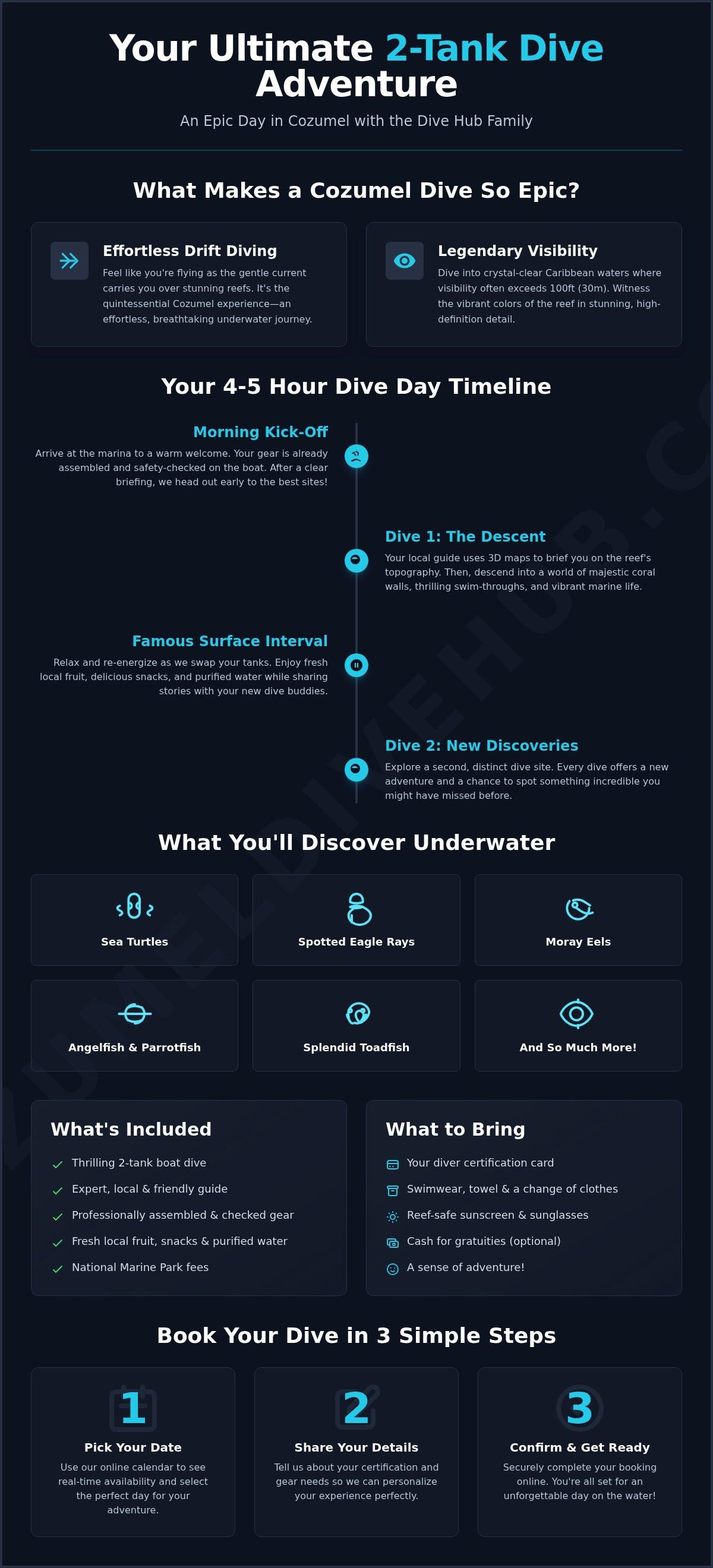
What Does a Two-Tank Morning Actually Look Like?
Roughly four to five hours door to door, of which about ninety minutes are underwater. Times shift by half an hour between operators, but the shape is the same across the island.
| Time | What Happens | What You Do |
|---|---|---|
| 7:00 | Check in at the shop, marina or hotel pier | Hand over the certification card, sign the paperwork, pay the park fee in cash |
| 7:15 | Tanks and gear loaded, wetsuit and BCD sized | Assemble your kit or check the set the crew has built |
| 7:30 | Depart; 15 to 40 minutes to the first site depending on how far south it is | Rig the boat side of things, take seasickness tablets before you leave, not after |
| 8:10 | Dive briefing: site map, depth, drift direction, hand signals, turn pressure, lost-buddy plan | Ask about the maximum depth and the NDL if it was not stated |
| 8:20 | Entry, usually a giant stride or a back roll, sometimes a negative entry if the current is running | Do a weight check on the first dive rather than assuming last year's number |
| 8:25–9:10 | Dive one: the deeper of the two, 40 to 50 minutes, safety stop, live boat pickup | Surface with the group; deploy an SMB if you drift off it |
| 9:10–10:10 | Surface interval, tank change, fruit and water on board | Drink, log the dive, tell the guide if you were cold or heavy |
| 10:10–11:00 | Dive two: shallower, usually a reef rather than a wall, 45 to 60 minutes | Longer and slower; this is where the photographs happen |
| 11:15 | Back at the pier, gear rinsed, tanks handed back | Tip the crew in cash, confirm tomorrow's time |
| 12:00 | Done for the day | Lunch, a nap, and no flying until the interval clears |
Two features of that timetable are specific to Cozumel. The deeper site comes first, always, because the profile has to step upward through the morning — which is why the famous southern walls are a first tank and the shallow reefs are a second. And the boat follows the group from the surface rather than sitting on a mooring, so nobody swims back to a fixed point at the end. The dive briefing guide covers what a good briefing includes, and the first drift dive guide is the one to read if you have only ever dived on a line.
Afternoon two-tank trips exist but are less common, and single-tank afternoon dives are widely offered as an add-on. Most divers find two tanks in a morning and an afternoon on land is the sustainable rhythm for a week, particularly with the surface interval and nitrogen loading of consecutive days stacking up.
Plan the Trip Around the Real Number
Once the budget is settled, our complete guide to diving Cozumel covers which reefs to ask for and when to come.
The cheapest advertised two-tank dive on the island is almost never the cheapest day of diving, and the most expensive one is sometimes the best value once the park fee and taxes are already inside it. Budget $160 to $240 per diver per day all-in, decide which of those line items you actually want, and compare quotes on the total rather than the headline.
Cozumel Dive Hub is an independent editorial guide, not a dive operator — there are no boats or instructors behind this site. What it does have is long relationships with island shops, which sometimes means access to rates that are not on the public price list, and a clear view of which operator suits which kind of diver.
Tell the trip planner what you need and get matched with the right Cozumel dive shop →
Frequently Asked Questions
How much does diving in Cozumel cost?
How far in advance should I book diving in Cozumel?
What do I need to give a Cozumel dive shop when I book?
What is the Cozumel marine park fee?
Is nitrox worth the surcharge in Cozumel?
Are tips expected on Cozumel dive boats, and how much?
Is gear rental included in a Cozumel dive package?
What is a Cozumel dive package?
What happens if the port closes for a Norte?
Are hotel pickups included in Cozumel dive packages?
Share This Article

Carmen Novelo
Carmen Novelo is a Cozumel native and an active scuba instructor and dive guide on the island. She has spent twelve years diving the Cozumel reef system, and writes about its dive sites, conditions and marine life for Cozumel Dive Hub.