Is Cozumel Diving Good for Beginners? A Local Expert's Guide to Your First Adventure
Cozumel works for beginners with one qualification: every dive here is a drift dive, not most of them. The conditions are forgiving, warm and clear with no surf on the leeward side, but the technique is not what you practised in a quarry.
Carmen Novelo · March 2, 2026 · 17 min read
Yes — but with one qualification that matters more than anything else written about this island: every dive in Cozumel is a drift dive. Not most of them. All of them. And drift diving is not the thing a new diver practised in a pool or a quarry.
That single fact is why some beginners have the best diving week of their lives here and a small number spend their first dive quietly panicking. The conditions are genuinely forgiving — warm, clear, no surf on the leeward side. The technique is genuinely different. Once somebody explains the difference before the boat leaves the dock, the difficulty largely evaporates.
The Honest Answer In Three Sentences
Cozumel is one of the easiest places in the Caribbean to be a new diver, because the visibility is enormous, the water is warm enough to dive in a 3mm shorty, and the current does the swimming for you. It is also one of the easiest places to end up on a dive that is far beyond a fresh Open Water card, because the same island holds reefs with 3-knot current and 130-foot walls. The difference between a great first week and a bad one is almost entirely site selection — and site selection is something a diver can and should ask for by name.
Why The Conditions Themselves Are Forgiving
Strip out the drift for a moment and look at what a beginner is actually dealing with.
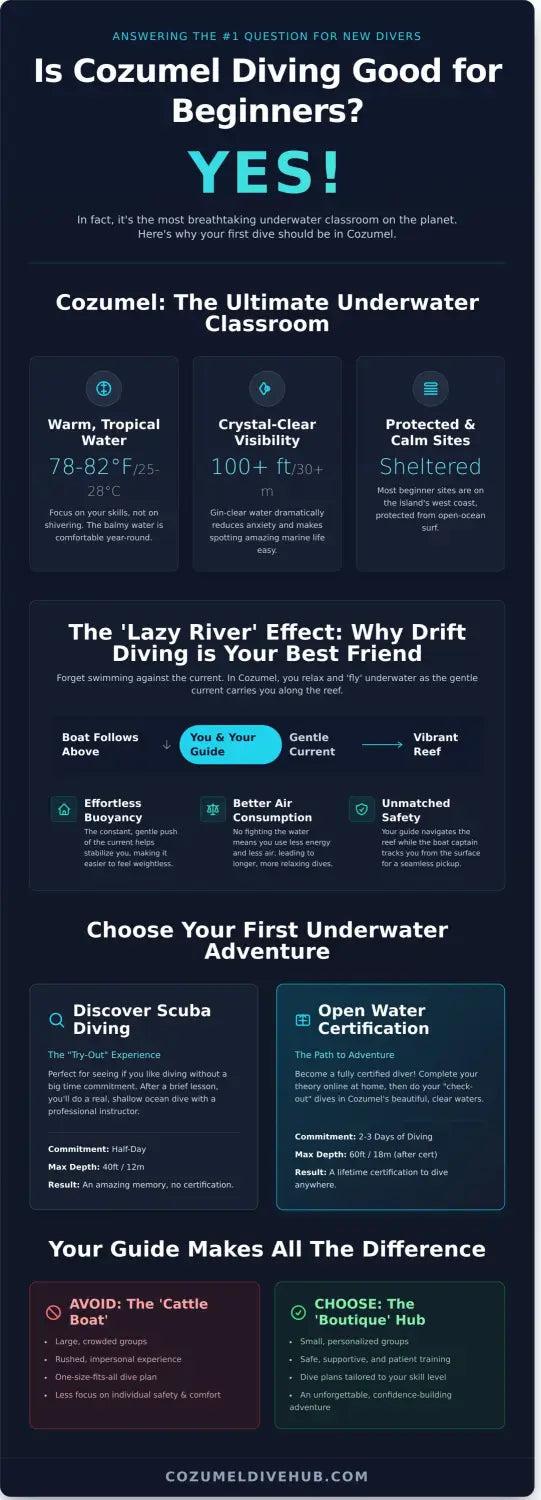
Visibility of 80–100 feet, year-round. Poor days here are still around 80 feet. That is not a small comfort — a large share of new-diver anxiety comes from not being able to see the group, the reef, or the surface. In Cozumel a diver can see all three at once for most of the dive.
Water between 78°F and 84°F. February sits at the cool end, late summer at the warm end. Nobody is task-loaded by cold, and nobody is fighting a thick wetsuit and eight kilos of lead.
No surf entries. The dive sites sit on the sheltered western side of the island. Entries are giant strides off a boat into flat water, not scrambles through breaking waves.
A protected marine park. Most sites lie inside the Arrecifes de Cozumel National Park, which means moorings, permits, briefed operators and reefs that are still worth looking at.
None of that is marketing. It's why Cozumel gets used as a training destination in the first place. There is a fuller month-by-month breakdown in the guide to Cozumel dive conditions through the year.
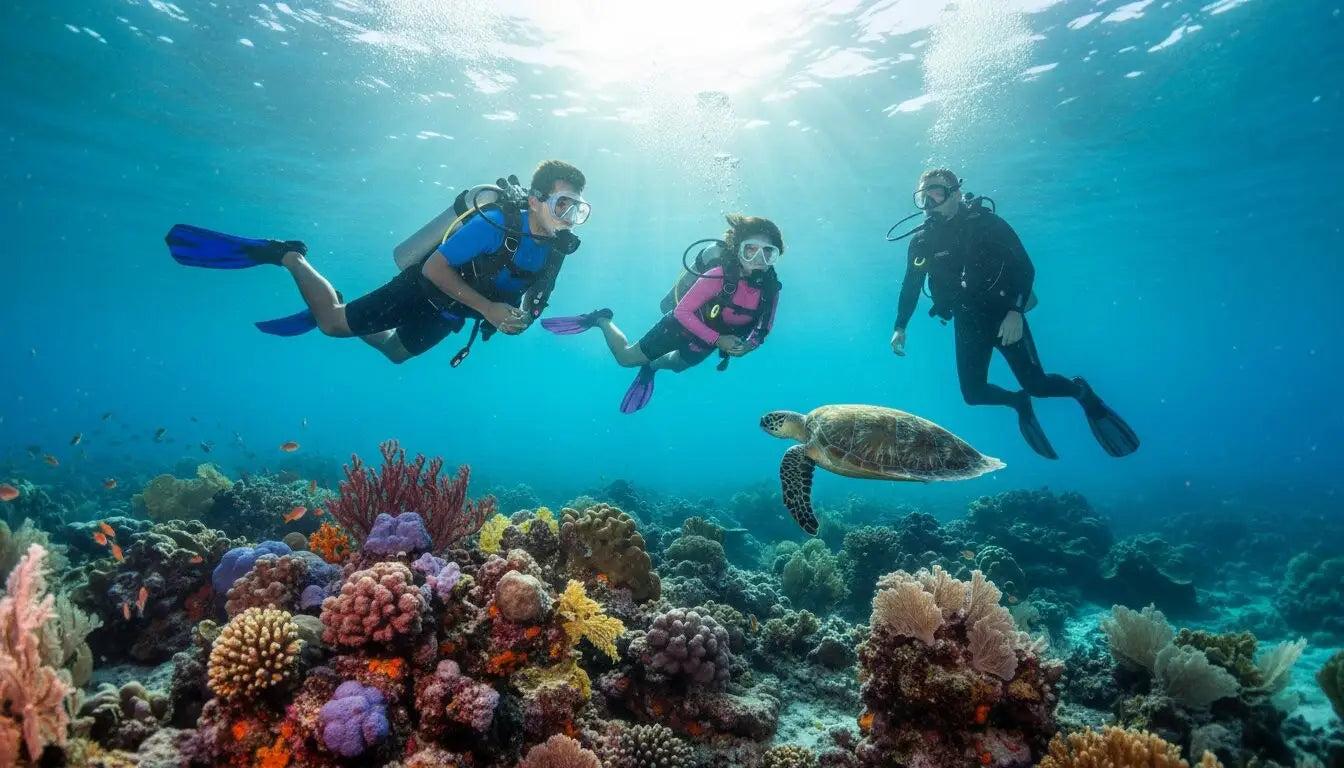
Drift Diving, Explained The Way It Should Be In The Briefing
Here is the mechanic that catches people out. In most of the world, a diver descends, swims a loop, and swims back to the boat. In Cozumel, the diver does not go back to the boat. The boat follows the diver.
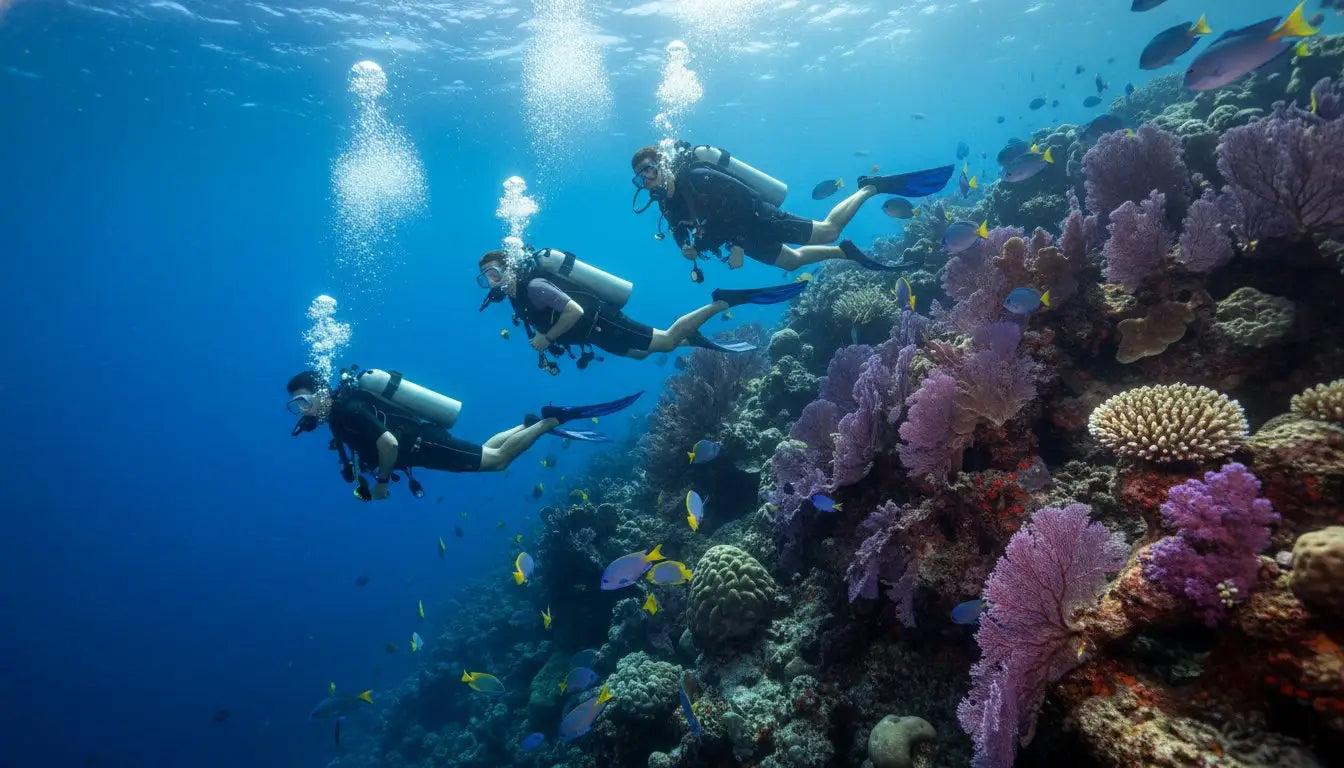
A typical Cozumel dive runs like this. The group rolls in — often a negative entry, meaning divers deflate and go straight down rather than gathering on the surface, because the boat cannot hold position in current. Everyone meets at depth, and from there the reef simply moves past. Fin kicks are for steering, not for propulsion. At the end, the group ascends together, the divemaster sends up a surface marker buoy, and the captain, who has been tracking the bubbles the whole time, comes to collect everyone wherever they surfaced — often a kilometre from where they started. That's live boat pickup.
Physically, this is easier than anything a new diver did during training. Almost no exertion means better air consumption and longer dives. The steady push of water actually helps stabilise a wobbly diver, which makes buoyancy feel more achievable, not less.
Psychologically, it takes some adjusting. Three things reliably unsettle first-timers:
- The negative entry. Going from dry to 20 feet in under a minute, with no surface pause to sort yourself out, feels abrupt the first time. Ask whether the first dive of the trip can be a normal descent down a line.
- Not being able to stop. New divers instinctively try to hold position to look at something, kick hard against the flow, and burn air fast. The fix is to tuck behind a coral head, where a pocket of still water almost always sits.
- Surfacing away from the boat. It looks alarming to come up in open water with no vessel alongside. It is completely normal, and the SMB is what makes it safe.
The dedicated walkthroughs of how Cozumel drift diving actually works and how strong the current really gets go deeper than there's room for here, and both are worth reading before the flight.
Site Choice Decides Everything
This is the part that separates a good first trip from a frightening one. Cozumel's reefs are not interchangeable. Below are the sites rated Beginner that also carry mild to moderate current — the ones to name when asked what the group would like to dive.
| Dive Site | Depth | Current | Why It Suits A New Diver |
|---|---|---|---|
| Paradise Reef | 30–40 ft | Mild to moderate | Shallow, close to town, sandy patches to practise on. The standard first dive of a trip. |
| Chankanaab Reef | 35–40 ft | Mild to moderate | Consistently gentle, shallow coral heads, easy to keep the group together. |
| San Clemente | 30–40 ft | Mild | The mildest current of any beginner site on the island. |
| Las Palmas | 40–70 ft | Mild to moderate | Open sand channels between coral, very hard to get disoriented. |
| Yellow House | 35–50 ft | Mild to moderate | Modest depth, relaxed pace, good second dive of the day. |
| La Francesa | 30–60 ft | Mild to moderate | A gentler taste of the southern reefs without the depth. |
| El Presidente | 20–70 ft | Mild to moderate | Wide depth range, so the dive can be kept shallow if things feel busy. |
| Palancar Gardens | 30–80 ft | Mild to moderate | The famous coral towers, dived at the shallow end. Beginner-appropriate if the profile stays above 60 ft. |
A second group is rated Beginner but moves noticeably faster — Yucab at 50–60 ft and Colombia Shallows at 30–50 ft both carry moderate to strong current. They're excellent dives and well within reach of a new diver who has a few Cozumel dives already logged. They are not the right choice for dive number five.
The Northern Reefs Are Not The Gentle Ones
This is the most common and most dangerous misconception about Cozumel, and it's worth stating flatly: "northern" does not mean "sheltered" here. The far northern sites carry the strongest current on the island. Barracuda Reef at 45–80 ft and San Juan Reef at 40–80 ft are both classed Strong to very strong and rated Advanced. Operators regularly report around 3 knots there and occasionally considerably more, plus down-currents and washing-machine conditions where the water wraps the island's northern tip. These are expert dives, run only in the right conditions, and no beginner should be on one.
The gentle reefs are mid-island. The ferocious ones are at the far north and the deep south.
The Deep South Is Not A Beginner Dive Either
Punta Sur starts at 90 ft. Devil's Throat runs 80–130 ft through a genuine swim-through that exits on a wall. Maracaibo reaches 150 ft, and Colombia Deep 120 ft. All are Advanced, all carry moderate to strong current, and all involve depths outside Open Water limits. They will still be there next trip.
What A New Diver Should Actually Do Before Arriving
Get certified properly, and give it time. Doing the PADI Open Water course in Cozumel is a reasonable plan, and finishing the theory online before flying saves days of holiday. If the goal is to test the water first rather than commit, Discover Scuba Diving is a supervised single dive to a maximum of 40 feet.
Refresh if it's been a while. A certification card doesn't expire, but the skills fade. Anyone who hasn't dived in a year or more should book a refresher session on the first morning rather than rediscovering their weighting on a drift.
Sort weighting on day one. Over-weighting is the single biggest cause of bad buoyancy, and bad buoyancy in current is what makes people uncomfortable. Insist on a proper weight check on the first dive.
Say you're new. Not as an apology — as information. A briefed divemaster will position a new diver next to them, pick a shallower profile, and choose a different site. An unbriefed one will assume everyone on the boat is fine.
Sort out vision underwater before the morning of the dive. Soft contact lenses are fine to dive in and are what most divers with a prescription use. Many dive centers can also supply a mask with corrective lenses, but that has to be requested ahead of time rather than asked for on the dock.
Check the age minimum if anyone in the group is under 15. Ten is the minimum age for both Discover Scuba Diving and the junior version of the Open Water course, and junior divers are held to shallower depth limits than adults — which in practice means the family dives the shallow mid-island reefs anyway.
Choosing An Operator That Suits A First Trip
Cozumel has a large number of shops and they are not all set up for beginners. Small groups matter more here than almost anywhere, because in current a divemaster cannot chase a diver who has drifted off. Reasonable questions to ask when comparing Cozumel dive centers: what the guide-to-diver ratio is, whether new divers are grouped separately from experienced ones, which sites are planned for the first day, and whether the crew handles gear setup and swaps between dives.
A shop that answers those quickly and specifically is a shop that thinks about beginners. A shop that answers "don't worry about it" is one to keep scrolling past.
So: Is It Good For Beginners?
It is very good for beginners who understand what they're signing up for and dive the right reefs. The current does the work, the water is warm, and the visibility means a nervous diver can always see where everyone is. The qualification — that this is drift diving, that the boat comes to you, that the northern and far-southern sites are for other people this trip — is not a warning against coming. It's the information that turns a slightly unnerving first dive into an easy one.
Ready to put the trip together? Start with the Cozumel dive trip planner for timing, logistics and what to book first.
Frequently Asked Questions
Is Cozumel a good place for beginner divers?
What is drift diving, exactly?
Can I dive in Cozumel right after getting certified?
What if I have never dived in the ocean before?
Which Cozumel dive sites should a beginner ask for?
Are the northern Cozumel reefs gentler than the southern ones?
Do I need my own dive gear for Cozumel?
How many dives a day is reasonable for a new diver?
What happens if I use my air faster than everyone else?
What water temperature and visibility should I expect?
Share This Article
Carmen Novelo
Carmen Novelo is a Cozumel native and an active scuba instructor and dive guide on the island. She has spent twelve years diving the Cozumel reef system, and writes about its dive sites, conditions and marine life for Cozumel Dive Hub.