Cozumel Night Dive: Your Ultimate Guide to an Unforgettable Experience
One animal justifies a Cozumel night dive: the splendid toadfish, sitting back under a ledge with yellow fin margins your torch catches first. Basket stars, reef octopus and lobsters out walking in the open come with it.
Carmen Novelo · February 21, 2026 · 15 min read
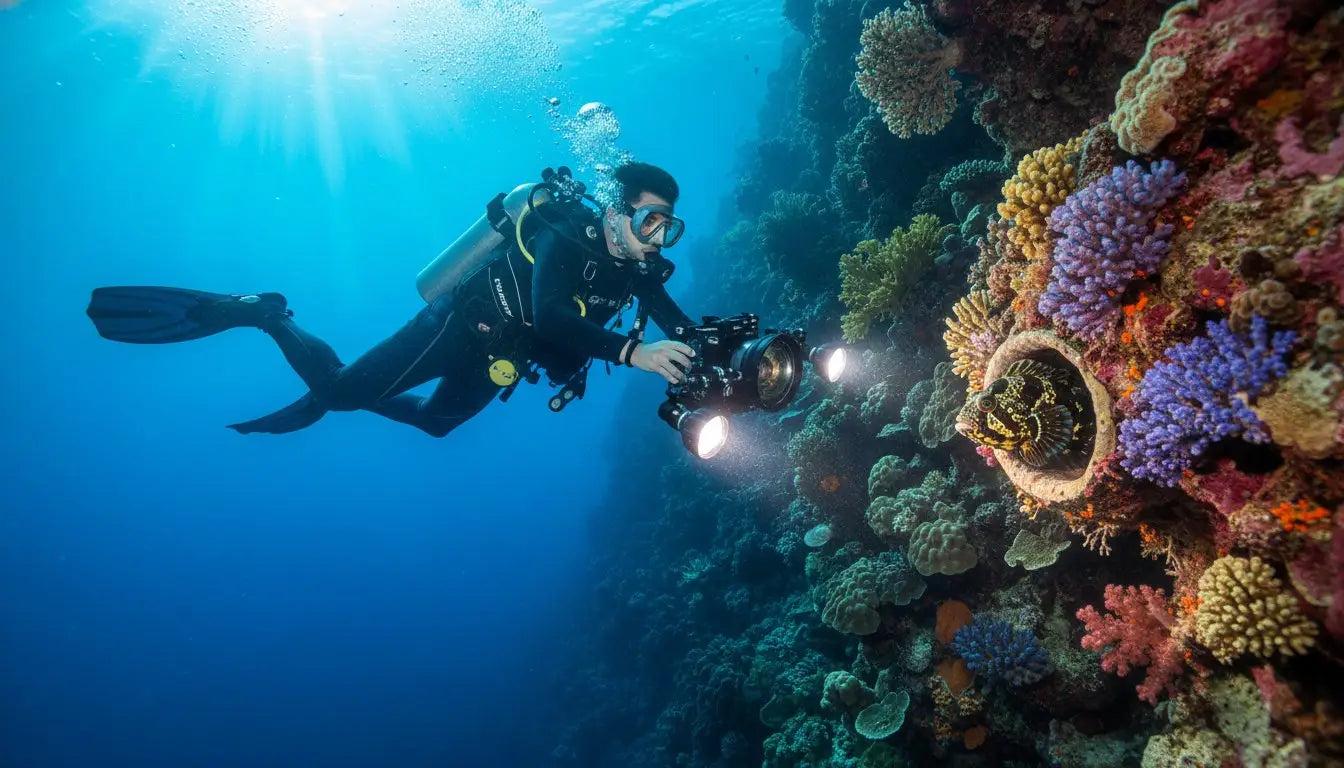
Point a torch under a coral ledge on Paradise Reef after dark and the first thing that comes back at you is yellow. Not the fish — the fin margins. A splendid toadfish sits back in the recess with only its broad, striped head showing, and the vivid yellow edging on its fins is what your light catches first. It is the single best reason to give up an evening in San Miguel and get back on a boat.
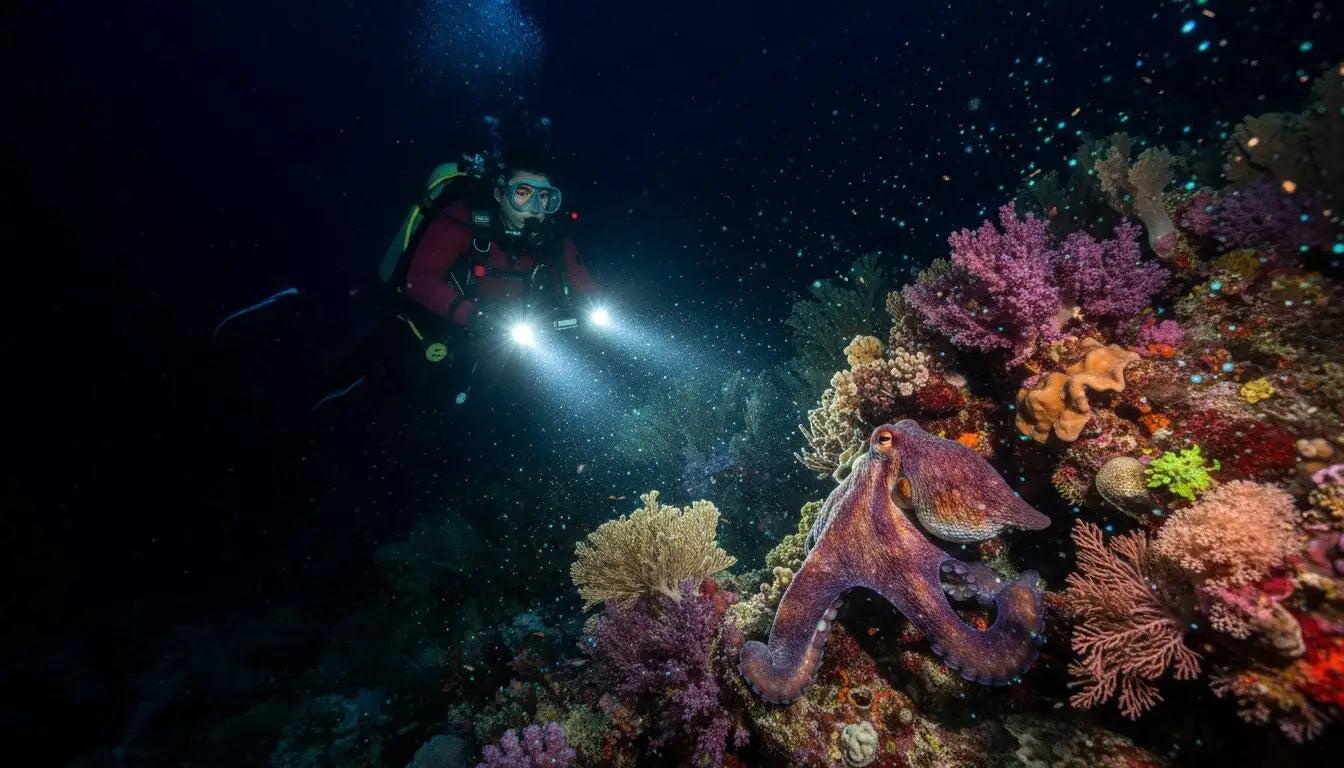
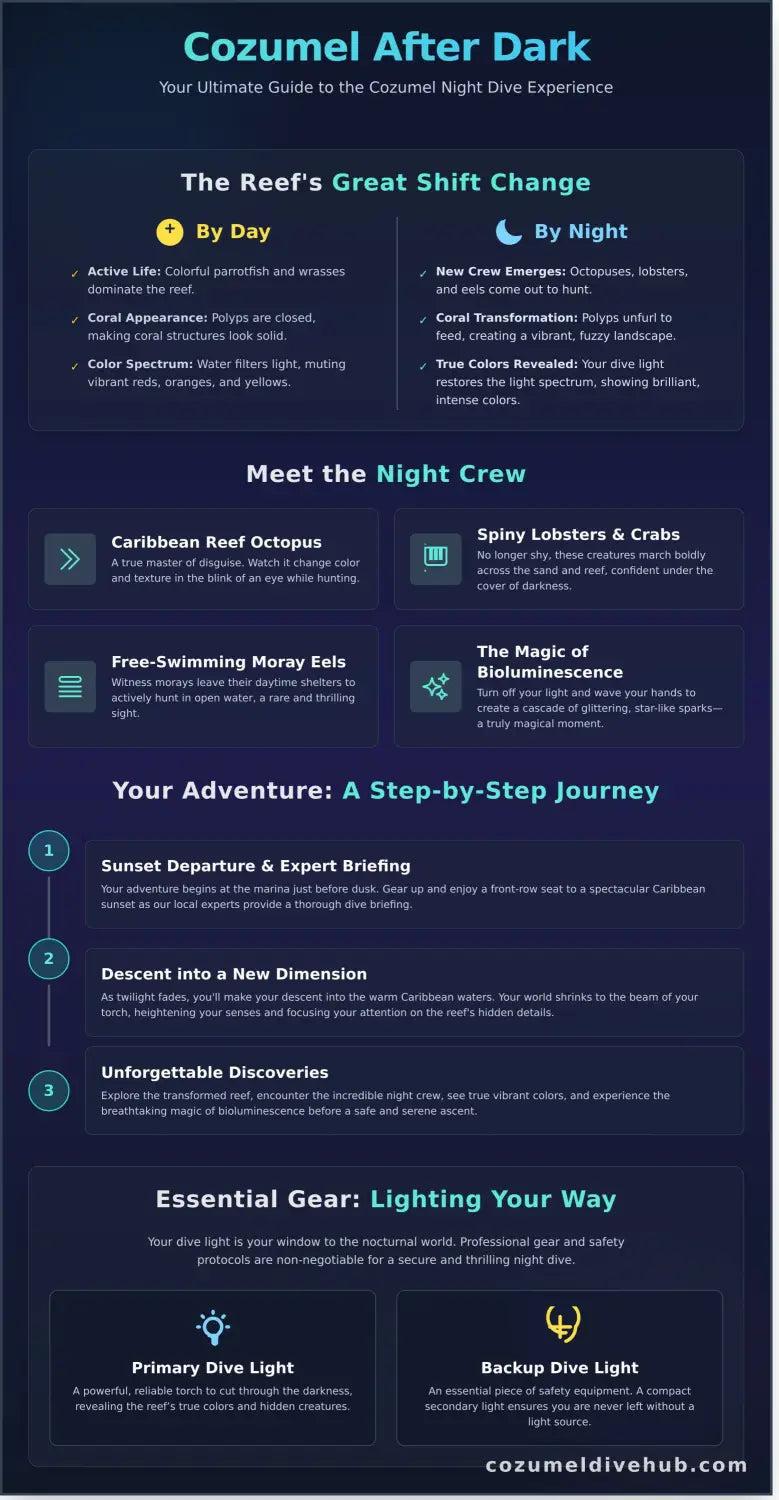
Around it, the reef has changed staff. Basket stars that were tight grey knots at midday have unfurled into feeding lattices the size of a dinner plate. Coral polyps are out, so the hard structure looks fuzzy instead of stony. A Caribbean reef octopus flows across the sand between coral heads with its skin cycling through textures. Spiny lobsters are out in the open, walking, which they never do at noon.
That is what a Cozumel night dive is. It is not a different reef. It is the same reef with a different shift working, and it is genuinely worth doing — on the right night, at the right site, once you have a few dives on the island already.
The Toadfish: What Is Actually True
Nearly every dive shop on the island will tell you the splendid toadfish (Sanopus splendidus) is found nowhere else on earth. That was the accepted position for decades and it is now slightly overstated. The Smithsonian's Caribbean fish database records the species from two places: Cozumel Island and Glover's Reef, Belize.
The correction is small and the point survives it. This is one of the most range-restricted reef fish in the Caribbean, Cozumel is the center of that range, and Cozumel is the only place where an ordinary recreational diver reliably sees one. Nobody is flying to Glover's Reef to tick it off.
Why it matters at night specifically:
- It lives in shadow. The Smithsonian description is blunt — it "lives in caves under corals," at roughly 10 to 25 metres. In daylight you are searching dark recesses in bright water, and your eye keeps sliding past them.
- It is more active after dark. Males become more vocal, and the fish sits further forward in the den rather than jammed at the back.
- You can hear it. The male produces a low, buzzing boat-whistle call. Divers hear it constantly on Cozumel reefs and mostly do not know what they are listening to. At night, with less boat noise on the water and a quieter reef, it is easier to place.
- A torch is how you find it anyway. Even on a bright noon dive, experienced guides light the ledges. At night everyone is already doing the one thing that works.
If you want the full search method — which ledges, how slowly, how to stop your group from drifting past — our dedicated splendid toadfish guide goes deeper than this article can.
One honest caveat on conservation status: the published IUCN Red List assessment for this species is old, and secondary sources cite different threat categories from different assessment versions. What is not in dispute across any of them is the reason for listing — an extremely small range, in water that carries heavy dive traffic. Treat the animal accordingly. Two frames, no touching, fins off the bottom.
What Comes Out After Dark
| Animal | Daytime | After dark | Where to look |
|---|---|---|---|
| Splendid toadfish | Wedged deep in a den, head barely visible | Sits forward, more vocal | Undercut ledges at the base of coral heads |
| Caribbean reef octopus | Almost never seen | Out hunting across sand and rubble | Open sand between coral heads |
| Basket star | A tight grey knot on a sea fan | Fully open feeding lattice | High on gorgonians, in the current |
| Caribbean spiny lobster | Antennae only, back in a crevice | Walking in the open | Sand channels and reef edges |
| Reef squid | Occasional, distant, skittish | Hangs in the torch beam, hunting | Mid-water, just off the reef |
| Coral polyps | Retracted; coral looks like rock | Extended; coral looks furred | Every hard coral head |
| Moray eel | Head out of a hole | Swimming free over the reef | Anywhere, and closer than you expect |
| Parrotfish | Grazing constantly | Asleep, sometimes in a mucus cocoon | Tucked into crevices |
The polyp change is the one people underrate. Hard coral at night is textured rather than solid, and once you notice it you cannot unnotice it. It is also the best argument for keeping your buoyancy honest — all that delicate structure is extended and exposed.
Where Night Dives Actually Happen
Cozumel night dives run on shallow, sheltered reef close to town. Not because of a rule, but because of what the island's water does. The current here is the whole reason the daytime diving is world-class, and it is also the reason nobody sensible takes a night group down the southern walls. You cannot see a current coming when you cannot see. Our guide to how strong the current gets explains what you would be managing blind.
The sites operators actually name, with our own listed depths and conditions:
| Site | Depth | Current | Level | Why it works at night |
|---|---|---|---|---|
| Paradise Reef | 30–40 ft | Mild to moderate | Beginner | The default. Close to the marina, easy navigation, dense ledge habitat |
| Chankanaab Reef | 35–40 ft | Mild to moderate | Beginner | Shallow and forgiving, long bottom times, good sand for octopus |
| Yucab Reef | 50–60 ft | Moderate to strong | Beginner | Classic toadfish ledges, but the current limits hovering |
| Las Palmas | 40–70 ft | Mild to moderate | Beginner | Quiet, scattered heads, rarely crowded after dark |
| Villa Blanca Wall | 50–100 ft | Moderate to strong | Intermediate | The shallow shelf above the wall, not the wall itself |
| Colombia Shallows | 30–50 ft | Moderate to strong | Beginner | Used by some operators; a longer boat ride each way |
| San Clemente | 30–40 ft | Mild | Beginner | The mildest current on the list |
Notice what is not on it. Palancar Gardens, Santa Rosa Wall, Punta Sur, Devil's Throat — the dives Cozumel is famous for — are daytime dives. A handful of operators list a southern site on a night-dive page, but the practical reality across the island is shallow mid-island reef.
If you booked a night dive expecting Palancar at night, you will be disappointed, and you should be. The southern reefs are big-structure, big-visibility, deep-blue dives. At night your world is a two-metre cone of light. The scale that makes those sites extraordinary is exactly the thing darkness takes away. Save them for the morning boat.
What Is A Twilight Dive, And How Is It Different?
A twilight dive is not a gentler night dive. It is a different product, and the thing you are paying for happens in the first twenty minutes of the second tank.
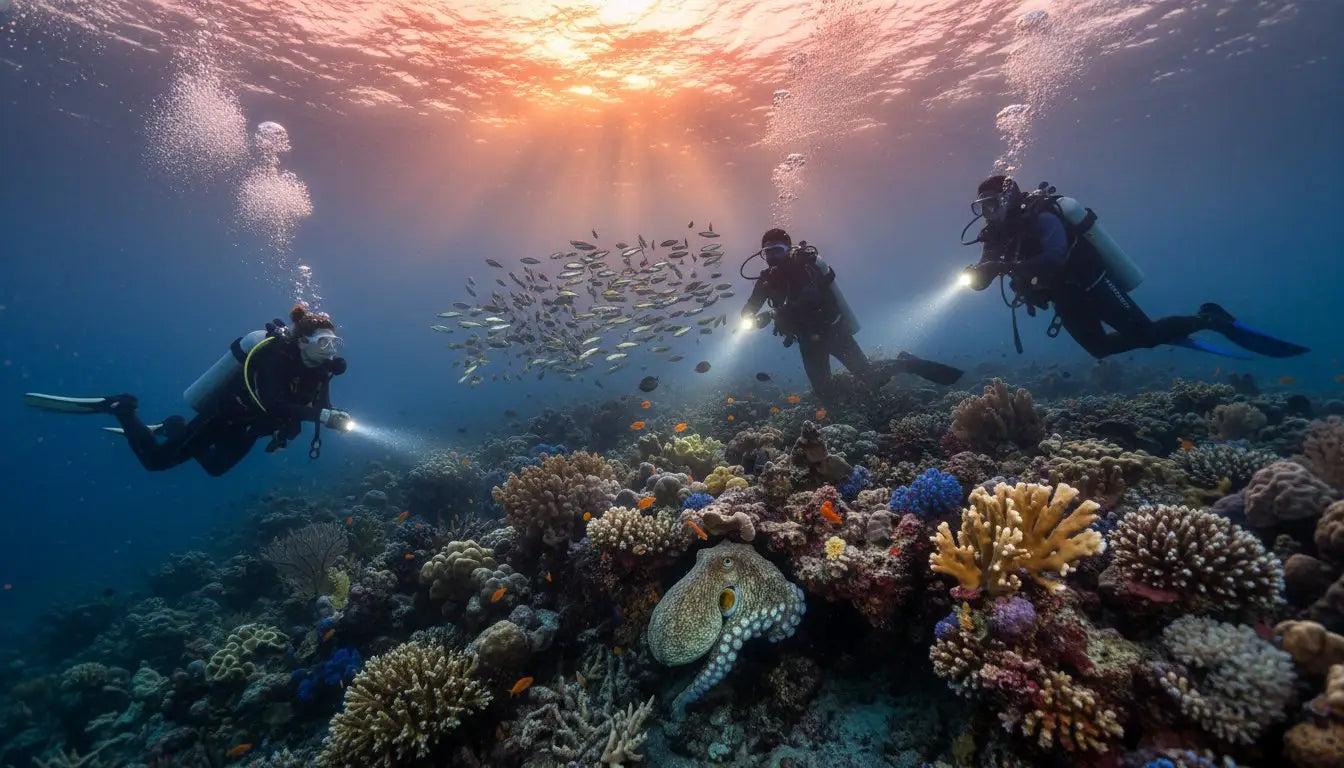
You board before sunset, motor out while the sky is still colouring, and go in as the light is draining rather than after it has gone. For the first ten or fifteen minutes you can see the reef without a torch. Then blue becomes grey, grey becomes black, and the beam quietly turns into the only thing you have. Most operators sell it as a two-tank evening: one dive in afternoon light, a surface interval on the boat while the sun goes down, and a second dive that starts at dusk and finishes in the dark. Dock to dock is usually three and a half to four hours. A boat is not the only way to do it — Dive Boutique also runs night dives from shore.
A true night departure leaves later, often around 7 pm, and everything from the giant stride onward happens by torchlight. Both get advertised as "night dives," and operators do not reliably distinguish between them, so ask which one you are booking. If the sunset is part of the pitch, it is a twilight trip.
The Shift Change Is The Whole Point
The reef does not turn over all at once, but it comes close, and the sequence is legible if you are in the water while it happens:
- The grazers quit first. Parrotfish, wrasse and surgeonfish stop feeding and start hunting for somewhere to wedge themselves. Some parrotfish spin a mucus cocoon once they are in.
- The mid-water fish drop down. Angelfish, butterflyfish and sergeant majors come off the blue and tuck into the structure, and their colour flattens as the light goes.
- The hunting window opens. For roughly ten to twenty minutes neither the day fish nor the night fish can see properly, and the predators exploit it. Tarpon, jacks, snapper and grouper work the reef edge hard during the changeover. It is the busiest part of the evening and it is over quickly.
- The night shift arrives. Coral polyps extend, basket stars unfurl on the gorgonians, spiny lobsters walk out of their crevices, and octopus start moving over open sand.
On a full-dark departure you miss stages one to three entirely and step straight into stage four. Stage four is excellent — it is most of what the rest of this guide is about — but the changeover only exists on a twilight trip.
| Twilight / sunset departure | Full-dark departure | |
|---|---|---|
| Entry | At dusk, with light still in the water | After dark, by torchlight |
| Main event | The day-to-night changeover | Established nocturnal behaviour |
| Ambient reference | Ten to fifteen minutes of it | None |
| Predator activity | The best window you will get | Quieter |
| Octopus odds | Good, later in the dive | Better |
| Usual format | Two tanks, afternoon plus dusk | One tank |
| Suits | A first night dive; wide-angle photography | Divers who have done it before |
If you have one evening and have never dived in the dark, take the twilight version — the ambient light makes the first descent far less abrupt, and you get the changeover as well. If you have already done twilight, the full-dark trip is the deeper cut.
How Does The Moon Phase Change A Night Dive?
Enough to be worth a glance at a lunar calendar before you pick your evening. Not enough to build a trip around.
Two things genuinely change: how much light reaches the reef, and how the animals behave in it. What does not change is the current. Cozumel's drift is driven by the Yucatán Current and the wind rather than by tidal exchange, so a spring tide around a full moon does not turn the mid-island reefs into something else.
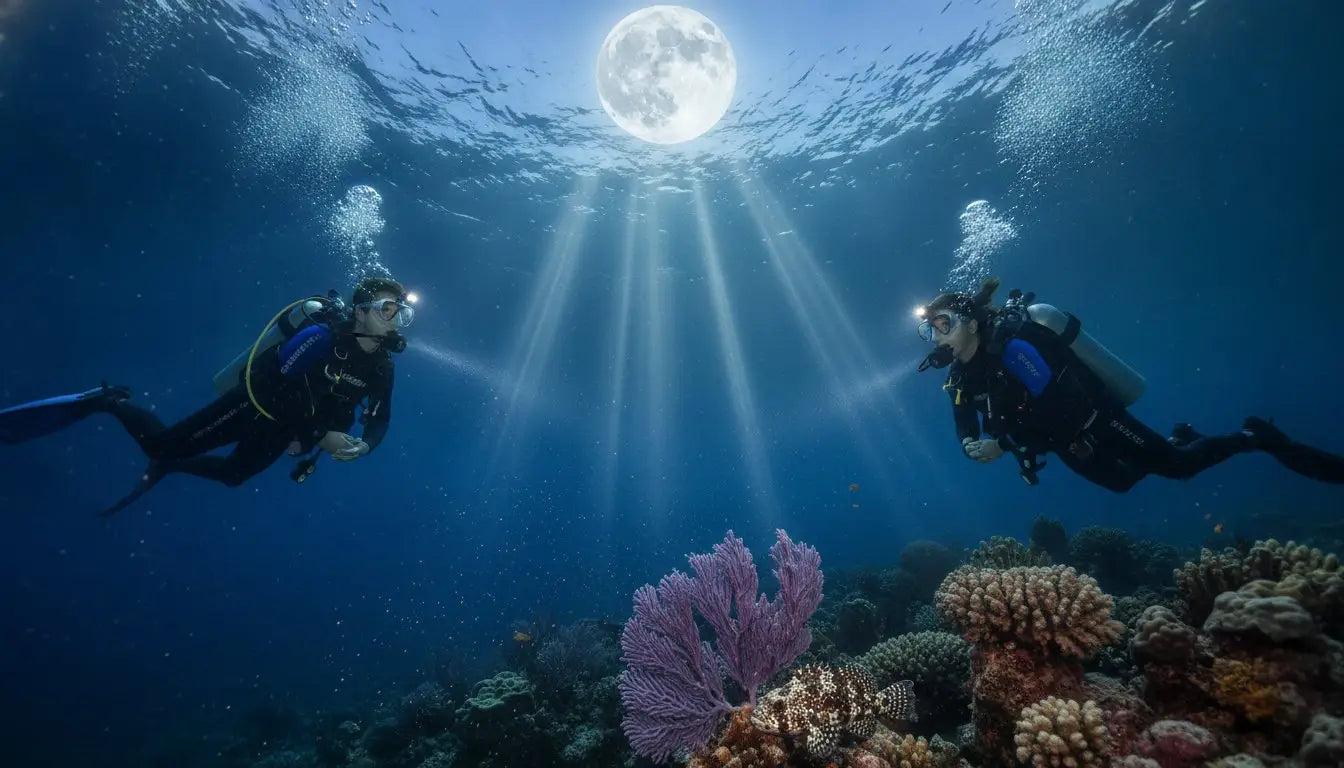
A bright moon puts usable light in the water. On a clear night over a 30 to 40 foot reef, once your eyes have adjusted you can make out the shape of the reef well past the end of your beam. Orientation gets easier, your buddy reads as a silhouette rather than just a moving light, and wide-angle photography becomes possible in a way it simply is not on a dark night. Divers who found their first night dive claustrophobic usually find a moonlit one much easier.
A dark moon is better for the small stuff. With no ambient light your eyes adapt fully and the beam gains contrast, which suits macro subjects and animals that sit still. It is also the only condition in which bioluminescence really shows. The plankton that flash when disturbed are easily washed out, so on a moonless night many guides run a short lights-out pause — everyone shields their torch for half a minute and sweeps a hand through the water. Do the same thing under a full moon and what you see is the reef, not the sparkle.
Behaviour shifts with the light. Reduced activity among small reef fish and zooplankton under bright moonlight is well described in reef ecology; being lit up is dangerous when something larger is hunting. So a full moon tends to mean fewer small animals in the open and more visible predator movement, and a new moon tends to mean the reverse.
| Moon phase | Ambient light | Bioluminescence | Best for | Trade-off |
|---|---|---|---|---|
| Full | Enough to read reef structure past the beam | Washed out | Nervous first-timers, wide-angle photography, orientation | Smaller reef life stays in cover |
| First / last quarter | Some, depending on the hour | Reasonable | A middle option with no real drawback | Nothing stands out either |
| New | None | The best you will get | Macro subjects, sleeping fish, the lights-out moment | The most disorienting version |
The bright window is not one night. The two evenings either side of a full moon carry nearly as much light, so you are choosing a three or four night span rather than a date. Check a lunar calendar against your travel dates, pick inside that span if it lines up, and if it does not, go anyway. Moon phase changes the flavour of a Cozumel night dive. It does not decide whether the dive is worth doing.
When You Should Not Book One
This is the part the brochures leave out.
Not on your first day. Your first Cozumel dive should be a daylight drift where you find out what the current actually does and how your rental gear sits. Adding darkness to an unfamiliar reef, unfamiliar weighting and possibly a first drift dive is stacking three new things at once. Do the night dive on day three or four.
Not if you are not already comfortable. Task loading is the real hazard, not the dark. You are now managing a torch in one hand, your gauges, your buddy's position, your depth, and a reef you can only see a slice of. Every one of those is a task you already handle in daylight without noticing. Add darkness and they all cost more attention. If your buoyancy still needs conscious effort, sort that first — a Peak Performance Buoyancy course is a better use of an evening than a night dive you spend fighting.
Not if you are recently certified and nervous about it. Most Cozumel operators will take an Open Water diver on a guided night dive; a Night Diver specialty is not required anywhere we checked. That does not mean it is the right call for you. If you want the structure, the PADI Night Diver course is three dives with an instructor and it teaches light signalling and night navigation properly. The full PADI course range covers the alternatives.
Not if you lost your buddy on the last dive. Buddy separation is the failure mode that turns a night dive from pleasant into serious. If you were not holding position in daylight, darkness will not help.
Torch Discipline
Two rules, and neither is optional.
Never point your torch at another diver's face. A modern dive light will destroy someone's night adaptation for several minutes and can genuinely disorient them. Light the reef, not people. To signal, put your beam on the reef and move it in a slow circle for "OK" or side to side for "problem" — cover this in the briefing so everyone uses the same set, and check it against the day hand signals you already know.
Always carry a backup. A dive with one torch and no backup is a dive you should not start. Primary lights fail — flooded switches, dead cells, a cracked lens on the ladder. A small secondary light clipped to your BCD is not a luxury; it is the difference between an inconvenience and an ascent in the dark. Most operators will lend you a primary. Fewer reliably provide the backup. Ask, and if the answer is vague, bring your own.
The rest of the kit list is short: a tank marker light or glow stick so your buddy can find you, a slate if you like writing things down, and the same well-maintained gear you would dive by day. Nothing exotic.
And a torch-etiquette point that matters for the animals as much as the divers — do not pin a beam on a sleeping parrotfish or a toadfish for minutes at a time. If you want photographs, the underwater photography guide covers how to get the shot without parking on the subject.
What The Marine Park Rules Actually Say
Every dive in Cozumel happens inside Parque Nacional Arrecifes de Cozumel, administered by Mexico's national protected areas commission. We read the park's published management programme looking for a night-diving rule, and there is not one. The administrative rules cover diving generally — no touching, no taking, no gloves without registration, mooring instead of anchoring — but they do not name permitted night-dive sites, restrict diving hours, or require a separate night permit.
So the site pattern above is operator practice and physics, not regulation. That is worth knowing, because you will occasionally be told "the park only allows night dives at Paradise," and that is not what the rules say.
What does apply, unchanged, after dark: the daily park fee, added to your bill by the operator, and the no-touch rules. Our marine park fee guide and the broader regulations for visiting divers cover both in detail.
Night vs Day On The Same Reef
Same site, two very different dives:
| Paradise Reef by day | Paradise Reef at night | |
|---|---|---|
| Field of view | The whole reef, 100+ ft of visibility | A cone of torchlight, a few metres wide |
| Pace | Drift, covering ground | Slow, often nearly static |
| What you see | Fish schools, turtles, reef structure | Individual animals, close, in detail |
| Toadfish odds | Good if the guide searches ledges | Better — more active and more vocal |
| Octopus odds | Poor | Good |
| Task load | Low | Noticeably higher |
| Best for | Your first dives of the trip | Day three onward |
Working It Into Your Week
A night dive is an evening commitment on top of a normal two-tank morning, and most people underestimate what that does to a dive week. Practical notes:
- Watch your nitrogen. A night dive is usually your third of the day. Check your computer, not your optimism.
- Book it mid-trip. Late enough that you are dialled in, early enough that it is not the day before you fly.
- Eat first. Boats leave at dinner time and you will be back around 9 pm.
- Confirm the departure format. Twilight or full dark — ask, because they are different evenings.
- Glance at the moon. Not a deciding factor, but it tells you which version of the reef you are getting.
- Ask about torches before the day of. Primary and backup, provided or rented.
- Bring a 3mm suit. You move slowly on a night dive and you cool faster than you expect, even in water that sat at 82°F all afternoon. A wetsuit you found slightly warm at noon is about right after dark.
- Choose the operator for group size. A guide with four divers can hold the group on a ledge. A guide with twelve, in the dark, cannot. Our guide to choosing a Cozumel dive shop covers how to ask that question so you get a real answer.
The Honest Summary
Cozumel night diving is worth doing, for a specific and defensible reason: it is the best chance you will get at a fish with one of the smallest ranges in the Caribbean, on reefs that are shallow and sheltered enough to make diving in the dark sensible. The octopus, the open basket stars and the extended coral polyps are real bonuses, not marketing.
It is also a dive that rewards being ready for it. Get a couple of daylight drifts in first, sort your buoyancy, carry two torches, pick the twilight or full-dark version deliberately, and choose an operator that runs small groups — a German-run shop that caps fun dives at four divers, Mermaid Divers, also offers blackwater diving for anyone who wants to go further after dark. Do that and you get the version of the dive people talk about for years.
New to diving here at all? Start with the complete beginner's guide to scuba diving in Cozumel, then build the evening into a proper itinerary with planning your Cozumel dive trip.
Frequently Asked Questions
What will I actually see on a Cozumel night dive?
Do I need a special certification to night dive in Cozumel?
Is night diving in Cozumel safe?
What kind of dive torch do I need?
Can a beginner do a Cozumel night dive?
Which Cozumel dive sites are used for night dives?
How deep are Cozumel night dives?
What time do Cozumel night dives depart?
Is the splendid toadfish really found only in Cozumel?
Does the moon phase matter for a Cozumel night dive?
Share This Article
Carmen Novelo
Carmen Novelo is a Cozumel native and an active scuba instructor and dive guide on the island. She has spent twelve years diving the Cozumel reef system, and writes about its dive sites, conditions and marine life for Cozumel Dive Hub.