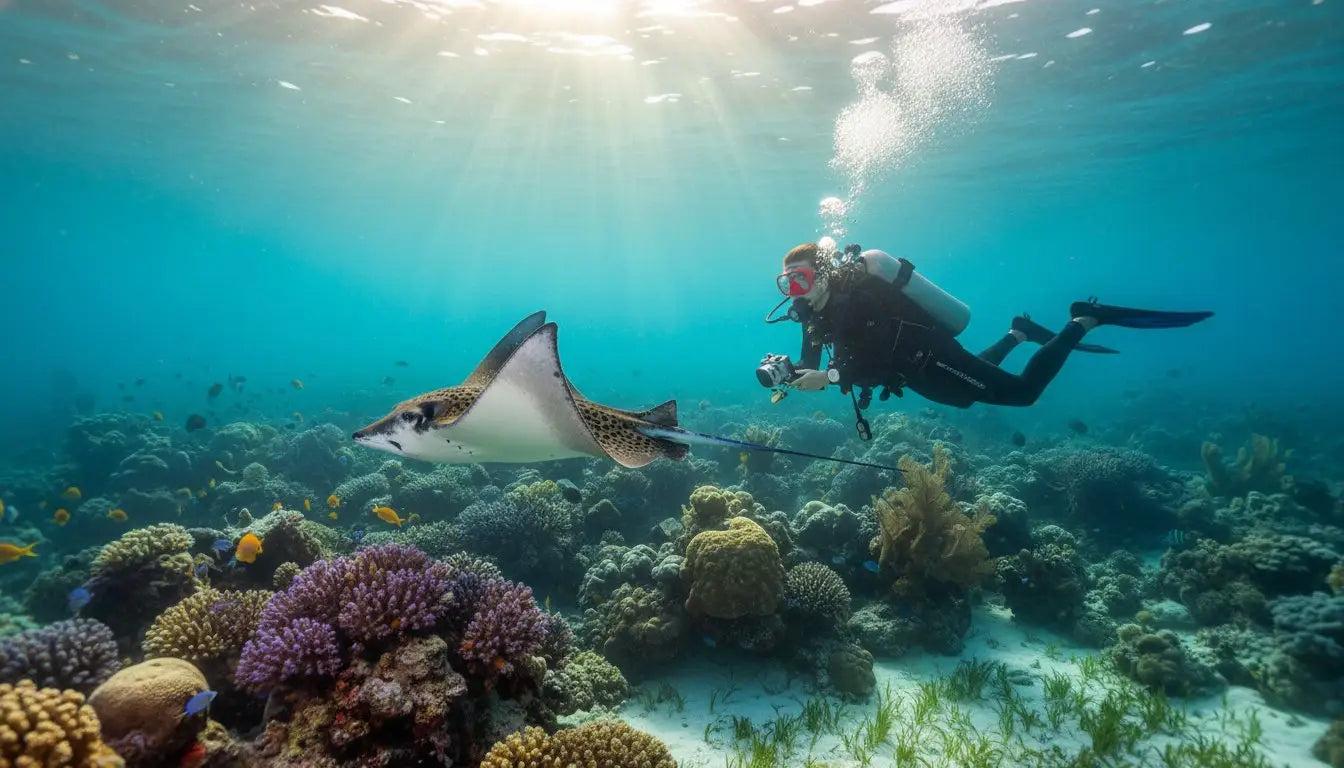
Cozumel Diving Regulations for Tourists: The 2026 Essential Guide
Three rules catch out most visiting divers: the park fee is charged per person per day in pesos and is rarely in the price you paid online, gloves are not allowed, and you cannot dive the reefs without an authorised boat and guide.
Carmen Novelo · March 13, 2026 · 20 min read
Three things catch out more visiting divers in Cozumel than anything else. The park fee is charged per person, per day, in pesos, and it is not usually part of the price you paid online. Gloves are not allowed, so the pair in your bag stays on the boat or in the hotel. And you cannot dive the reefs on your own — the park requires an authorised boat and an authorised guide, whatever your certification says.
Everything below is the actual rule, with the source it comes from, and a plain statement of whether it is federal law or something dive operators do by convention. That distinction matters. A lot of what circulates as "Cozumel law" is really shop policy, and a few things people treat as polite suggestions are criminal offences.
What The Park Is And Where It Begins
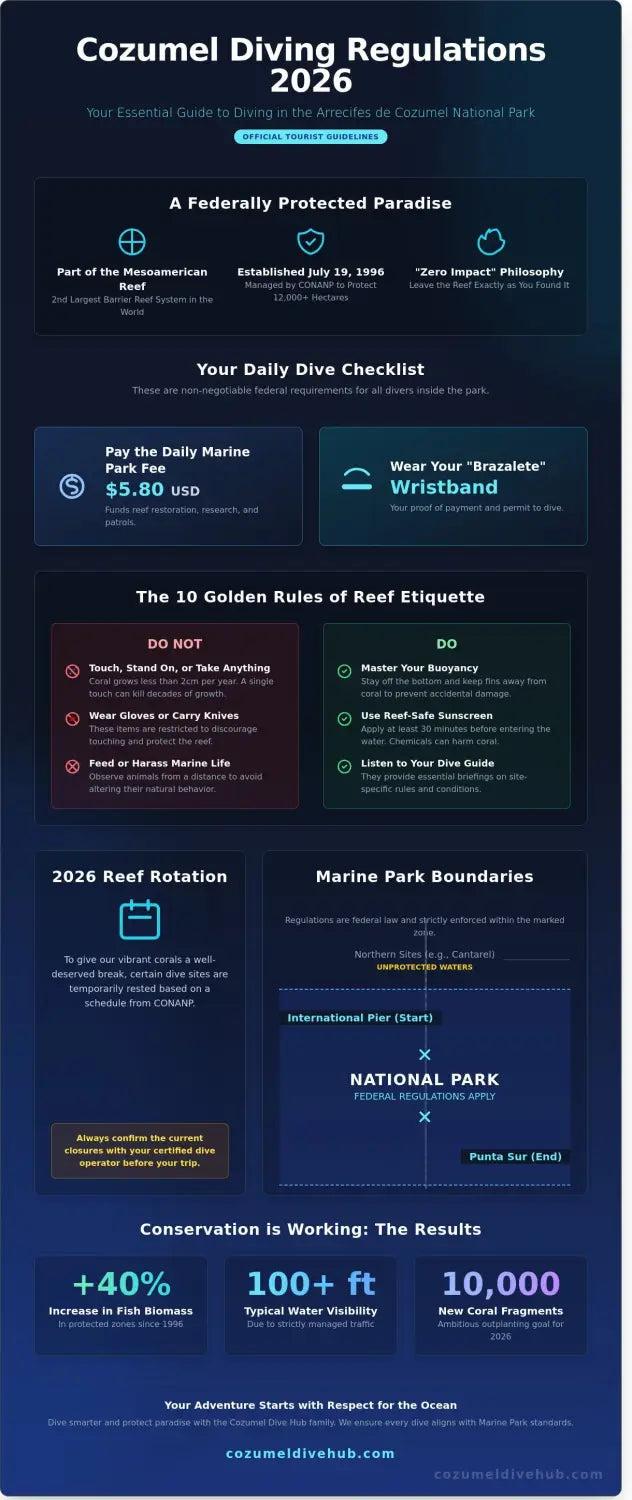
The Parque Nacional Arrecifes de Cozumel was decreed on 19 July 1996 and covers roughly 120 square kilometres — about 11,987 hectares — of reef and coastal water along the island's leeward side. It is administered by CONANP, Mexico's National Commission of Natural Protected Areas, under the federal environmental law, LGEEPA.
Inside those boundaries you are in a federal protected natural area. The rules are not house rules. They are enforced by CONANP rangers and by the Mexican Navy, and several of them sit on top of criminal statutes that apply anywhere in Mexico. Most of the famous wall and drift sites — Santa Rosa Wall, Palancar Caves, Paso del Cedral — are inside the park. Some northern sites are not, which is why a handful of operators run trips that behave slightly differently.
CONANP publishes the park's visiting hours as 06:00 to 22:00 daily, extended to 23:00 in the summer schedule. That single line matters more than most of the night-diving folklore you will read, and it is covered further down.
The Park Fee: 225 Pesos Per Person, Per Day
CONANP lists the entry charge for Parque Nacional Arrecifes de Cozumel as $225 MXN per person, per day, described as a cobro de derechos — a rights charge. The legal basis is Article 198 of the Ley Federal de Derechos, which sets entry charges for federal protected areas. Because it is set in pesos and revised periodically, quoting it in dollars ages badly; check the peso figure before you travel.
CONANP also publishes exemptions and reductions: no charge for children under 12, adults over 65, pensioners and people with disabilities; 75% off for students and teachers; 50% off for Mexican nationals and foreign residents. All of these require valid credentials at the point of payment.
In practice you will hand pesos to your dive shop in the morning and get a wristband — the brazalete — which is your proof of payment. Carry cash. Card payment at the dock is not something you should assume. The marine park fee is charged for every day you enter the park, not per dive and not per trip, so a three-day, six-dive package means three payments. There is a fuller breakdown of the charge and how shops handle it in the 2026 marine park fees guide.
One detail almost nobody mentions: Article 198 of the Ley Federal de Derechos singles out four Cozumel reefs — Maracaibo, Punta Sur, El Islote and Chun-Chacaab — as sites of restricted carrying capacity within the park. That is a real, written legal distinction, and it is part of why those southern sites are harder to get onto than Palancar.
You Must Dive With An Authorised Boat And Guide
CONANP's published rules for the park instruct visitors to contratar embarcaciones y guías autorizados por la CONANP — to hire boats and guides authorised by CONANP. This is the rule people argue about most, usually along the lines of "I'm a Master Scuba Diver, surely I can just go".
The requirement is not about your competence. It is a condition of access to a protected area: commercial and recreational use of the park runs through operators holding CONANP authorisation, and the authorised guide is the person accountable for what the group does on the reef. There is no tourist-facing permit that lets an independent visitor take a boat onto the park reefs alone.
The practical consequence is that choosing your operator is the single decision that determines whether your diving is legal. An authorised shop's paperwork is what puts you legitimately on a mooring at Palancar. This is worth checking rather than assuming; the Cozumel dive centers directory is a starting point for working out who runs what.
What is not in CONANP's published rules is a maximum diver-to-guide ratio. Small-group limits of four, six or eight divers are operator policy — a genuine quality difference between shops, and often worth paying for, but not a number the park has published.
Do Not Touch, Do Not Take, No Gloves
CONANP's visitor rules for the park are short and blunt. Translated, they are: stay 1.5 metres off the reef; do not feed the wildlife; hire CONANP-authorised boats and guides; anchoring is prohibited; do not touch the reefs; do not use sunscreen; do not disturb marine fauna; do not fish; and do not use gloves, knives or pointers (varillas).
The glove ban is the one visitors resist. The logic is behavioural: a diver with bare hands does not reach for the reef. The park's long-circulated rules card adds that working dive professionals may register to carry gloves and knives — which is where the "gloves are allowed if registered" line comes from — but there is no route for a visiting recreational diver to register. If you are cold, the answer is a thicker wetsuit, not gloves.
"Do not take" is absolute and includes empty shells, coral rubble and anything else that looks like a souvenir. Collecting is covered by the park rules and, for protected species, by federal wildlife law. No-touch diving is not an aspiration here; it is the operating standard, and it rests almost entirely on your buoyancy. If your trim is rusty, a refresher before a strong-current drift is a better investment than any piece of gear.
Sea Turtles Are A Criminal Matter
This is the rule where the consequences stop being administrative. Article 420 of the Código Penal Federal makes it an offence to capture, harm or kill a sea turtle or marine mammal, or to collect or store their products or by-products. The penalty is one to nine years' imprisonment and a fine of 300 to 3,000 días multa.
The article also carries an aggravating clause: where the conduct occurs in, or affects, a natural protected area, the penalty increases by up to three additional years and up to 1,000 additional días multa. Cozumel's reefs are a natural protected area. That aggravation applies by default.
Nobody reading this is planning to harm a turtle. The point is calibration: chasing, cornering, riding or grabbing a turtle for a photograph is not a scolding offence in Mexico, it sits under a criminal statute. Green and hawksbill turtles are common on Cozumel's reefs and are entirely used to divers — hang back, let them surface on their own line, and film from behind. There is more on the season and the behaviour in the sea turtle nesting season guide.
Mooring Buoys, Not Anchors
CONANP states plainly that anchoring is prohibited in the park, and lists mooring buoys for authorised vessels among the services it provides. An anchor dropped on a reef destroys structure that took decades to grow, and the chain does more damage than the anchor.
For divers this is mostly invisible — it is the captain's rule, not yours — but it shapes your dive. Cozumel is drift diving: the boat follows your bubbles and collects you where you surface, rather than sitting on a hook. It is why a surface marker buoy and staying with your group matter more here than at many destinations, and why the dive briefing always covers the pickup.
Sunscreen: Where Law And Policy Get Confused
This is the most misreported rule on the island, so here is the careful version.
CONANP's own published visitor rules for Parque Nacional Arrecifes de Cozumel say, flatly, no usar bloqueador solar — do not use sunscreen. Not "use biodegradable sunscreen". The park's older rules card, widely reproduced by local operators, prohibits sunblock or suntan oil that is not biodegradable.
What does not exist is a Mexican statute defining "reef-safe", certifying brands, or publishing an approved list. When a shop tells you a particular bottle is "approved", that is the shop's judgement or a marketing claim, not a legal designation. Some operators check bags at the dock; some do not. That variation is itself the tell that this is being enforced as policy rather than as a codified standard.
The clean answer that satisfies every version of the rule: wear a long-sleeved rash guard and a hat, and skip lotion on the parts of you that go in the water. If you use anything, mineral zinc oxide or titanium dioxide is what operators here accept. The terminology page has more on what reef-safe sunscreen does and does not mean, and the eco-friendly diving guide covers the wider set of choices.
Lionfish: Why You Cannot Just Spear One
Divers reasonably ask why an invasive species is protected by a no-take rule. It is not exactly protected — but you personally are not authorised to remove it.
Lionfish culling in the Cozumel park runs through organised programmes. In May 2026 a specialist lionfish control brigade began operating on the island, made up of trained tourism service providers and volunteers, supported by CONANP's PROREST programme. Removal happens through that structure, by trained participants, under the park's authorisation.
For a visiting diver the park rules apply as written: no fishing, and no knives, spears or pointers. Bringing a pole spear on a recreational dive is not lionfish conservation, it is a park violation. If you want to be involved, the route is joining a sanctioned effort, not improvising — the conservation efforts guide covers what participation actually looks like.
Spearfishing And Fishing
Straightforward: CONANP's park rules prohibit fishing (no pescar) and prohibit carrying knives and pointers. Spears, harpoons, hooks and explosives appear on the park's prohibited-items list. Recreational spearfishing inside Parque Nacional Arrecifes de Cozumel is not a grey area.
Night Diving: What The Park Actually Says
Here is a case where the commonly repeated rule is not one.
CONANP publishes park hours — 06:00 to 22:00, extended to 23:00 under the summer schedule. What CONANP does not publish for Parque Nacional Arrecifes de Cozumel is a list of approved night-dive sites, a curfew specific to diving, or a rule confining night dives to particular reefs. If you have read that night diving in Cozumel is "only permitted at Paradise Reef", that is operator and harbourmaster practice, driven by boat logistics, proximity to town and individual operators' permits — not a published park regulation.
The practical effect is similar: night dives here do happen on a small number of shallow, close-in reefs such as Paradise Reef, and your shop will tell you where it can go. But it is worth knowing which constraint you are under, because operator practice varies between shops in a way that law does not. The night dive guide covers what the experience is like.
The Rules, And What Enforcement Looks Like
| The rule | Law or practice? | If you break it |
|---|---|---|
| Pay $225 MXN per person, per day | Law — Ley Federal de Derechos art. 198; amount published by CONANP | No wristband, no park access; rangers can stop the boat |
| Use a CONANP-authorised boat and guide | Law — CONANP park rules | You are off the water; the operator's authorisation is at risk |
| Stay 1.5 m off the reef, do not touch or stand on it | Law — CONANP park rules | Warning, then removal; damage can escalate to enforcement action |
| No gloves, knives or pointers | Law — CONANP park rules (registration exception is for working professionals) | Items confiscated, dive ended |
| Do not fish, collect or take anything | Law — CONANP park rules | Confiscation and sanction; protected species escalate to criminal |
| Do not feed or disturb marine fauna | Law — CONANP park rules | Sanction; harassment of protected species is a separate offence |
| Do not capture or harm a sea turtle | Criminal law — Código Penal Federal art. 420 | 1–9 years' imprisonment and 300–3,000 días multa, increased by up to 3 years inside a protected area |
| Boats moor, never anchor | Law — CONANP park rules | Sanction against the vessel and its authorisation |
| Do not use sunscreen in the park | CONANP park rule as published; no statutory brand standard | Usually refused boarding or asked to rinse; enforcement varies by operator |
Repeated Often, But Not Law
| The claim | Status | What is actually true |
|---|---|---|
| "Reefs close on a published rotation calendar" | Not a published CONANP schedule | CONANP can and does restrict access to specific zones; there is no public 2026 rotation calendar to plan around |
| "Only biodegradable sunscreen brands are legally approved" | Practice | No Mexican statute defines or certifies "reef-safe"; there is no official approved-brand list |
| "Night diving is only allowed at one reef" | Practice | The park publishes hours, not a night-dive site list; the site limit comes from operators |
| "Maximum 8 divers per guide" | Practice | A shop-by-shop policy, not a published park ratio |
| "Snorkellers must wear a life vest" | Practice | A widespread operator and tour requirement, not a rule CONANP publishes for the park |
| "You may spear lionfish to help" | Not permitted for visitors | Culling runs through authorised, trained brigades; park rules still prohibit fishing and pointers |
Planning Around The Rules
None of this is onerous once you know it. Budget pesos for the fee, leave the gloves and the spray sunscreen at home, pack a rash guard, and pick an operator whose CONANP authorisation you have actually confirmed. Everything else — the no-touch standard, staying off the bottom, letting turtles come to you — follows from decent buoyancy and a good briefing.
If you want the rest of the logistics in one place, including how the fee fits into a multi-day dive package, start with the Cozumel dive trip planner.
Frequently Asked Questions
How much is the Cozumel marine park fee in 2026?
Do I need a guide to dive in Cozumel if I am already certified?
Why are gloves banned for divers in Cozumel?
Is biodegradable sunscreen legally required in Cozumel?
What is the penalty for harming a sea turtle in Mexico?
Can I spear lionfish while diving in Cozumel?
Are Cozumel's reefs closed on a rotation schedule?
Is night diving restricted in the Cozumel marine park?
Can boats anchor on Cozumel's reefs?
Do I pay the park fee once or every day?
Share This Article

Carmen Novelo
Carmen Novelo is a Cozumel native and an active scuba instructor and dive guide on the island. She has spent twelve years diving the Cozumel reef system, and writes about its dive sites, conditions and marine life for Cozumel Dive Hub.