Minimum Age for Scuba Diving in Cozumel: The 2026 Family Guide
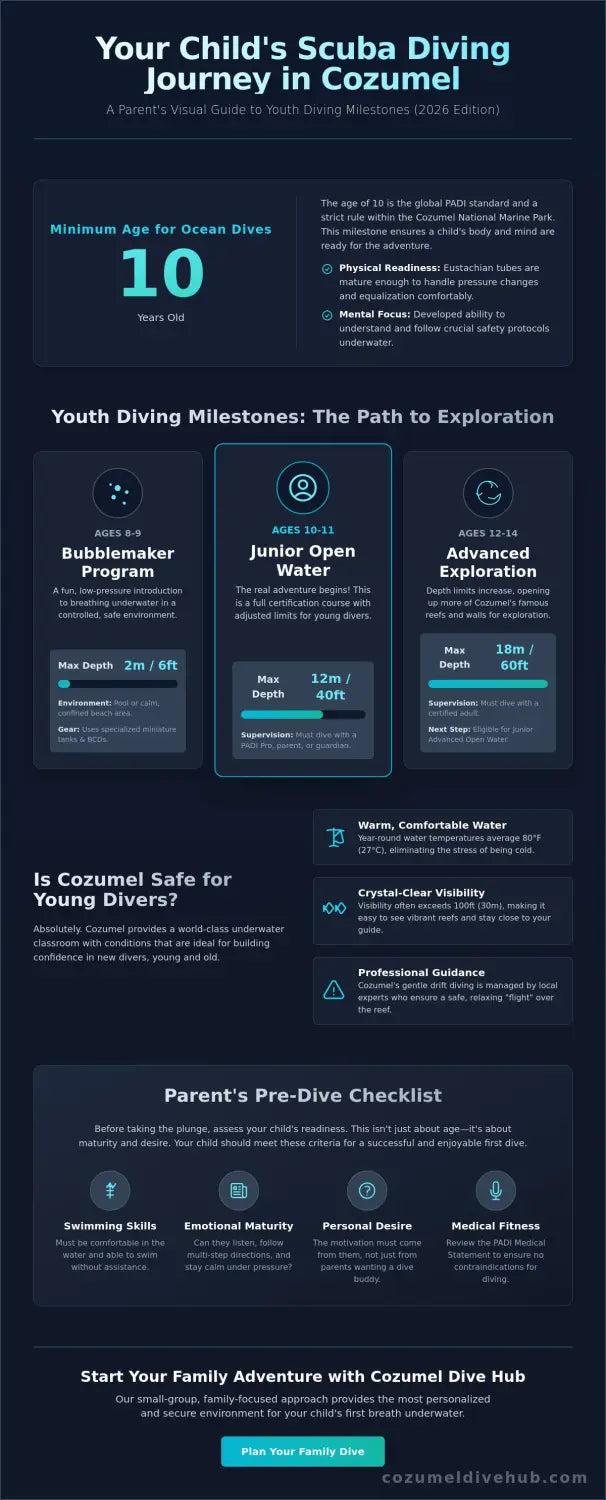
The minimum age for scuba diving in Cozumel is 10 years old for any dive in the ocean and 8 for pool-only programmes. Those are PADI and SSI standards rather than local rules, so every shop on the island works to the same numbers.
Carmen Novelo · April 27, 2026 · 17 min read
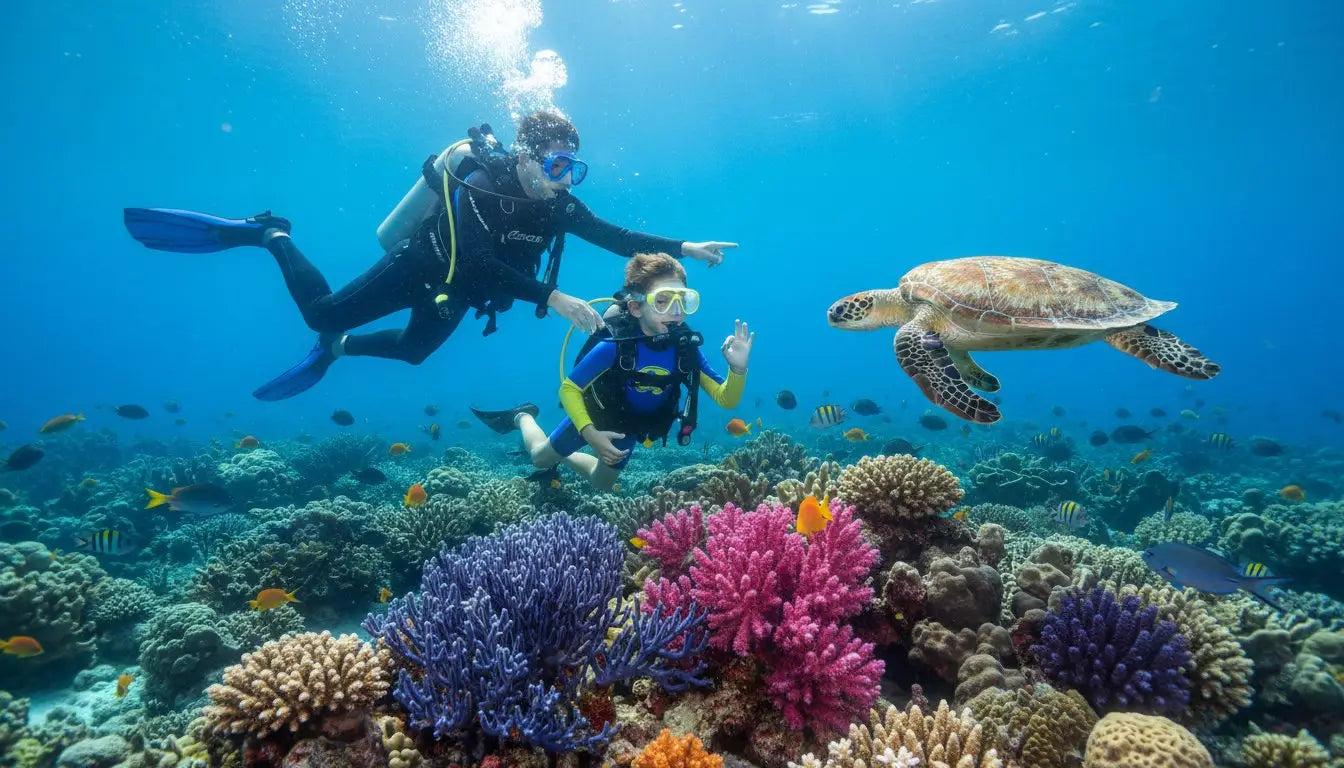
The minimum age for scuba diving in Cozumel is 10 years old for any dive in the ocean, and 8 years old for pool-only programmes. A 10-year-old can do a supervised Discover Scuba Diving experience to a maximum of 12 metres (40 feet), or train for a Junior Open Water Diver certification with either PADI or SSI. Children of 8 and 9 stay in confined water: PADI Bubblemaker to a maximum of 2 metres (6 feet), PADI Seal Team, or SSI Scuba Explorers. These are training-agency standards, not local Cozumel rules, so every shop on the island works to the same numbers.
What changes between shops is not the age — it is the depth cap they apply, the supervision they provide, and which reef they choose. That last point matters more in Cozumel than almost anywhere else, because this island is a drift diving destination and not every site marked "beginner" is calm. This guide sets out the verified ages and depth limits, then covers which Cozumel sites genuinely fit a child working under a 40-foot ceiling.
What Are The Minimum Ages And Depth Limits By Programme?
Every figure below comes from the published PADI and SSI standards current in 2026.
| Programme | Minimum Age | Where It Happens | Maximum Depth | Who They Dive With |
|---|---|---|---|---|
| PADI Bubblemaker | 8 | Pool or confined water | 2 m / 6 ft | PADI Professional |
| PADI Seal Team | 8 | Pool or confined water | Confined water only | PADI Professional |
| SSI Scuba Explorers | 8 | Pool or confined water | 3 m / 10 ft | SSI Professional |
| SSI Try Scuba | 8 | Pool or confined water | 5 m / 16 ft | SSI Professional |
| PADI Discover Scuba Diving | 10 | Confined water, then open water | 12 m / 40 ft | PADI Professional |
| SSI Basic Diver | 10 | Open water | 12 m / 40 ft | SSI Professional |
| Junior Open Water Diver, ages 10–11 | 10 | Open water | 12 m / 40 ft | Certified parent or guardian, or a dive professional |
| Junior Open Water Diver, ages 12–14 | 12 | Open water | 18 m / 60 ft | Any certified adult |
| PADI Junior Advanced Open Water, ages 12–14 | 12 | Open water | 21 m / 70 ft | Any certified adult |
| Open Water Diver (no junior status) | 15 | Open water | 18 m / 60 ft | Certified buddy |
The two numbers people get wrong are the junior depth bands. A 10- or 11-year-old is held to 12 metres (40 feet), and their buddy must be a certified parent, a certified guardian, or a dive professional — another certified adult is not enough at that age. From 12, the cap rises to 18 metres (60 feet) and any certified adult can act as buddy.
What Can An 8 Or 9 Year Old Do In Cozumel?
Nothing in the ocean, and that is a firm standard rather than a cautious shop policy. What is available is genuinely good, though, and it is all pool-based.
PADI Bubblemaker is a single short session on scuba gear in water shallower than 2 metres (6 feet), using small tanks and child-sized buoyancy jackets. PADI Seal Team is the longer option: a series of pool "AquaMissions" covering buoyancy, navigation and environmental awareness, still entirely in confined water.
On the SSI side, Scuba Explorers has the same age-8 minimum with a 3-metre (10-foot) pool ceiling, and SSI Try Scuba allows a confined-water depth of 5 metres (16 feet). SSI also asks Explorers participants to swim 12 metres without any buoyancy aid before in-water training begins.
Not every Cozumel dive center has a pool. Shops with their own pool or a shallow, sheltered house-reef entry are the ones that can run these programmes properly, so it is worth asking before you commit to a date.
What Happens When A Child Turns 10?
Ten is the threshold for the open ocean, and there are two routes.
A Discover Scuba Diving experience is the no-commitment option: a briefing, some shallow-water skills, and then one supervised dive to no more than 12 metres (40 feet) with a dive professional. There is no certification at the end, and it can be repeated. The SSI Basic Diver programme covers similar ground with the same 12-metre open-water limit. If you want the fuller picture of how an introductory dive runs here, the Discover Scuba Diving in Cozumel guide walks through the day.
The Junior Open Water Diver certification is the real qualification. The theory, the pool sessions and the four open-water dives are identical to the adult course — only the depth cap and the buddy rules differ. It typically takes three to four days, which is a meaningful chunk of a family holiday, so many families do the eLearning portion at home first. The PADI certification in Cozumel guide covers the sequence in detail.
How Do PADI And SSI Compare For Young Divers?
The minimum ages and the junior depth caps are effectively the same. The differences are in programme names and how the pool progression is structured.
| Stage | PADI | SSI |
|---|---|---|
| First pool experience, age 8 | Bubblemaker — 2 m / 6 ft | Scuba Explorers — 3 m / 10 ft |
| Extended pool programme, age 8 | Seal Team AquaMissions, confined water | Try Scuba — 5 m / 16 ft confined water |
| Supervised ocean dive, age 10 | Discover Scuba Diving — 12 m / 40 ft | Basic Diver — 12 m / 40 ft |
| Entry certification, age 10 | Junior Open Water Diver | Junior Open Water Diver |
| Depth cap at ages 10–11 | 12 m / 40 ft | 12 m / 40 ft |
| Depth cap at ages 12–14 | 18 m / 60 ft | 18 m / 60 ft |
| Junior status ends | Age 15 | Age 15 |
| Next step from age 12 | Junior Advanced Open Water — 21 m / 70 ft at 12–14, 30 m / 100 ft from 15 | Continuing-education programmes, junior depth caps still applying |
Both certifications are recognised worldwide, so the choice usually comes down to which agency the shop you like actually teaches. The PADI versus SSI comparison for Cozumel goes further into the practical differences.
When Does A Junior Certification Become A Full One?
At 15, automatically. A PADI Junior Open Water Diver is considered an Open Water Diver from their fifteenth birthday, and there is no course to retake and no exam to sit. The only administrative step is ordering a replacement certification card without the "Junior" prefix, either online or through a dive shop. Taking any continuing-education course after 15 also produces a new card without the junior designation. SSI works the same way — junior status simply ends at 15.
Worth knowing before a trip: if the child is 14 on booking and 15 by the time you travel, the depth limits that apply are the ones for their age on the day of the dive, not the age printed on the card.
What Paperwork Does A Minor Need?
Every diver completes the Diver Medical Participant Questionnaire before any in-water programme, adult or child. For anyone under 18, the form must be signed by a parent or guardian rather than the participant. If any question is answered "yes", the standard process is that the participant obtains a physician's sign-off before diving — this applies identically to adults and children.
That is the procedural picture and nothing more. Whether a particular child should dive is a question for their own doctor, ideally well before you fly, not something to resolve at a dive shop counter on the morning of a boat departure. Bringing a completed and signed form with you removes the most common cause of a family being turned away on the day.
Is Cozumel A Good Place For A Child's First Ocean Dive?
Honestly, it depends on the child, and the standard answer of "warm, clear water, therefore ideal" skips something important.
Cozumel is a drift-diving island. The current runs along the reef and divers move with it, so entries are usually negative or rapid, groups stay together as a unit, and the boat follows from the surface rather than waiting at a fixed line. For a confident, water-comfortable child this is exhilarating — less kicking, more flying. For a nervous child, being carried somewhere they cannot swim back from is exactly the wrong first impression. The Cozumel drift diving guide and the honest breakdown of how strong the current actually gets are both worth reading before you decide.
The genuine advantages are real: the water is warm year-round, visibility is exceptional, and there is no cold or murk to add stress. The month-by-month conditions guide shows how little the temperature moves. Children still lose heat faster than adults simply because they are smaller, so a full wetsuit is normal here even in summer — a cold child stops enjoying the dive long before an adult would.
The practical answer for a hesitant child is to start in a pool, then choose a sheltered mid-island site rather than a famous southern wall, and to accept that a very short, very shallow first dive is a success.
Which Cozumel Dive Sites Actually Suit A Young Diver?
This is where "beginner-friendly" gets misleading. Several Cozumel sites classified as beginner-level carry moderate to strong current — the classification refers to the terrain being simple, not to the water being calm. A site can be shallow, easy and still move a small diver faster than they would like.
| Dive Site | Depth Range | Current | Fits A 40 ft / 12 m Cap? |
|---|---|---|---|
| San Clemente | 30–40 ft | Mild | Yes — the calmest option on the list |
| Money Bar Reef | 10–20 ft | Mild to moderate | Yes, with plenty of margin |
| Coral Princess Reef | 10–20 ft | Mild to moderate | Yes, with plenty of margin |
| Tikkila Shallow Reef | 15–30 ft | Mild to moderate | Yes |
| Paradise Reef | 30–40 ft | Mild to moderate | Yes, at the limit |
| Chankanaab Reef | 35–40 ft | Mild to moderate | Yes, at the limit |
| Playa Corona | 20–40 ft | Mild to moderate | Yes |
| Palancar Gardens | 30–80 ft | Mild to moderate | Shallow coral heads only, not the wall |
| Chankanaab Bolones | 35–40 ft | Moderate to strong | Depth yes, current no |
| Yucab Reef | 50–60 ft | Moderate to strong | No |
| Punta Dalila | 40–60 ft | Moderate to strong | No |
| Columbia Shallows | 30–50 ft | Moderate to strong | No |
The pattern is geographic. The sheltered mid-island and near-town reefs — San Clemente, Money Bar, Coral Princess, Tikkila, Paradise, Chankanaab, Playa Corona — sit in shallower water with gentler flow and are the sensible choices for a 10- or 11-year-old on a 40-foot cap. The famous southern sites are deeper, faster, or both.
Palancar Gardens deserves a specific note, because it is the site most often promised to families. Its coral heads start around 30 feet, so the top of the site is legal for a junior diver on a 12-metre limit, but the reef drops well past 80 feet and the memorable swim-throughs are below the cap. A 10-year-old can dive Palancar Gardens; they simply cannot dive the part of it that appears in the photographs. From 12, with a 60-foot ceiling, considerably more of it opens up.
What Can Younger Children Do Instead?
Under 8, there is no scuba option anywhere, but the snorkelling in Cozumel is unusually good for small children because so much of the reef sits in shallow, calm water.
El Cielo is the obvious one — a sandbar in 5 to 15 feet of water on the sheltered west side, famous for its starfish, and shallow enough that a nervous swimmer can stand. The El Cielo sandbar guide covers how to visit it without the crowds. The broader snorkelling roundup lists the shore-accessible options, several of which sit directly above the same reefs the divers in the family will be on.
For a family splitting between divers and non-divers, mid-island sites with beach access make the logistics far simpler than a southern boat trip. The family diving guide and the Cozumel with kids guide both cover how families structure a mixed-ability week here.
What Should You Ask A Dive Shop Before Booking?
Age minimums are identical across the island, so they tell you nothing about a shop. These questions do:
- How many children have you actually taught this year, and what ages?
- Do you have a pool, or is confined-water training done on a beach?
- Which specific site would you take a 10-year-old to on their first dive, and why that one?
- Do you have child-sized masks, fins, wetsuits and buoyancy jackets in stock, or are you fitting adult gear?
- What ratio do you run for junior divers, and does the child get a dedicated professional?
- What happens if my child ends the dive after ten minutes?
A shop that answers the site question with a specific name and a reason has thought about it. A shop that answers "wherever conditions are good" probably has not. The guide to choosing a Cozumel dive shop covers what else separates operators here, and the beginner assessment of Cozumel is a useful sanity check if the whole family is new to diving.
Planning The Trip Around The Ages
Once you know which band your child falls into, the rest of the planning follows from it. An 8-year-old needs a shop with a pool. A 10-year-old on a 40-foot cap needs a mid-island itinerary, not a southern wall day. A 13-year-old on 60 feet can join most standard two-tank boat trips. A 15-year-old is simply a diver.
Build the itinerary around the youngest diver's limit and everyone has a better week. Start with Plan Your Cozumel Dive Trip to put the pieces together.
Frequently Asked Questions
What is the minimum age for scuba diving in Cozumel?
Can an 8-year-old scuba dive in Cozumel?
How deep can a 10-year-old dive in Cozumel?
Does a parent need to be a certified diver?
What happens to a Junior Open Water certification at 15?
Is the current in Cozumel too strong for a child?
What is the minimum age for Junior Advanced Open Water?
Does a child need a medical form to dive?
What can children under 8 do in Cozumel?
Do PADI and SSI have different minimum ages?
Share This Article
Carmen Novelo
Carmen Novelo is a Cozumel native and an active scuba instructor and dive guide on the island. She has spent twelve years diving the Cozumel reef system, and writes about its dive sites, conditions and marine life for Cozumel Dive Hub.
