El Cielo Cozumel: The Starfish Sandbar
El Cielo is a waist-deep sandbar covered in starfish. Boat-only, often crowded, and there are rules about touching them that people ignore.
Carmen Novelo · August 19, 2026 · 5 min read
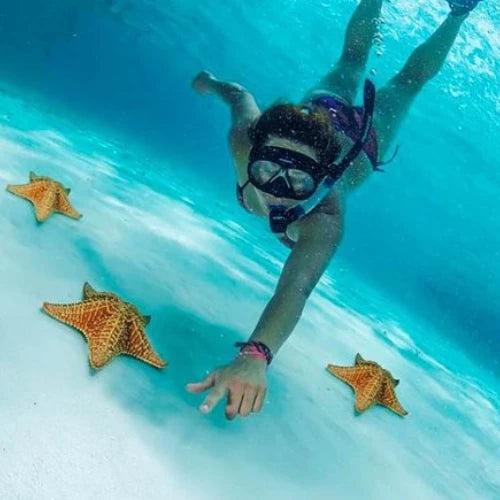
El Cielo is a shallow sandbar off the southern tip of Cozumel, reachable only by boat, where red cushion sea stars sit scattered across white sand in roughly one to three metres of clear water. It is not a reef dive and there is almost no coral there — the site's logged depth range is 5 to 15 feet with mild to moderate current, and most people stand rather than swim. The single thing you most need to know before you go: lifting a sea star out of the water kills it, and taking or disturbing marine organisms — starfish explicitly included — is prohibited inside Parque Nacional Arrecifes de Cozumel. A photograph with a starfish in your hand is a dead animal and a park violation. Everything else on this page is secondary to that.
For the island-wide picture of where Cozumel snorkelling works, read the Cozumel snorkelling guide. The full site record is on the El Cielo dive site page.
Why You Must Not Lift the Starfish at El Cielo
Most tour pages skip this or reduce it to a polite suggestion. It is neither optional nor a matter of etiquette.
The biology. Red cushion sea stars, Oreaster reticulatus, have no lungs and no gills. They exchange oxygen across their body surface through thin-walled structures called papulae, and through the tube feet on their underside. Both work only when submerged. Lift one into the air and those structures collapse against themselves; the animal starts suffocating within about a minute, and air forced into its water-vascular system causes damage it may not recover from. The tissue is also easily torn by handling. An animal that took years to reach that size can be killed by a thirty-second photograph, and the damage is often invisible — it does not die in your hands, it dies later.
The law. El Cielo sits inside Parque Nacional Arrecifes de Cozumel, administered by CONANP. The published park prohibitions forbid fishing for, collecting or disturbing any marine organism, with fish, coral, shells and starfish named specifically. They also forbid standing on or holding the reef, feeding any animal, carrying gloves without registration, and using non-biodegradable sunblock. Rangers and guides enforce this; visitors can be removed from the site, and both guests and operators can be sanctioned.
The evidence it matters. CONANP staff have publicly reported a drastic reduction in the sea star population at this site — estimated at close to 20 percent over a five-year period — and attributed it to human interaction, calling on watersport operators to stop guests handling the animals. The starfish at El Cielo are not an inexhaustible photo prop. They are a declining population being loved to death by exactly the picture everyone wants.
What to do instead. Photograph them underwater. Put the camera in the water rather than the animal in the air — a phone in a cheap waterproof pouch held below the surface gets a better picture than a hand-held starfish anyway, because the colour and the light are right. Do not stand on them, do not rearrange them into patterns, do not move them into shallower water for a shot. If a guide or another passenger picks one up, saying something is reasonable and normal.
The same principle applies to everything else in the water here, which is covered in more detail in the reef conservation guide.
What Is El Cielo, Exactly?
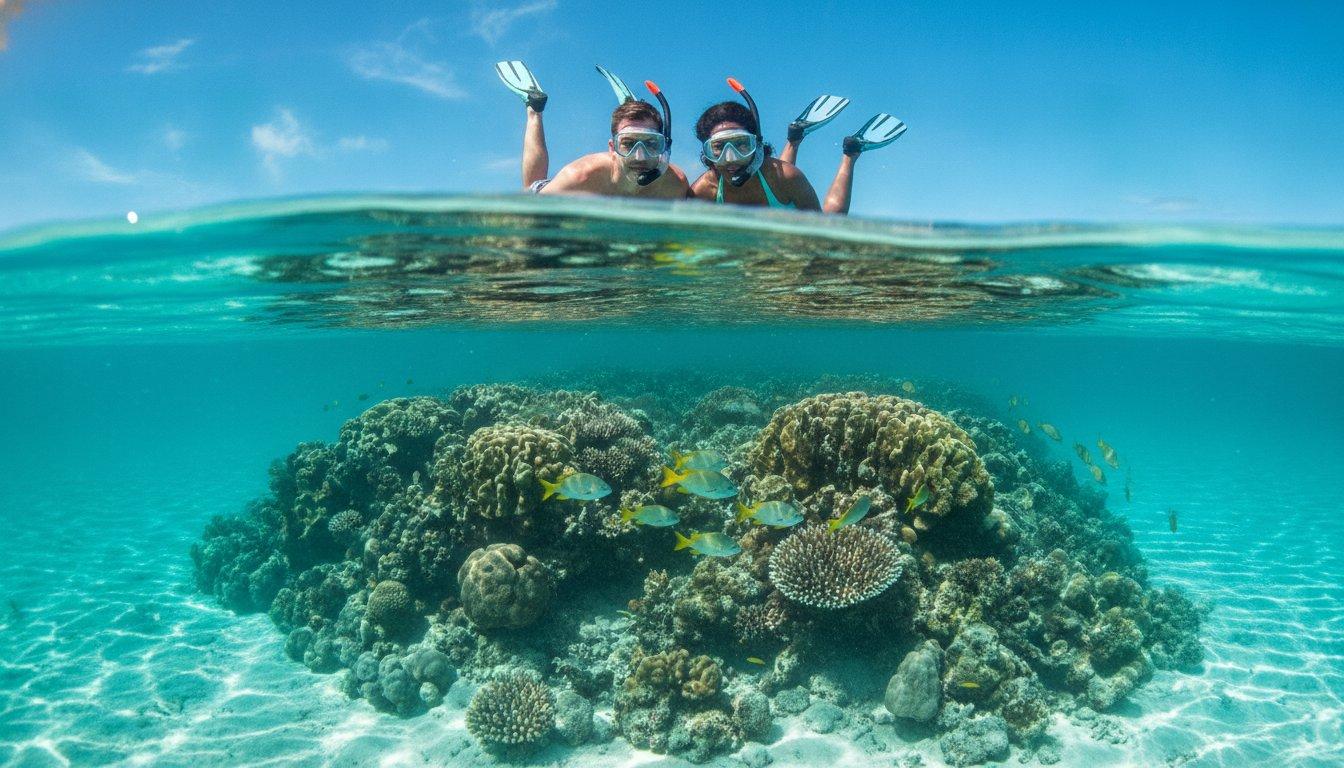
El Cielo — "the sky" — is a shallow sand flat inside a sheltered lagoon at the southern end of Cozumel's west coast, between Colombia Deep to the north and Punta Sur to the south. The name comes from the water: on a flat, sunlit day the sand throws the light back so evenly that the surface reads as sky.
| Attribute | El Cielo |
|---|---|
| Type | Sandbar and shallow lagoon, not a reef |
| Logged depth range | 5–15 ft |
| Typical standing depth on the bar | Waist to chest deep |
| Current strength | Mild to moderate |
| Skill level | Beginner |
| Coral | Minimal — this is sand |
| Access | Boat only, no shore access exists |
| Position | Between Colombia Deep and Punta Sur |
That table is the honest sales pitch and the honest warning at once. If you arrive expecting the coral gardens Cozumel is famous for, you will be disappointed — those are at Palancar and Columbia Shallows, which most El Cielo itineraries visit on the same trip. If you arrive wanting to stand in luminous shallow water among large sea stars with rays passing at knee height, it delivers exactly that.
What Do You Actually See at El Cielo?
| What | How likely | Notes |
|---|---|---|
| Red cushion sea stars | The reason people come | On open sand; look, photograph, do not lift |
| Southern stingrays | Common | Cruise the shallows, sometimes between standing people |
| Small schooling fish | Common | Around the sparse structure and grass patches |
| Conch and other shells | Common | Living animals; leave them |
| Spotted eagle ray | Occasional | Logged at the site, more likely in cooler months |
| Green or hawksbill turtle | Occasional | Over grass rather than sand |
| Coral and reef fish | Sparse | Go to the reef stops on the same trip for these |
The stingrays are the underrated part of the day. They are unbothered by people, they pass close, and watching one glide by at knee height in a metre of clear water is what most people actually remember. The rules are the same as for the starfish: give them room, do not chase, do not corner them against a boat, and never attempt to touch or ride one. A stingray that feels trapped is the only way this becomes a problem.
Turtles are a genuine possibility here but not a reliable one — the Cozumel sea turtle guide covers where and when they actually turn up and the no-touch rule that applies.
How Do You Get to El Cielo and What Does It Cost?
Boat only. There is no road, no beach access and no way to walk in. Boats leave from the downtown marinas and from the piers, and El Cielo is at the far southern end of the island, so a trip there is a half day rather than an hour.
Prices below were checked against published operator pages in August 2026. The spread is wide because "an El Cielo trip" covers everything from a six-person panga to a sixty-person catamaran.
| Option | Published price | What it is |
|---|---|---|
| Small-group boat, 3 stops | From about $50 USD per person | 8–16 guests, two reef stops plus the sandbar, 3–4 hours |
| Larger group tour | From about $63 USD per person | Bigger boat, park fee often charged separately |
| Party catamaran | Roughly $60–90 USD per person | 30–60 guests, music, open bar, the sandbar as backdrop |
| Private charter | Varies widely by boat and length | From a few hundred dollars; confirm capacity and hours |
| Marine park fee | 225 MXN per person per day | Charged to everyone entering the water inside the park |
Always establish whether the park fee is inside or outside the headline price. It is the most common surprise at the dock, and the marine park fee guide has the current detail.
Which El Cielo Trip Should You Book?
There are effectively two completely different days sold under the same name.
The party catamaran. Thirty to sixty people, music, an open bar and a stop at the sandbar. These are genuinely enjoyable and a lot of people have an excellent day on one. But the boat is the event and the sandbar is the backdrop; you get a scheduled window in the water with a large group in it.
The small boat. Six to sixteen people, a quieter anchorage, and enough time to stand still and watch. If El Cielo itself is the reason you booked, this is the version that delivers it. It is also the version where a guide actually briefs the group on the starfish rule instead of shouting it over a speaker.
Neither is wrong. Just know which you have booked before you pay. What to book on a Cozumel snorkel tour compares boat types across all the island's trips, and most operators are listed among the island's dive centers.
If you are prone to motion sickness, note that the run south is the longest boat leg on the standard snorkelling circuit — the seasickness guide is worth reading first.
When Is the Best Time to Visit El Cielo?
Go early. The first boats reaching the sandbar around 9:00 to 9:30 find it close to empty. On a heavy cruise day by midday there can be eight to a dozen boats anchored and a hundred people in the water, which is bad for the experience and worse for the animals. Late-afternoon and sunset departures are the other quiet window, at the cost of some clarity.
Go on a calm day. The clarity that gives El Cielo its name needs a flat surface and no recent wind. After a norte the sand is stirred up and the place is ordinary. Any operator worth booking will move or cancel rather than take you to a churned-up sandbar.
Go in the shoulder months. May, June and September are dramatically quieter than the winter high season, and they also bring the lightest current and warmest water. December to March gives better visibility island-wide but stronger current, more wind and far more boats. The month-by-month numbers are in the conditions guide, and the current guide explains why the south end behaves differently from the north.
Is El Cielo Worth It? Who It Suits
| Visitor | Verdict |
|---|---|
| Non-swimmers and nervous swimmers | Excellent — you can stand, and every boat carries vests |
| Families with young children | Excellent — shallow, calm, short in-water time |
| Anyone who wants a photograph of the water | Excellent on a flat, early, sunlit morning |
| Snorkellers wanting coral and fish | Poor on its own — book the version with two reef stops |
| Divers | Not a dive. Depth is 5–15 ft over sand |
| Anyone wanting a quiet spot | Only on an early or late departure |
| People who want to hold a starfish | Do not book this trip |
The fair summary: El Cielo is worth it if you go early, on a calm day, with an operator whose boat is not the main event, and if you understand that you are visiting a shallow sand flat rather than a reef. It is one stop on a good half-day, not a half-day on its own.
The Rules in Short
- Do not lift, hold, move, stack or stand on the sea stars. They suffocate out of water and the population here is already in decline.
- Do not touch, chase or ride the stingrays. Give them a wide berth and let them pass.
- No touching anything else either — conch, shells, coral, fish. Nothing leaves the water.
- Mineral sunscreen only. Non-biodegradable sunblock is prohibited inside the park; a rash guard is better than lotion anyway.
- No feeding. Food changes behaviour and harms the animals.
- Pay the park fee. It funds the protection the site depends on.
- Say something. If a guide encourages guests to hold a starfish, that operator is part of the problem, and it is worth reporting and worth not booking again.
Fitting El Cielo Into a Cozumel Trip
The sensible way to do El Cielo is as part of an early three-stop morning that also takes in real reef, then to spend the rest of the trip elsewhere — a shore day at Sky Reef, a boat morning over Paradise Reef, or, if you dive, the southern walls that begin just north of the sandbar and run down to Punta Sur and Devil's Throat.
Browse the dive site index to see how the reef line changes at the south end of the island, look through explore Cozumel for what else fills a day down there, and use the Cozumel trip planner to put the whole week in order.
Frequently Asked Questions
Can you touch or pick up the starfish at El Cielo?
Why does lifting a starfish out of the water kill it?
Is it illegal to touch starfish at El Cielo in Cozumel?
What is El Cielo in Cozumel?
How deep is the water at El Cielo?
How do you get to El Cielo Cozumel?
How much does an El Cielo tour cost?
Is the El Cielo party catamaran worth booking?
What is the best time of day to visit El Cielo?
Are there stingrays at El Cielo?
Share This Article

Carmen Novelo
Carmen Novelo is a Cozumel native and an active scuba instructor and dive guide on the island. She has spent twelve years diving the Cozumel reef system, and writes about its dive sites, conditions and marine life for Cozumel Dive Hub.