Avoiding Seasickness on Cozumel Dive Boats: The Ultimate Diver's Guide (2026)
Seasickness on a Cozumel dive boat is prevented, not treated: stay on deck with the horizon in view, rig your gear before the boat leaves, sit mid-hull, and ask to get in early. Mid-island reefs also cut a 40-minute crossing to about 12.
Carmen Novelo · March 12, 2026 · 20 min read
Seasickness on a Cozumel dive boat is prevented, not treated. The measures with the strongest support are behavioural: stay on deck with the horizon in view, assemble your gear before the boat leaves the pier, sit near the middle of the hull, avoid alcohol the evening before, eat something light rather than nothing, and ask to get in the water early — Divers Alert Network notes that once you are submerged the body stops receiving the conflicting signals that cause the nausea. If you use a medication, DAN's stated position is that you take a trial dose on land first, on a day when you do not need to drive or operate machinery, because drowsiness is a side effect of most of them. Cozumel adds one lever almost nobody offers you: ask for mid-island reefs instead of the southern sites, which turns a 35 to 45 minute crossing into a 10 to 15 minute one.
This page reports published guidance from Divers Alert Network and the CDC. It is not medical advice, and no drug or dose is recommended here. Decisions about medication belong to you and a doctor — ideally one familiar with diving, or the DAN medical information line.
Why Do Divers Get Seasick on the Way to Cozumel's Reefs?
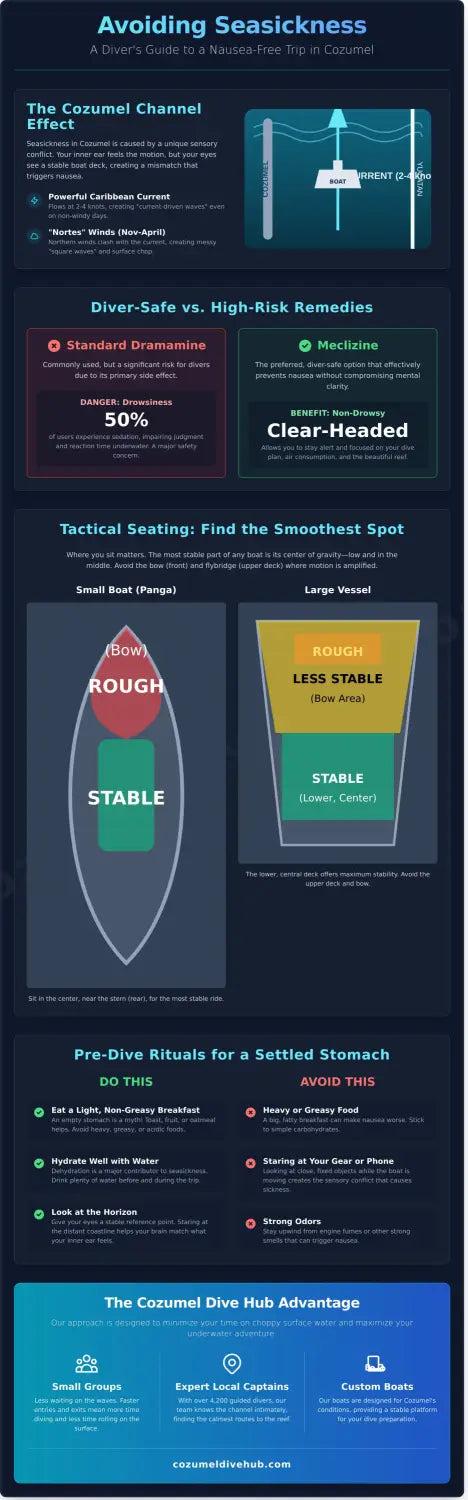
Motion sickness is a sensory conflict. Your inner ear registers the roll and pitch of the hull while your eyes, fixed on a dive bag or a regulator hose, report that nothing is moving. The brain cannot reconcile the two signals and produces nausea, cold sweat, yawning and salivation. This is why the two most reliable free interventions — looking at the horizon and not looking down — work: they restore agreement between what you see and what you feel.
Cozumel's specific contribution is the Yucatán Current, which flows north through the channel between the island and the mainland and is the reason the island's drift diving is world famous. Moving water alone does not make you sick. What makes the ride uncomfortable is wind pushing against that northbound flow, which shortens and steepens the wave period and produces the chop divers describe as a washing machine. On a calm morning the west side of the island is close to flat. On a windy one the same route is a different boat trip entirely. The current guide covers what that water does underwater; this page is about the twenty to forty-five minutes before you reach it.
Two more Cozumel-specific factors matter. The surface interval on a two-tank dive is when most people go green, because the boat is stationary or idling and rolling beam-on to the swell rather than cutting through it. And because Cozumel runs live boat pickups, the vessel manoeuvres to collect divers rather than sitting on a mooring, adding engine vibration and exhaust to the mix.
What Is a Norte, and Why Does It Ruin the Ride?
A Norte is a winter north wind that reaches Cozumel roughly between November and March, arriving with a cold front off the North American continent. It is the single condition most likely to turn a pleasant crossing into a punishing one, and in stronger episodes the port authority closes the port outright and all diving stops for a day or two.
The mechanism is simple. The current runs north. A Norte blows south against it. Wind against current stacks the sea into short, steep, closely spaced waves, and a dive boat crossing that at speed slams rather than glides. Nortes are also the reason schedules change at short notice: when the northern sites are unworkable, boats move south or hug the lee of the island, and the crossing may get longer rather than shorter.
If you are prone to seasickness and travelling in Norte season, the practical response is to build flexibility into your booking rather than to fight the weather. Ask about the port-closure policy before you pay, keep a spare day at the end of the trip, and treat a windy forecast as a reason to request closer reefs. The month-by-month conditions guide and the best time to dive Cozumel guide both cover the seasonal pattern in more detail, and the hurricane season safety guide covers the other end of the calendar.
Which Cozumel Dive Sites Have the Shortest Boat Ride?
This is the most useful and least offered piece of advice on the island. Cozumel's reef runs roughly north to south along the west coast, and dive site order maps directly onto boat time from the main piers near San Miguel. The famous southern names — Palancar, Colombia, Punta Sur, Maracaibo — are the longest rides. The mid-island reefs are a fraction of the distance and are excellent dives in their own right.
If motion is your limiting factor, ask the dive center for the closer sites by name. Most operators will accommodate a specific request on a private or small-group booking, and many run a dedicated shallow or beginner itinerary that goes no further than the middle of the island anyway.
| Dive Site | Position on the Reef | Typical Crossing | Skill Level |
|---|---|---|---|
| Paradise Reef | Close to town | Shortest — often around 10 minutes | Beginner |
| Villa Blanca Wall | Close to town | Short | Intermediate |
| Las Palmas Reef | Close to town | Short | Beginner |
| Chankanaab Reef | Mid-island north | Around 15 minutes | Beginner |
| C-53 Wreck | Mid-island | Around 15 minutes | Intermediate |
| Tormentos Reef | Mid-island | Moderate | Intermediate |
| Yucab Reef | Mid-island | Moderate | Beginner |
| Santa Rosa Wall | South-central | Longer | Advanced |
| Palancar Gardens | South | 35 to 45 minutes | Beginner |
| Punta Sur | Far south | 40 minutes or more | Advanced |
| Maracaibo Reef | Far south | Longest ride on the island | Advanced |
Crossing times vary with the departure pier, the boat, and the sea state — a Norte can add fifteen minutes to any of these. Use the ordering rather than the clock, and confirm with the operator. The full Cozumel dive sites guide lists every site on the reef in order.
There is a genuine trade-off here and it is worth naming honestly. The southern walls are spectacular and they are why many people come. If you would rather dive Palancar sick than Paradise well, that is a legitimate choice. But a diver who spends the whole surface interval at the rail and skips the second tank has, in practice, paid for one dive. Two comfortable mid-island dives usually beat one miserable southern one.
What Does DAN Say About Seasickness Medication and Diving?
Divers Alert Network publishes guidance on seasickness prevention for divers. The summary below reports what that guidance and the CDC Yellow Book actually say. It does not recommend anything to you.
| Medication | Class | What Published Guidance Says | Reported Drawback for Divers |
|---|---|---|---|
| Dimenhydrinate (Dramamine) | First-generation antihistamine | DAN lists it among the common over-the-counter options for divers; some divers report taking it the night before rather than the morning of | Sedating; CDC rates it more sedating than scopolamine |
| Meclizine (Bonine, Dramamine Less Drowsy) | Antihistamine | DAN lists it alongside dimenhydrinate; both act by suppressing the nerve pathways involved in vomiting | Still causes drowsiness in some people despite the "less drowsy" labelling |
| Cyclizine (Marezine) and diphenhydramine (Benadryl) | Antihistamines | Named by DAN in the same list of over-the-counter options | Drowsiness; diphenhydramine is markedly sedating |
| Scopolamine transdermal patch | Anticholinergic, prescription | DAN describes it as reducing nerve activity in the inner ear and releasing the drug slowly through the skin. CDC gives a 6 to 8 hour onset and up to 72 hours of action | DAN reports dry mouth and blurred vision, and possible hallucinations, confusion, agitation and disorientation. DAN specifically warns that wearing it more than three days can produce withdrawal symptoms that mimic decompression sickness |
| Cinnarizine | Antihistamine, not sold over the counter in the US | Listed by the CDC Yellow Book among motion sickness drugs, with roughly an 8 hour duration. DAN's seasickness article does not cover it | Sedation is the class effect; availability varies by country |
| Promethazine (Phenergan) | Phenothiazine, prescription | DAN Southern Africa notes it can be used as a sedative-hypnotic | Described as the most sedating option; DAN notes it may impair the mental and physical abilities required for hazardous tasks |
| Ginger | Food and supplement | See the section below | Weak and contradictory evidence base |
Three points from that guidance are worth pulling out because they are the ones divers most often miss.
Drowsiness is the safety issue, not the nausea. DAN's wording is direct: "Drowsiness is a side effect of many of these medications, so experiment with them to test your susceptibility to drowsiness before using one of these medications while diving." The concern is not that you will feel sleepy on the boat. It is that impaired alertness at depth degrades gas management, buoyancy, and your ability to respond to a problem.
The scopolamine patch has a diving-specific hazard. Beyond dry mouth and blurred vision — which alone can make a dive computer hard to read — DAN flags that wearing the patch for more than three days can produce withdrawal symptoms that mimic decompression sickness. On a week-long dive trip that is not a theoretical problem: it can send a healthy diver toward a chamber, or worse, cause a real hit to be dismissed as patch withdrawal.
There is a plausible interaction with narcosis. DAN notes it is theoretically possible that certain drugs might enhance, or be enhanced by, the narcotic effect of nitrogen, and applies the concern mainly to dives deeper than about 80 feet with medications that carry alcohol or heavy-machinery warnings. Cozumel's southern walls routinely go past that depth. If you are considering a sedating medication and deep wall dives on the same day, that is a conversation for a physician. The glossary entry on nitrogen narcosis explains the underlying effect.
Should You Try a New Motion Sickness Drug for the First Time on a Dive Day?
No. This is the clearest, most consistently repeated line in the published guidance, and it is the rule most often broken by travellers who buy something at a pharmacy on the way to the pier.
DAN's instruction is to take one dose and assess your condition on a day when you will not need to drive, operate heavy machinery, or generally need your wits about you, and to use the medication for diving only if you are unimpaired and pleased with the result. The CDC Yellow Book makes the same point from the clinician's side, advising that a trial dose of one or more medications be considered before departure, because side effect profiles vary widely between individuals. For prescription medications more broadly, DAN suggests roughly 30 days of use is needed to confirm the dosage is right and to reveal side effects.
The practical version for a Cozumel trip: whatever you plan to use, use it once at home, weeks before you fly, on a day off. Not in the hotel room at 6am. A drug you have never taken, a boat, a warm cabin and 60 feet of water is a combination with no upside.
Anyone taking any regular medication, or with any medical condition, should also work through a dive medical form and get a physician's clearance before diving. DAN's own position is that any medical condition or medication should prompt a diver to seek a physician's approval prior to diving.
Does Ginger Actually Work for Seasickness?
The honest answer is that the evidence is weak and inconsistent, and it is routinely oversold.
DAN's seasickness article says ginger tea, ginger candy or ginger ale "can soothe the stomach" and that research suggests ginger reduces contractions in the stomach, which may help relieve nausea. That is a modest claim about symptom soothing, not a claim that ginger prevents motion sickness.
The CDC Yellow Book is blunter: "The efficacy of particular diets, supplements, vitamins, ginger, and so on, has only weak and contradictory supporting evidence."
The trial record explains why both are hedged. The frequently cited 1982 study that found powdered ginger outperformed dimenhydrinate used a rotating-chair model with a small sample, and it is more than forty years old. Later work has gone both ways: some trials using 1 to 2 grams of ginger found reductions in nausea and in the gastric rhythm disturbance that accompanies motion sickness, while a 1991 study found little preventive effect from 500 mg pretreatment. A 2020 open-label trial of a ginger extract in 174 travellers reported significant improvement, but it was single-arm and unblinded, and its own authors concluded that randomised, blinded, placebo-controlled trials are still needed.
What that adds up to: ginger is cheap, food-safe for most people, causes no drowsiness, and is therefore one of the few options with no diving-specific downside. It is not a proven substitute for a medication that works for you, and it is not something to rely on as your only plan if you are severely affected. Treat it as a low-cost thing to try, not as the answer. Ginger can interact with some medications, including blood thinners, so it is still a question for your doctor rather than a free pass.
Acupressure wristbands sit in a similar evidence category — widely used, cheap, no sedation, no strong trial support. Nothing about them is dangerous for a diver, which is more than can be said for a sedating drug you have never taken.
What Actually Works on the Boat: Non-Drug Measures
These are the measures DAN publishes for divers, and they cost nothing. They also work regardless of whether you use medication.
Stay on deck. Do not go below. An enclosed cabin or a head with no window removes the horizon and traps odours. It is the single fastest way to convert queasy into sick.
Keep the horizon in view. DAN's instruction is to stare at an unmoving object in the distance, such as the horizon. On the west side of Cozumel that is easy: the mainland coast is visible on clear days and the island itself is always to one side.
Set your gear up before the boat leaves the pier. Assembling a regulator on a rolling deck means looking down, head bent, hands busy, exactly the posture that triggers symptoms. Do it alongside, in flat water. This also means you are ready when it is time to get in.
Sit near the middle of the boat. DAN advises positioning yourself near the center and avoiding the upper or lower decks, where bobbing and swaying are more pronounced. The bow is the worst place on a small boat in chop.
Stay upwind of the exhaust. DAN specifically lists avoiding inhaling exhaust fumes and avoiding strong odours. Diesel and sunscreen are both common triggers.
Skip the alcohol the night before. DAN's list includes avoiding alcohol the evening before you travel. Cozumel makes this harder than it sounds, and it matters more than most divers accept.
Eat lightly rather than not at all. DAN advises avoiding heavy meals prior to diving, staying hydrated, and eating dry crackers to help settle a queasy stomach. Bland and small beats both a fry-up and an empty stomach.
Ask to get in the water early. DAN's guidance is explicit: if you start to feel ill, ask if you can be one of the first to enter the water, because once in the water the body no longer receives the conflicting signals from the eyes and limbs, which can alleviate the nausea. This is the reason experienced divers on rough days gear up first and jump first. Say something to the guide before you are past the point of being useful — a negative entry is not the moment to discover you cannot function.
Small Boat or Large Boat: Which Is Better if You Get Seasick?
There is no clean answer, and anyone who gives you one is selling something. The trade-off is real in both directions.
| Factor | Small Boat: Panga or Six-Pack | Large Boat: Cattle Boat Style |
|---|---|---|
| Motion | More of it. A light hull follows every wave and slams in chop | Less of it. More mass and a longer waterline damp the ride, particularly in short chop |
| Where you sit | On deck, in open air, horizon always visible — the correct position by default | Deck space exists, but so does a cabin and a head, and people go inside |
| Time in the water | Small groups gear up and enter faster, which is the fastest relief available | More divers means longer waits at the surface, and the surface interval is when people get sick |
| Shade and shelter | Usually little or none. Sun and heat worsen nausea | Shade, seating, a toilet, and somewhere to lie down |
| Site flexibility | Easier to ask for closer reefs on a small charter | Fixed itinerary is more common |
| Fumes | Outboard exhaust is close | Engines are further from where you sit, but a cabin traps smells |
The pattern worth understanding: a large boat moves less, but its comforts tempt you into the exact behaviours that make seasickness worse — sitting down inside, out of the wind, without a horizon. A small boat moves more, but it forces you into the right position and gets you underwater sooner, which is the trade-off fast small-boat operators such as Sharky's Scuba build their whole product around. If you choose a larger vessel, choose it and then behave as though you are on a small one: stay outside, stay midships, stay looking at the horizon.
DAN's own published tip list does suggest choosing larger boats where possible. That is sound as far as it goes. It assumes you stay on deck. The dive boat comfort and amenities checklist covers what to ask about shade, seating and heads, and the small-group diving guide and the guide to avoiding crowded boats cover the other side of the trade.
What Should You Do if You Vomit Underwater?
This frightens people more than any other part of the subject, and the guidance is clear, short, and reassuring.
DAN's instruction is to keep your primary regulator in your mouth and vomit through it. Most regulators can process vomit without issue. Removing the second stage is the dangerous action, not the vomiting: a DAN case study makes the point that keeping the primary in place after vomiting at depth prevents you from unintentionally inhaling water, which can happen while transitioning to another regulator.
The sequence reported in that case study runs as follows. Stay as calm as you can and keep breathing through the fouled regulator. Wait until the retching has completely stopped and all involuntary reflexes have subsided before doing anything else — do not start swapping equipment mid-episode. Then clear the second stage, using the purge if you need it, and if it will not clear, switch to your backup octopus. In the case DAN documented, the diver's buddy stayed close and was ready to donate air in case neither regulator cleared, which is the buddy system doing precisely the job it exists for.
After that, signal your buddy and the guide, and end the dive together with a normal controlled ascent and a safety stop if your profile calls for one. Vomiting is not by itself a reason to skip the stop or to bolt for the surface — a rapid ascent is a far greater risk than the nausea. If you are unsure whether you are fit to continue, or you feel unwell afterwards, that is a question for the boat crew and, if symptoms persist, for a doctor. Cozumel has recompression facilities; the hyperbaric chamber guide lists them.
One practical note: raise it in the dive briefing if you are worried. Telling the guide before the dive that you are queasy is not embarrassing, it is information they need, and it usually results in you being put in the water first.
When Should You Skip the Dive Entirely?
Nobody should dive through symptoms to avoid wasting money. Repeated vomiting causes dehydration, and dehydration is one of the accepted risk factors for decompression sickness. A diver who is severely nauseated, weak, or unable to think clearly is not fit to dive that day, whatever the boat schedule says.
The same applies to medication side effects. If a drug leaves you groggy, blurry-visioned or foggy, the correct response is to sit the dive out, not to descend and hope it lifts. Guidance from DAN and the CDC on drowsiness exists precisely because the consequences at depth are worse than on land.
Talk to the crew. Most Cozumel operators would far rather reschedule a diver than deal with an incident, and many will move you to a calmer, closer itinerary or a different day. This is also why booking with some slack in the schedule matters — see the safety and conditions guide and, if this is your first trip, the first-time diver guide and the beginner's guide to Cozumel diving.
Planning a Cozumel Dive Trip Around Seasickness
Put together, the plan for a susceptible diver looks like this. Book with a flexible schedule, especially between November and March when a Norte can close the port. Ask the dive center, in writing, whether they will run mid-island reefs on request. Test any medication at home weeks in advance and clear it with a doctor. Skip the drinks the night before. Set up your gear on the pier. Stay outside, stay midships, watch the horizon, and ask to be first in. If you are sick underwater, keep the regulator in.
That is most of the problem solved without spending anything beyond the cost of the trip itself, and it turns the reefs from something you endure the ride to into something you actually get to see. When you are ready to put the trip together, start with the complete Cozumel dive trip planner.
Frequently Asked Questions
What is the fastest way to stop feeling seasick on a dive boat?
Does DAN recommend taking seasickness medication before diving?
Can you take Dramamine or Bonine and still scuba dive?
Is the scopolamine patch safe for scuba diving?
Does ginger actually work for seasickness?
What should you do if you vomit underwater while scuba diving?
Where should you sit on a Cozumel dive boat to avoid seasickness?
Which Cozumel dive sites have the shortest boat ride?
What is a Norte and does it affect diving in Cozumel?
Should you eat before a Cozumel dive boat trip?
Share This Article

Carmen Novelo
Carmen Novelo is a Cozumel native and an active scuba instructor and dive guide on the island. She has spent twelve years diving the Cozumel reef system, and writes about its dive sites, conditions and marine life for Cozumel Dive Hub.