Avoiding Crowded Dive Boats in Cozumel: A Local's Insider Guide
A crowded Cozumel dive boat means 16 to 24 divers, two or three pickups before the reef, and a guide watching eight people at once. But small is not automatically better, and the guide-to-diver ratio matters more than the length of the hull.
Carmen Novelo · April 2, 2026 · 19 min read
A crowded dive boat in Cozumel usually means 16 to 24 divers on one hull, two or three pickups before the boat reaches the reef, and a guide trying to keep eyes on eight or more people in a moving current. Divers call it a cattle boat. But small is not automatically better: a six-diver panga moves far more in chop, carries no toilet and almost no shade, and costs more per dive. What actually decides how the day goes is the guide-to-diver ratio, who chooses the dive sites, and how many pickups happen before yours — not the length of the hull.
This guide is written from the diver's side of the transaction. Cozumel Dive Hub is an independent editorial guide to diving the island; it does not run boats, employ guides or sell dives. What follows is the trade-off in both directions, the specific questions that get a useful answer out of a dive shop, and the places on the reef where crowding genuinely spoils a dive rather than merely annoying you.
What Does "Cattle Boat" Actually Mean In Cozumel?
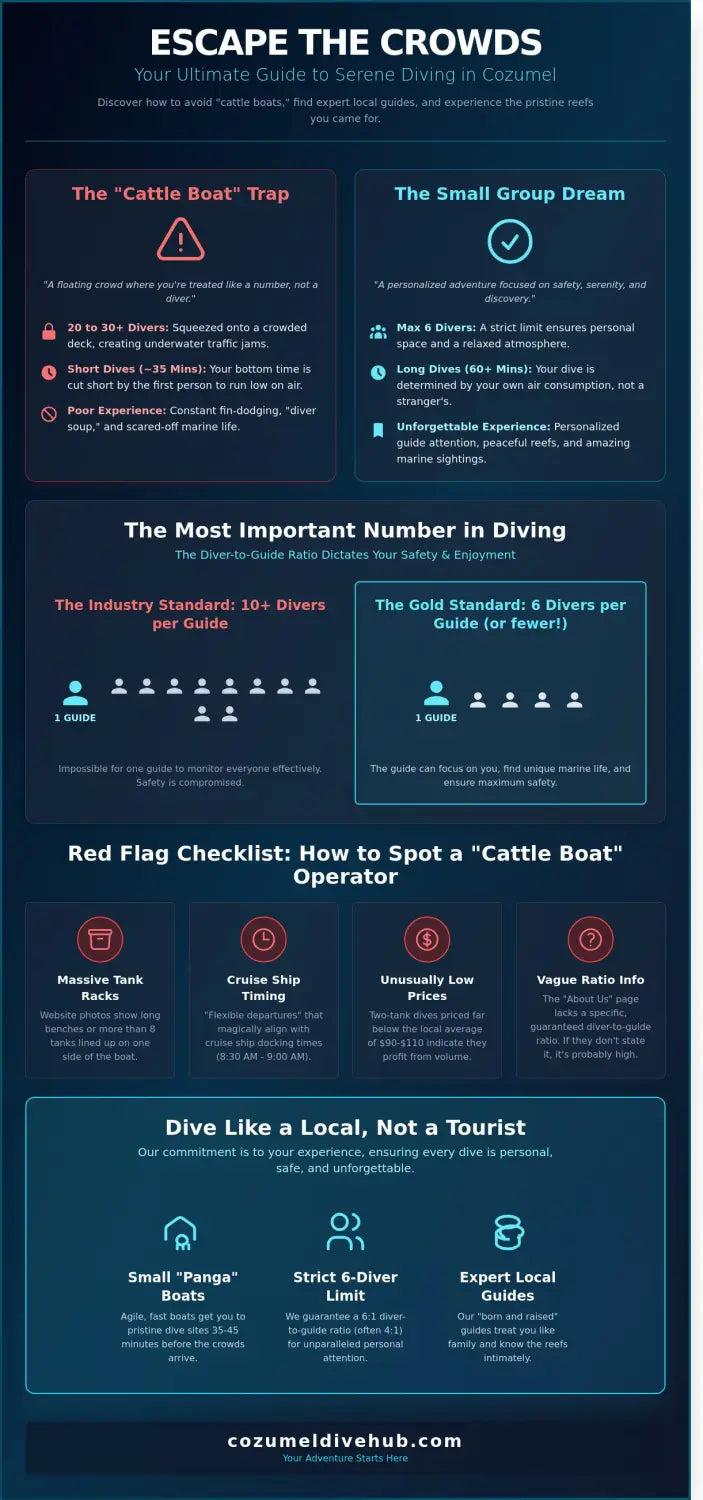
The term describes an operating model, not a safety standard. A large Cozumel dive boat typically carries 16 to 24 divers, sometimes more on a double-deck hull, split between two or three guides. The economics are simple: high passenger numbers keep the advertised two-tank dive price down, which is why the cheapest rates on the island almost always come from the biggest boats. Plenty of them are professionally run, carry emergency oxygen and have experienced captains. The problem is not competence. It is what a full boat does to the shape of the day.
Four things tend to go wrong, and they compound.
The morning gets long. A boat filling 20 seats collects divers from several piers. Hotel pickup is a genuine convenience when yours is first and a chore when yours is fourth, adding 40 to 60 minutes on a bench before anyone gets wet. If the pickup order matters to you, it is a question worth asking rather than assuming. The dive boat pickup and hotel logistics guide covers how the routes usually run, including which shops board divers from a pier they own and skip the circuit altogether.
The guide is managing, not watching. In Cozumel's drift diving conditions a divemaster is doing head counts continuously. Past roughly eight divers, headcounts crowd out everything else: no time to point out a splendid toadfish tucked under a ledge, no time to notice that one diver is finning hard and burning gas, no spare attention for the person who is quietly uncomfortable.
The dive ends on someone else's air. A guided group surfaces when the first diver reaches reserve pressure. The more people in the group, the higher the odds that somebody gets there early. This is arithmetic, not bad luck, and it is the most common complaint divers have about big boats.
The reef gets a traffic jam. On open wall sites this barely matters. In narrow terrain it matters a great deal, which is covered further down.
Spotting The Model Before You Book
You can usually identify a high-volume operation from a website. Look for long continuous bench seating running down both sides of the hull, a second deck, or photos showing fifteen-plus tanks racked up for a single departure. Compare the advertised price against the island's normal range — the Cozumel diving cost breakdown sets out what a two-tank morning typically runs, and a rate well below it is usually being subsidised by passenger volume. Departure times built around the cruise piers are another tell; the cruise port diving guide explains how that schedule works.
None of these signals means an operator should be avoided. They tell you what kind of day to expect, which is a different and more useful thing. For a wider view of vetting shops, see the guide on how to choose a Cozumel dive shop.
How Cozumel Dive Boat Types Compare
Every boat on this island is a compromise between speed, comfort, cost and attention. Nothing wins on all four.
| Boat Type | Typical Divers | Does Well | You Give Up |
|---|---|---|---|
| Six-pack panga | Up to 6 | Fast to the southern reefs, quick entries and exits, guide sees everyone, flexible site changes | Shade, toilet, dry storage, stability in chop; highest price per diver |
| Small fibreglass boat | 6 to 10 | Good balance of speed and shelter, usually one or two guides, manageable ladder queue | Limited deck space; often still no toilet on the smaller hulls |
| Mid-size dive boat | 10 to 16 | Toilet, shade, fresh water, dry bench space; steadier ride | Group pace, slower entries, less say in site selection |
| Large or double-deck boat | 16 to 24+ | Cheapest per diver, most stable in wind and swell, full facilities, big crew | Long pickups, queues at the ladder, ratios often 8:1 or worse |
| Private charter | Your group only | Full control of sites, timing and pace; ideal for photography and mixed-ability groups | Cost, which is the whole trade |
If a charter is under consideration, the section further down on when a private boat is worth the money sets out what it costs and what it actually fixes. The term itself is worth knowing too: a six-pack boat is a vessel licensed to carry no more than six passengers, and in Cozumel it has become shorthand for small-group diving generally. A panga is the small open outboard hull used throughout Mexico — quick and nimble, with nothing between you and the sun.
Why A Smaller Boat Is Not Automatically The Better Choice
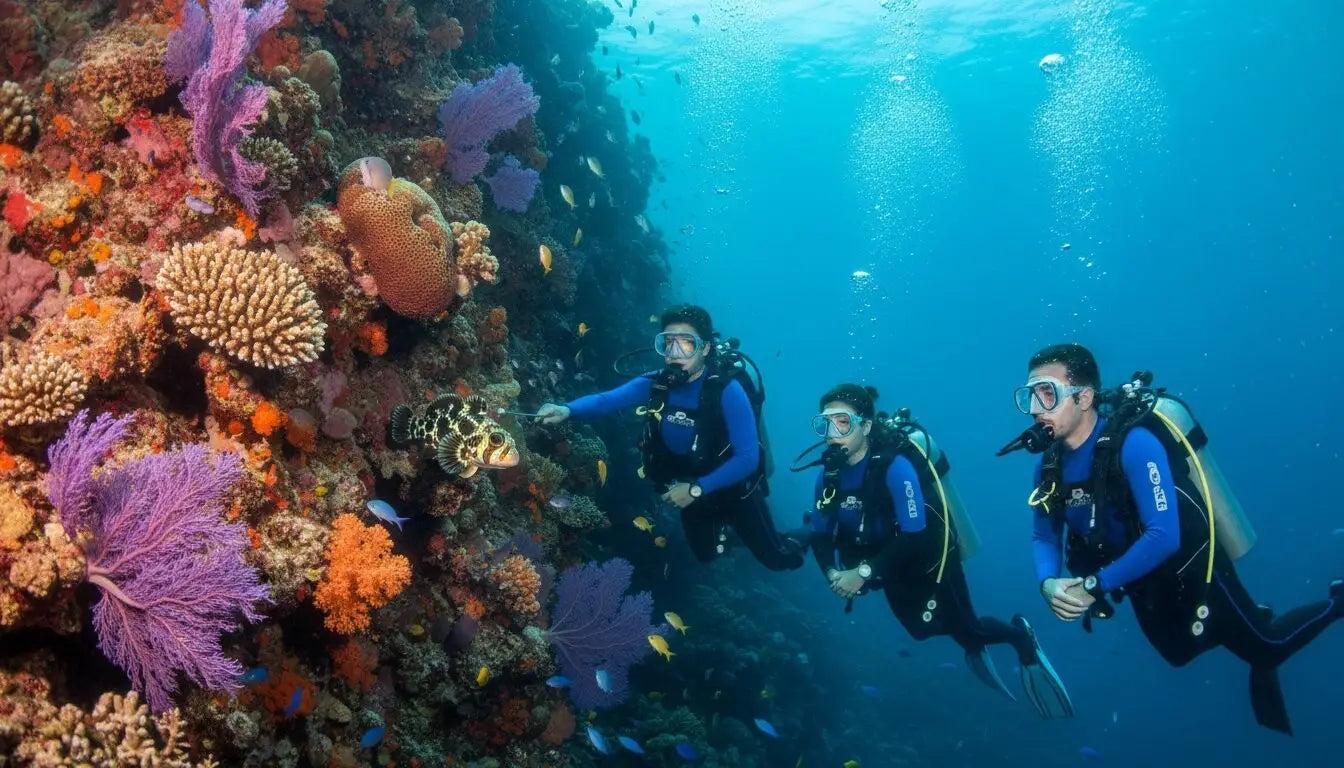
The small-group pitch is easy to sell because the upside is easy to picture. The downside is real and rarely mentioned.
Motion. A short, light hull follows every wave. On a calm day the difference is negligible; on a windy one it is the difference between a pleasant surface interval and a miserable one. Divers prone to motion sickness are consistently better off on a bigger boat, and the seasickness guide for Cozumel dive boats explains why hull length and where you sit both matter.
Facilities. A large boat with a marine toilet, a fresh-water rinse tank, real shade and somewhere dry to leave a camera is genuinely more comfortable across a five-hour morning. On a panga, the surface interval is spent sitting in the sun in a wet wetsuit with nowhere to change. The onboard checklist further down sets out what to look for before assuming that small equals pleasant.
Cost. Fuel, crew, mooring and park logistics are much the same whether six people or twenty are aboard. Splitting those costs six ways produces a higher per-diver price, and that premium is the honest reason small-group diving costs more. It is not a luxury markup.
Weather range. During norte season between roughly November and March, north winds build fast and the port can close outright. Small boats reach that limit sooner. A larger hull will sometimes still run comfortably on a day when the panga fleet stays tied up, and the month-by-month guide to diving Cozumel sets out when to expect it.
Where a small boat clearly wins is entries and exits. A back roll entry puts six people in the water within seconds, so the group descends together instead of strung out along the reef — which is the whole argument for an owner-operated outfit like Azul Divers, running a single 29-foot boat with a maximum of eight divers. On a large boat, a giant stride entry from a high platform for twenty divers takes several minutes, and the ladder queue at the end takes several more.
What Should A Cozumel Dive Boat Actually Have On Board?
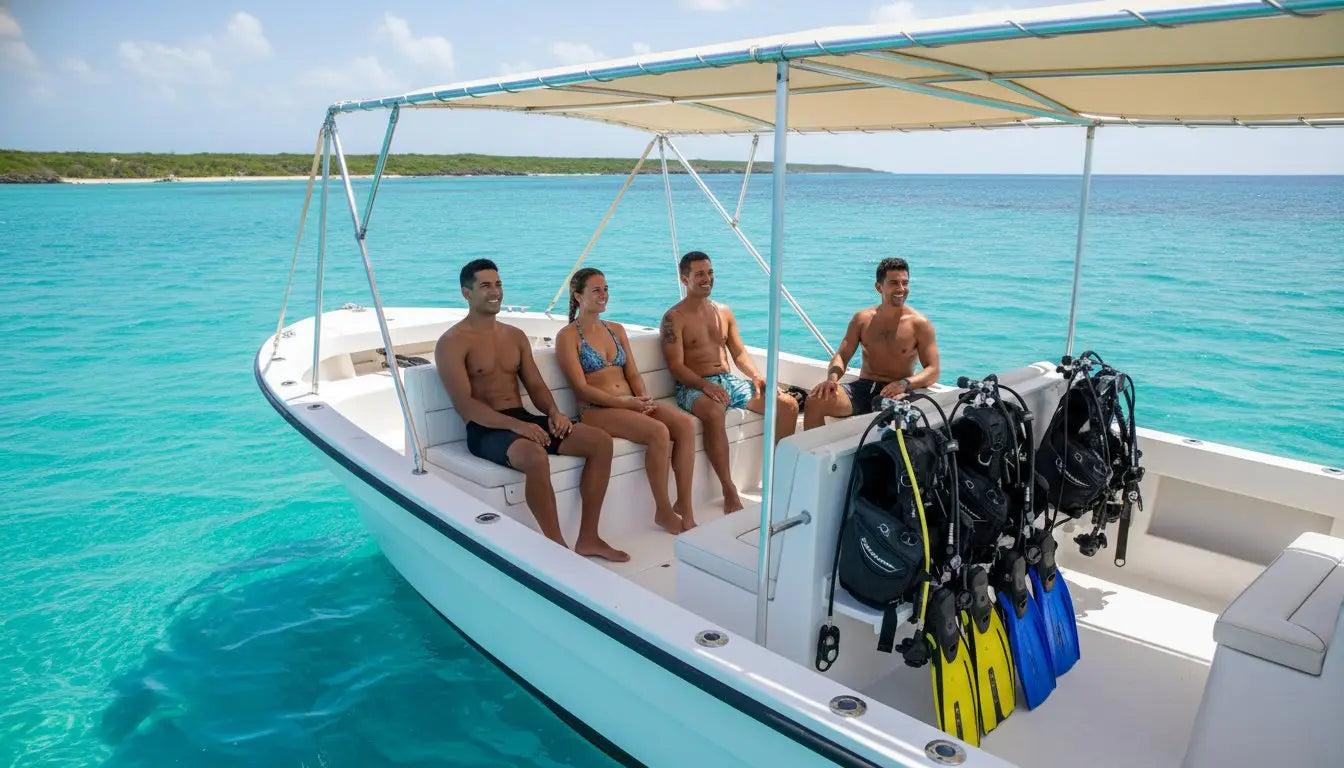
Hull length gets all the attention. The fittings decide whether the five hours between leaving the pier and getting back to it are pleasant. A standard Cozumel morning is a two-tank dive with an hour of surface interval in the middle, spent wet, on a deck, in the sun, a long way from a bathroom. Eight things decide how that goes, and none of them appear on the price list.
| On Board | Why It Matters On A Cozumel Morning | What Adequate Looks Like |
|---|---|---|
| Shade | Four to five hours of tropical sun between two dives is the main cause of afternoon fatigue | A fixed bimini or hardtop over the bench seating, not a strip over the helm |
| Marine head | The surface interval runs about an hour, and the alternative is the open ocean | An enclosed head; if there is none, learn that at booking rather than at sea |
| Fresh-water rinse | Salt is what kills camera housings, computers and mask seals | A dedicated fresh-water tank or bucket, kept separate from the deck wash |
| Dry storage | Phones, wallets, dry clothes and a camera have to live somewhere | A closed locker or a proper dry box, not a crate under the bench |
| A climbable ladder | You exit a moving boat in a current, tired, at the end of every dive | Wide rungs, side rails, and enough depth to stand on with fins still on |
| Secure tank racks | Loose cylinders slide on the run south and take shins with them | Fixed racks with straps or bungees, one slot per diver |
| Water and food | Diving dehydrates you, and the second tank is worse on an empty stomach | Purified water available all morning plus fruit or something salty |
| Emergency oxygen and a radio | Basic provision for the one day it matters | A serviced emergency oxygen kit the crew can point at, and a working VHF |
Two of those are worth expanding, because they are the ones divers regret ignoring.
The Ladder Is Worth Being Fussy About
You board once and exit twice, both times in moving water. A narrow ladder with shallow rungs forces you to pull your fins off in the swell, hand them up, and climb barefoot on a wet aluminium step, which is awkward on a calm day and genuinely unpleasant in a metre of chop. The wide, deep style most Cozumel boats use lets you climb with fins on. That is faster, steadier and the single biggest comfort difference between two otherwise identical hulls. On a large boat it also sets the length of the queue: twenty divers up a slow ladder is fifteen minutes of your morning, twice.
Deck layout matters for the same reason. Somewhere to sit down wearing a tank, room to stand up without hitting the person beside you, and a clear path to the entry point remove most of the gear-fumbling that makes a first boat dive stressful.
Whether There Is A Toilet Changes How You Plan The Day
Mid-size and large boats generally carry an enclosed marine head. Most panga and six-pack hulls do not, because there is nowhere to put one. That is not a fault, it is a consequence of the boat being ten metres long, but it does mean the morning needs planning: use the facilities at the shop or the marina before boarding, and drink deliberately rather than either dehydrating yourself or overdoing it at eight in the morning. Divers who find this genuinely limiting, and plenty do on a four-hour trip to the far south, should treat a head as a booking requirement and filter boats on it rather than hope.
What Turns A Surface Interval Into A Rest Rather Than An Endurance Test
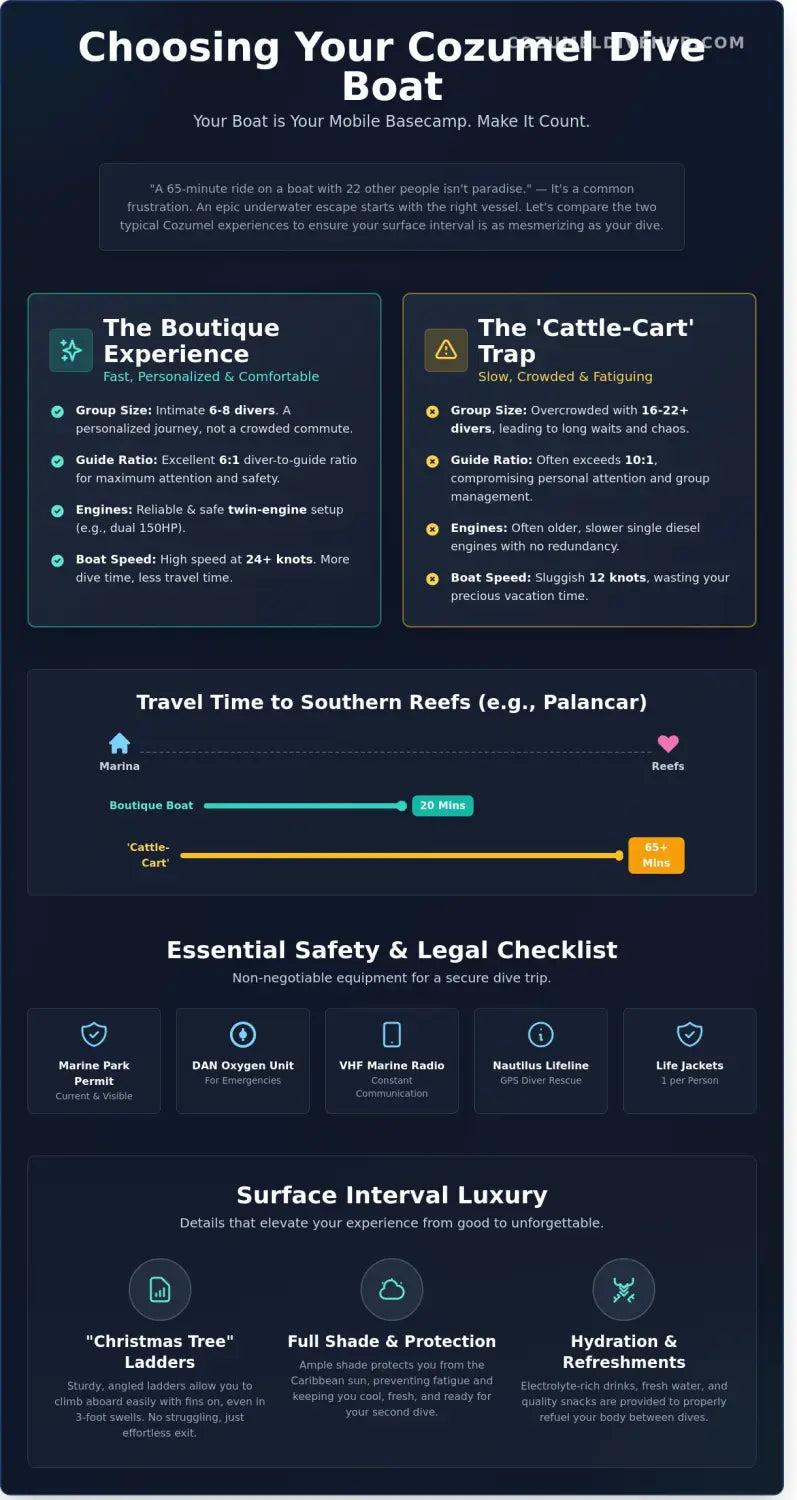
The water is warm year-round, which fools people. Sitting on an open deck in a wet wetsuit while the boat runs back up the coast is a wind-chill problem rather than a water-temperature one, and the second dive is measurably less enjoyable when you start it cold. A boat with wind shelter solves it; so does a dry towel and a light windbreaker in your bag, which costs nothing.
Food and water are the other half. Nobody needs catering, but four to five hours between breakfast and the pier with nothing aboard is a poor plan, and dehydration on a warm deck makes both air consumption and seasickness worse. Most operators put out purified water and cut fruit. Towels are far less commonly provided, so pack one. The Cozumel dive trip packing list covers what belongs in a boat bag, and the gear rental versus bringing your own comparison covers what is worth carrying to the island at all.
One more check costs nothing. Operators working inside Parque Nacional Arrecifes de Cozumel hold a marine park authorisation and collect the marine park fee per diver per day; the 2026 marine park fees guide sets out what is due and when. A boat that cannot answer that question has answered it.
Why Guide-To-Diver Ratio Matters More Than Boat Size
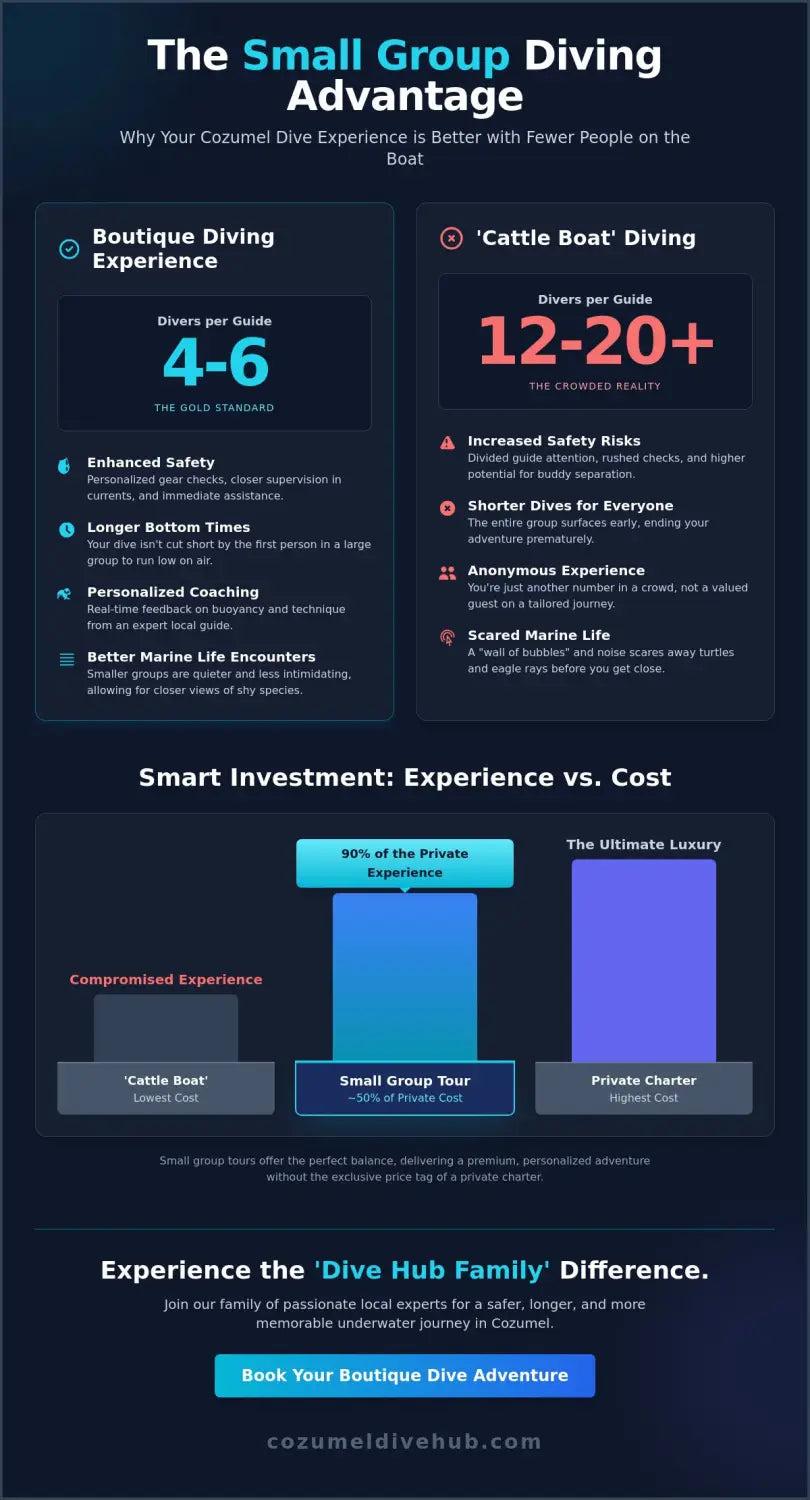
Boat size is a proxy. Ratio is the thing itself. A 16-diver boat carrying three guides gives you a working ratio near 5:1; a 12-diver boat with one guide gives you 12:1. The bigger boat is the better dive in that comparison, and the brochure will tell you the opposite.
Four to six divers per guide is the practical ceiling for close supervision in Cozumel conditions. Above roughly eight, supervision becomes crowd management. That threshold matters more in some circumstances than others:
- Newer divers benefit most from a low ratio, because a guide within arm's reach can fix a buoyancy or weighting problem before it becomes a stressful dive. If you are still building confidence, the beginner's guide to scuba diving Cozumel and the piece on whether Cozumel suits beginners both cover what to expect from the current.
- Photographers need the group to tolerate them stopping. In a group of fifteen, stopping means falling behind. The underwater photography guide for Cozumel assumes a pace you will not get on a full boat.
- Solo travellers get assigned a buddy, and who that is matters more when the guide has no spare attention. The solo diver guide covers how pairing usually works.
- Experienced divers on a wall in a strong current often care less about ratio than about site choice.
Which brings up the second half of the equation. Site selection is the other lever, and it is entirely in the operator's hands. Two boats leaving the same marina at the same hour can produce completely different days depending on whether the captain reads the wind and picks a sheltered reef or simply follows the fleet south. An operator who rotates between Paso del Cedral, Columbia Shallows and Maracaibo according to conditions is giving you more than one who runs the same two moorings every morning. Both boats use a live boat pickup; only one is thinking.
Where Crowding Genuinely Ruins The Dive
On an open wall, a big group is a mild irritation. In narrow terrain it is the whole dive. Cozumel has a handful of sites built around confined passages, and these are where group size stops being a matter of taste.
A swim-through takes divers single file. At Palancar Caves, the coral formations are riddled with tunnels and chimneys, and a group of eighteen turns each one into a queue. The divers at the back hold position in the current waiting their turn, then pass through a passage already full of exhaled bubbles and stirred sediment from everyone ahead. The Palancar Reef guide describes the terrain in detail; the topography is the attraction, and volume is what degrades it.
The Devil's Throat at Punta Sur is the sharper example. It is a vertical chimney that exits deep on the wall, dark in the middle, and it must be dived one diver at a time in a tightly controlled line. This is not a place to be sixteenth in a queue, low on gas, waiting in the blue. The Devil's Throat dive guide is explicit about the experience and control required, and group size is part of that calculation. If a boat carrying twenty divers has Punta Sur on the schedule, ask how the descent order is handled before you get on it.
By contrast, Santa Rosa Wall and Palancar Gardens absorb larger groups without much loss, because the reef is wide and the current spreads people out naturally. A big boat headed for open wall sites is a very different proposition from a big boat headed into a cave system. The Palancar Gardens and Horseshoe comparison is a useful reference for which parts of that reef are open and which are confined.
How Cruise Ship Timing Shapes The Crowd On The Reef
Cozumel's dive traffic is not evenly spread. Ship-sold shore excursions have to be back aboard by mid-afternoon, so cruise-linked diving concentrates into the morning. Between roughly 9am and 1pm on a multi-ship day, the popular moorings on the southern reefs carry the heaviest boat traffic of the week.
There are two reasonable responses. The first is to leave early — an 8am departure typically reaches the first mooring ahead of the bulk of the fleet. The second is to dive in the afternoon, when the shore-excursion boats have gone back. The trade-off is honest: the wind usually builds through the day, so an afternoon departure often means a rougher ride and slightly more surge on shallow sites. If the boat is small, that trade-off gets more expensive.
Season matters as much as time of day. Ship volumes and diver numbers both peak in the winter months, and the same operator running the same boat may put eight divers on it in September and eighteen in February. A night dive sidesteps the question entirely, and night groups are small almost everywhere by default.
Which Questions To Ask Before You Book
Most shops answer these questions honestly if asked directly by email. The pattern of the answers tells you more than any individual number — an operator that gives specific figures without hedging is describing a system it actually runs.
| Ask This | Why It Matters | A Straight Answer Sounds Like |
|---|---|---|
| How many divers will be on the boat on my date? | Capacity is not the same as the actual booking for your day | "Currently 7 booked, maximum 10" |
| How many divers does each guide take? | This is the number that decides supervision quality | "Six per guide, always split if we go over" |
| How many pickups happen before mine? | Determines how much of your morning is spent waiting | "You are second of three, on the water by 8:40" |
| What happens if one diver reaches reserve early? | Reveals whether the whole group surfaces or the guide splits it | "The second guide takes them up, the rest continue" |
| Who picks the dive sites, and when? | A captain reading conditions beats a fixed schedule | "The captain decides that morning based on wind" |
| Is there shade, a toilet and drinking water aboard? | Decides the comfort of the surface interval, not the dive | "Shade and water yes, no head on the small boat" |
| Can I climb the ladder with my fins on? | Decides how hard the exit is at the end of every dive | "Wide ladder, fins stay on, rails both sides" |
| Where does a camera or a phone go while I dive? | Salt water ruins the kit you cannot replace on the island | "Dry box under the console, it stays closed" |
| Is food and drinking water provided, or do I bring it? | Four to five hours pass between breakfast and the pier | "Water and fruit aboard, bring your own towel" |
| Does the boat carry emergency oxygen? | Basic safety provision; the answer should be immediate | "Yes, DAN unit, crew trained annually" |
| Are marine park fees included in the price? | Avoids a surprise charge at the pier | "Park fee is separate, paid on the day" |
That last one catches people out regularly. The marine park fee is charged per diver per day and is often quoted separately from the dive price; the Cozumel marine park fees guide explains what is due and when. Gear rental is usually separate too.
A vague answer is still an answer. "It depends on the day" to the question of maximum group size means the cap moves with demand, which means it is not a cap.
What Crowding Actually Costs You In Bottom Time
The realistic loss is ten to twenty minutes across a two-tank morning, not a ruined trip. It accumulates from three places: the extra pickups before departure, the slower entries and ladder queues, and the group surfacing on the first diver's reserve pressure rather than yours.
That last one is worth understanding rather than resenting. Air consumption varies enormously between divers, and in a strong current it varies more. A relaxed diver with good trim may surface with half a tank while a nervous one is at reserve after 35 minutes. Grouping divers with similar consumption rates is the standard fix, and it is easier to do on a boat with several guides than on a boat with one. If bottom time is the priority, diving on nitrox will do more for a repetitive dive day than boat size will.
Carrying an SMB and knowing how to use it also changes the maths, because a diver who can be picked up independently is less dependent on the group's schedule. The drift diving guide and the guide to how strong the current runs in Cozumel both cover the pickup procedure in detail.
Which Boat Suits Which Diver
There is no universally correct answer, only a match between what a boat is good at and what a particular diver needs.
| If You Are | Best Fit | Reason |
|---|---|---|
| Newly certified, still building confidence | Small boat, 4:1 to 6:1 ratio | Guide within reach; short entries reduce anxiety |
| Prone to motion sickness | Larger hull, morning departure | Stability beats intimacy on a moving deck |
| Shooting photos or video | Six-pack or private charter | Requires a group willing to stop and wait |
| Diving on a tight budget | Large boat, shoulder season | Cheapest per diver; ratio matters less on open walls |
| Travelling as a group of four or more | Private charter | Often close to small-boat pricing once split |
| Booked on Punta Sur or Palancar Caves | Small group, whatever the hull | Confined terrain is where group size genuinely bites |
| Diving in norte season | Larger boat with shelter | Wider weather window and a drier ride |
| Working on an advanced course | Small group with a dedicated instructor | Skills need supervision the group pace will not allow |
When Is A Private Boat Or A Private Guide Worth The Money?
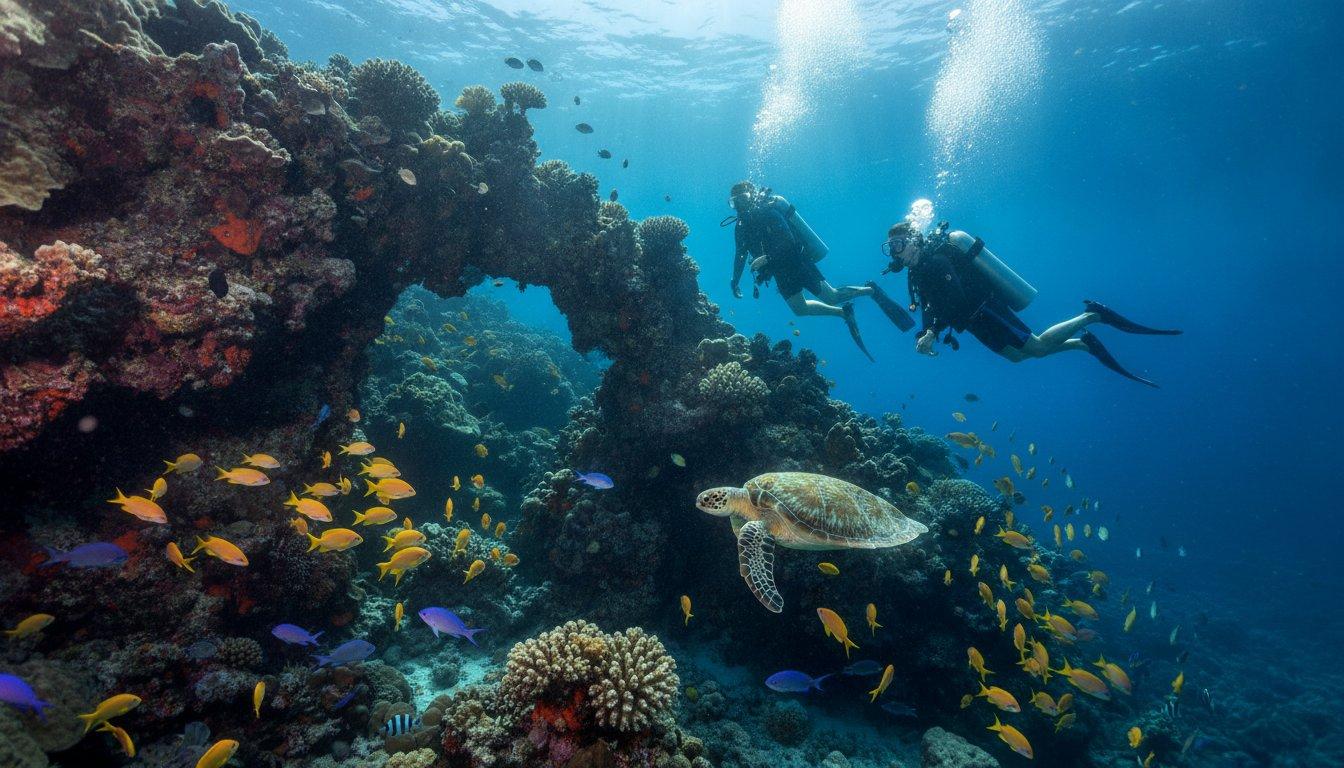
Two quite different things get sold as "private" in Cozumel, and they cost very different amounts. A private guide is a divemaster assigned to you alone on an otherwise ordinary boat: you still ride with everyone else, but your dive is planned around your gas and your pace rather than the group's. A private charter is the whole boat — hull, captain, crew, schedule and site list.
Published 2026 rate sheets at Cozumel dive centers, checked in August 2026, put a private guide at roughly $85 to $110 per day on top of the normal dive price. Private charters start around $590 for a two-tank day for four to six divers and run to roughly $768 to $1,100 per day for a boat to yourselves. The marine park fee of 225 MXN per person per day is separate either way. That arithmetic is the whole decision: split four or five ways a charter is a modest upgrade on a group ticket, while paid by two it is a significant expense. The Cozumel dive packages guide sets out how those rates sit against multi-day pricing.
The situations below are the ones where the money buys something specific rather than just exclusivity.
| Situation | Which Version Helps | What It Actually Fixes |
|---|---|---|
| A wide skill gap inside the group | Private guide | Removes the compromise where the strongest divers dive a beginner profile and the newest diver dives beyond their comfort. One guide can hold the pair together at a depth that suits both |
| Shooting stills or video | Private guide, or a charter for more than one shooter | Buys permission to stop. Photography is incompatible with a group of twelve moving at drift pace, and a dedicated guide will hold position and find subjects instead of counting heads |
| A nervous or newly certified diver | Private guide | Puts a professional within arm's reach for the whole dive, so a weighting or buoyancy problem gets fixed in the first five minutes rather than souring the whole morning |
| A family split between divers and snorkellers | Private charter | Lets one boat serve both at a shallow site instead of splitting the family across two bookings and two schedules |
| A group of four or more travelling together | Private charter | Per-diver cost lands close to small-boat pricing once split, and the group stops being separated by boat assignments |
| Wanting particular sites or an early start | Private charter | Site choice and departure time become yours, which is the only reliable way to reach a popular southern mooring before the cruise-linked fleet |
What private money does not buy is worth stating too. It does not change the weather: if the port closes in a norte, a chartered boat stays tied up like everyone else, so ask what the reschedule and refund terms are before paying a deposit. It does not lift certification limits — a private guide cannot take an Open Water diver to 130 feet. And it does not make a small hull steadier, so a diver prone to seasickness may be better served by a seat on a large stable boat than by a private panga. Operators offering charters and private guiding are flagged in the dive centers directory.
Booking The Boat, Not The Brochure
"Small group" is a marketing phrase with no fixed meaning in Cozumel. Some shops use it for six divers, others for fourteen. The words that carry information are numbers: divers on the boat, divers per guide, pickups before yours. Ask for those three and most of the ambiguity disappears.
The honest summary is that boat size is a preference, not a quality ranking. A well-run large boat with three guides, shade and a sensible site rotation will out-dive a badly run small one every time. What matters is that you choose deliberately rather than discovering the model at the pier on the first morning — and that the choice matches the sites on the schedule and the weather in the forecast.
Plan your Cozumel dive trip to work out the boat, the sites and the season together, rather than one at a time.
Frequently Asked Questions
How many divers are on a typical Cozumel dive boat?
What does 'cattle boat' mean in Cozumel diving?
What should a Cozumel dive boat have on board?
Is a small dive boat always better than a large one in Cozumel?
What guide-to-diver ratio should you look for in Cozumel?
Do Cozumel dive boats have a toilet on board?
Do crowded dive boats shorten your bottom time?
Which Cozumel dive sites get worst in a crowd?
Does an afternoon dive avoid the cruise ship crowds in Cozumel?
Are small-group dive boats more expensive in Cozumel?
Share This Article

Carmen Novelo
Carmen Novelo is a Cozumel native and an active scuba instructor and dive guide on the island. She has spent twelve years diving the Cozumel reef system, and writes about its dive sites, conditions and marine life for Cozumel Dive Hub.