Cozumel Diving for Solo Travelers: Your Guide to Safety, Socializing, and Epic Reefs
You do not dive alone in Cozumel even when you arrive alone: every boat dive is guided, and a diver without a partner is assigned one or kept beside the guide. The real solo penalty is the hotel room, which is priced per room, not per diver.
Carmen Novelo · April 10, 2026 · 17 min read
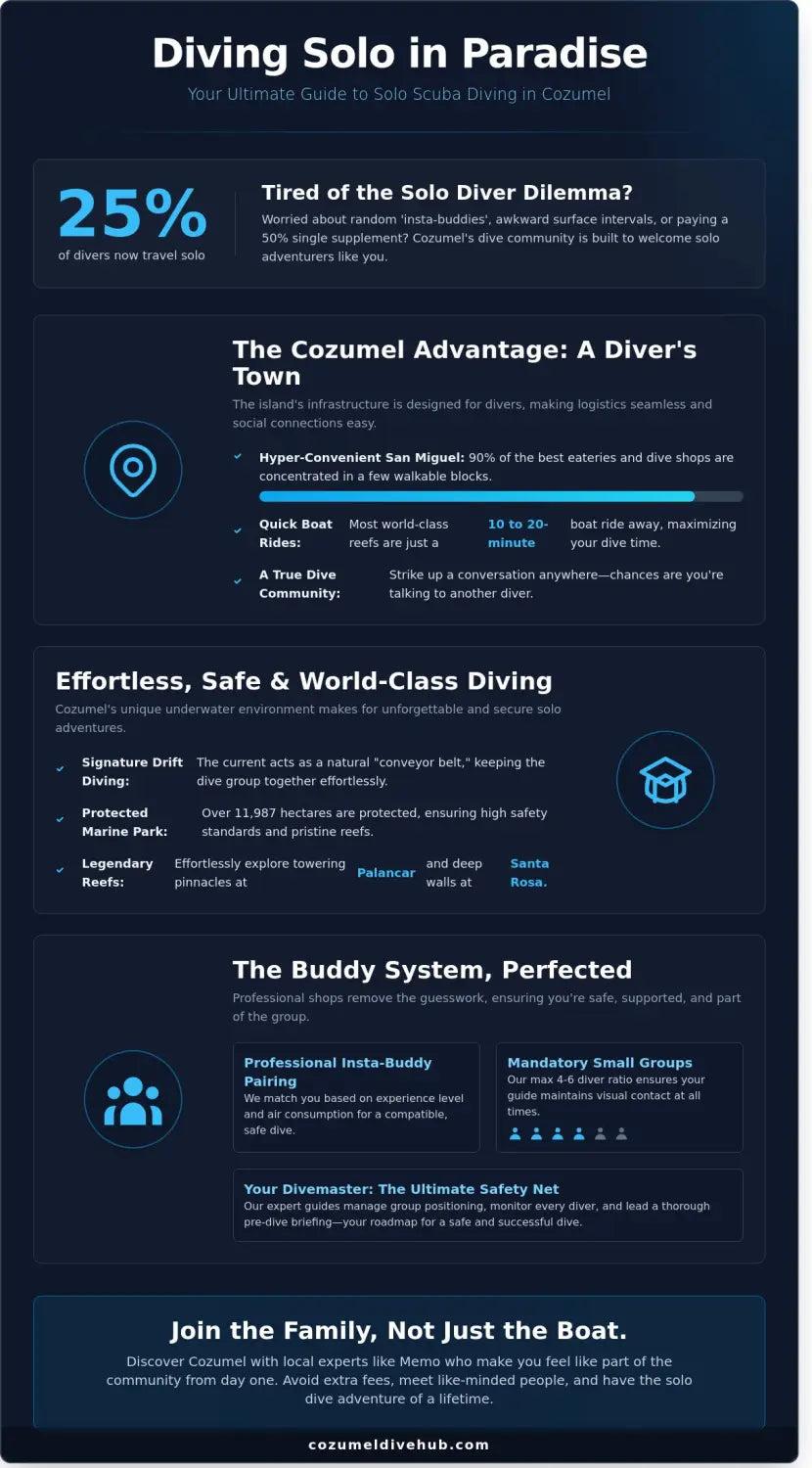
You do not dive alone in Cozumel, even when you arrive alone. Every guided boat dive on the island runs with a professional leading it, and a diver who turns up without a partner is either assigned a buddy from the rest of the group or kept alongside the guide for the whole dive. Both are normal, neither costs extra, and nobody on the boat will find it unusual. The real solo-travel penalty in Cozumel is not underwater at all — it is your hotel room, which is priced per room while diving is priced per diver, so a week of diving costs a solo traveller exactly what it costs each half of a couple. This guide covers how buddy assignment actually works, what travelling alone genuinely adds to the bill, the safety habits that matter more when nobody at home knows your schedule, and which kind of dive boat actually results in meeting people.
Are You Really Diving Alone in Cozumel?
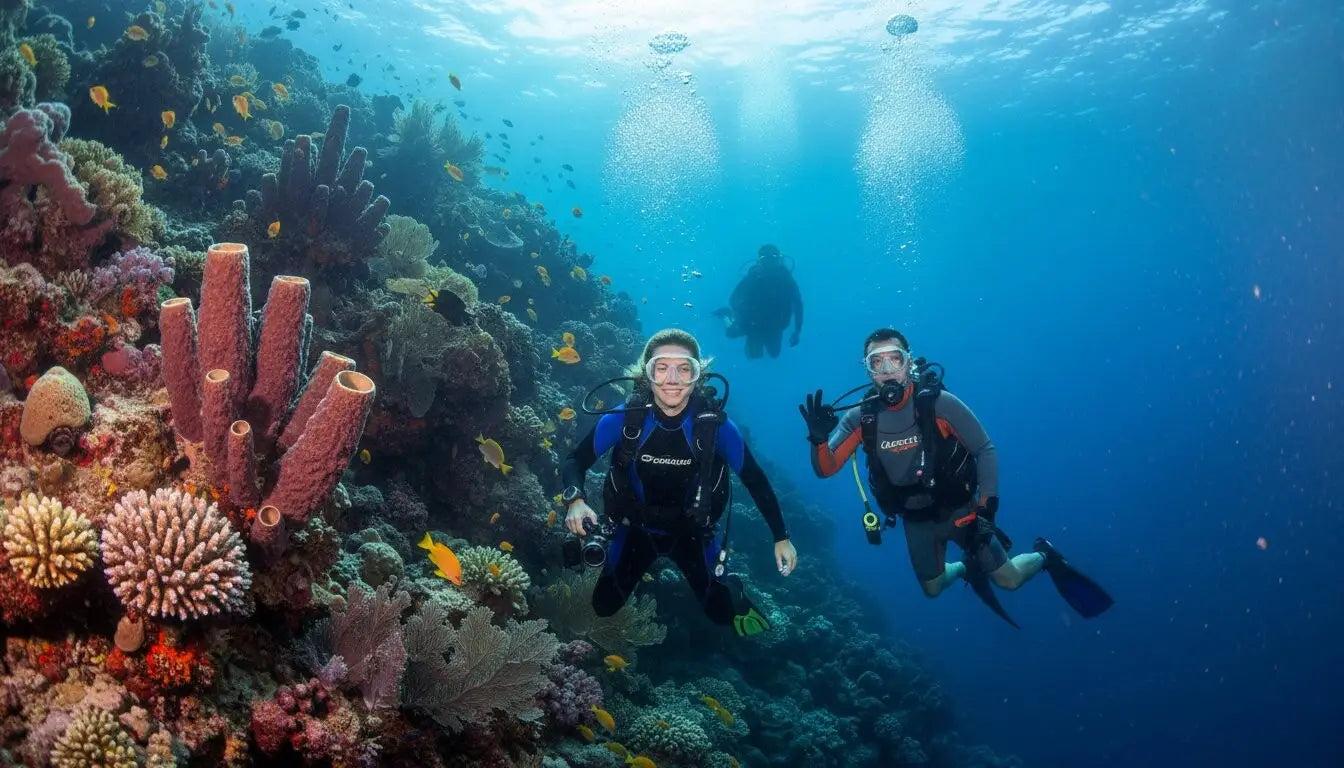
No. Cozumel's diving is almost entirely guided boat diving, and the guide is part of the dive, not an optional extra. When you book onto a boat as a single diver, one of three things happens, and the shop decides which on the morning based on who else is aboard.
- You are paired with another diver. The most common outcome, usually another solo traveller or the odd person out of an uneven group. The pairing is made from what you tell the shop, so the certification level and dive count you give at check-in genuinely determine who you end up with.
- You are kept next to the divemaster. Standard practice when the numbers are odd, when conditions are lively, or when you have said you are recently certified or out of practice. This is the better outcome for most people and it is not a demotion.
- You are a third in a pair. A three-person team works fine and is common on smaller boats. It asks you to be slightly more deliberate about position and eye contact.
The buddy system still applies in all three cases, and the part that matters most happens on the boat, not underwater: check each other's gear before you go in, agree hand signals, and say out loud what pressure you plan to turn on. A stranger buddy works if you spend two minutes establishing those things, and does not if you skip them.
What genuinely differs about Cozumel is the drift. Because these are group drift dives with a live boat following the bubbles, the current does much of the work of holding a group together, and separation looks different here than it does on a static reef. Staying with the group is less about swimming and more about not stopping. Every briefing should cover the separation drill; the lost-your-group guide sets out the standard version.
Note that "solo diving" in the technical sense — deliberately diving without a buddy, carrying redundant gas — is a separate discipline with its own certification, covered by the PADI Self-Reliant Diver course. That is not what arriving in Cozumel by yourself means, and it is not what any operator will put you into on a standard reef morning.
What Does Travelling Alone Actually Cost in Cozumel?
The single-supplement problem is real, but it lands almost entirely on lodging rather than on diving. Understanding which is which is the difference between a manageable budget and an unpleasant surprise.
| Cost line | How it is priced | Solo penalty |
|---|---|---|
| Hotel or apartment | Per room or per unit | Full. One person pays what two would |
| Multi-day dive package | Per diver | None |
| Two-tank boat dive | Per diver | None |
| Marine park fee | Per diver per day | None |
| Rental gear | Per diver | None |
| Private guide | Per booking, often quoted for one to two divers | Yes. The same fee covers a pair |
| Private charter | Per boat | Severe. The whole boat on one bill |
| Taxis | Per trip | Full |
| Ferry to the mainland | Per person | None |
| Meals | Per person | None |
Published 2026 rate sheets at Cozumel dive centers bear this out. Two-tank boat dives run roughly $105 to $149 depending on the shop and the trip, and every one of those figures is per diver. Five-day, ten-dive packages are listed between about $475 and $600, which works out roughly 5 to 10 percent below the equivalent day rate — a discount for booking consecutive days, not for bringing a friend. Marine park fees run 225 MXN per person per day in cash. Nothing in that structure charges you more for arriving by yourself.
Where it does bite is the private options. A private divemaster is listed at about $85 for one or two divers at some Cozumel shops and around $110 per person at others; the first structure means a solo diver pays the same as a couple would split. Private charters, at roughly $768 for up to four people and $1,100 for up to six, are effectively out of reach for one person. If you want more attention than a group boat gives, the cheaper route is a small boat rather than a private one. If it is genuinely one-to-one attention you are after, Different Diving with Laura is a one-instructor operation that runs nothing but 1:1 private and 2:1 semi-private dives.
Figures above are US dollars from published 2026 Cozumel operator rate sheets, checked in August 2026, and each shop sets its own. The broader breakdown sits in the Cozumel diving cost guide and the dive packages guide. Because so much of the island runs on cash — marine park fees in particular — the currency guide for divers is worth reading before you land.
Getting the Lodging Number Down
The room is the line to attack, and there are only a few levers: a smaller room in downtown San Miguel rather than a resort, a dive-and-stay package where the operator bundles accommodation, or shoulder-season dates. Options are collected in the where to stay directory. If you end up somewhere without walkable food, budget for taxis both ways every evening, which quietly adds up over a week.
Safety When Nobody at Home Knows Your Schedule
This is the one genuine difference between diving Cozumel alone and diving it with someone. Not the water — the paper trail. When you travel with a partner, somebody always knows which boat you got on and when you were due back. Alone, nobody does unless you arrange it.
Tell Someone Your Dive Plan
Before the trip, send one person at home the dive shop's name and phone number, the dates you have booked, and where you are staying. Update it if you switch operators. It costs one message and it means that if you go quiet for two days, the person worrying about you knows exactly who to call rather than starting with an embassy. Shops keep manifests; they can answer "did they get on the boat this morning" in seconds if someone asks.
Dive Insurance Matters More Alone
Dive-specific cover pays for chamber treatment and, more importantly, for evacuation — and evacuation decisions get made faster when there is a policy number than when there is not. Travelling alone raises the stakes because there is no partner to make phone calls, argue with an insurer, or hold your passport while you are in a chamber. Carry the policy number somewhere findable, not only in an email account you would need a phone to open. See the travel insurance for Cozumel diving guide and the hyperbaric chamber locations guide for where treatment actually is on the island.
Why a Computer with a Logbook Earns Its Place
A dive computer that stores and downloads your dive profiles does something specific for a solo traveller: it is the only record of what you actually did. A buddy who has dived the same profile all week can tell a doctor how deep you went and how long you stayed. Alone, your computer is that witness. It holds your real depths, times, ascent rates and no-decompression limit history, which is exactly what a physician needs if you present with symptoms.
The same applies to the logbook side. Shops ask what you have dived recently before deciding who to pair you with and which sites to run, and a downloadable log answers that question with data rather than a claim. A diver who can show twelve dives in the last year gets treated differently from one who says so.
Two more habits that carry more weight alone than in a pair:
- Carry your own surface marker buoy. On drift dives with live boat pickup, being visible at the surface is the whole safety case. Do not assume your assigned buddy has one.
- Fill in the dive medical form honestly. Nobody is travelling with you who knows your medical history, so the form is the only version the shop has.
Diving conservatively is the other half of it. Slower ascents, longer safety stops and a bigger reserve cost nothing, and better air consumption buys you all three. If you are planning several dives a day for a week, nitrox is worth the certification; the enriched air course takes a day. And plan the end of the trip around flying after diving rather than discovering the interval on your last morning.
For divers who want to be genuinely useful rather than merely present when something goes wrong on a boat, the PADI Rescue Diver course is the single most valuable thing a frequent solo traveller can add.
Which Kind of Dive Boat Actually Leads to Meeting People?
Here is the honest version, because most writing on this subject pretends every boat is equally social. It is not the island that determines whether you meet anyone. It is the boat, and specifically whether the same people are on it tomorrow.
| Boat type | Typical passengers | Same faces the next day? | Realistic for meeting people |
|---|---|---|---|
| Six-pack boat or panga, booked as a multi-day package | Up to 6 | Usually yes | Best. Same crew and largely the same divers all week |
| Mid-size shop boat | 8 to 12 | Partly | Moderate. A core of repeat guests plus turnover |
| Large boat serving cruise and day guests | 15 or more | Rarely | Poor. Friendly for a morning, gone by tomorrow |
The mechanism is repetition, not friendliness. Five consecutive mornings on a small boat with the same three or four divers and the same two crew is roughly fifteen hours together, most of it spent talking through surface intervals with nothing else to do. That produces dinner invitations. A sixteen-person boat where the passenger list resets every morning produces pleasant conversations and no continuity, however cheerful the crew are. If meeting people is a real goal of the trip, book five days with one shop on a small boat rather than shopping around daily for the best price. The trade-offs between boat sizes are covered in the guide to avoiding crowded dive boats, and the operator landscape in the best dive centers in Cozumel roundup.
Two smaller points worth knowing. First, the surface interval is where the socialising actually happens — an hour on a bench between dives, usually with fruit and water, is the only unstructured time in a dive morning. Second, the crew are the constant. Divers rotate; the same captain and guide are there every day, and being remembered by them is what makes a shop feel like somewhere you belong by day three. That is also, incidentally, what gets you the better buddy pairing.
Afternoons and evenings are the other half. Cozumel's downtown is compact enough that a solo diver can walk to dinner, and the island has a visible dive crowd that makes eating alone unremarkable. The eat and drink listings cover where, and there is a full list of what to do with a no-dive day if the port closes or you need a surface day before flying.
Downtown or the Resort Zone for a Solo Traveller?
This decision matters more for a solo traveller than for anyone else, because everything a couple solves with company, a single traveller solves with location.
Downtown San Miguel is walkable. That is the entire argument, and it is a strong one. Restaurants, cafés, dive shops, supermarkets, the ferry pier and the waterfront are all within a compact area, which means dinner does not require a taxi negotiation, an evening walk is a real option, and the practical friction of doing everything by yourself drops sharply. It is also where most of the independent dive shops and their piers are, so a walk to the boat replaces a pickup.
The hotel zones, north and south, put you closer to some marinas and further from everything else. They suit divers who want a resort, a pool and a bundled dive operation on site, and they suit anyone who does not mind that leaving the property in the evening costs a taxi each way. For a solo traveller eating out five nights running, that is a meaningful recurring cost and a meaningful recurring decision.
The where to stay directory sets out both, and if you do end up outside the center, check whether your operator runs hotel pickup — the dive boat pickup guide covers which locations are practical. Local transport options are in the getting around listings.
Is Cozumel Safe for Solo Travellers?
Cozumel is widely regarded as one of the more straightforward destinations in Mexico for independent travellers, including women travelling alone, and the diving industry here is built around visitors who arrive without a group.
The factual position, as of the US State Department advisory dated 29 May 2026: Quintana Roo, the state Cozumel belongs to, is rated Level 2, "Exercise Increased Caution" — the same level assigned to a number of Western European countries — and there are no restrictions on US government employee travel within the state. The advisory's general guidance for the region is to pay attention to your surroundings after dark and to stay in well-lit pedestrian and tourist areas. Levels are reviewed periodically, so check the current advisory for your own nationality before you travel rather than relying on any article's summary.
Beyond that, the practical rather than personal considerations for a solo diver are the ordinary ones: know where your accommodation is on a map before you need to find it at night, keep enough cash for a taxi separate from the rest of your money, and read the cancellation policy before you prepay a multi-day package, because a norte between November and March can close the port with no notice and no partner to share the rebooking admin with. Water and dive-condition questions are answered in is it safe to dive in Cozumel and the month-by-month conditions guide.
How to Build a Solo Dive Week in Cozumel
A structure that works, assuming six or seven nights.
- Book one shop for five consecutive days, on a small boat, as a package. This buys the discount, the same crew, the same buddies and the reputation that gets you good pairings. It also removes five booking decisions from your week.
- Say your real dive count at check-in. Understating it gets you put in a group that is too fast; overstating it gets you sites you will not enjoy. The shop is using this to place you with a buddy.
- Take the first day easy. Gentler drift sites like Yucab Reef and Paso del Cedral are a better first morning than a deep wall, particularly if you have not dived in months.
- Keep one day clear of diving. Both for the flight interval at the end and because a norte or a rough morning will eventually eat one. Ideas for filling it are in the certified diver's blueprint for Cozumel.
- Sort seasickness before day one, not on day two. A small boat in a swell is unforgiving, and there is nobody with you carrying spare tablets; the seasickness guide covers what works.
- Vet the shop on how it handles single divers. Ask directly how they pair solo guests and how many people are on the boat. A shop that answers precisely is telling you what its mornings are like — see the guide to choosing a dive shop.
The Practical Summary for Solo Divers
Arriving in Cozumel alone changes very little about the diving and quite a lot about the budget. Underwater you are assigned a buddy or placed on the guide's shoulder, which is routine and costs nothing extra. On paper, diving is priced per diver and lodging is priced per room, so the room is the only line that punishes you. The habits worth adding are the ones that compensate for having nobody who knows your schedule: someone at home holding your shop's details, dive-specific insurance you can produce a number for, and a computer that logs what you actually did.
And if you want to come home having met people, that is a booking decision rather than a personality one — five days, one shop, one small boat.
Start planning your Cozumel dive trip with the sites, conditions and operator information in one place.
Frequently Asked Questions
Will I be assigned a dive buddy in Cozumel if I travel alone?
Do solo travellers pay more to dive in Cozumel?
What happens if there is no other solo diver on the boat?
Do I need dive insurance if I am travelling alone?
How do I meet other divers in Cozumel?
Should a solo traveller stay downtown or in the resort zone in Cozumel?
Is Cozumel safe for solo female travellers?
Why should a solo diver carry their own surface marker buoy?
Is solo diving without a buddy allowed in Cozumel?
What should I tell someone at home before a solo dive trip?
Share This Article

Carmen Novelo
Carmen Novelo is a Cozumel native and an active scuba instructor and dive guide on the island. She has spent twelve years diving the Cozumel reef system, and writes about its dive sites, conditions and marine life for Cozumel Dive Hub.