Currency to Use for Diving in Cozumel: The Ultimate Diver's Money Guide
Bring Mexican pesos. Dollars are accepted almost everywhere a diver spends money in Cozumel, but when you pay in dollars for a peso price the shop sets the exchange rate in its own favour, and the 225-peso park fee is cash only anyway.
Carmen Novelo · June 25, 2026 · 5 min read
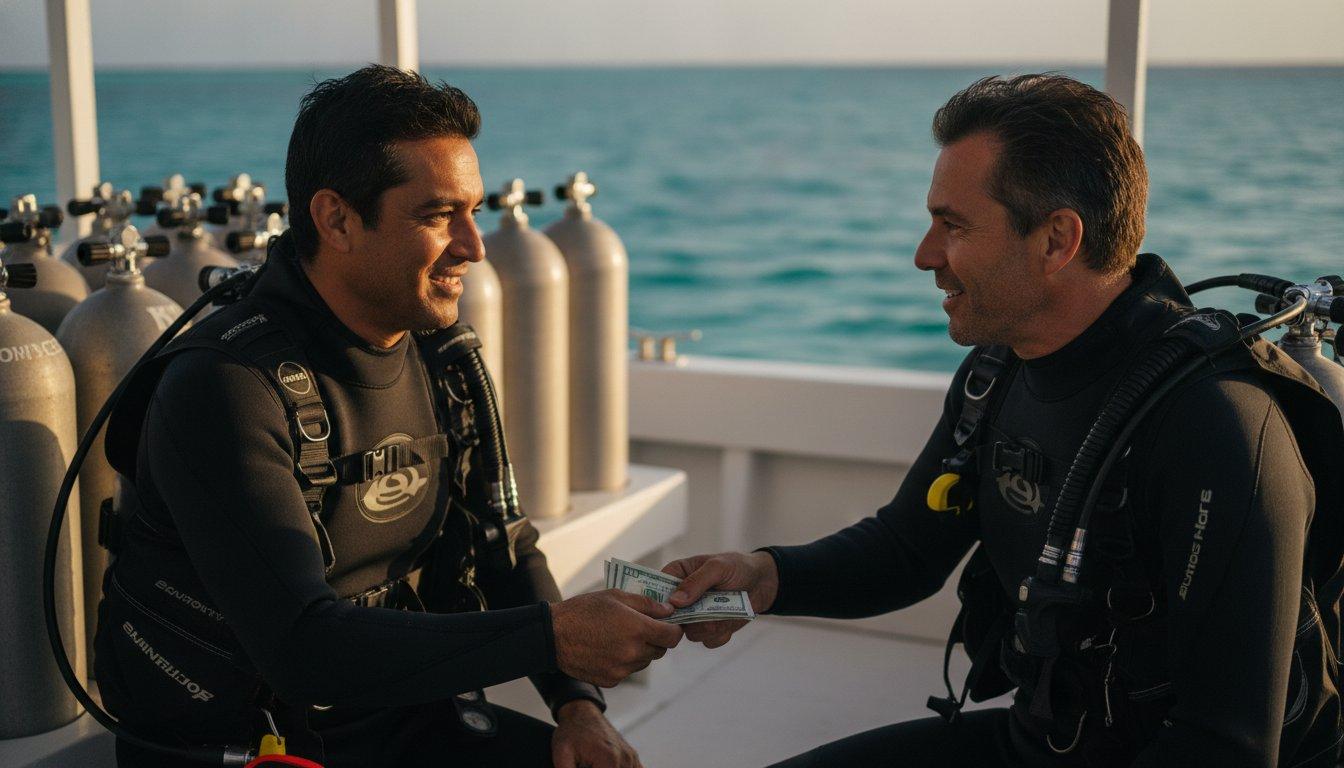
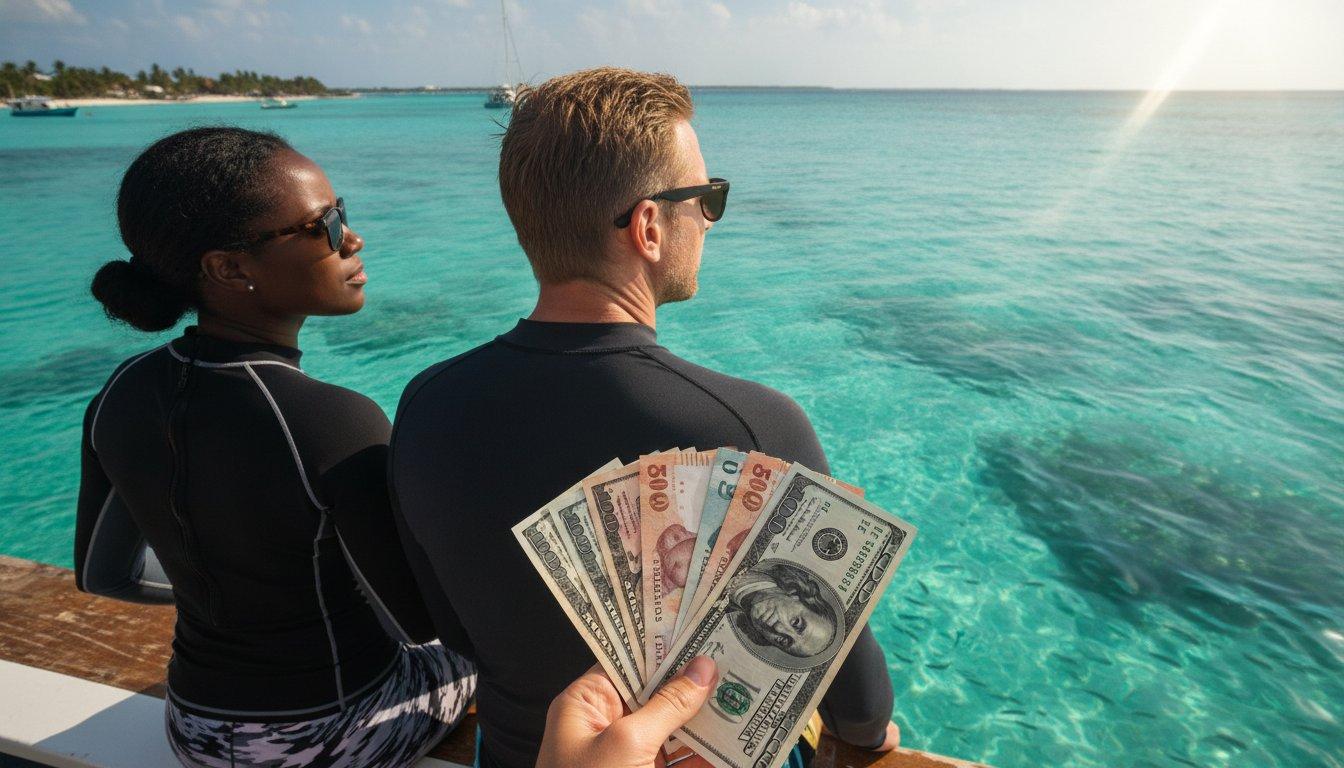
Bring Mexican pesos. US dollars are accepted almost everywhere a diver spends money in Cozumel, so you will never be stuck — but when you hand over dollars for something priced in pesos, the shop sets the exchange rate, and that rate is set in the shop's favour. Local money guidance for the island puts it bluntly: you lose money paying in dollars for an item priced in pesos. Pesos are also what you need for the one unavoidable daily charge that is effectively cash-only.
That charge is the marine park fee: 225 Mexican pesos per person, per day, set by CONANP for Parque Nacional Arrecifes de Cozumel, collected by your dive shop, and almost universally paid in cash. It is separate from the price of your dives and it is not usually included in advertised prices. If you remember one line from this page, that is the one.
The rest is detail: which dive shops take cards and what they add for it, what is strictly cash, how to use an ATM without giving away 9% at the machine, and which currency to tip in. This page does not publish an exchange rate, because the rate moves and a number printed here would be wrong within weeks.
Pesos or Dollars: What Actually Happens When You Pay in Dollars
Cozumel runs on dual pricing. Dive operators frequently quote in US dollars because most of their customers are American and Canadian; restaurants, taxis, convenience shops and market stalls price in pesos. There are exceptions on the dive side too — Mermaid Divers publishes its prices in Mexican pesos — but both currencies circulate freely and nobody will refuse your dollars.
The cost is invisible and it happens at the moment of conversion. When a business priced in pesos accepts your dollars, it applies its own house rate, which is set conservatively to protect the business against currency movement between now and when it banks the money. That is a rational thing for them to do. It is also a spread you are paying, on every transaction, and it is why the same $100 goes measurably further as pesos.
There is a second, quieter cost. US notes handed to a small business have to be banked or exchanged, which takes time and sometimes a fee, and Mexican banks apply strict condition standards — torn, taped, heavily marked or badly worn notes are frequently refused outright. If you do carry dollars, carry clean ones in small denominations.
The practical split most experienced Cozumel divers use:
- Pesos for anything priced in pesos: the marine park fee, taxis, food away from the tourist strip, convenience stores, small shops, and tips.
- Dollars or card for large dive-shop transactions that were genuinely quoted in dollars: multi-day packages, courses, charters.
- Card where it is accepted without a surcharge and your card has no foreign transaction fee.
What to Pay With on a Cozumel Dive Day
| Item | Typical currency | Card accepted? | Notes |
|---|---|---|---|
| Marine park fee (225 MXN/person/day) | Pesos | Rarely — treat as cash only | Exact change speeds up boarding |
| Two-tank boat dive | USD or MXN | Usually at established shops | Surcharge possible; ask first |
| Multi-day dive package | USD or MXN | Usually | Often the transaction worth putting on a card |
| Certification course | USD or MXN | Usually | Frequently pre-payable online |
| Gear rental | USD or MXN | Usually at the shop | Often bundled with the dive |
| Nitrox surcharge | USD or MXN | Usually | Added per tank |
| Crew tips | Pesos or clean small USD | No | Cash, handed over on the boat |
| Taxis | Pesos | No | Fixed zone fares; agree before riding |
| Beach clubs, small restaurants, market stalls | Pesos | Varies | Small local places are commonly cash |
| Water, snacks, pharmacy | Pesos | Larger stores yes | Small tiendas cash |
Print that table's logic into a simple habit: card for the big dive-shop bill, pesos for everything that happens at the pier and after it.
The Marine Park Fee: The One Genuinely Cash-Only Charge
Every diver and snorkeller entering Parque Nacional Arrecifes de Cozumel pays a daily marine park fee. As of 2026 it is 225 pesos per person, per day. You receive a dated wristband, the brazalete, valid for one calendar day.
What matters for your money planning:
- It is set in pesos, not dollars. Any source giving you a confident single dollar figure is quoting a snapshot of the exchange rate rather than the fee. Budget the peso number.
- It is per day, not per trip. Six diving days means six fees, per person.
- It is not usually in the advertised price. Dive shops collect it on CONANP's behalf and generally list it as an exclusion. When comparing shop prices, check whether the quote includes it before you conclude one is cheaper.
- Cash, in pesos, is the frictionless option. Operators will often take dollars, at their rate. Bringing the pesos avoids that.
Fees are revised periodically, usually with effect from 1 January, so confirm the current figure before you fly. The Cozumel marine park fees guide tracks the rate and its history in detail.
Do Cozumel Dive Shops Take Credit Cards?
Most established dive centers do, and Visa and Mastercard are the reliable ones. American Express acceptance is patchier. Smaller operations, one-boat outfits and independent guides may be cash-only, and this is not a sign of anything except a small business avoiding processing fees.
Two things to ask before you assume the card will work:
Is there a surcharge? Card processing costs the merchant, and in Mexico that cost is commonly passed to the customer. Surcharges in the region of 4 to 5 percent are widely reported across Cozumel businesses, and dive shops are not exempt. On a $600 dive package that is a real number. Ask when you book, not when you pay.
Is IVA included? Mexico's value added tax is 16 percent. Whether a quoted dive price includes it varies by operator and by whether you are being quoted a cash price or an invoiced one. A shop that suddenly adds tax at payment is not necessarily doing anything improper, but you want to know in advance. Ask for the all-in figure including the marine park fee and any tax, in writing, when you book. This is one of the transparency signals worth weighing when choosing a Cozumel dive shop.
A cash discount is common. Because the shop avoids the processing fee, many operators will quietly price cash lower. If you are booking a multi-day dive package, it is worth asking directly whether cash changes the number.
When to use the card anyway: for large pre-paid bookings, a card gives you chargeback protection and a record that cash does not. That protection is worth more than a few percent if a shop closes, a boat does not run, or a cancellation policy is disputed. Weigh it rather than defaulting either way.
What Is Cash-Only on a Diving Trip
Assume cash for all of these, and carry pesos for them:
- The marine park fee, every day you dive
- Crew tips, every day you dive
- Taxis, which are the main way divers move around San Miguel and to the hotel zones
- Small local restaurants, taco stands and lunch counters
- Beach clubs and small vendors on the east side
- Market stalls and small souvenir shops
- Public toilets and small incidentals
None of these are large individually. Together, across a week, they are the reason divers who plan only for card payments end up making a bad ATM withdrawal on day two.
ATMs in Cozumel: Which Machines to Use
Withdrawing pesos from an ATM is generally the cheapest way to get local currency — better than airport exchange counters and better than a casa de cambio in the tourist strip. But the machine you choose matters a lot.
Use ATMs at bank branches. Machines physically built into a bank building, ideally during opening hours when staff and security are present, are the safer and cheaper option. Major Mexican banks maintain branches in San Miguel around the town center.
Avoid standalone machines in shops, hotel lobbies, bars and on street corners. These charge substantially higher operator fees — tourist-zone and hotel machines are widely reported to charge several times what a bank machine does — and they are the machines most exposed to card skimming.
Basic security habits: tug the card slot before inserting, since skimming overlays are often loosely attached; cover the keypad while entering your PIN; do not accept help from anyone who approaches you at the machine; and if a card is retained, call your bank immediately rather than following a stranger's advice.
Reduce the number of withdrawals. Most fees are charged per transaction, both by the Mexican machine and often by your home bank. Fewer, larger withdrawals cost less than many small ones. Tell your bank you are travelling before you go, and check whether your card reimburses foreign ATM fees — some travel-focused accounts do.
Dynamic Currency Conversion: Always Decline
This is the single easiest money mistake to avoid, and almost every visiting diver makes it at least once.
At the end of an ATM withdrawal or a card payment, the machine will offer to charge you in your home currency instead of pesos. The wording varies: "Would you like to be charged in USD?", "Accept conversion", "We'll convert this for you", or a rate displayed as "guaranteed". The friendly framing is the point.
Decline it, every time. Choose to be charged in Mexican pesos (MXN).
Accepting means the machine's payment processor sets the exchange rate rather than your own bank, and that rate carries a markup — commonly reported in the range of 5 to 10 percent, with markups of 9 percent or more documented in Mexico specifically. Declining hands the conversion back to your card network and issuing bank, whose rates sit far closer to the interbank rate.
Two things worth knowing:
- Declining does not cancel your transaction. It simply proceeds in pesos. Many people accept because they are afraid the withdrawal will fail. It will not.
- The peso option is often the less prominent button. Look for wording like "Continuar sin conversión", "Continue without conversion", "Decline conversion", or a "change currency" option. If the screen shows an amount in dollars, you have not declined yet.
The same prompt appears on card terminals in restaurants and shops. Same answer: pesos.
Which Currency Should You Tip In?
Both work, and neither causes offence. Pesos are marginally better for the recipient, because the money is spendable immediately without a conversion that shaves value off it. Dollars are more convenient for short trips and cruise calls, and much published guidance is quoted in dollars anyway.
If you tip in dollars, the condition rule applies with force: clean, undamaged notes in small denominations. A crew of three splitting a single large note has a problem, and a torn note may be hard for them to bank at all.
Amounts, who gets the money and how it is split between the guide, the captain and the deckhand are covered properly in the Cozumel dive crew tipping guide. Budget for it as a real cost either way.
Where to Check the Exchange Rate
This page deliberately does not print a peso-to-dollar rate. The rate moves daily, sometimes sharply, and a fixed number in an article is a number that becomes wrong.
Check it the day you need it, from a source that reports the mid-market rate rather than a retail rate: your bank's app, a major financial data site, or a currency conversion tool. Then treat that as the benchmark. When a shop, exchange house or ATM offers you a rate, you can immediately see the spread you are being asked to accept. A few percent is normal for a retail transaction. Nine or ten percent is dynamic currency conversion, and you should decline it.
How Much Cash Should You Bring for a Dive Week?
Rather than a total, build it from the recurring daily items, because those are the ones that must be cash:
| Daily cash item | Per diver, per diving day |
|---|---|
| Marine park fee | 225 pesos |
| Crew tips | Roughly 200–500 pesos, or the dollar equivalent |
| Taxis, food, water, incidentals | Varies widely by how you travel and eat |
Multiply the first two by your number of diving days, add a realistic figure for food and transport, and add a buffer. Withdraw in two or three larger ATM visits rather than daily small ones. Keep the cash split between your accommodation safe and what you carry, and keep the day's diving cash in something waterproof — piers, boats and salt water are unkind to paper money.
For the wider picture of what a Cozumel dive trip actually costs, including tanks, gear rental, courses and boats, see the Cozumel diving cost breakdown and the dive packages guide. Divers coming from North America will find travel logistics in the planning a Cozumel dive trip from the USA guide, and cruise passengers should read the Cozumel cruise port diving guide, since a few hours ashore leaves no time for an ATM problem.
The Short Version
Bring pesos. Get them from a bank ATM, not the airport and not a machine in a shop. Decline every offer to be charged in your home currency. Keep 225 pesos per person per day aside for the marine park fee plus cash for tips and taxis. Put the big dive-shop bill on a card if there is no surcharge, and ask about surcharges and tax before you book rather than at the till.
Do that and the money side of the trip disappears into the background, which is exactly where it belongs. When you are ready to build the rest of the trip — operators, sites, courses and timing — start with the Cozumel dive centers directory and Plan Your Cozumel Dive Trip.
Frequently Asked Questions
Should you use pesos or US dollars for diving in Cozumel?
How much is the Cozumel marine park fee in 2026?
Is the Cozumel marine park fee cash only?
Do Cozumel dive shops accept credit cards?
Should you decline the offer to be charged in your home currency?
Which ATMs are safest to use in Cozumel?
How can you reduce ATM fees in Mexico?
What should you know about paying dive shops in US dollars?
What is cash only on a Cozumel dive day?
Where should you check the peso exchange rate before paying?
Share This Article

Carmen Novelo
Carmen Novelo is a Cozumel native and an active scuba instructor and dive guide on the island. She has spent twelve years diving the Cozumel reef system, and writes about its dive sites, conditions and marine life for Cozumel Dive Hub.