Renting Scuba Gear in Cozumel: 2026 Price Guide & Rental Tips
Full rental scuba gear in Cozumel runs about US$25 to US$40 a day in 2026, with most shops near US$30. Per item it is roughly $10 to $16 for a BCD or regulator and $10 to $18 for a computer, which cheap sets almost never include.
Carmen Novelo · March 14, 2026 · 19 min read
A full set of rental scuba gear in Cozumel — BCD, regulator, mask, fins and a thin wetsuit — runs roughly US$25 to US$40 per day in 2026, with most shops clustered near US$30. Piece by piece you will pay about US$10 to US$16 a day for a BCD or a regulator, US$8 to US$14 for a wetsuit, and US$10 to US$18 for a dive computer, which is almost never folded into the cheaper sets. Every figure on this page was checked in August 2026 against operators' own published price lists, and each is sourced in the tables below.
That is the number most people search for. The more useful question is which of those items you should be renting at all. Cozumel is one of the easiest places in the Caribbean to arrive with nothing but a swimsuit, and for a lot of divers that is the right call — but not for every piece of kit, and the break-even point is closer than the usual advice suggests.
This is an independent guide. Cozumel Dive Hub does not rent gear, run boats or take bookings; the rates below come from shops that publish theirs, and you should confirm current prices with whichever operator you choose from the Cozumel dive centers directory.
What You Actually Pay: Per-Item Rental Rates
Rates are quoted per day, not per dive, so a two-tank morning and a single afternoon dive on the same day usually count as one rental. Several shops price in pesos and several in dollars; the peso figures below are reproduced as published, at an exchange rate hovering around 17 to 18 pesos to the dollar in mid-2026.
| Item | Typical Daily Rate | Published Examples (Checked August 2026) |
|---|---|---|
| Full set (BCD, regulator, mask, fins, wetsuit) | US$25–40 | Blue Note Scuba US$40 / 750 MXN; Blue Magic US$30 single day, US$25 multi-day; Deep Blue US$32; Dive Boutique US$25; Salty Endeavors US$30 |
| BCD only | US$10–15 | Deep Blue US$12; Blue Note US$12 / 200 MXN; Dive Paradise 250 MXN; Blu-emotion 200 MXN |
| Regulator with SPG | US$10–16 | Deep Blue US$16 (wrist computer included); Blue Note US$12; Dive Paradise 250 MXN; Blu-emotion 200 MXN |
| Wetsuit (shorty or 3mm full) | US$8–14 | Blue Note US$12; Deep Blue US$12; Sand Dollar Sports US$10; Dive Paradise 250 MXN shorty |
| Mask and snorkel | US$5–8 | Dive Boutique US$8; Dive Paradise 140 MXN; Blu-emotion 100 MXN |
| Fins | US$5–8 | Dive Boutique US$5; Dive Paradise 140 MXN; Blu-emotion 100 MXN |
| Dive computer | US$10–18 | Blue Magic US$10; Dive Boutique US$10; Blue Note US$12 / 200 MXN; Dive Paradise 320 MXN |
| Dive light | US$10–18 | Blue Magic US$10; Dive Boutique US$12; Blue Note US$12; Dive Paradise 320 MXN |
| Nitrox fill, 80cf | US$12–15 per tank | Blue Note US$12; Blue Magic US$12; Sand Dollar US$13; Dive Paradise adds 230 MXN |
Two patterns are worth noticing. First, the bundle is cheaper than the sum of its parts almost everywhere: Deep Blue's full set at US$32 against US$12 for the BCD plus US$16 for the regulator plus US$12 for the wetsuit makes the point. If you need three or more items, take the set. Second, the spread between the cheapest and dearest shop is smaller than it looks once you account for what is in the box — a US$25 set that excludes the wetsuit is not cheaper than a US$30 set that includes it.
Multi-day bookings shave a little off. Blue Magic drops from US$30 to US$25 a day on multi-day full sets, and from US$40 to US$35 with a computer added. That is a real saving over a week, though not a large one, and it is not worth choosing a shop you otherwise dislike to get it.
What Is Included in a Quoted Dive Price, and What Is Not
This is where most budgets go wrong, and it has nothing to do with gear quality. A quoted two-tank boat price in Cozumel conventionally covers the tank, the weights and belt, the in-water guide, the boat, and water or a snack. Dive Paradise states plainly that trip rates include tanks, weights, belts, snacks and water, and that equipment is not included. Blue Magic's inclusions read the same way. Blu-emotion lists guide, tanks, weights, water, refreshments and towel.
So: tank and weights are in, everything you wear is out, unless a package explicitly says otherwise.
| Normally Included | Normally Extra |
|---|---|
| 80cf aluminium tank | All rental gear you wear |
| Weights and weight belt | Dive computer (nearly always separate) |
| In-water guide | Marine park fee, cash |
| Boat, water, light snacks | Nitrox fill surcharge |
| Surface marker buoy at some shops | 100cf tank upgrade, roughly US$7–12 |
| Dive light for night dives | |
| Crew tips |
The one that catches people out is the computer. It is treated as an add-on nearly everywhere, at US$10 to US$18 a day, and yet plenty of boats expect every diver to have one. Deep Blue is a notable exception in bundling a wrist computer with each regulator rental. Assume it is extra and be pleasantly surprised.
The other is the marine park fee. Cozumel's reefs sit inside a federally protected park, and the fee is 225 pesos per person per day as of 2026 — roughly US$13 to US$14 — collected in cash and set by the federal parks agency, not by dive shops. Operators quote slightly different peso figures depending on when they last refreshed their price lists (Dive Paradise shows 215 MXN, Blue Note 220 MXN, Blue Magic 255 MXN), which tells you the number moves and the shops round. Bring pesos; the full breakdown of the park fee and the question of which currency to carry are covered separately.
For how gear costs fold into multi-day and course pricing, the Cozumel diving packages guide is the page that owns the overall dive-price picture. This one sticks to gear.
Bring It or Rent It: An Item-by-Item Verdict
The honest answer is not "bring everything" or "rent everything". It splits cleanly by weight and by how personal the fit is.
| Item | Weight in Your Bag | Rental Cost | Verdict |
|---|---|---|---|
| Mask | ~1 lb | US$5–8/day | Bring. Fit is personal and a leak ruins dives. |
| Dive computer | under 1 lb | US$10–18/day | Bring if you own one. Worth owning if you dive more than occasionally. |
| Rash guard | negligible | rarely rented alone | Bring. Weighs nothing, doubles as sun cover. |
| Boots | ~2 lb | usually with fins | Bring if your feet are hard to fit. |
| Wetsuit | 3–5 lb | US$8–14/day | Rent. Bulky, and Cozumel needs very little of one. |
| Fins | 4–6 lb | US$5–8/day | Rent unless you are attached to a specific blade. |
| BCD | 6–8 lb | US$10–15/day | Rent. Heaviest single item; rentals are fine. |
| Regulator | 5–6 lb | US$10–16/day | Rent. Heavy, and shops service theirs on a schedule. |
| Tank and weights | n/a | included | Never bring. |
The Mask Is the One Piece Worth Carrying
A mask weighs about a pound and costs almost nothing to pack, and it is the only item where a poor fit degrades every minute of every dive. A rental mask that seeps slowly means you spend a drift along Palancar clearing it instead of looking at the reef. Face shapes vary enough that shops cannot stock for everyone, and the ones that fit best are usually the first to go in high season.
If you wear glasses, this stops being advice and becomes a requirement — only a minority of shops keep corrective lenses in rental stock, and the diopters they hold are generic. There is a full guide to prescription masks in Cozumel, and a separate one on keeping a mask from fogging, which matters more with an unfamiliar mask than a broken-in one.
The Computer Is the One Piece Worth Owning
At US$10 to US$18 a day, a rental computer costs roughly US$50 to US$90 over five days of diving. Entry-level wrist computers sell for a few hundred dollars, so two or three trips pays for one outright. That is the straightforward argument.
The better argument is continuity. Your own computer carries your dive history, your personal conservatism setting and your nitrox defaults, and you already know which button does what. Learning an unfamiliar menu on a boat, in the sun, two minutes before a drift dive, is a bad time to be reading a manual. If you dive more than once a year, this is the item to buy first — which computer suits Cozumel diving is worth a read before you do.
BCDs and regulators are the opposite case. They are the heaviest things in a dive bag, they are the fiddliest to travel with, and a serviced rental from a busy Cozumel shop is genuinely fine. Nobody has ever had a better week because they brought their own jacket.
The Baggage Maths: When Flying Your Own Gear Pays
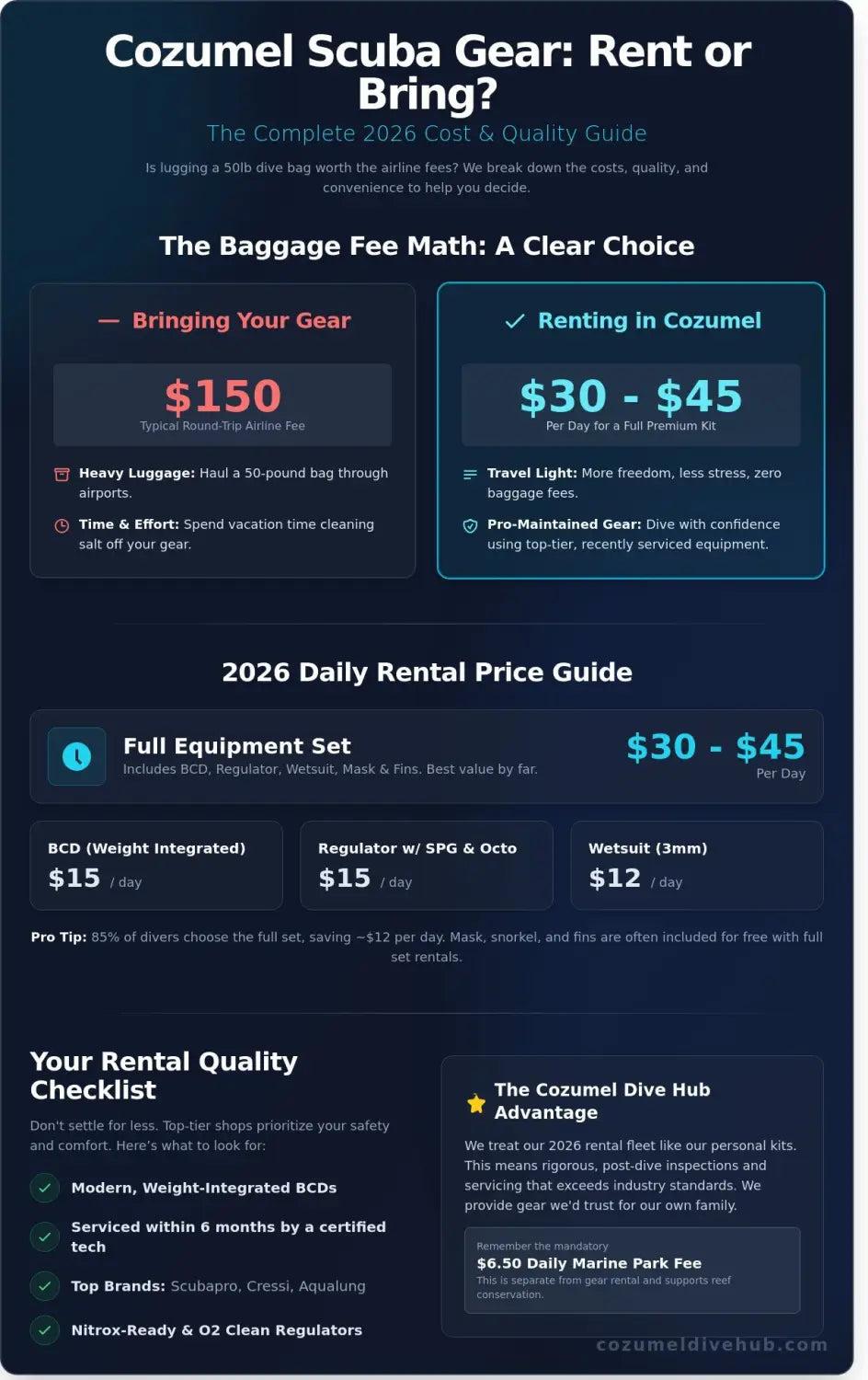
Dive gear is heavy in a way that is easy to underestimate. A BCD is 6 to 8 pounds, a regulator set 5 to 6, fins 4 to 6, a 3mm suit 3 to 5, boots about 2, and the bag itself another 6 to 8. That is 26 to 35 pounds before a single item of clothing. Most divers who bring gear end up checking a second bag or paying an overweight charge on the first.
In 2026 the major US carriers charge roughly US$45 to US$55 for a second checked bag each way, and about US$100 each way for a bag between 51 and 70 pounds. Work a real example for a week in Cozumel with five diving days:
- Rent everything. Full set at US$30 a day for five days: US$150. Add a computer at US$12 a day and it is US$210.
- Fly your own gear as a second checked bag. US$55 each way: US$110 round trip. No rental cost.
- Fly your own gear and go overweight instead of checking a second bag. US$100 each way: US$200 round trip — worse than renting.
So against a second-bag fee, owning starts to win at about day four: US$110 divided by US$30 a day is 3.7 rental days. Against an overweight fee, renting wins for a whole week. And that break-even ignores the purchase price of the gear, annual servicing on a regulator, and the possibility that your bag arrives a day after you do — which in Cozumel means missing the diving you flew there for.
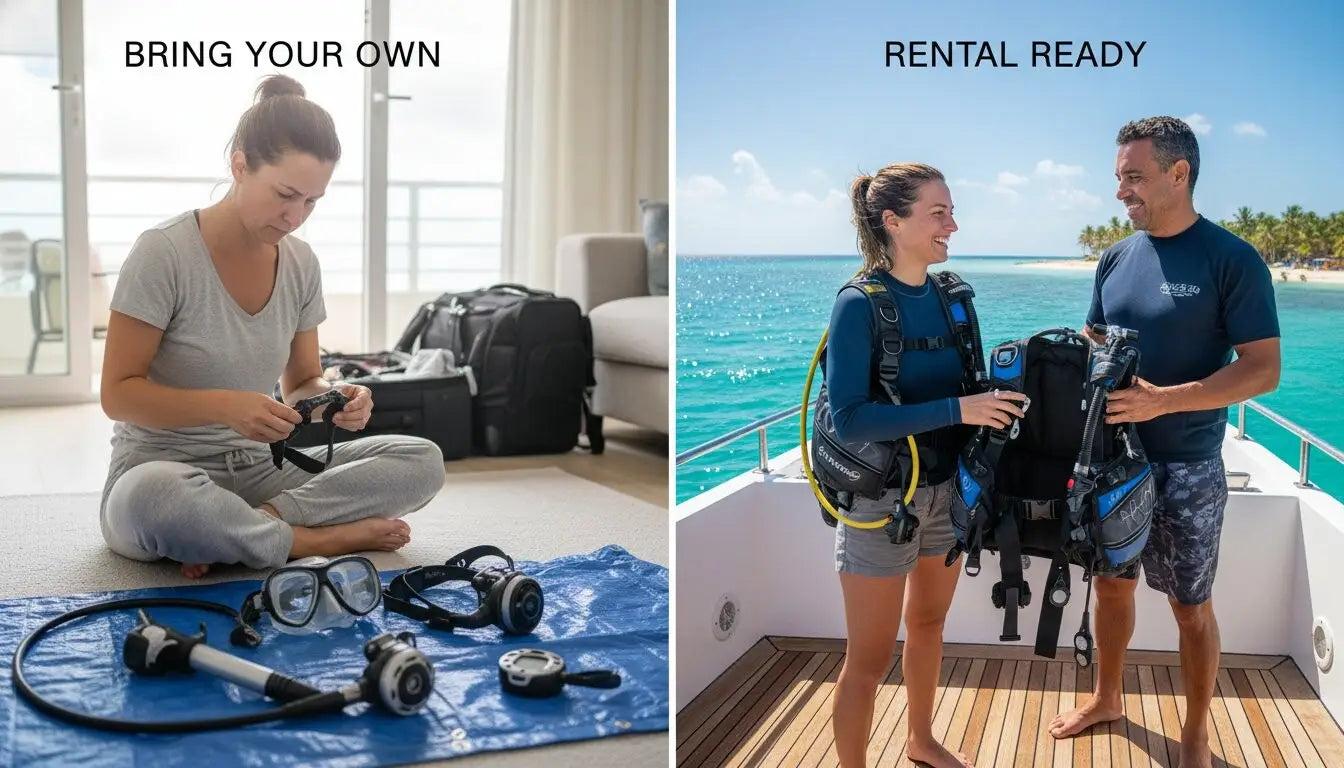
The sensible conclusion for a typical week: fly with a mask, a computer, a rash guard and maybe boots in your carry-on, rent the rest, and check one normal bag. That keeps you under every weight limit and costs about US$120 to US$150 in rental for five days of diving. If you are staying two weeks or diving twelve days, the arithmetic flips and your own kit pays. There is a longer treatment of flying with dive gear to Cozumel, and a packing list if you decide to bring it.
Cruise passengers can skip this section entirely. For a single day ashore, renting is the only rational choice — see the guide for cruise ship divers.
Wetsuit Thickness for Cozumel Water
This is where over-renting happens most. Cozumel water sits roughly between 78°F and 84°F across the year — Sand Dollar Sports puts the range at 79°F in winter to 86°F in high summer. There is no cold season in any meaningful sense.
- July through October (about 83–86°F): a rash guard is enough for most people. A 3mm shorty if you feel the cold.
- November through April (about 78–81°F): a 3mm full suit is the sensible default, particularly if you are doing two or three dives a day.
- A 5mm is overkill for almost everyone. Consider it only if you chill badly, or you are diving four times a day for a week straight.
Renting a full 3mm and finding you did not need it costs you nothing extra, since shorty and full suits price the same at most shops. Buying a 5mm for a Cozumel trip is money and baggage weight spent on nothing. Month-by-month numbers are in the year-round water temperature guide and the conditions by month breakdown.
One caveat: thermal comfort is not only about temperature. Repetitive diving cools you cumulatively, and Cozumel's currents mean you are drifting rather than working, so you generate little heat. Divers who are fine in a shorty on day one are often glad of a full suit by day four.
Gear the Marine Park Will Not Let You Use
Two items are decided by park rules rather than by shop policy, and both change what you pack.
Gloves. Diving gloves are not permitted on reef dives inside Parque Nacional Arrecifes de Cozumel, on the reasoning that a diver wearing them is far more willing to grab the reef. Shops do not rent them for reef dives, so there is nothing to budget and nothing to pack. The habit the rule forces — hands off the structure, buoyancy doing the work — is the one Cozumel guides care most about anyway.
Sunscreen. The park restricts sunscreens that are not biodegradable, and crews usually raise it in the briefing. The practical answer is not a different bottle but a garment: a long-sleeved rash guard covers the part of you that burns during a surface interval and puts nothing in the water. What a reef-safe sunscreen label needs to say is worth checking before you buy.
Park rules are set by the federal authority and can be tightened between seasons, so confirm the current version with your operator when you book.
Practical Rental Details Worth Knowing
Reserving Ahead
For a standard size, turning up on the morning is usually fine. Reserve ahead if you need something shops hold in small numbers: extra-small or extra-large BCDs and wetsuits, wide boots, or a prescription mask. Christmas, Easter and the summer months thin out inventory across the island, and a message a few days in advance costs nothing.
If you plan to dive nitrox, flag it when booking rather than on the dock — fills are planned in advance and the surcharge runs US$12 to US$15 a tank.
Checking the Gear Before You Board
Do this on land, where fixing a problem is trivial:
- Put the BCD on with weight in the pockets and check it does not ride up under your chin.
- Inflate it fully and leave it a minute. A bladder that sags has a leak.
- Breathe from both second stages. Listen for a free flow, and check the mouthpiece is not split.
- Press the mask to your face without the strap and inhale gently through your nose. It should hold.
- Confirm the computer is in the right gas mode if you are on nitrox.
Speak up immediately if something does not fit. A wetsuit that flushes water or a BCD that shifts is a comfort and safety issue, not a minor annoyance, and any decent shop will swap it before the boat leaves. Damage waivers are worth asking about too: some shops include accidental damage in the daily rate, others bill for a lost fin or a flooded computer.
Ask what happens to gear between days as well. Most operators will hold rented kit rinsed and hanging overnight on a multi-day booking, which saves carrying it back to the hotel each evening — ScubaLuis states overnight rinsing and storage as part of the service.
Servicing, rental and repairs on the island. If a regulator needs attention before the first boat, or you would rather rent locally than fly with a full bag, the gear service and rental shops are listed by what they actually handle.
Getting the Gear Decision Right
Rent the heavy things, bring the personal ones, budget US$25 to US$40 a day if you are renting a full set, and add the marine park fee in cash on top. That covers ninety per cent of it. The rest is choosing an operator whose gear is looked after — which is a question about the shop, not the price list, and one the dive centers directory is built to help with.
Ready to put the numbers into a plan? Start with planning your Cozumel dive trip.
Frequently Asked Questions
How much does scuba gear rental cost in Cozumel?
Is gear rental included in the price of a Cozumel dive trip?
Does a rental package include a dive computer?
Should I bring my own scuba gear to Cozumel or rent there?
What wetsuit thickness do I need for diving in Cozumel?
Do I need to reserve rental gear in advance?
What should I do if the rental gear does not fit?
Is it worth flying with your own dive gear?
Are tanks and weights included when you rent gear?
Is the marine park fee part of the gear rental price?
Share This Article

Carmen Novelo
Carmen Novelo is a Cozumel native and an active scuba instructor and dive guide on the island. She has spent twelve years diving the Cozumel reef system, and writes about its dive sites, conditions and marine life for Cozumel Dive Hub.